

True architectural transformation is rarely a matter of simple construction; it’s a profound psychological endurance test that challenges even the most composed homeowner. When your London sanctuary becomes a site of dust and constant choices, it’s easy to feel overwhelmed by the weight of thousands of micro-decisions. You aren’t failing if you feel the pressure. You’re experiencing the natural friction of creating something extraordinary. Dealing with renovation stress in 2026 requires more than just patience; it demands a technical approach to emotional management. With construction material costs rising by 9.6 percent this year, the fear of spiraling budgets is a legitimate burden that weighs heavily on the pursuit of perfection.
You deserve a process that mirrors the elegance of your finished home. This guide provides the master-level tools needed to reclaim your peace of mind and navigate the complexities of a major refurbishment with grace. We’ll explore a sophisticated framework for builder communication, strategies to combat decision fatigue, and a clear roadmap to ensure your vision remains uncompromised. You’ll gain the clarity to move from chaos to a restored emotional balance, ensuring the journey toward your ideal living environment is as refined as the result itself.
Key Takeaways
- Understand the physiological impact of living in a construction zone and how to manage the situational anxiety inherent in bespoke home transformations.
- Discover why the Design-Build model and professional project management serve as vital technical buffers against the uncertainties of major building works.
- Master practical tactics for dealing with renovation stress, including the creation of a construction-free sanctuary and the discipline of renovation-free days.
- Identify the unique financial and structural stressors of the London market to better navigate the complexities of heritage property refurbishments.
- Learn how a commitment to uncompromising quality and expert craftsmanship eliminates the long-term anxiety of corrective repairs.
What is Renovation Stress and Why Does it Happen?
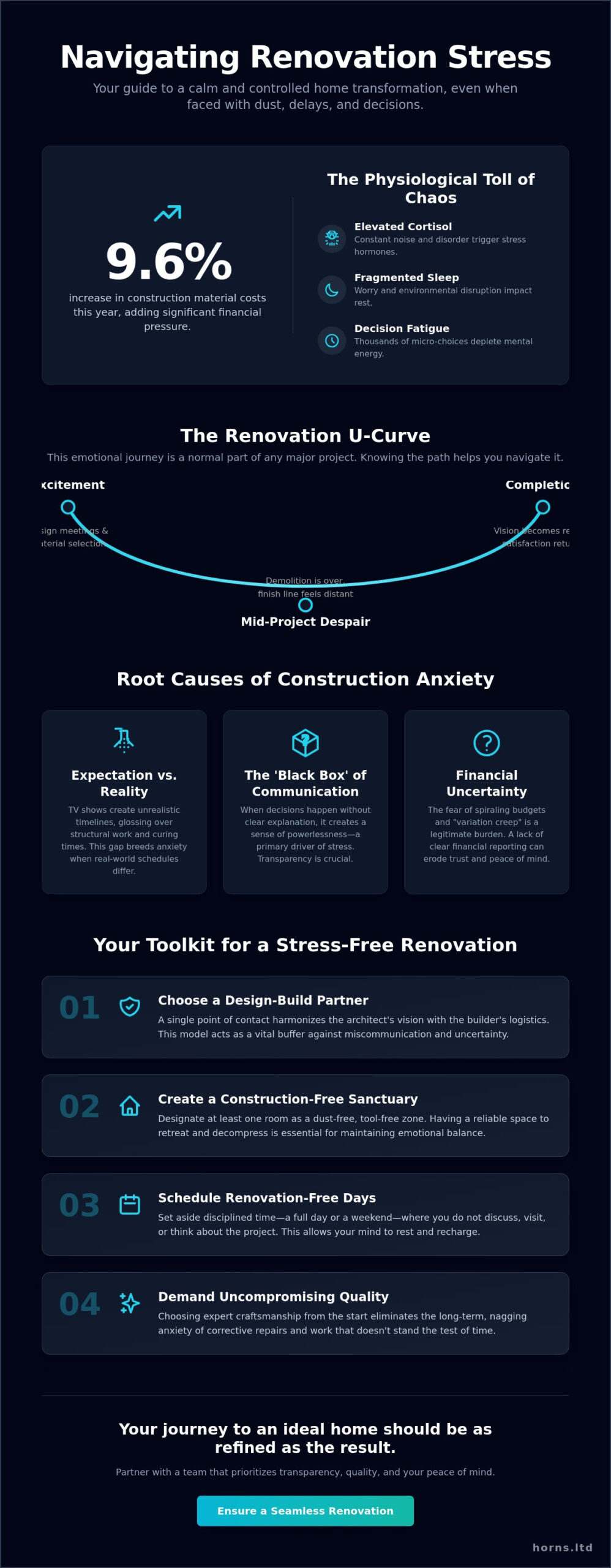
Renovation stress isn’t merely a colloquialism for being busy; it’s a profound form of situational anxiety rooted in the disruption of one’s primary environment. When the walls of your home are stripped back to the brickwork, your brain loses its most fundamental sense of security. This environmental instability triggers a physiological cascade. Studies in understanding stress management reveal that chronic exposure to noise and disorder elevates cortisol levels, leading to fragmented sleep and heightened irritability. For the London homeowner, where the architectural stakes are exceptionally high, this pressure is magnified by the desire for absolute perfection. In a market where construction input prices have risen by 9.6 percent as of May 2026, every minor delay feels like a significant financial blow to your investment.
Every significant project follows what experts call the Renovation U-Curve. It begins with the intoxicating rush of design meetings and material selection where everything feels possible. However, as the demolition phase concludes and the structural work begins, many fall into a trough of mid-project despair where the finish line feels impossibly distant. Dealing with renovation stress during this phase is about recognizing that this dip is a structural part of the process, not a sign of failure. Understanding that your emotional state will fluctuate as much as the site schedule allows you to maintain a necessary sense of perspective.
The Hidden Toll of Decision Fatigue
The mental energy required to curate a bespoke home is immense. You aren’t just choosing a floor; you’re deciding on the specific grain of oak, the width of the planks, and the precise luminosity of the finish. This paradox of choice often leads to a paralyzing exhaustion. Whether it’s selecting Chiswick-style cornicing or the exact placement of brass sockets, every micro-choice consumes cognitive resources. Decision fatigue is the deteriorating quality of decisions made after a long session of decision-making.
Living in a Construction Zone: Environmental Impact
Living amidst a full home refurbishment means the pervasive presence of dust and the relentless rhythm of power tools. The lack of a true sanctuary space creates a sense of permanent displacement, even while you remain within your own post code. Family dynamics often shift as daily routines are sacrificed to accommodate site schedules. This temporary mindset, while necessary, carries a hidden mental cost. Dealing with renovation stress effectively requires an acknowledgement of this environmental toll.
The Root Causes of Construction Anxiety
Many homeowners begin their journey with expectations forged by the curated, accelerated reality of renovation television. These programs often gloss over the weeks of structural stabilization or the meticulous curing times required for high-end finishes. When real-world timelines diverge from these fictional benchmarks, anxiety takes root. Dealing with renovation stress becomes significantly harder when the silence from a site is interpreted as stagnation rather than the necessary, invisible labor of technical precision. This gap between expectation and reality is the primary breeding ground for project-related tension.
The friction between architects, builders, and homeowners often stems from a lack of shared technical language. An architect’s vision and a builder’s logistical reality must be harmonized through constant, transparent dialogue. Without this, the homeowner is left in a state of perpetual uncertainty. This breakdown in communication isn’t just a logistical hurdle; it’s an emotional drain that erodes the joy of creation and replaces it with a wearying sense of vigilance.
The ‘Black Box’ of Construction Communication
Construction can often feel like an opaque black box where decisions are made without the client’s full comprehension. When you don’t understand why a specific structural delay is necessary, you naturally feel a loss of agency. Powerlessness is a primary driver of anxiety. Dealing with renovation stress is far more manageable when you’re armed with data rather than doubts. Professional management mitigates this through weekly site meetings and detailed digital progress reports. These tools transform the black box into a transparent process, replacing suspicion with a shared understanding of the project’s technical fidelity. It’s about ensuring you’re a participant in the journey, not just a spectator to the chaos.
Financial Anxiety and Variation Creep
For those inhabiting London’s historic Victorian terraces, the fear of the hidden cost is a constant companion. Older properties rarely reveal their secrets until the first joist is lifted. The distinction between provisional sums and fixed-price contracts is where much of this tension resides. Unexpected structural remediations can trigger panic if a robust contingency hasn’t been established. Variation creep, the slow accumulation of small changes, can lead to a budget that feels untethered from reality. To better understand the landscape of investment required for these complex projects, it’s helpful to review our guide on Property Renovation Costs in London.
Choosing a team that values precision over placeholders is the first step in protecting your investment. Finding a partner who prioritizes this level of fiscal and technical transparency is essential for a successful full home refurbishment that respects both your vision and your peace of mind.
Structural Solutions: Mitigating Stress Through Management
Homeowners often view emotional strain as an inevitable byproduct of construction. In reality, it is frequently the result of fragmented project management. When a refurbishment lacks a singular, authoritative vision, you are forced to bridge the gap between architectural intent and site execution. This role is exhausting and unnecessary. Dealing with renovation stress becomes significantly easier when you employ a dedicated project manager who serves as both a technical and emotional buffer. They translate complex site logistics into clear, actionable insights, ensuring you aren’t burdened by the minute friction of daily trade coordination. A comprehensive pre-construction phase acts as the ultimate antidote to mid-project panic. By investing in precision engineering during the planning stages, we identify potential structural clashes before they manifest physically, preventing the rework challenges that so often derail London projects.
Design-Build: The Seamless Path to Completion
The Importance of the RIBA Stages
Following a structured framework provides a psychological safety net that is often overlooked in informal arrangements. Adhering to the RIBA stages provides a predictable roadmap that transforms a chaotic process into a series of defined, manageable milestones. There’s a profound sense of comfort in knowing exactly where your project stands within the wider timeline. Skipping the Technical Design stage, or Stage 4, is perhaps the most common source of high-level project anxiety. Without this granular level of detail, builders are left to interpret intentions on site, which inevitably leads to compromises. True tranquility in a refurbishment comes from the certainty that every joist, socket, and finish has been meticulously accounted for before the first hammer is swung. This level of preparation ensures that dealing with renovation stress is handled through technical foresight rather than reactive crisis management.
How to Deal with Renovation Stress: 5 Practical Steps
Building a masterpiece requires more than just skilled trades; it demands a strategy for personal preservation. While the technical frameworks discussed previously provide the foundation, your daily habits during a refurbishment determine your long term well being. Dealing with renovation stress is not about ignoring the chaos, but about creating intentional boundaries that protect your mental space. When your home is in flux, your mind needs constants. By implementing these five practical steps, you can maintain a sense of luxury and control even when the floorboards are up.
Creating Your Sanctuary Room
Psychological anchoring is essential when your environment is being dismantled. You must establish one room as a total sanctuary that remains entirely untouched by construction. This space should be hermetically sealed from dust using professional grade plastic sheeting and tension poles. It isn’t enough for the room to be clean; it must reflect your aesthetic standards. Keep your finest linens here, your favorite art, and ensure it remains a zone of sensory peace. Having a single room that feels like a finished home provides a vital retreat when the rest of the property feels alien. It serves as a physical reminder that the current disruption is merely a temporary state on the path to perfection.
Mastering the Communication Protocol
The relentless drip of ad hoc questions can lead to total cognitive exhaustion. To combat this, implement the One Channel rule. Move every single communication to one specific app or email thread. This prevents the anxiety of checking multiple platforms for updates. Set firm boundaries on when you are available. A professional project lead will respect a Friday Wrap Up report. This document should summarize the week’s progress and outline the goals for the following Monday, allowing you to enjoy a peaceful weekend without the nagging fear of the unknown. Clear boundaries foster mutual respect and ensure that your home life remains distinct from the site’s requirements.
- Schedule Renovation Free Days: Dedicate at least one day a week where no house talk is permitted. This allows family dynamics to reset and prevents the project from becoming your only personality trait.
- Combat Dust Despair: Invest in professional cleaning services every fortnight mid project. While it may seem counterintuitive, removing the fine layer of construction silt from non work areas significantly reduces the feeling of being overwhelmed.
- Visualize the Long Game: Keep high fidelity 3D renders of the finished design easily accessible. When the mid project trough hits, looking at the precise beauty of the end result acts as a technical north star for your morale.
The journey toward a refined living space should be as considered as the architecture itself. If you are ready to begin a project where your peace of mind is prioritized alongside technical excellence, explore our approach to full home refurbishments. We understand that true quality includes the quality of your experience throughout the process.
Partnering for Peace: The Horns Construction Methodology
True peace of mind in construction isn’t found in hope; it’s engineered through decades of technical discipline and localized expertise. At Horns Construction, we’ve spent 20 years navigating the unique architectural fabric of London, refining a methodology that treats your emotional well being as a critical project metric. We understand that dealing with renovation stress is often a byproduct of uncertainty. To eliminate this, we’ve replaced the traditional ‘estimate’ with a rigorous fixed price quoting system. By providing financial transparency from the outset, we remove the fear of the hidden cost, allowing you to focus on the artistic evolution of your home rather than the ledger. Our commitment to uncompromising quality ensures that every detail is executed with precision the first time, preventing the long term anxiety of corrective repairs.
The bespoke nature of our Full Home Refurbishments is designed to protect the client experience at every stage. We don’t just build structures; we curate a journey that respects your lifestyle and your vision. This level of care requires a maximalist approach to project management where no detail is too small to be documented and no concern is too minor to be addressed. We take the burden of technical fidelity off your shoulders, allowing you to remain the visionary of your home without being consumed by the logistics of its creation.
Bespoke Project Management in West London
In neighborhoods like Fulham and Chiswick, a refurbishment is never a solitary event. It’s a delicate operation that exists within a community. Our project management style prioritizes site cleanliness and proactive communication with your neighbors, ensuring your project doesn’t become a source of local friction. Because we utilize an in house team of master tradespeople, we’ve eliminated the ‘missing builder’ syndrome that plagues so many London sites. You’ll never have to wonder who’s in your home or when they’ll arrive. The Horns touch transforms a standard construction site into a meticulously managed architectural project where order and respect are the baseline, not the exception.
From Vision to Completion Without the Chaos
The psychological benefit of a turnkey service cannot be overstated. When one team handles everything from the initial structural analysis to the final decorative flourish, the friction of handovers is eliminated. Our clients often describe the process as exhilarating rather than exhausting because they’re shielded from the technical chaos of the site. Dealing with renovation stress becomes a thing of the past when you have a partner who values your tranquility as much as the straightness of a joist. We invite you to experience a stress-free transformation with Horns Construction, where your sanctuary is built with the same grace and precision we bring to our craft.
Embracing the Future of Your London Home
With over 20 years of West London expertise, Horns Construction specializes in turning complex refurbishments into seamless, dignified experiences. Our dedicated project management and fixed-price comprehensive quotes provide the financial and logistical certainty you deserve. You don’t have to sacrifice your peace of mind to achieve perfection. Start your stress-free London renovation with Horns Construction today and discover how our commitment to uncompromising quality protects both your home and your sanity. Your vision deserves a process as refined as the final result.
Frequently Asked Questions
Is it normal to feel depressed during a house renovation?
It’s entirely normal to experience periods of low mood or situational anxiety during a major refurbishment. The loss of your primary sanctuary disrupts your fundamental sense of security and daily routine, which can lead to significant emotional strain. When dealing with renovation stress, acknowledging these feelings as a natural response to environmental upheaval is the first step toward reclaiming your peace of mind.
How can I avoid hidden costs that cause financial stress?
Avoiding financial anxiety requires a shift from vague estimates to fixed-price comprehensive quotes based on detailed technical design. You should ensure your contract includes a robust contingency fund, typically 10 to 15 percent, to account for structural discoveries common in older London properties. Transparency during the pre-construction phase prevents the variation creep that often triggers mid-project panic and budget overruns.
Should I move out during a full home refurbishment in London?
Relocating is almost always the superior choice for maintaining your mental well being during a full home refurbishment. Living amidst dust and constant noise significantly elevates cortisol levels and fragments family life. If moving out isn’t possible, you must strictly enforce a sanctuary zone as discussed earlier to provide a necessary psychological retreat from the active construction site.
How do I deal with a builder who isn’t communicating?
Address communication silence by formalizing all interactions through a dedicated project lead or a specific digital protocol. You should schedule mandatory weekly site meetings where progress is documented against the original timeline. If a builder remains unresponsive, it often indicates a lack of administrative structure, requiring a firm re-establishment of professional boundaries and reporting expectations.
What is the most stressful part of a home renovation?
Most homeowners find the structural phase or the mid-project trough to be the most taxing period. This is the stage where the initial excitement of design has faded, but the refined aesthetic finishes are not yet visible. Dealing with renovation stress during this phase requires focusing on the technical milestones of the RIBA stages and trusting the long term vision of the project.
How can I protect my relationship with my partner during a build?
Protecting your partnership requires the strict implementation of renovation-free days where no talk of construction is permitted. It’s helpful to delegate specific decision-making areas to each partner to avoid constant conflict over thousands of micro-choices. Maintaining a shared vision through high-quality 3D renders helps ground both individuals in the final outcome rather than the temporary friction of the site.
What are the early signs that a renovation project is going off-track?
Early warning signs include a consistent failure to meet minor milestones and a noticeable decline in site cleanliness. If tradespeople are absent for several days without a technical explanation, or if the weekly reports become vague and non-committal, the project’s management architecture is likely failing. Addressing these issues immediately prevents them from snowballing into significant delays and increased emotional pressure.
How do I manage decision fatigue when choosing finishes?
Manage decision fatigue by batching choices into specific, scheduled sessions rather than making them ad hoc. You can limit your options by working with a curated palette provided by your designer to avoid the paralyzing paradox of choice. Trusting the expertise of your project lead allows you to delegate smaller technical details, preserving your mental energy for the high-impact aesthetic decisions that define your home.