

What if the most significant investment in your home isn’t the physical stone or timber, but the invisible lines of a masterfully drawn plan? You’re likely wondering, “do i need an architect for an extension uk,” and the answer lies in the delicate balance between basic utility and architectural excellence. While you aren’t legally required to hire a chartered professional for every project, the 2026 regulatory environment is a complex landscape where a single oversight can silence your ambitions before the first spade hits the ground.
It’s understandable to feel a sense of trepidation regarding professional fees that can range from 5% to 15% of your total build cost. You want to ensure every pound is an investment in quality rather than a contribution to unnecessary bureaucracy. This definitive guide promises to demystify the legal requirements and provide the expert insights you need to decide if your vision requires a standalone architect. We’ll examine the impact of the Future Homes Standard, compare cost-saving alternatives like architectural technologists, and provide a clear framework to help you start your construction journey with absolute confidence.
Key Takeaways
- Understand that while no UK law mandates a chartered architect for domestic extensions, navigating the “Lead Designer” requirements remains vital for modern safety and compliance.
- Explore how professional architectural expertise transforms cramped Victorian terraces into light-filled, spatially efficient masterpieces that adhere to the 2026 “Golden Thread” of building safety.
- Evaluate the financial and logistical differences between the traditional independent route and the seamless design-build model to answer the question: do i need an architect for an extension uk?
- Learn how to calculate the return on investment by comparing upfront professional fees against the potential long-term costs of remedial works and planning delays.
- Discover how an integrated construction approach bridges the gap between artistic vision and technical buildability, ensuring a compromise-free execution of your home’s transformation.
Is an Architect Legally Required for a UK House Extension?
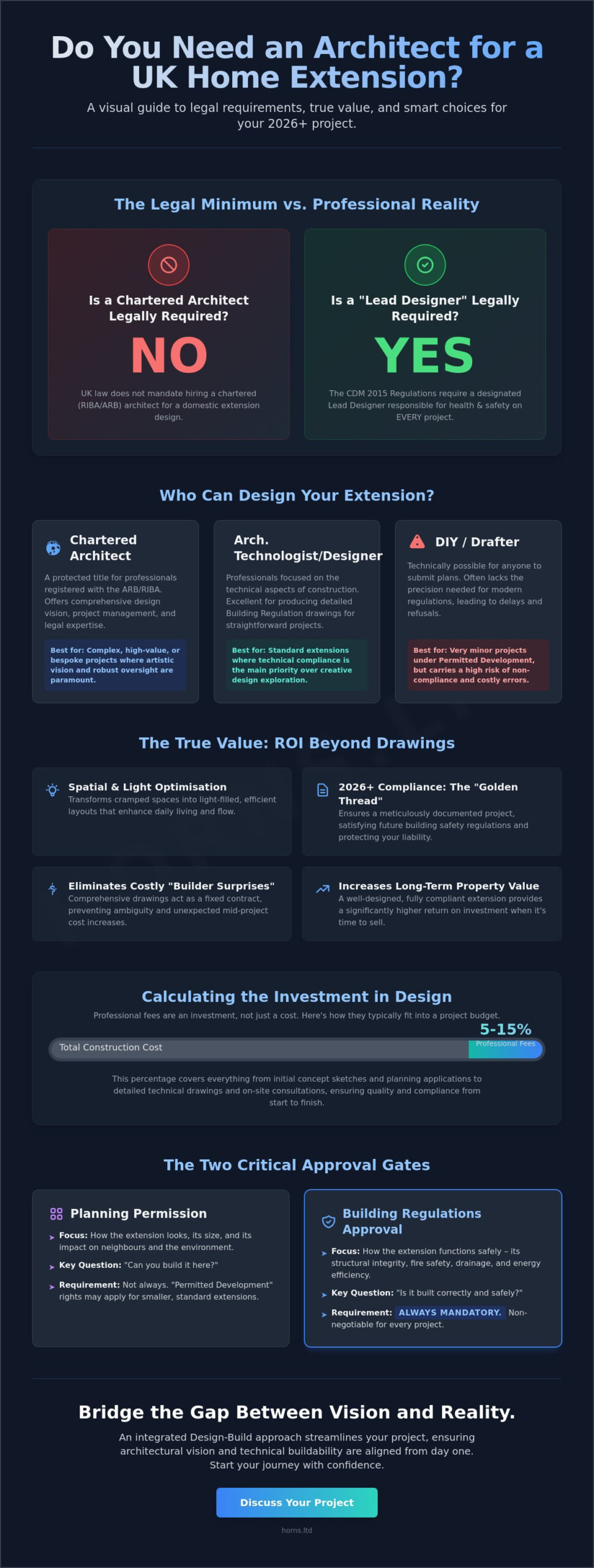
The question of whether one must engage a chartered professional often begins with a fundamental misunderstanding of the British planning system. When homeowners ask, “do i need an architect for an extension uk,” they are often searching for a legal mandate that simply does not exist. In the United Kingdom, no statute requires you to hire a member of the Royal Institute of British Architects (RIBA) to design a domestic extension. This freedom is a unique facet of the architectural landscape in the UK, where the focus remains on the quality of the submission rather than the credentials of the submitter. However, this absence of a legal requirement shouldn’t be mistaken for an absence of regulation. Under the Construction (Design and Management) Regulations 2015, every project must have a designated “Lead Designer” responsible for health and safety, a role that carries significant weight regardless of the designer’s formal title.
The Legal Minimum vs. Professional Reality
Technically, any individual can submit a planning application. You could, in theory, sketch your vision on the back of an envelope and present it to the local authority. Yet, the reality of the 2026 planning environment is far more demanding. DIY drawings often lack the uncompromising precision required to satisfy increasingly stringent local council demands, frequently leading to costly refusals or delays. While a chartered architect is a protected title requiring rigorous registration with the ARB, an architectural designer is a broad term for professionals who may possess significant experience but lack that specific statutory accreditation. Choosing the latter might save on upfront fees, but it places the burden of technical fidelity squarely on the homeowner’s shoulders. Even under “Permitted Development” rights, your project isn’t exempt from professional standards; it simply means you don’t need a full planning application, provided you stay within very specific, rigid parameters.
Building Regulations: The Non-Negotiable Step
It’s vital to distinguish between planning drawings, which focus on how a building looks, and technical construction drawings, which dictate how it actually functions. Building Control approval is a mandatory, non-negotiable step for every extension. This process ensures the structural integrity, fire safety, and energy efficiency of the new space. Without professional drawings that include detailed structural calculations, you risk creating a space that’s legally uninhabitable. These documents form the “Golden Thread” of information that protects your liability. When the time comes to sell your home, a lack of proper certification can collapse a chain instantly. Professional oversight ensures that every joint, beam, and insulation layer meets the 2026 standards, providing a level of security that a simple sketch can never achieve. It’s about more than just a permit; it’s about the enduring value and safety of your most precious asset.
The True Value of Architectural Expertise: Beyond Just Drawings
An extension is far more than a mere addition of square meterage; it’s a profound orchestration of light, volume, and technical precision. When homeowners contemplate the question, “do i need an architect for an extension uk,” they often focus on the immediate cost of the fee. However, the true worth of a professional designer lies in their ability to translate an abstract desire for space into a high-performing architectural reality. The True Value of Architectural Expertise manifests in the subtle details that define a home’s soul, from the way a skylight captures the morning sun to the effortless flow between a kitchen and a landscaped garden. This artistic vision is underpinned by the “Golden Thread” of information, a requirement in the 2026 building safety landscape that ensures every material and structural choice is documented for the lifetime of the building.
Beyond aesthetics, detailed architectural specifications serve as a vital shield against the “builder surprises” that often plague ill-conceived projects. A comprehensive set of drawings acts as a definitive contract, leaving no room for ambiguity or mid-project cost hikes. By defining every finish, fixture, and structural connection before the first brick is laid, you gain absolute control over your budget. For those seeking an uncompromising approach to their own home’s evolution, exploring a bespoke house extension can ensure every detail is handled with the precision your property deserves.
Navigating London’s Planning Complexities
The architectural landscape of West London, with its historic Victorian terraces and prestigious Conservation Areas, presents a unique set of challenges. Navigating the delicate balance between modern living and heritage preservation requires a sophisticated understanding of local borough policies and Listed Building Consent. A professional designer doesn’t just draw; they negotiate. They manage the intricate “Right to Light” assessments and privacy concerns that often arise with neighbouring properties in densely populated areas. For a deeper look at these specific regional nuances, see our guide on House Extensions in London.
Technical Precision and Structural Integrity
The transition from a conceptual sketch to a buildable reality requires a “tender pack” of uncompromising detail. This document allows contractors to provide accurate, fixed-price quotes, eliminating the guesswork that leads to financial friction. There is a deep synergy between architectural artistry and structural engineering; one provides the beauty, while the other ensures the permanence. By specifying exact material quantities and high-performance components, professional drawings ensure that material waste is kept to an absolute minimum. This level of technical fidelity is what separates a standard construction project from a meticulously crafted masterpiece that will stand for generations.
To achieve this level of finish, especially with intricate timber work and ongoing property upkeep, you can click here to learn more about professional carpentry and maintenance services.
Architect vs. Design-Build Company: Navigating Your Options
Choosing the right path for your home’s evolution is a decision of profound consequence. It’s a choice between two distinct philosophies of creation. When you ponder, “do i need an architect for an extension uk,” you’re essentially deciding how you want the symphony of construction to be conducted. The traditional route involves hiring an independent designer to compose the vision, while the design-build model offers a seamless, integrated performance where the composer and the orchestra are one. Before committing, it’s vital to verify the credentials of any professional you engage. The Architects Registration Board provides clarity on whether someone can legally use the title, helping you understand Is an Architect Legally Required for your specific needs.
Pros and Cons of the Traditional Architect Route
The traditional approach offers a certain poetic independence. You gain a dedicated advocate whose sole focus is the artistic and functional integrity of the design. This freedom allows for a level of creative flair that can result in a truly unique masterpiece. However, this separation can occasionally lead to a “design-budget disconnect.” An independent architect might craft a breathtaking vision that, while beautiful on paper, proves prohibitively expensive or technically impractical to build. This often creates friction between the design team and the contractors, leaving the homeowner to navigate the resulting delays and financial strain. Without a single point of accountability, the blame for errors can shift between parties, complicating the resolution of mid-project challenges.
Why Design-Build is Trending in London for 2026
In the fast-paced, high-stakes environment of West London, the design-build model has become the preferred choice for those seeking uncompromising quality without the logistical headaches. This approach offers a single point of responsibility for every stage, from the first conceptual sketch to the final brick. By integrating the design and construction teams from day one, you ensure that the project is designed to a specific, fixed-price budget. This eliminates the risk of “builder surprises” and ensures that the technical buildability is baked into the artistic vision.
For discerning homeowners, this model provides a level of certainty and tranquility that the traditional route often lacks. You aren’t just hiring a builder; you’re engaging a partner who manages the planning, structural engineering, and craftsmanship in one unified workflow. To understand how this fits into the wider landscape of premium residential development, explore our insights on Construction Companies in London. This integrated approach ensures that the “Golden Thread” of information remains unbroken, providing a meticulously documented and flawlessly executed extension that enhances both your lifestyle and your property’s enduring value.
Calculating the ROI: When Does an Architect Pay for Themselves?
Investing in a home extension is a significant financial commitment, often ranging between £70,000 and £120,000 for a standard London project. When you ask yourself, “do i need an architect for an extension uk,” the answer often reveals itself through a cold analysis of return on investment. Professional fees, which typically sit between 5% and 15% of the total build cost, should be viewed as an insurance policy against mediocrity and expensive technical errors. A meticulously designed space doesn’t just improve your daily life; it can increase your property’s value by 11% to 23%. In the competitive London market, a home that balances artistic flair with functional precision always commands a premium.
Beyond the immediate market value, smart design generates long-term savings through uncompromising energy efficiency. With the full enforcement of the Future Homes Standard in 2026, extensions now require stringent U-values for walls (0.18 W/m²K) and roofs (0.15 W/m²K). A professional ensures these targets are met through a “fabric-first” approach, reducing your reliance on expensive heating systems. While FHS compliance can add between £4,200 and £9,800 to a 30m² build, the reduction in long-term running costs and the avoidance of remedial works make it a financially sound path. If you’re looking for a partner to manage this delicate balance of cost and quality, our premium house extension services provide the technical mastery your home deserves.
Project Scale as a Deciding Factor
The complexity of your vision dictates the level of expertise required. A simple, single-storey “box” extension might be safely handled by an architectural technologist or a high-quality design-build firm. However, as soon as you introduce multi-storey elements or complex structural changes, a chartered architect becomes non-negotiable. This is especially true for West London’s period properties. Refurbishing a Victorian terrace requires a deep respect for heritage and a surgical precision to integrate modern amenities without compromising the building’s soul.
The Cost of Planning Failure
Planning failure is a silent budget killer. While a householder planning application in England costs £548 as of April 2026, the true cost of a rejection lies in the months of delay. Every week of stagnation adds to your mortgage interest and may force you into expensive temporary living arrangements. Professional drawings significantly reduce the risk of rejection by navigating the nuances of local borough policies from the outset. To understand how to avoid these pitfalls during a broader renovation, explore our guide on Mastering Home Refurbishment in London. Investing in precision at the start ensures your construction journey remains a calm, predictable process rather than a series of expensive corrections.
Streamlining Your Extension with Horns Construction’s Integrated Approach
The journey of home transformation shouldn’t be a fragmented struggle between competing professionals. When you ask, “do i need an architect for an extension uk,” you’re really seeking a path that guarantees both artistic elegance and structural certainty. At Horns Construction, we’ve spent 20 years refining an integrated model that bridges the traditional gap between a designer’s vision and a builder’s reality. In the prestigious neighbourhoods of West London, where every centimetre of a Victorian terrace is precious, our approach ensures that your extension is treated as a singular work of art, executed with uncompromising engineering mastery.
Our in-house team combines architectural design, structural engineering, and master craftsmanship under one roof. This synergy is particularly vital for navigating the 2026 UK Building Regulations, including the stringent requirements of the Future Homes Standard. Instead of chasing multiple consultants for updates on U-values or heat-pump-ready infrastructure, you benefit from a unified “Golden Thread” of information. We don’t just build; we curate an environment where technical compliance and aesthetic beauty exist in perfect harmony, removing the weight of regulatory scrutiny from your shoulders.
From Initial Concept to Completion
Our collaborative design process places your lifestyle at the very centre of the project. We handle the complexities that often derail ambitious builds, such as managing the intricacies of the Party Wall Act and liaising with local council planning departments on your behalf. By taking full responsibility for these administrative burdens, we allow you to focus on the creative evolution of your space. Our successful history of delivering high-end extensions in boroughs like Hammersmith and Fulham serves as a testament to our ability to satisfy both the homeowner’s ambition and the council’s rigorous heritage requirements.
Your Next Steps: Booking a Consultation
Starting your project with a design-build team requires a shift in perspective toward total project harmony. Before our first meeting, it’s helpful to consider your primary goals: is it the capture of north-facing light, the creation of a professional-grade kitchen, or the addition of a bespoke master suite? We provide transparent, comprehensive quotes that reflect the true cost of premium London construction in 2026, ensuring there’s no ambiguity as the project unfolds. If you’re ready to transform your residence with a team that values precision and artistic integrity, Contact Horns Construction for an expert extension consultation today. We’ll help you navigate every design and construction nuance, ensuring your vision is realised with the dignity and technical excellence it deserves.
Elevating Your Home’s Architectural Legacy
The decision of how to proceed with your home’s transformation is a choice between mere construction and true architectural artistry. While the question do i need an architect for an extension uk may not have a single legal answer, the 2026 regulatory landscape makes professional oversight indispensable for any high-end project. You’ve discovered how architectural expertise protects your investment, ensuring compliance with the Future Homes Standard while potentially adding up to 23% to your property’s market value. By choosing an integrated design-build model, you eliminate the friction between vision and execution, gaining a single point of accountability for your entire journey.
Horns Construction brings over 20 years of West London construction expertise to every project. We specialize in the meticulous renovation of high-end Victorian properties, offering comprehensive project management that carries you from the first planning sketch to the final, hand-finished detail. Our approach ensures that your extension isn’t just a building; it’s a carefully crafted masterpiece that enhances your lifestyle for generations. Book a professional design and build consultation with Horns Construction and start your journey toward a home that reflects your uncompromising standards. Your vision deserves nothing less than perfection.
Frequently Asked Questions
Is an architect legally required for a small kitchen extension in the UK?
No UK law mandates the use of a chartered architect for a small kitchen extension. However, you’re legally required to appoint a “Lead Designer” under the Construction (Design and Management) Regulations 2015 to manage health and safety risks. While you can technically design the space yourself, the 2026 energy efficiency standards make professional technical input vital for ensuring the structure is legally compliant and habitable.
How much does an architect cost for a typical London house extension?
Architect fees generally range from 5% to 15% of the total build cost for a full service from concept to completion. For smaller London projects, you might find fixed fees for the initial design and planning phase starting between £1,500 and £4,000. These costs reflect the technical precision needed to satisfy the rigorous demands of West London’s high-specification residential market and complex planning boroughs.
Can a builder do the drawings for my extension instead of an architect?
A builder can produce drawings for your project, but they often lack the professional indemnity insurance and deep design theory provided by a chartered professional. When considering “do i need an architect for an extension uk,” remember that a builder’s sketch might prioritize ease of construction over spatial elegance. An integrated design-build team offers a superior alternative, ensuring your drawings are both artistically refined and technically buildable.
What is the difference between an architect and an architectural technologist?
The distinction lies in their core focus; architects are trained in design theory, spatial philosophy, and the artistic soul of a building. Architectural technologists specialize in the science of architecture, focusing on the technical assembly, material performance, and buildability of the structure. Both are highly capable of delivering an extension, though an architect is often preferred for projects requiring a unique, uncompromising aesthetic vision.
Regardless of which professional you choose, the selection of high-performance components like roof lanterns and premium glazing is essential for a successful build. To explore how specialist installation services can support your project’s goals, learn more about Windows in the Dales.
Do I need an architect if I am building under Permitted Development?
You aren’t legally required to hire an architect for Permitted Development, but their guidance is invaluable for navigating the strict limits on height, depth, and materials. Even if full planning permission isn’t needed, obtaining a Lawful Development Certificate is a wise step that requires professional-grade drawings. This certificate provides the legal certainty needed to protect your property’s value and ensure a smooth sale in the future.
What happens if I build an extension without professional drawings?
Building without professional drawings risks immediate rejection from Building Control and can lead to dangerous structural flaws. Without a documented “Golden Thread” of information, you’ll struggle to prove compliance with the 2026 Future Homes Standard during a future property sale. The cost of remedial works to fix technical errors often far outweighs the initial investment in a set of meticulously crafted, professional plans.
How long does the architectural design phase typically take?
The design phase usually requires between 4 and 12 weeks of quiet contemplation and technical refinement. This duration allows your team to perfect the flow of light and the selection of materials before the eight-week planning process begins. Rushing this stage is a compromise that often leads to missed opportunities for spatial efficiency and can result in a home that lacks a cohesive architectural character.
Will an architect help me with the Party Wall Agreement?
An architect can facilitate the process by preparing the technical drawings required for the agreement and acting as your Party Wall Surveyor. While they provide the structural data needed for neighbours to understand the impact on shared boundaries, complex disputes may require a dedicated specialist. Having your designer involved ensures that boundary issues are managed with the technical mastery and diplomacy required to keep your project on track.