

Your London residence is far more than a structure; it’s a sanctuary of personal expression and your most significant financial legacy. Approaching a premium renovation without a structured framework is akin to painting a masterpiece without a canvas. We understand that the nuances of the RIBA stages for homeowners can feel daunting, especially when navigating the 2026 Future Homes Standards or the delicate requirements of a local conservation area. You deserve a process that honors the artistry of your vision while maintaining the rigorous precision of modern engineering.
True luxury resides in the peace of mind that comes from professional transparency and meticulous planning. This guide offers a sophisticated roadmap for your upcoming extension or refurbishment, designed to replace confusion with absolute clarity. We’ll break down each phase of the architectural journey, showing you how to mitigate investment risks and foster better communication with your builders. From the initial concept to the moment you step into your finished space, you’ll gain the tools to ensure your project is executed with the uncompromising quality your home demands.
Key Takeaways
- Gain a profound understanding of the RIBA Plan of Work as a sophisticated framework that transforms your creative vision into a meticulously managed reality.
- Master the early RIBA stages for homeowners to establish feasibility and navigate London’s complex planning landscape with professional poise.
- Discover how Stage 4 serves as the critical bridge where artistic design meets engineering precision, ensuring your project adheres to the latest 2026 building standards.
- Navigate the physical metamorphosis of your home during the construction and handover phases, ensuring every detail aligns with the original technical blueprint.
- Explore the advantages of a seamless design-build journey that harmonizes architectural expertise with uncompromising craftsmanship for a truly bespoke result.
What is the RIBA Plan of Work and Why Does It Matter?
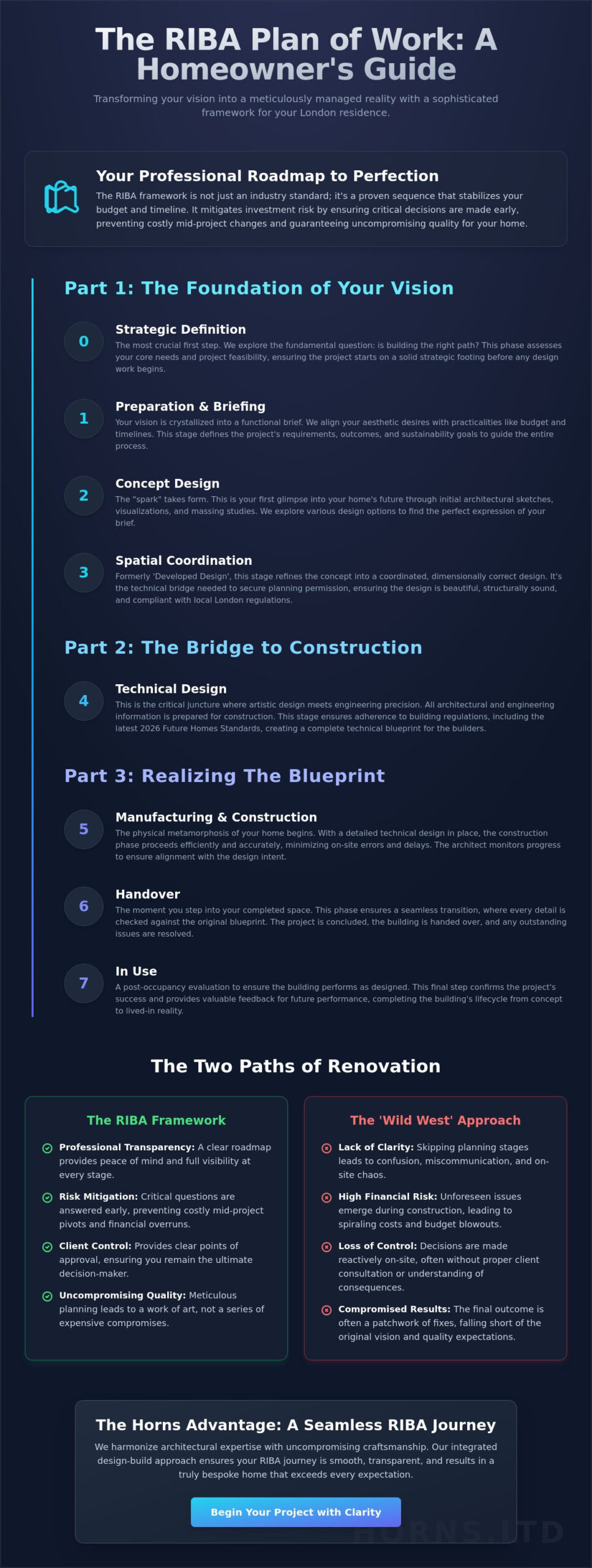
The Royal Institute of British Architects (RIBA) created the Plan of Work as a definitive framework to manage the intricate complexities of modern building. It isn’t just a professional standard for architects; it’s a sophisticated architectural choreography that guides a project from its initial “spark” of an idea to the final, polished reality. By organizing a renovation into eight distinct phases, from Stage 0 to Stage 7, the framework ensures that every technical detail and aesthetic nuance is addressed with the precision it deserves. For those investigating the RIBA stages for homeowners, this structure provides the ultimate assurance that their vision will be realized without compromise.
Adhering to this established sequence is the most effective way to avoid the renovation nightmares that can occur in the high-stakes London property market. Many projects fail because they lack a clear roadmap. The RIBA framework acts as a stabilizer for your budget and timeline. It demands that critical questions are answered early, preventing the costly mid-project pivots that often lead to financial overruns. It’s a method that values patience and planning; ensuring that the final result is a work of art rather than a series of expensive compromises.
The Language of Professional Construction
Mastering the RIBA stages for homeowners means engaging with a specific, professional vocabulary. Terms like “briefing” and “spatial coordination” aren’t just industry jargon. They represent pivotal moments where your desires are translated into technical requirements. “Spatial coordination” is particularly vital in London’s compact footprints, as it ensures that the artistic flow of a room doesn’t conflict with its structural needs. This language allows for a seamless dialogue between the homeowner and the construction team, ensuring that quality is never sacrificed for speed. It’s the foundation of a truly bespoke experience.
RIBA Stages vs. The ‘Wild West’ of Building
The temptation to skip directly to the construction phase is often strong, yet it’s a path fraught with risk. In the “Wild West” of unmanaged building, skipping the preparation or technical design stages often results in structural errors or planning permission failures, especially in London’s protected conservation areas. The RIBA stages protect the client at every juncture. They ensure you remain the ultimate decision-maker, providing a clear point of approval before the project moves from the drawing board to the site. It’s a measured approach that respects the history of your property while embracing the future of your lifestyle.
Stages 0-3: From Strategic Definition to Planning Approval
The first four RIBA stages for homeowners represent the intellectual and artistic genesis of a project. Before a single brick is laid, these phases ensure that your investment is grounded in logic and inspired by vision. Stage 0, Strategic Definition, is perhaps the most overlooked yet vital phase. It’s the moment we ask whether building is the right path or if a clever internal reconfiguration could achieve your goals. This moves seamlessly into Stage 1, Preparation and Briefing, where we align your aesthetic desires with the practicalities of a 2026 budget. According to the Official RIBA Plan of Work, this is where the project’s requirements are crystallized into a functional brief.
Stage 2, Concept Design, is where the “spark” takes physical form through initial visualizations. Whether it’s a loft conversion or a rear extension, this is your first glimpse into the future of your home. It’s a phase of exploration and refinement. Finally, Stage 3, Spatial Coordination, refines these ideas into a coordinated set of drawings. It’s the technical bridge needed to secure planning permission. By finalizing the architectural layout here, we ensure that the design is both beautiful and structurally sound before moving toward the more intensive technical phases.
Feasibility in the London Context
Evaluating the potential for house extensions within the capital requires an intimate knowledge of its unique architectural heritage. London’s Victorian terraced structures and strictly guarded conservation areas present constraints that demand a delicate touch. Feasibility is the balance between architectural ambition and local planning reality. We meticulously assess the structural integrity and historical context of your property to ensure that the proposed design isn’t just beautiful but achievable under current 2026 regulations. This early diligence protects your investment from the outset.
Securing Planning and Party Wall Agreements
In boroughs like Hammersmith or Fulham, Stage 3 is the critical juncture for submitting planning applications. The density of London living means that Party Wall considerations must be addressed early to prevent costly delays. By the time you reach the end of Stage 3, every spatial detail is coordinated. This precision prevents “on-site surprises” that can derail high-value refurbishments. If you’re ready to explore how these phases apply to your property, a bespoke renovation consultation can provide the clarity you need to proceed with confidence.
Stage 4: Technical Design – The Bridge to Construction
Stage 4 is the crucible where artistic ambition is forged into technical certainty. While previous phases focused on the silhouette and flow of your space, this stage demands a transition from evocative visualizations to rigorous technical blueprints. For those navigating the RIBA stages for homeowners, this is the most critical juncture for financial protection. It involves the meticulous integration of structural engineering, thermal performance data, and detailed specifications. Skipping this step to “break ground” early is a common pitfall that leads to structural compromises and escalating costs. True luxury construction doesn’t leave details to chance; it defines them before the first craftsman arrives on site.
Many homeowners feel the urge to start building once planning permission is granted, yet doing so without a technical design is building on a foundation of assumptions. Stage 4 provides the structural calculations and building regulation notes that ensure your home is safe, efficient, and durable. It’s the phase where we coordinate the invisible elements of the build, such as complex plumbing routes and electrical loads, ensuring they don’t clash with the aesthetic finishes. This discipline is what separates a standard renovation from a masterfully executed refurbishment.
The Detail Required for a Fixed-Price Quote
Precise technical specifications are the only way to secure an accurate home refurbishment price. A professional tender package replaces the “guesstimate” with a binding commitment to quality. This phase ensures that every element, from the placement of discrete electrical sockets to the specific grain of your bespoke joinery, is documented and priced. In an era where construction material prices rose by 2.6% in the 12 months to March 2026, having a fixed rulebook is essential for budget security. As noted in the NBS guide to the RIBA Plan of Work, the alignment of design and specification is what transforms a creative vision into a viable build.
Building Regulations and Compliance
Compliance with the 2026 Future Homes and Buildings Standards isn’t merely a legal obligation; it’s a commitment to the longevity and energy efficiency of your residence. This is particularly vital for a complex kitchen renovation London where structural alterations and advanced ventilation systems must harmonize perfectly. Stage 4 documents act as the absolute rulebook for your builder, ensuring that every technical nuance meets the highest professional standards. By investing in this level of detail, you mitigate the risks of non-compliance and ensure your home remains a high-value asset for generations.
Stages 5-7: Manufacturing, Construction, and Handover
The transition from technical drawings to the physical dance of construction is a profound moment in any project’s lifecycle. Stage 5 is where the abstract becomes concrete; literally. For those following the RIBA stages for homeowners, this is the phase where your investment takes its final, tangible form. It begins with site preparation and the rhythmic arrival of master craftsmen. Throughout this stage, the primary objective is to ensure the physical build aligns perfectly with the technical blueprints established in Stage 4. Constant monitoring is essential to maintain the integrity of the design and the precision of the engineering.
Once the structure is complete, we enter Stage 6, the Handover. This isn’t merely a transfer of keys; it’s a formal process of inspection and certification. It includes the “snagging” period, where every minor detail is scrutinized to ensure it meets our uncompromising standards. Finally, Stage 7 focuses on the long-term performance of your home. This post-occupancy phase allows us to evaluate how the building functions in daily life, addressing the defects liability period and ensuring the residence remains a masterpiece of both form and function.
The Reality of Stage 5 on a London Site
Executing a high-end renovation in West London requires a sophisticated approach to logistics. The narrow streets and proximity of neighbors demand a builder who understands the delicate balance of parking permits, noise management, and community relations. It’s our responsibility to follow the RIBA-aligned plan with absolute quality control. While construction is inherently messy, we strive to protect the artistic vision throughout the process. We treat your property with the reverence of an art gallery, ensuring that the manual production of your home is handled with dignity and care.
Handover and the ‘Aftercare’ Phase
The Handover in Stage 6 is the culmination of months of meticulous labor. During this phase, we conduct final walkthroughs to ensure every finish is flawless. For specialized areas, such as those handled by premium bathroom fitters london, Stage 7 is particularly vital. It ensures that complex plumbing and bespoke tiling systems perform perfectly under real-world conditions. This professional certification offers the peace of mind that your home isn’t just finished; it’s perfected. If you’re ready to begin your journey toward a flawlessly executed London home, contact Horns Construction today for a consultation that respects your vision and your investment.
The Horns Advantage: A Seamless RIBA Journey
The traditional separation between architect and builder often creates a friction that can compromise the final result. At Horns Construction, we’ve refined a design-build philosophy that seamlessly integrates the RIBA stages for homeowners, ensuring that the artistic intent of Stage 2 is never lost during the rigorous activity of Stage 5. With over 20 years of experience navigating the architectural landscape of West London, we understand that a premium renovation is a singular journey. We act as the custodians of your vision, providing a unified point of accountability that translates complex professional frameworks into a transparent, stress-free experience. This integration allows us to maintain uncompromising standards, where technical fidelity and aesthetic beauty coexist in perfect harmony. Our team manages the delicate interplay between surveyors, engineers, and artisans, ensuring that the transition between each RIBA phase is fluid and focused on the ultimate goal: your satisfaction.
True luxury is found in the absence of uncertainty. By operating as a cohesive unit, we eliminate the common miscommunications that lead to budget overruns or delays. We don’t just follow a plan; we inhabit the design, treating every refurbishment as a legacy project. This approach is particularly effective for the intricate demands of London properties, where heritage constraints and modern aspirations must be balanced with surgical precision. We recognize that your home is your most personal sanctuary, and our role is to protect its integrity throughout the entire metamorphosis.
Artistic Vision Meets Engineering Precision
We view bespoke residential building as a carefully crafted work of art, where every joint and finish contributes to a larger narrative of luxury. Our process places significant emphasis on Stage 4 technical depth; this is where we protect your investment by resolving every structural and mechanical detail before construction begins. A builder who truly understands the architectural roadmap is a rare asset in the London market. By bridging the gap between design theory and site reality, we ensure that the engineering precision required for modern standards never overshadows the soulful, artistic essence of your home. Every material is selected for its nívó, and every work process is executed with a meticulousness that honors the traditions of fine carpentry and joinery.
Start Your Project with Horns Construction
The journey toward your refined London residence begins with a single, strategic conversation. Whether you’re at the very beginning of Stage 0 or looking to breathe new life into an existing concept, we’re here to guide you. We invite you to contact our West London team for a consultation to discuss the unique potential of your property. You may also explore our portfolio of Stage 6 completions across the capital, showcasing the enduring quality of our craftsmanship. We look forward to providing a calm, professional, and entirely bespoke renovation journey that honors the legacy of your home.
Realizing Your Vision with Architectural Precision
Your London home is an evolving masterpiece that requires a disciplined framework to reach its full potential. By embracing the RIBA stages for homeowners, you replace the anxiety of the unknown with a structured journey toward excellence. You’ve seen how early strategic definition and the technical rigor of Stage 4 serve as the bedrock for financial and structural security. In a city where conservation constraints and Victorian heritage demand a master’s touch; this roadmap is your most valuable asset.
Horns Construction brings over 20 years of West London expertise to your project, specializing in high-end residential refurbishments that honor both tradition and modern innovation. We navigate the complexities of planning and conservation with a calm, authoritative precision, ensuring your investment is protected at every juncture. It’s time to move beyond the drafting board and begin the physical realization of your sanctuary. Begin your premium home transformation with Horns Construction today. Your vision deserves a partner who treats building as an art form and quality as a non-negotiable standard.
Frequently Asked Questions
Do I really need to follow all 8 RIBA stages for a small extension?
Yes, the framework is designed to be scalable for projects of any size. While a small extension may move through the phases more quickly, skipping the logic of preparation or technical design often leads to budget creep and structural oversights. Adhering to the RIBA stages for homeowners ensures that even modest additions receive the same level of professional scrutiny and artistic care as a full mansion refurbishment.
At what stage should I hire a construction company like Horns?
You should ideally engage a construction partner during Stage 1 or Stage 2. Early collaboration allows us to provide essential feasibility advice and realistic cost appraisals while your designs are still fluid. This proactive approach prevents the heartbreak of falling in love with a concept that exceeds your financial boundaries or technical constraints. It ensures a harmonious transition from the architect’s vision to the builder’s reality.
How much does it cost to go through the architectural stages?
Architectural fees in London for 2026 typically range between 8% and 15% of the total construction cost for a full service. Some professionals offer fixed fees for residential projects, which can range from £3,000 to over £15,000 depending on the complexity of the work. These costs reflect the deep technical expertise required to navigate London’s unique planning landscape and ensure your project meets the highest quality standards.
Can Stage 3 and Stage 4 be combined to save time?
While some fast-track projects attempt to overlap these phases, it’s a strategy that carries significant risk. Stage 3 focuses on the “what” for planning approval, while Stage 4 defines the “how” for construction. If you invest heavily in technical blueprints before planning is granted, any required design changes from the council could render those expensive technical drawings obsolete. A measured, sequential approach protects your investment from unnecessary waste.
What is the most important RIBA stage for budget control?
Stage 4, Technical Design, is the most critical phase for maintaining financial discipline. This is the moment where every nut, bolt, and bespoke finish is specified in detail. By resolving all technical questions before the build begins, you eliminate the “unknowns” that lead to expensive variations on site. For those navigating the RIBA stages for homeowners, this phase provides the ultimate peace of mind through a fixed-price tender package.
What happens if I want to change the design during Stage 5?
Changes during the construction phase are possible but often result in significant delays and increased costs. Altering the design once work has commenced disrupts the coordinated “rulebook” established during technical design. It may require new structural calculations or revised building regulations applications. We always encourage our clients to find their absolute “higgadt” or calm certainty during the earlier design phases to avoid these mid-build complications.
Does the RIBA Plan of Work apply to loft conversions in London?
The framework is essential for loft conversions, particularly given the 2026 updates to fire safety and energy efficiency regulations. Loft projects involve complex structural alterations to a property’s roof and floor plate, requiring precise engineering and spatial coordination. Following the RIBA stages ensures that your new sanctuary isn’t just beautiful, but also fully compliant with the latest safety standards and structural requirements.
How do the RIBA stages interact with CDM regulations?
Construction Design and Management (CDM) 2015 regulations are integrated into the process from the very beginning of Stage 1. Health and safety responsibilities are established during the briefing phase and continue through to the final handover. Your principal designer ensures that safety is “designed in” to the project, protecting the craftsmen on site and ensuring the long-term safety of everyone who inhabits the finished home.