

What if the legal frameworks you might view as bureaucratic hurdles are actually the invisible architecture protecting your home’s legacy? Many homeowners embarking on a luxury renovation feel a quiet unease that CDM regulations for domestic projects will invite unnecessary costs or technical confusion into their creative process. It’s understandable to worry about the legalities of a site accident or the weight of unknown responsibilities. You deserve to enjoy the transformation of your property without the shadow of legal liability hanging over the craftsmanship.
This guide ensures you navigate these requirements with absolute confidence, revealing how the law typically lifts the burden of compliance from your shoulders and places it firmly with your experts. We’ll explore how the 2015 regulations and the Building Safety Act 2022 work together to safeguard your investment. By the end of this article, you’ll understand exactly how these standards protect your property and ensure a safe, professional environment, allowing you to focus on the artistry of your new space while your team manages the rigour of the law.
Key Takeaways
- Understand how your legal responsibilities under CDM regulations for domestic projects automatically transfer to your Principal Contractor, ensuring you remain protected without needing technical expertise.
- Discover why every residential project, from a bespoke loft conversion to a precise kitchen fitting, must adhere to the CDM 2015 framework to maintain site safety and legal compliance.
- Learn about the long-term strategic value of the Health and Safety File, a crucial document that preserves the integrity and future maintenance potential of your home.
- Gain insights into managing the unique complexities of London renovations, where limited site access and structural works demand rigorous safety planning and expert oversight.
- Identify the benefits of appointing a competent Principal Designer and Contractor to handle the meticulous documentation required for a seamless, legally sound build.
Understanding CDM Regulations for Domestic Projects in 2026
The Construction (Design, and Management) Regulations 2015, commonly referred to as CDM 2015, represent a sophisticated framework designed to integrate safety into the very DNA of a build. For the discerning homeowner in London, these regulations ensure that every artistic choice, from the structural integrity of a loft conversion to the precise layout of a bespoke kitchen, is underpinned by a commitment to human welfare. CDM regulations for domestic projects aren’t merely a legal requirement; they’re a professional standard that ensures your home remains a sanctuary, even during the most complex phases of its transformation. By planning health and safety from the initial sketch, we eliminate risks before they ever reach your doorstep.
The core objective of this legislation is the seamless coordination of every professional involved in your project. It demands that health, safety, and welfare are considered from day one, creating a culture of engineering precision that mirrors the high-end finishes you expect. Whether we are discussing the manual production of custom joinery or the technical loyalty required for a full home refurbishment, the regulations provide a structure where everyone knows their role. This proactive approach prevents the chaotic environments often associated with lower-quality builds, replacing them with the calm, methodical progress that defines a premium project.
Does CDM Apply to My Small Renovation?
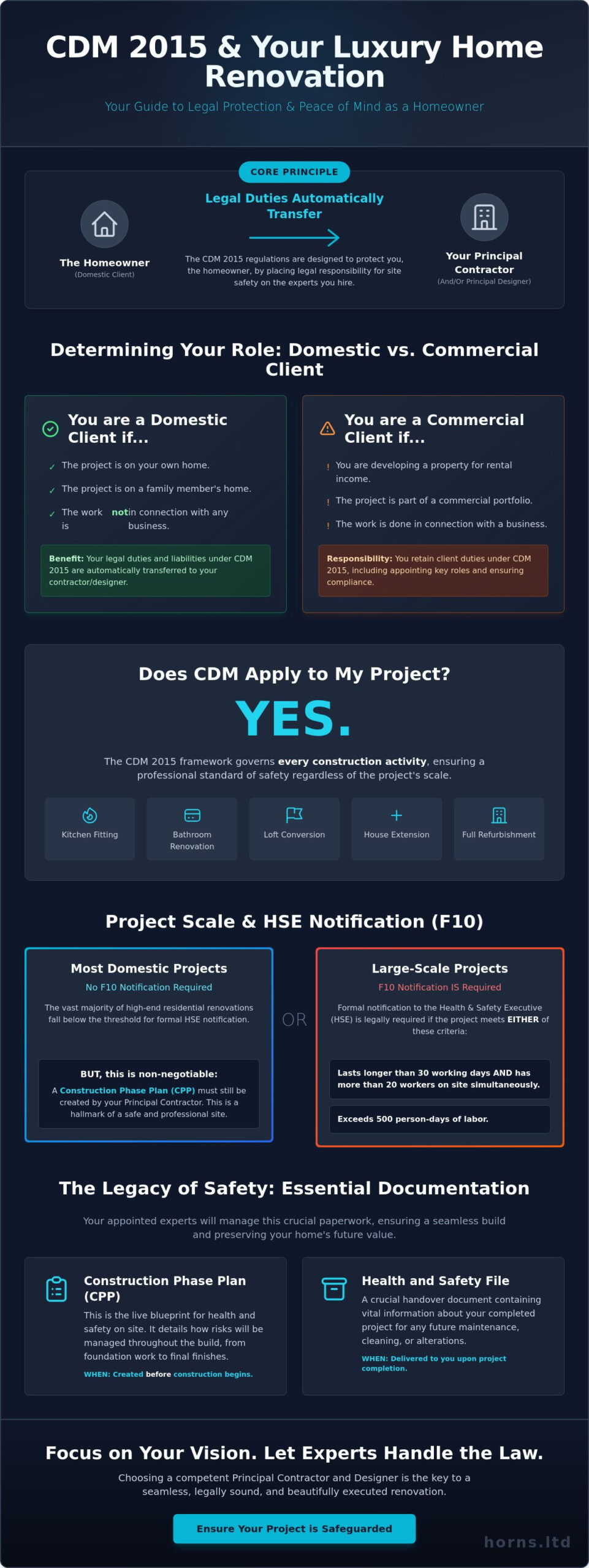
The scope of CDM 2015 is absolute. It governs every construction activity, whether you’re commissioning a minor bathroom fitting or a comprehensive house extension. While the regulations apply to all, the administrative weight scales with the project’s complexity. Most high-end residential works won’t reach the formal HSE notification threshold, known as an F10. This notification is only required if the project exceeds 30 working days and involves more than 20 workers simultaneously, or if the total labour exceeds 500 person-days. Even without a formal notification, the requirement for a Construction Phase Plan remains a non-negotiable mark of quality and safety.
Commercial vs. Domestic: Identifying Your Role
A domestic client is defined as an individual having work performed on their own residence, or that of a family member, which isn’t in connection with a business. This distinction is vital. As a domestic client, the law recognises that you aren’t a construction expert. Consequently, your legal duties are elegantly transferred to your Principal Contractor or Designer. However, if you’re developing a property for rental income or as part of a commercial portfolio, you step into the role of a commercial client. Maintaining your status as a domestic client ensures that your journey remains focused on the aesthetic and functional evolution of your property, rather than the minutiae of legal liability.
The Transfer of Duties: Why Homeowners Aren’t Legally Liable
The profound beauty of the legal framework surrounding CDM regulations for domestic projects is its inherent recognition of the homeowner as a patron of craft, rather than a technical overseer. You shouldn’t need to spend your evenings studying health and safety protocols or site management logistics. The law is designed to protect your peace of mind by ensuring that legal liabilities are elegantly and automatically transferred to the professionals you entrust with your vision. This shift allows you to remain the creative heartbeat of the project while the rigorous demands of compliance are handled with engineering precision by your chosen team.
This transfer isn’t merely a convenience; it’s a structural safeguard. By placing responsibility in the hands of those with the necessary skills, knowledge, and experience, the regulations ensure that every manual task and technical installation is performed within a secure, professionally managed environment. It’s about creating a sanctuary of safety that mirrors the sanctuary you are building for your family.
How Duties Pass to Your Contractor
In the context of a single-contractor project, such as a bespoke kitchen fitting, the legal duties transfer automatically to the contractor. However, most sophisticated London renovations involve multiple trades. For these multi-contractor projects, the role of Principal Contractor becomes essential. This lead professional takes the mantle of site safety, coordinating every specialist from the electrician to the tiler. If you don’t make a formal appointment in writing, the law typically assigns these duties to the contractor in control of the construction phase, ensuring no gap in protection exists. For those seeking absolute clarity and professional rigour, choosing a partner like Horns Construction ensures these transitions are handled with total transparency.
The Architect’s Role as Principal Designer
Safety begins long before the first stone is laid. The Principal Designer, often your architect, carries the responsibility of “designing out” risks during the planning phase. This might involve specifying materials that are safer to install or ensuring that the structural layout of a loft conversion doesn’t pose unnecessary hazards to the craftsmen. Their technical fidelity ensures that the aesthetic brilliance of the design is matched by its practical safety. At Horns, we often integrate these roles, providing a seamless continuity between the artistic vision of the designer and the manual excellence of the build team, ensuring that your CDM regulations for domestic projects compliance is handled as a single, unified masterpiece of project management.
Navigating CDM Challenges in London Residential Renovations
London’s architectural tapestry presents a unique set of challenges where the proximity of heritage buildings and the narrowness of historic streets demand a higher level of logistical mastery. In high-density boroughs, implementing CDM regulations for domestic projects isn’t just a legal checkbox; it’s an essential strategy for maintaining the narrative of the street and the safety of the community. When working on a tight West London site, every delivery and waste removal must be choreographed with surgical precision to avoid disrupting the public or compromising the structural stability of neighbouring properties. It’s this level of foresight that separates a standard build from a truly professional renovation.
The intersection of Party Wall agreements and CDM duties is where professional expertise truly shines. Managing the safety concerns of shared boundaries requires more than just a legal document; it necessitates a proactive safety culture that respects the emotional and physical space of your neighbours. By integrating these considerations into the pre-construction phase, we ensure that the build progresses with the quiet dignity that a premium renovation deserves. This protects both the residents and the public from the inherent risks of urban construction, ensuring the project remains a positive addition to the local environment.
Loft Conversions and Working at Height
Elevating your home through a loft conversion introduces the complex variable of roof-level work. Within a London terrace, this requires bespoke scaffolding designs that go beyond simple access; they must serve as a robust safety envelope for the craftsmen. Under CDM regulations for domestic projects, these structures must be meticulously planned to manage the risks of working at height while ensuring the structural integrity of the existing building during significant roof alterations. It’s a delicate balance of engineering and manual skill that prevents incidents before they can occur, preserving the safety of everyone on site.
Basements and Groundworks Safety
Subterranean projects represent the pinnacle of urban construction risk. The excavation of a basement requires detailed pre-construction information to ensure the stability of the entire street. Logistical safety becomes the primary focus here, as the removal of hundreds of tonnes of earth must be managed without compromising the safety of the public or the site team. Meticulous planning of material deliveries and waste management ensures that the site remains a controlled, professional environment. This reflects the high standards of a project where every detail has been considered and every potential risk has been mitigated through technical fidelity.
Essential Documentation: The Health and Safety File
The Health and Safety File is the definitive biography of your home’s structural and technical evolution. It’s far more than a collection of administrative paperwork; it represents a premium asset that preserves the integrity of your property for decades to come. Under CDM regulations for domestic projects, this file is the final masterpiece delivered at the conclusion of your renovation. It serves as a comprehensive archive of the materials used, the precise location of hidden services, and the architectural logic of the build. Without it, your home’s history is incomplete, leaving future craftsmen to guess what lies behind the walls.
The long-term value of this documentation cannot be overstated, particularly within the sophisticated London property market. When the time comes to sell your residence, discerning buyers and their solicitors will treat this file as a mark of quality. It proves that the project was managed with the technical fidelity and legal rigour expected of a high-end refurbishment. A complete file includes as-built drawings, operation manuals for bespoke heating systems, and specific data on the materials used in your manual joinery or tiling. This level of transparency ensures that any future maintenance or further artistic changes can be performed with absolute precision and safety.
The Pre-Construction Information Pack
Success begins with transparency during the earliest stages of design. As a homeowner, you play a vital role by providing the pre-construction information pack. This involves disclosing known risks, such as the location of existing utilities or the presence of asbestos, which is common in many heritage London properties. Gathering this data early prevents the friction of unexpected delays and budget overruns. It allows your team to respect the traditions of the building while implementing the most modern safety solutions. If you’re unsure how to compile this data, Horns Construction can guide you through the process of professional risk disclosure.
The Construction Phase Plan
Every project, regardless of its scale, requires a Construction Phase Plan (CPP) before a single tool is lifted. This document is the ethical and technical blueprint for how the site will be managed daily. It outlines the site rules, the provision of welfare facilities for the craftsmen, and the emergency protocols that safeguard everyone involved. Your contractor’s ability to produce a robust CPP is a direct reflection of their commitment to excellence. It ensures that the creative energy of your project is never undermined by a lack of site discipline, providing a controlled environment where artistry and safety coexist in perfect harmony.
Choosing a Principal Contractor: How Horns Safeguards Your Project
The selection of your construction partner is the single most significant decision in the lifecycle of your renovation. When you choose Horns Construction, you aren’t merely hiring a builder; you’re appointing a guardian for your property’s legacy. We embrace the role of Principal Contractor with a level of engineering precision that mirrors our commitment to artistic excellence. By managing the full spectrum of CDM regulations for domestic projects, we ensure that the legal and technical complexities of your build remain invisible to you, allowing the creative process to flourish in a secure, professional environment. This allows you to witness the transformation of your home with the calm assurance that every detail is being handled by experts.
Our integrated ‘Design and Build’ approach provides a rare continuity that is often lost in traditional project structures. Because we oversee both the creative vision and the manual execution, the health and safety narrative remains unbroken from the first drawing to the final tiler’s stroke. This eliminates the friction of miscommunication and ensures that the safety protocols specified in the design phase are carried out with meticulous attention on-site. It’s a holistic method that safeguards your investment while delivering the uncompromising quality your home deserves. We believe that a high-end finish is only truly successful when it’s underpinned by high-end safety standards.
Our 20 Years of London Expertise
With over 20 years of experience navigating the architectural nuances of West London, we understand that a safe site is the foundation of a superior finish. Our work in high-density boroughs has taught us that site discipline and technical fidelity go hand in hand. We only employ highly qualified tradespeople who share our maximalist approach to quality and safety. A tidy, well-managed site isn’t just about compliance; it’s a reflection of the respect we have for your home and the craftsmen who are transforming it. This culture of precision ensures that every house extension or full home refurbishment we undertake meets our rigorous internal standards for excellence.
Start Your Compliant Renovation Today
Your journey toward a transformed home should be defined by inspiration, not administration. We invite you to discuss your vision with us, knowing that the burden of CDM regulations for domestic projects, including site planning and regulatory liaison, will be handled by our expert team. We manage the technical rigour so you can focus on the aesthetic evolution of your space. It’s time to build with total peace of mind and the confidence that your project is legally sound. Contact Horns Construction for a professional, CDM-compliant quote and discover how we blend safety and artistry into every bespoke project.
Secure the Future of Your London Home Transformation
Mastering the complexities of CDM regulations for domestic projects ensures that your creative vision is built upon a foundation of absolute safety and legal rigour. You’ve seen how professional project management elegantly transfers liability away from the homeowner, while the creation of a comprehensive Health and Safety File secures your property’s value for future generations. It’s about more than just compliance; it’s the technical fidelity that defines a truly premium renovation. By choosing a partner who understands the nuances of London’s architectural landscape, you protect both your investment and your peace of mind.
With over 20 years of London construction experience, Horns Construction specializes in West London loft conversions and extensions that balance artistic ambition with engineering precision. We provide comprehensive project management from the initial design to the final, exquisite finish, handling every regulatory detail with meticulous care. Your dream home deserves a masterpiece of professional oversight and uncompromising quality. Book a consultation for your premium London home refurbishment today and begin your journey with the confidence that every structural and legal detail is in expert hands.
Frequently Asked Questions
Do I personally need to notify the HSE about my home extension?
No, you don’t have to manage this notification yourself. As a domestic client, your legal duties, including the requirement to notify the Health and Safety Executive, transfer automatically to your Principal Contractor. They’ll handle the F10 form on your behalf if the project’s duration or labour intensity meets the statutory thresholds. This allows you to focus on the aesthetic evolution of your home while your team manages the regulatory dialogue.
What happens if my builder doesn’t follow CDM regulations?
Failure to comply with these standards can lead to severe consequences for the contractor, including significant six-figure fines and legal prosecution by the HSE. While your duties transfer to the professionals, a builder who ignores CDM 2015 risks the safety of everyone on your property and the legal standing of the build. Choosing a team with a maximalist approach to safety ensures your project remains a sanctuary of professional excellence rather than a legal liability.
Is there a cost associated with CDM compliance for domestic projects?
Compliance shouldn’t be viewed as a separate surcharge but as an essential component of a high-quality build’s overhead. The time required for meticulous risk assessment, the creation of a Construction Phase Plan, and the assembly of the Health and Safety File are typically integrated into your professional quote. These costs reflect the technical fidelity and engineering precision required to maintain a safe, orderly site that respects both the craftsmen and your property.
How do CDM regulations affect my insurance for a loft conversion?
Adhering to CDM regulations for domestic projects is often a prerequisite for securing comprehensive insurance for major structural works. Insurers look for evidence of a robust safety culture and professional project management before covering risks like structural movement or site accidents. Demonstrating that your project is CDM-compliant provides the technical assurance insurers need to protect your home throughout its transformation.
What is an F10 notification and does my London project need one?
An F10 is a formal notice submitted to the HSE for projects that exceed 30 working days and involve more than 20 workers simultaneously, or those that surpass 500 person-days of labour. Most bespoke London extensions don’t reach this threshold, but your Principal Contractor will monitor these metrics with surgical precision. If your project does become notifiable, they’ll ensure the paperwork is submitted before any manual work begins on site.
Can I appoint my architect to take on the CDM client duties?
Yes, you can formally appoint your architect as the Principal Designer in writing to manage these responsibilities. This is a sophisticated choice for complex renovations, as it ensures health and safety considerations are woven into the design from the very first sketch. It allows your designer to “design out” potential hazards, ensuring the artistic vision for your home is matched by a practical, safe construction strategy.
Does CDM apply to DIY projects I do myself?
The regulations don’t apply to work you perform entirely by yourself as a domestic DIY enthusiast. However, the moment you hire a professional for a specific task, such as a bathroom fitting or electrical services, CDM 2015 takes effect. The law exists to protect the people working on your home, ensuring that even small-scale professional interventions are conducted within a safe, regulated environment.
What is the ‘Health and Safety File’ and where should I keep it?
The Health and Safety File is the technical biography of your renovation, containing as-built drawings, material data, and maintenance manuals. You should keep this document in a safe place, ideally alongside your property’s title deeds, as it’s an essential asset for future maintenance. Solicitors will invariably request this file during the sale of your property to prove the build’s compliance and structural integrity.