
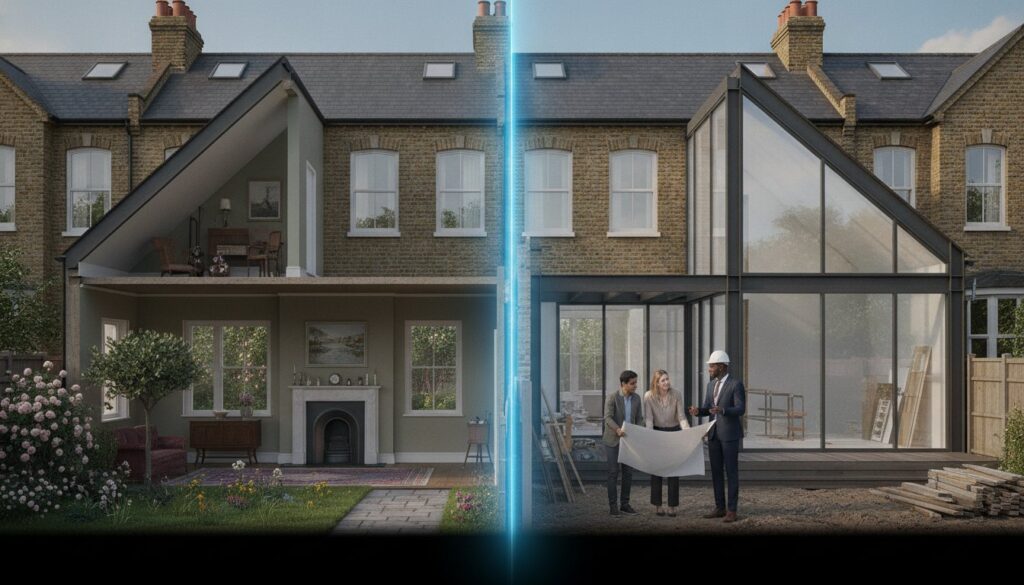
Approximately 95% of residential transformations in our city’s dense architectural landscape require a formal legal bridge between vision and reality. For the discerning homeowner, securing a party wall agreement for extension london is not merely a bureaucratic hurdle; it’s a vital act of structural diplomacy that protects the integrity of your heritage property. It’s natural to feel a sense of trepidation when faced with complex statutory notices or the potential for friction with those living just beyond your boundary. You’ve likely spent months perfecting every aesthetic detail, and the thought of legal delays or accidental damage to an adjoining terrace is enough to stall even the most inspired project.
We believe that technical precision should mirror the artistic ambition of your home. This guide provides a definitive roadmap to mastering the Party Wall etc. Act 1996 with the poise and clarity your project deserves. You’ll discover how to manage surveyor fees, which typically range from £750 to £1,800 per professional in 2026, while ensuring your timeline remains uncompromised. We’ll explore the essential notice periods and the protective value of a schedule of condition, giving you the confidence to begin your build without the shadow of future litigation or property disputes.
Key Takeaways
- Understand the technical triggers, including the 3-metre and 6-metre excavation rules, that necessitate a party wall agreement for extension london.
- Learn the strategic advantage of the “soft launch” approach to prevent project delays through proactive, informal diplomacy with your neighbours.
- Navigate the nuances of the Party Wall etc. Act 1996 to ensure structural modifications, such as steel beam insertions, remain legally unassailable.
- Identify the specific roles of surveyors in managing dissent and how to budget for professional oversight without compromising your architectural vision.
- Discover how meticulous planning from the boundary line inward aligns technical compliance with premium home refurbishment standards.
Navigating the Party Wall Act 1996 in London’s Dense Architectural Landscape
The pursuit of an exquisite home expansion in our capital often begins with a rigorous understanding of the legal tapestry that binds us to our neighbours. The Party Wall etc. Act 1996 serves as the definitive framework for this structural diplomacy. It isn’t merely a set of rules; it’s a sophisticated mechanism designed to facilitate progress while honouring the sanctity of existing foundations. In the context of a high-end project, the “Building Owner” carries the mantle of the visionary developer, while the “Adjoining Owner” holds the right to protection. This relationship requires a balanced, technical approach to ensure a party wall agreement for extension london is handled with professional grace and absolute legal certainty.
London’s unique architectural heritage, particularly in the tightly packed Victorian and Edwardian enclaves of West London, creates a landscape where homes are inextricably linked. This density demands a level of precision that goes beyond standard building practices. Every structural intervention is a dialogue between two properties. The Act ensures this dialogue is documented, preventing the friction that often arises from misunderstood boundaries or poorly communicated technical plans. It serves a dual purpose: it empowers you to realise your architectural ambitions while meticulously safeguarding the structural interests of those sharing your boundary line.
What Constitutes a Party Wall in London?
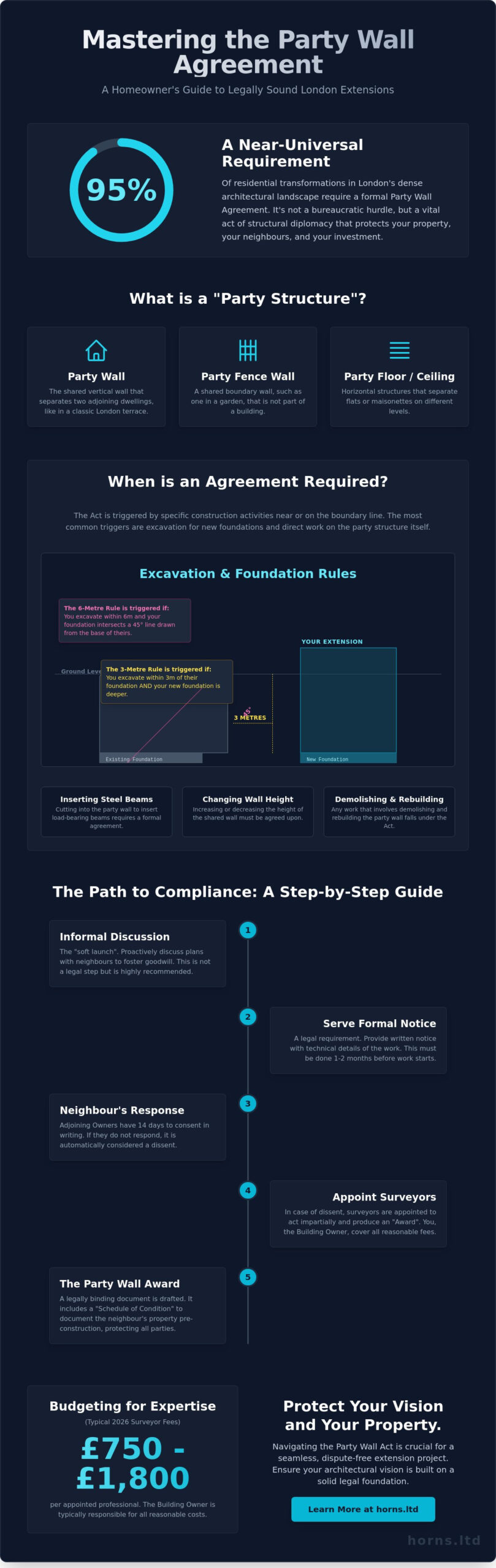
Defining a party wall requires a keen eye for architectural detail. In a classic London terrace, the shared vertical wall that separates two dwellings is the most common example. However, the legal definition extends to “Party Fence Walls,” which are shared garden boundaries not part of a building. For those embarking on sophisticated flat conversions or basement excavations, horizontal party structures between floors become the primary focus. Understanding these distinctions is the first step in ensuring your party wall agreement for extension london covers every technical nuance of your specific site.
The Historical Context of London’s Building Regulations
The rigour of modern boundary laws traces its lineage back to the Great Fire of London in 1666. This historic event necessitated the first significant building acts to prevent future catastrophes, shaping the way we view shared structures and fire safety. By 2026, the standards for documentation have reached a new zenith of precision. Respecting the architectural heritage of areas like Kensington, Chelsea, or Chiswick means acknowledging that your extension is part of a continuing historical narrative. Modern standards require more than just consent; they demand a meticulous record of the existing fabric to protect the timeless value of London’s residential treasures.
Triggers and Technicalities: When Does Your Extension Require a Formal Agreement?
Determining the exact moment your architectural plans cross into the territory of the Party Wall etc. Act 1996 requires a blend of engineering insight and legal foresight. It isn’t always the total scale of the project that dictates the need for a party wall agreement for extension london, but rather the specific nature of the structural intervention. Even a seemingly modest side-return extension can involve delicate work on shared fabric that demands formal recognition under the law. We see this most frequently when a design requires the demolition of an existing boundary wall to make way for a new, structurally sound perimeter that serves the expanded living space.
Excavation and Foundation Proximity
Groundwork is often the most sensitive phase of any London project. The 3-metre rule is the fundamental benchmark for most residential builds. If your new foundations fall within three metres of a neighbour’s structure and reach a depth greater than their existing footings, the Act is triggered. For more ambitious projects involving deep basements or complex split-level designs, the 6-metre rule applies. This involves a 45-degree line drawn downwards from the base of the neighbour’s foundations; if your excavation intersects this imaginary line, formal notice is mandatory. The 3-metre rule remains the primary trigger for most London rear extensions.
Structural Modifications to Shared Fabric
Beyond the ground, the shared wall itself often serves as the anchor for your new design. Inserting Reinforced Steel Joists (RSJs) into a shared chimney breast or wall is a high-precision task that requires careful documentation. Even minor interventions, such as cutting into the party wall to install weatherproofing or lead flashing at the junction of your new extension, fall under statutory requirements. When projects involve full home refurbishments, we often find it necessary to raise or thicken a party wall to accommodate contemporary ceiling heights or improved thermal performance.
In the historic context of London, where properties frequently rest on shifting clay, underpinning shared boundaries for double-storey extensions becomes a masterclass in structural integrity. This process ensures the new loads are safely distributed without compromising the adjoining property. Every cut, every beam, and every cubic metre of soil removed represents a technical dialogue between two homes. By addressing these triggers early, you ensure your project proceeds with the quiet confidence that only comes from meticulous preparation and professional respect for the shared architectural fabric.
Strategic Diplomacy: Managing Neighbourly Consent and the Surveyor’s Role
Success in London’s elite property market depends as much on interpersonal grace as it does on architectural brilliance. Before a single legal document is served, we advocate for a “soft launch” approach. This involves a thoughtful, informal conversation with your neighbours to share your vision and explain the measures taken to protect their home. It transforms a cold statutory requirement into a collaborative effort to preserve the character of the street. When you approach a party wall agreement for extension london with this level of transparency, you often dissolve anxieties before they crystallize into formal disputes.
The Party Wall Surveyor occupies a unique, quasi-judicial role. They don’t act as your personal advocate; they serve the Act itself to ensure the structural integrity of both properties. In nearly all residential extensions, the Building Owner is responsible for the professional fees of both surveyors. In London, these costs typically range from £750 to £1,800 per surveyor, reflecting the high level of expertise required to navigate historic structural complexities. This investment isn’t just a cost; it’s a premium insurance policy that secures your project’s timeline and reputation.
The Three Possible Responses to a Notice
Once the formal notice is served, the adjoining owner has fourteen days to respond. Their choice dictates the procedural rhythm of your build. Consent is the swiftest path, allowing work to proceed without a formal Award, though we still recommend a Schedule of Condition. If the neighbour dissents, you can appoint an “Agreed Surveyor” for efficiency, which is a sophisticated way to maintain momentum while ensuring impartial technical fidelity. In more complex scenarios, each party may appoint their own representative. While this adds layers of scrutiny, it remains a structured path to a resolution rather than a project-ending conflict.
The Party Wall Award and Schedule of Condition
The culmination of this process is the Party Wall Award. This document is a meticulous blueprint for the construction phase, detailing everything from specific working hours to the exact method of structural support. We work closely with surveyors to ensure the Award reflects the technical precision of our onsite methods. A vital component is the “Schedule of Condition,” which is a photographic and descriptive record of the neighbour’s property before work begins. This document acts as a definitive shield, protecting you from unfounded damage claims and ensuring that the final result of your extension is celebrated by all parties involved. This level of detail ensures that your architectural vision is realized without the shadow of future litigation.
The Timeline of Compliance: Serving Notices Without Derailing Your Project
Precision in timing is just as vital as the meticulous finish of a bespoke kitchen. In the sophisticated world of London property, the cadence of your project is dictated by statutory notice periods that cannot be bypassed. For structural work directly affecting a shared wall, the Act mandates a two-month notice period. If your design involves excavations within three or six metres of a neighbour’s foundation, a one-month notice is required. Mastering these windows is essential for a seamless party wall agreement for extension london, ensuring your vision isn’t stalled by preventable legal friction.
By 2026, the shift toward digital notice serving has streamlined the process, though it requires rigorous adherence to valid electronic communication protocols. You must obtain prior written consent from your neighbours to serve notices via verified digital platforms; otherwise, traditional recorded delivery remains the gold standard for legal certainty. This digital evolution allows for swifter coordination, yet the human element remains paramount. We recommend an informal discussion with neighbours at least two weeks before the formal notice arrives, allowing them to process the technical details in a relaxed environment.
Step-by-Step Notice Serving Protocol
The integrity of your notice depends on the accuracy of your data. This begins with identifying every “Adjoining Owner,” a term that encompasses freeholders and any leaseholders with more than a year remaining on their term. Your notice must be accompanied by precise architectural drawings and clear method statements that detail how the structural work will be executed. Serving these documents via recorded delivery or a verified digital platform provides the legal audit trail necessary to protect your project’s start date. If a neighbour doesn’t respond within the initial 14-day window, a formal ten-day follow-up notice must be issued before a surveyor can be appointed on their behalf.
Integrating Legal Compliance into Your Build Schedule
When planning sophisticated house extensions London, homeowners must account for these statutory windows early in the design phase. While the standard determination period for a planning application is eight weeks, London boroughs often take 10 to 13 weeks in practice. You should use this time to resolve party wall matters, as waiting for a planning decision before serving notices can push your start date back by months. Party Wall matters should begin as soon as structural designs are finalized. If your neighbour dissents and an “Agreed Surveyor” is required, you should buffer for a three-month lead time to reach a final Award. To ensure your build remains on its intended path, consult with our experts to align your legal compliance with our construction schedule.
Seamless Integration: How Horns Construction Safeguards Your Architectural Vision
Achieving a flawless finish in a high-end property requires more than just skilled craftsmanship; it demands a sophisticated approach to structural diplomacy. At Horns Construction, we view the process of obtaining a party wall agreement for extension london as an integral part of the design journey rather than a separate legal hurdle. Our approach to home refurbishment begins at the boundary line, ensuring that every technical detail of the Party Wall Award is harmonized with your aesthetic goals. By utilizing advanced structural engineering and quiet-build techniques, we minimize the sensory impact of construction on your neighbours. This preserves the social fabric of your street while we transform your living space with unwavering commitment to quality.
Meticulous Project Management for Discerning Clients
Our legacy in West London spans over 20 years, a tenure that has granted us a profound understanding of the capital’s unique architectural sensitivities. This deep-rooted experience allows us to anticipate the specific concerns of neighbours in historic terraces before they even arise. We maintain a collaborative and highly professional workflow with the city’s leading Party Wall Surveyors, ensuring that pre-construction documentation is exhaustive and legally unassailable. We protect your investment through comprehensive schedules of condition and precise method statements. This level of preparation prevents the delays often caused by common boundary disputes, allowing the physical work to proceed with the calm, measured pace of a true artisan project.
From Legal Compliance to Architectural Excellence
Legal constraints should never dictate the soul of a home. We specialize in creative engineering solutions that ensure Party Wall requirements don’t compromise your interior layout, ceiling heights, or natural light levels. Whether it’s the subtle, high-precision placement of an RSJ or the meticulous underpinning of a heritage wall, the Horns signature is found where structural integrity meets artistic design. We ensure that every Party Wall Award reflects the premium quality of your investment, turning a statutory necessity into a blueprint for excellence. Your home deserves a transition that is as smooth as the final aesthetic result.
Consult with Horns Construction for your bespoke London extension and discover how we bridge the gap between architectural ambition and neighbourly cooperation.
Elevating Your Vision Beyond the Boundary Line
Your London home is a sanctuary of heritage and personal expression. Navigating the complexities of the Party Wall Act 1996 isn’t merely about legal box-ticking; it’s about ensuring your architectural ambitions are realized with absolute structural and social harmony. By prioritizing early diplomacy and meticulous documentation, you’ve already laid the groundwork for a project that flows with professional grace. A robust party wall agreement for extension london acts as a definitive safeguard, protecting both your investment and the historical fabric of our city’s unique terraces.
With over 20 years of West London construction expertise, we specialize in the delicate structural integration required for Victorian and Edwardian properties. We provide comprehensive project management from the first statutory notice to the final artistic detail, ensuring every boundary is respected and every vision is fulfilled. Your journey toward an exquisite home expansion should be as refined as the final result. We believe that true perfection lies in the details, both legal and architectural.
Secure your architectural legacy with Horns Construction’s bespoke extension services. We look forward to bringing your vision to life with the precision and passion it deserves.
Frequently Asked Questions
Do I really need a party wall agreement for a single-storey rear extension?
Yes, most London rear extensions trigger the Act because they involve excavating new foundations within three metres of a neighbour’s structure. Even if your homes are detached, you’ll likely need a party wall agreement for extension london if your new footings are deeper than theirs. This legal framework ensures that your architectural ambitions don’t compromise the structural integrity of the properties flanking your own.
What happens if my neighbour refuses to sign the party wall notice?
A refusal to sign, or a simple lack of response within fourteen days, is legally defined as “dissent.” This doesn’t mean your project is cancelled; it simply means a dispute is deemed to have arisen under the Act. You’ll then need to appoint a surveyor to resolve the matter through a formal Party Wall Award. This step adds a layer of professional scrutiny that protects both parties throughout the construction phase.
How much does a party wall agreement cost in London for 2026?
Total costs typically range between £1,500 and £3,600 per affected neighbour, covering the professional fees for both your surveyor and theirs. Individual surveyor rates in the capital currently sit between £150 and £200 per hour. While these figures represent a significant investment, they secure the expert documentation required to prevent far more costly legal disputes or damage claims in the future.
Can I start my extension before the party wall award is finalized?
No, you shouldn’t commence any work covered by the Act until the Award is formally served and signed. Starting prematurely is a breach of your statutory duty and can lead to a court injunction that halts your project entirely. Patience during this phase is vital to ensure your build proceeds on a foundation of total legal and structural certainty.
Does a party wall agreement cover damage to my neighbour’s property?
Yes, a primary function of the agreement is to provide a clear protocol for “making good” any damage caused by the works. The Award will specify that you are responsible for repairing any structural or cosmetic issues that arise as a direct result of your extension. A meticulously prepared Schedule of Condition acts as your baseline, ensuring that only genuine, new damage is attributed to your project.
How long does a party wall agreement remain valid once signed?
A party wall notice remains valid for one year from the date it was originally served. If you don’t commence the specific works described in the notice within those twelve months, the notice expires. You’ll then need to serve a fresh notice and potentially negotiate a new party wall agreement for extension london to ensure your project remains compliant with 2026 regulations.
Is a party wall agreement required for a detached house extension?
Yes, proximity is the primary trigger for the Act, not just shared physical walls. If you’re excavating for a new extension within three metres of a detached neighbour’s home, and your foundations reach a lower depth than theirs, you must serve notice. The Act is designed to protect all nearby structures from the potential ground movement caused by your new foundations, regardless of the gap between buildings.
Who pays the surveyor’s fees in a London party wall dispute?
The Building Owner, who is the person undertaking the extension, is almost always responsible for paying all reasonable surveyor fees. This includes the costs for your own surveyor and the fees for any surveyor appointed by your neighbours. In the rare event that a neighbour acts vexatiously or causes unnecessary costs, a surveyor might apportion some fees to them, but this is an exception to the standard rule.