
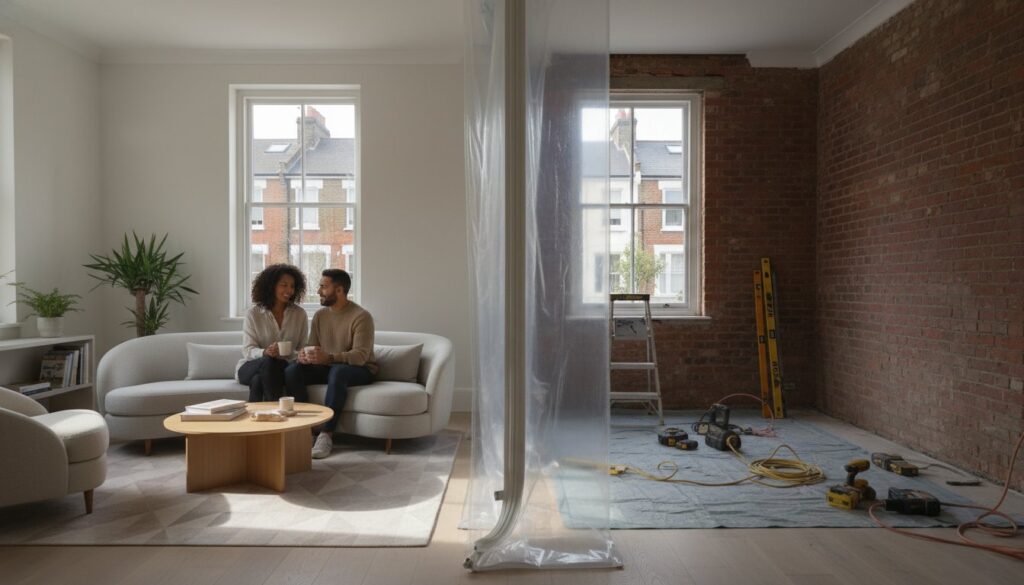
What if the evolution of your home wasn’t a grueling test of endurance, but a meticulously choreographed performance of architectural artistry? Most homeowners approach the inevitable dust and disruption with a profound sense of dread, wondering how to live in your house during a renovation without sacrificing their sanity or the sanctity of their daily rituals. It’s a valid concern; the loss of a functional kitchen or the quiet intrusion of fine debris into your private spaces can feel like a direct affront to the lifestyle you’ve so carefully curated.
We believe your peace of mind should never be a casualty of progress. This 2026 master guide provides the logistical blueprint you need to maintain your family’s health and your property’s value while your vision takes shape. We’ll explore the “Sanctuary Zone” strategy, the technical reality of 2026 OSHA silica standards, and the precise moment when the national median rent of $1,844 for a temporary residence becomes a necessary investment. You’re about to learn how to navigate the technical precision of a renovation while preserving the soul of your home.
Key Takeaways
- Navigate the psychological “middle-project slump” with a professional framework designed to preserve your mental well-being during complex structural changes.
- Discover the logistical secrets of how to live in your house during a renovation by establishing high-functioning temporary kitchens and maintaining essential plumbing services.
- Calculate the 2026 cost-benefit reality of staying on-site, accounting for lifestyle expenses and the “Project Acceleration” benefits of an empty property.
- Protect your home’s air quality through the technical application of HEPA extraction and zip-wall systems to mitigate the impact of respirable dust.
- Learn how a meticulous phased scheduling approach and a daily “Clean Site” mandate ensure your refurbishment remains a sophisticated, manageable experience.
The Reality of a Live-in Renovation: Psychological and Physical Preparation
Transforming a home is an intimate process of improving a broken, damaged, or outdated structure that demands more than just technical skill; it requires psychological fortitude. Most homeowners begin with a surge of aesthetic excitement, yet they often find themselves unprepared for the “renovation fatigue” that sets in around the midpoint of the project. This is the period when the novelty of a new kitchen layout fades and the reality of persistent dust and restricted movement becomes heavy. Understanding how to live in your house during a renovation starts with accepting that your domestic rhythm will shift. It isn’t about lowering your standards for living; it’s about shifting your focus toward a meticulously managed environment where progress and presence coexist.
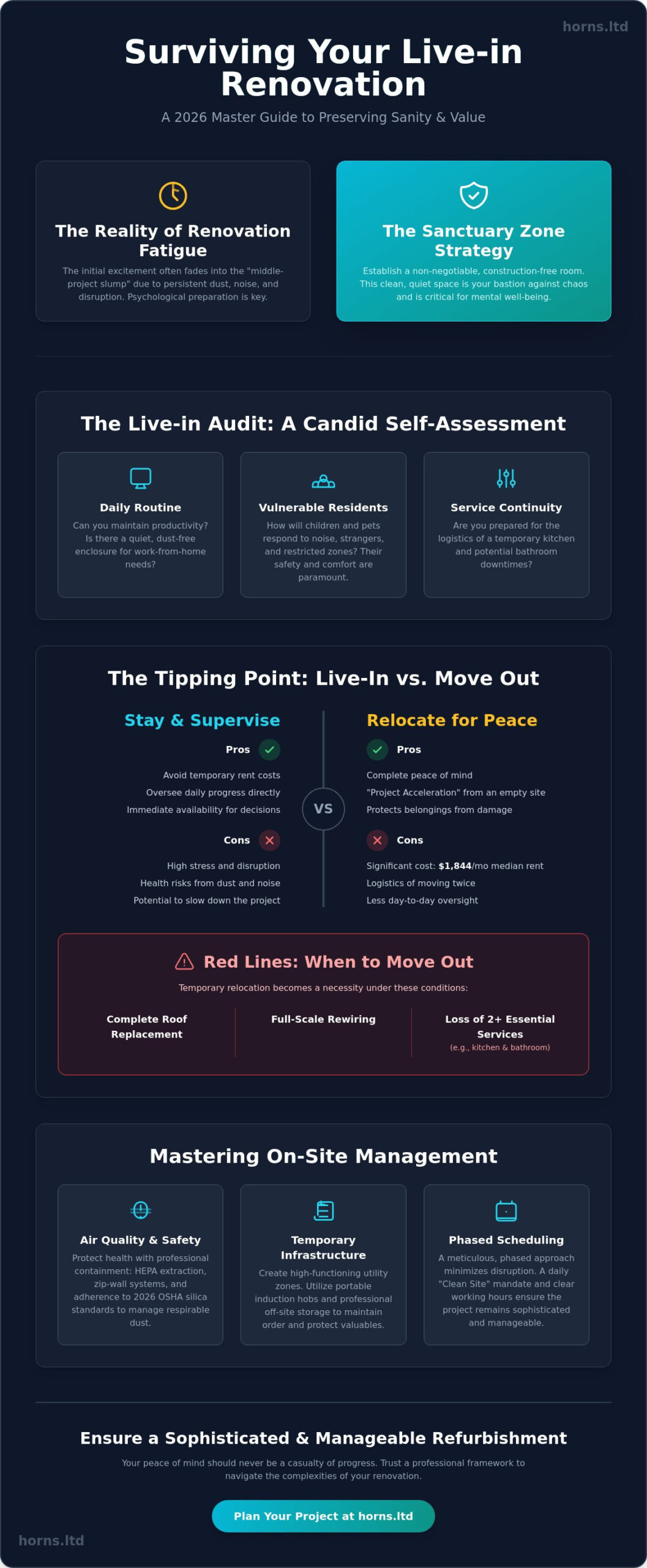
To preserve your mental well-being, the creation of a “Sanctuary Zone” is non-negotiable. This is a single room, perhaps a master bedroom or a formal lounge, that remains entirely untouched by the construction process. It must be a bastion of cleanliness and beauty, curated with your favorite scents and textiles, where the sounds of heavy machinery can be momentarily forgotten. Establishing this boundary extends to your relationship with the craftsmen on-site. In the exclusive enclaves of West London, professional boundaries are the foundation of a successful live-in project. A clear understanding of working hours and designated site access ensures that while your home is a workplace, it never ceases to be your private retreat.
The London Context: Space and Access Constraints
The architectural charm of London’s Victorian and Edwardian terraces brings unique challenges to the live-in experience. In narrow streets like those found in Fulham or Chiswick, the logistics of managing skips and material deliveries require the precision of a stage manager. Structural changes in these historic homes often feel more intrusive than in modern builds, as the very bones of the property are exposed. Maintaining harmony with neighbors is vital, particularly when navigating the complexities of shared party walls. Proactive communication regarding the loudest phases of the work isn’t just polite; it’s a strategic necessity for a peaceful neighborhood presence.
Assessing Your Tolerance: The Live-in Audit
Before the first floorboard is lifted, a candid self-assessment is essential to determine your family’s resilience. Consider the following factors in your audit:
- Daily Routine: Can those working from home find a quiet, dust-free enclosure?
- Vulnerable Residents: How will children and pets respond to restricted zones and unfamiliar noise?
- Service Continuity: Are you prepared for the logistical dance of temporary kitchen setups?
While many phases are manageable, certain “red lines” demand a temporary relocation. If the project involves a complete roof replacement or a full-scale rewiring that leaves the property without power for extended periods, the risks to comfort and safety escalate. The live-in threshold is officially crossed when the project necessitates the simultaneous loss of two or more essential services, such as your primary bathroom and functional cooking facilities.
Creating Temporary Infrastructure: Kitchens and Bathrooms
Living without a primary kitchen or bathroom is often the most visceral challenge of a domestic transformation. To master the art of how to live in your house during a renovation, you must treat your temporary setup not as a makeshift camp, but as a secondary, high-functioning utility zone. This involves more than just plugging in a kettle. It requires the deliberate placement of portable induction hobs in a utility room or a wide hallway, ensuring that your culinary standards remain intact while awaiting a bespoke kitchen fitting. The key is to maintain a sense of order that mirrors the quality of the final result you’re working toward.
Beyond cooking, the logistical burden of storage often surprises homeowners. While it’s tempting to shuffle boxes from room to room, this “shuffling” method risks damaging fine finishes and creates a claustrophobic environment. Professional off-site self-storage is the superior choice for preserving property value and mental clarity. By clearing the site entirely, you allow craftsmen the space required for technical precision, while ensuring your heirlooms remain untouched by the inevitable vibrations of structural work. This clarity of space translates directly into a more efficient project timeline.
The ‘Microwave Gourmet’ Setup
A three-month period without a traditional oven shouldn’t mean a diet of processed meals. Invest in a high-quality air fryer and a portable induction plate to maintain a sophisticated menu. Crucially, you must establish a dedicated washing-up station. Relying on a bathroom sink for dishes is a common mistake that leads to hygiene fatigue; instead, use a large plastic basin and a dedicated water source in your utility area. This setup helps you minimize pollution from sources inside the home by containing food waste and moisture away from your sleeping quarters.
Maintaining Hygiene and Sanitation
Sanitation requires a rigid order of operations. In multi-storey West London homes, we recommend staged bathroom refurbishments to ensure at least one working shower remains accessible at all times. If your project involves a full-scale plumbing overhaul, consider the hire of a high-end portable toilet unit or a temporary shower cubicle. For laundry, while temporary machine hookups are possible, many homeowners prefer the convenience of local West London launderette services during the most disruptive weeks. This keeps your sanctuary zone free from the humidity and noise of drying clothes, maintaining the quiet dignity of your daily life.
Live-in vs. Move-out: A Cost-Benefit Analysis for 2026
The decision to remain in your home during a master-scale refurbishment is often viewed through the narrow lens of financial savings. However, a sophisticated analysis reveals that the true cost of staying involves a complex interplay of time, technical efficiency, and psychological well-being. Mastering how to live in your house during a renovation requires more than just grit; it demands an appreciation for the “Project Acceleration” factor. Builders naturally work with greater momentum in an empty property where they don’t need to perform a complete “pack-down” and site-cleansing routine at the end of every working day. This unhindered access allows for a seamless flow of trades, often reducing the overall project duration and ensuring that the structural integrity of your vision is achieved without compromise.
The Hidden Costs of Staying
While you might avoid a monthly rent payment, the “live-in tax” manifests in other ways. Increased expenditure on specialized cleaning services, the necessity of dining out, and the inevitable project delays caused by restricted site access can quickly erode your projected savings. The link between housing features and illness and injury is clear, and the cumulative stress of navigating a construction zone can lead to “renovation burnout.” This mental fatigue often results in poor decision-making during the critical final stages of selecting textures and finishes, potentially impacting the long-term aesthetic value of your investment. When you compare the national median asking rent of $1,844 for a two-bedroom property to the 15% efficiency loss inherent in a live-in build, the perceived savings of staying on-site often evaporate into the reality of a prolonged construction schedule.
Strategic Vacations and Phased Vacancy
A more nuanced approach involves the “Hybrid Strategy,” where you remain on-site during the lighter aesthetic phases but vacate during the heavy structural work. This is particularly effective when coordinating your annual leave with the most intrusive milestones of a house extension. The “Roof-Off” phase or the period of full-scale structural demolition represents a natural red line where relocation becomes a strategic necessity for your peace of mind. By stepping away during these high-impact weeks, you protect your family’s health and allow the construction crew to operate at peak technical precision. This phased vacancy ensures that the most dangerous and dusty work is completed without the constraints of maintaining a liveable domestic environment, ultimately preserving the sanctity of your home.
Dust, Air Quality, and Site Safety Management
The most pervasive adversary in any high-end refurbishment isn’t the noise or the lack of a kitchen; it’s the microscopic particulate matter that threatens to permeate every fiber of your home. Mastering how to live in your house during a renovation requires a commitment to clinical-grade dust containment. We don’t merely suggest “covering furniture.” A professional approach utilizes zip-wall systems and heavy-duty 6-mil polythene sheeting to create hermetically sealed barriers between active work zones and your living quarters. This is particularly critical in 2026, as OSHA has intensified enforcement of the respirable crystalline silica standard, setting the permissible exposure limit at 50 micrograms per cubic meter of air. To protect your family, your contractor should be monitoring for the “Action Level” of 25 µg/m³, ensuring that the air you breathe remains as pristine as your final design.
Advanced Dust Mitigation
Sophisticated contractors now employ the “Negative Pressure” technique, where high-volume fans vent air directly from the work zone to the exterior. This creates a vacuum effect, preventing fine particles from escaping through small gaps. Protecting your home’s HVAC system is equally vital; sealing return vents with specialized filters prevents the circulation of debris throughout the property. For daily maintenance, a standard domestic vacuum is insufficient. You require a tool like the Oneida XT14 Cyclonic HEPA Dust Extractor, priced at $1,149 in 2026, which is designed to capture wood, drywall, and concrete dust with surgical precision before it settles into your upholstery.
Site Safety for Residents
In the architectural landscape of West London, safety is an exercise in discipline. Establishing “Red Zones” where children and pets are strictly prohibited is the first step in a professional safety protocol. At the end of each working day, the site foreman must conduct a safety sweep to ensure all tools are secured and temporary openings are locked. This level of oversight is part of the mandatory CDM regulations, which apply even to residential projects. Ensuring your property is secure against the unique risks of London’s urban environment is paramount. If you’re planning a complex structural change, consider our full home refurbishment services to ensure your project is managed with the technical rigor it deserves.
In older London homes, the presence of lead paint or asbestos is a reality that cannot be ignored. Professional testing before any demolition begins is a non-negotiable step in preserving your health. When these materials are identified, they must be handled by specialists using dedicated containment protocols. By addressing these technical safety requirements with a maximalist’s eye for detail, you ensure that your journey toward a more beautiful home is as safe as it is transformative.
The Horns Construction Approach to Live-in Refurbishments
At Horns Construction, we view a master-scale project not as a series of technical tasks, but as a carefully managed partnership between our craftsmen and your daily life. We understand that the secret to how to live in your house during a renovation lies in the discipline of the crew on-site. Our ‘Clean Site’ mandate is a cornerstone of our philosophy. It isn’t a mere suggestion; it’s a technical requirement. Every evening, our teams perform a comprehensive tidy-up, removing debris and securing tools to restore a sense of domestic order. This ritual respects the fact that your home remains a sanctuary even amidst structural change. With over 20 years of experience navigating the architectural complexities of West London, we’ve refined our project management to prioritize your comfort without ever compromising on technical fidelity.
Transparency is the hallmark of a premium service. We utilize dedicated project management applications and facilitate mandatory weekly site meetings to ensure you’re never left wondering about the next phase of progress. This constant dialogue allows us to adjust to the nuances of your life, rather than forcing your life to bend to the build. We believe that a successful live-in project is defined by the absence of stress, achieved through meticulous planning and a deep respect for the user experience.
Bespoke Scheduling for Minimal Disruption
We meticulously stage every full home refurbishment to maintain essential services for as long as possible. By sequencing the work with surgical precision, we ensure that your daily rituals are preserved. We respect the “Quiet Hours” necessary for the modern London professional working from home, scheduling the most intrusive acoustic work for specific, pre-agreed windows. A recent project in Ealing serves as a testament to this approach. We completed an extensive loft conversion while the family continued to use their home fully, achieved through a segregated access strategy and a rigorous phased timeline that kept the living floors pristine.
Expert Guidance from Design to Completion
Our design-build model is specifically engineered to eliminate the friction often found between architects and on-site residents. By integrating the design and execution phases, we provide a seamless transition from vision to reality. You gain exclusive access to our network of vetted tradespeople who specialize in the unique etiquette of residential work. They aren’t just master carpenters or electricians; they’re professionals who respect the sanctity of your private space. We don’t just build structures; we curate an experience that honors your investment and your peace of mind. For those seeking this level of professionalism in North America, you can learn more about HMJ Contracting and their approach to high-quality builds.
Ready to transform your home with a team that values your lifestyle as much as the final finish? Contact Horns Construction for a consultation and discover how to live in your house during a renovation with absolute confidence.
Orchestrating a Masterful Transformation
Understanding how to live in your house during a renovation is an exercise in domestic choreography. It requires a delicate balance between the technical demands of a construction site and the sanctity of your daily rituals. By establishing dedicated Sanctuary Zones and employing advanced HEPA filtration, you ensure that your domestic life remains a source of inspiration rather than a point of conflict. The logistical complexities of temporary infrastructure are merely the prelude to a more refined, purposeful living space that honors your investment.
With over 20 years of experience in West London, Horns Construction has become a specialist in live-in residential projects. Our approach is fully insured and strictly CDM compliant, providing the technical rigor required for complex builds while safeguarding your family’s well-being. We believe that the process of creation should be as dignified as the final masterpiece. We don’t just build structures; we curate environments where your lifestyle can continue to flourish even during the most significant transitions.
Start your stress-free London renovation with Horns Construction. Your journey toward a transformed home begins with a partner who values your comfort as much as the final finish.
Frequently Asked Questions
Is it safe to live in a house during a major structural renovation?
Living on-site is safe provided your contractor maintains a rigorous separation between the construction “Red Zone” and your private living quarters. Safety depends on the technical stabilization of the structure and strict adherence to CDM regulations. However, if the project involves a complete roof removal or a total loss of power for extended periods, the risks to your health and comfort may necessitate a temporary relocation to preserve your well-being.
How do I protect my furniture and clothes from construction dust?
The most effective protection involves using 6-mil polythene sheeting and professional zip-wall systems to create airtight barriers. Standard fabric drop cloths are insufficient for fine particulate matter. For your most cherished heirlooms and wardrobes, off-site climate-controlled storage is the only method that guarantees absolute protection. If items must stay, seal wardrobe doors with low-tack painter’s tape to prevent dust from infiltrating through the gaps.
What is the best way to set up a temporary kitchen?
Establish a high-functioning utility zone in a hallway or laundry room using portable induction hobs and an air fryer. It’s vital to create a dedicated washing-up station with a large basin to avoid using the bathroom sink for dishes. This separation maintains essential hygiene and allows you to continue preparing sophisticated, nutritious meals while your bespoke kitchen fitting is being meticulously crafted by our carpentry team.
How do I manage my pets while builders are in the house?
Create a secure, soundproofed enclosure within your “Sanctuary Zone” to shield pets from the vibrations and unfamiliar scents of construction. Pets are highly sensitive to the acoustic shifts of a renovation, so maintaining their routine is paramount for their health. If the day’s schedule includes high-decibel structural work, consider day-boarding to prevent stress-related illness or the risk of an accidental escape through open site access points.
Can I stay in my house during a loft conversion in London?
Yes, stay-in loft conversions are remarkably manageable because the primary structural work is contained above your existing living floors. Most tradespeople will use external scaffolding for access, which significantly reduces the footprint of the construction crew inside your home. This is an ideal scenario for how to live in your house during a renovation, as the dust and disruption are naturally confined to the uppermost levels of the property.
How much money do I actually save by living in during a renovation?
While you avoid the direct cost of a rental, which averages $1,844 nationally in 2026, the net savings are often diminished by the “live-in tax.” This includes a 15% loss in construction efficiency due to daily site pack-downs and the increased costs of dining out and professional cleaning. You must weigh the emotional cost of the disruption against the technical benefits of allowing the build to proceed unhindered in a vacant property.
What should I do if my water or electricity is cut off for longer than expected?
Contact your project manager immediately to verify the restoration timeline and activate your pre-arranged contingency plan. For any planned outage exceeding eight hours, a professional team should have temporary power hookups or water storage solutions ready. If essential services are lost for more than 24 hours without a technical resolution, it’s time to trigger your “red line” relocation plan to ensure your family’s safety.
How do I maintain a good relationship with my builders while living on site?
Establish clear boundaries and use a professional communication protocol, such as a dedicated app or a weekly site meeting, to discuss progress. Avoid interrupting craftsmen during their technical tasks, as this can break the flow of precision work. Providing a dedicated break area and respecting their scheduled working hours fosters a culture of mutual respect, ensuring your home is treated with the artistic care and technical fidelity it deserves.