

Could a five-star review still be the wrong evidence for your Islington project? A glowing rating can feel reassuring, but it may say little about whether the work resembles your own or how the builder handled communication, timing and day-to-day decisions. That’s why islington builders reviews are most useful when you look beyond the score and consider the detail behind it.
It’s reasonable to want confidence before inviting a building team into your home. The challenge is separating specific, relevant evidence from broad praise, particularly when you’re planning a loft conversion, house extension or full refurbishment. This guide explains how to assess reviews, compare them with project evidence and identify the working practices that matter. You’ll also see how to relate your requirements to a project-led service such as Horns Construction, which supports projects from initial design and planning through to completion. Details about similar work, communication and coordination can help you judge whether a builder suits your Islington home.
Key Takeaways
- Use islington builders reviews as a starting point, not a verdict. Look for first-hand detail about comparable projects and the working experience.
- Assess reviews in five steps: check project relevance, read the specifics, consider recency, compare supporting evidence and note how communication is described.
- Weigh reviews alongside photographs, a clear project scope and information about support across different stages. Images alone don’t establish who completed the work or when.
- Build a shortlist around project match, detailed feedback, scope clarity and communication. Consider practical Islington factors such as layout, access and neighbour coordination.
- Relate your requirements to Horns Construction’s London work in extensions, loft conversions and full home refurbishments, with support from initial design and planning through completion.
Islington Builders Reviews: What Customer Feedback Can, and Cannot, Tell You
A builder review is most useful when it comes from someone describing first-hand experience of a real project. Look for enough context to understand what work was done and what it was like to work with the team, rather than praise that could apply to any service. For example, feedback about a small decorating job may reveal little about the planning and coordination involved in a loft conversion.
This distinction matters when reading islington builders reviews. Islington is a varied London borough, and the needs of one home may differ considerably from another’s. A review about a comparable property and scope can offer more relevant insight than a higher score for work unlike yours. A useful rule of thumb is: a review is most useful when its project details match the reader’s needs.
Ratings are signals, not guarantees. A score can’t establish workmanship, prove that a builder is right for your project or promise a particular outcome. Reviews also appear in different contexts: trade directories and professional discovery platforms help people find and assess businesses, while a builder’s project information may show photographs or describe work undertaken. Each source offers a different kind of evidence. Consider what it can tell you and what it leaves unanswered.
What should an Islington builder review actually tell you?
Read for specifics. Does the reviewer identify the type and scope of work, such as a refurbishment, extension or loft conversion? Do they describe how communication worked, whether different stages were coordinated and how questions were handled? These details help you assess the working experience, not just the finished appearance. Comments about finish or reliability are useful as individual accounts, but they shouldn’t be treated as universal promises about every project.
Why star ratings alone are an incomplete guide
A single score can conceal differences in project scale and in what customers value. One homeowner may focus on clear updates; another may emphasise the completed finish. Read the accompanying text to understand the circumstances behind a rating, then compare it with relevant photographs or case-study details. Images can illustrate a project, but they don’t independently establish who completed the work or when.
Keep the source in view, too. A directory review, a profile on a professional discovery platform and project information published by a builder aren’t interchangeable. Each may provide context, but none should be stretched beyond what it actually shows. For general background on the borough, explore Islington. For a building decision, focus on evidence tied to the work and working practices relevant to your home.
Be precise with claims about ratings and review totals. Don’t infer a company-wide score or count from selected comments or a single platform. A measured reading of the evidence gives you a sounder basis for comparing builders, without mistaking popularity for suitability.
How to Assess Islington Builders Reviews in Five Practical Steps
Use a consistent method to turn online feedback into a practical comparison. The aim isn’t to collect the most praise, but to find evidence that relates to your home, your scope of work and the way you want a project managed. Keep notes as you read. A simple comparison makes it easier to separate relevant detail from personal preference or broad promotional language.
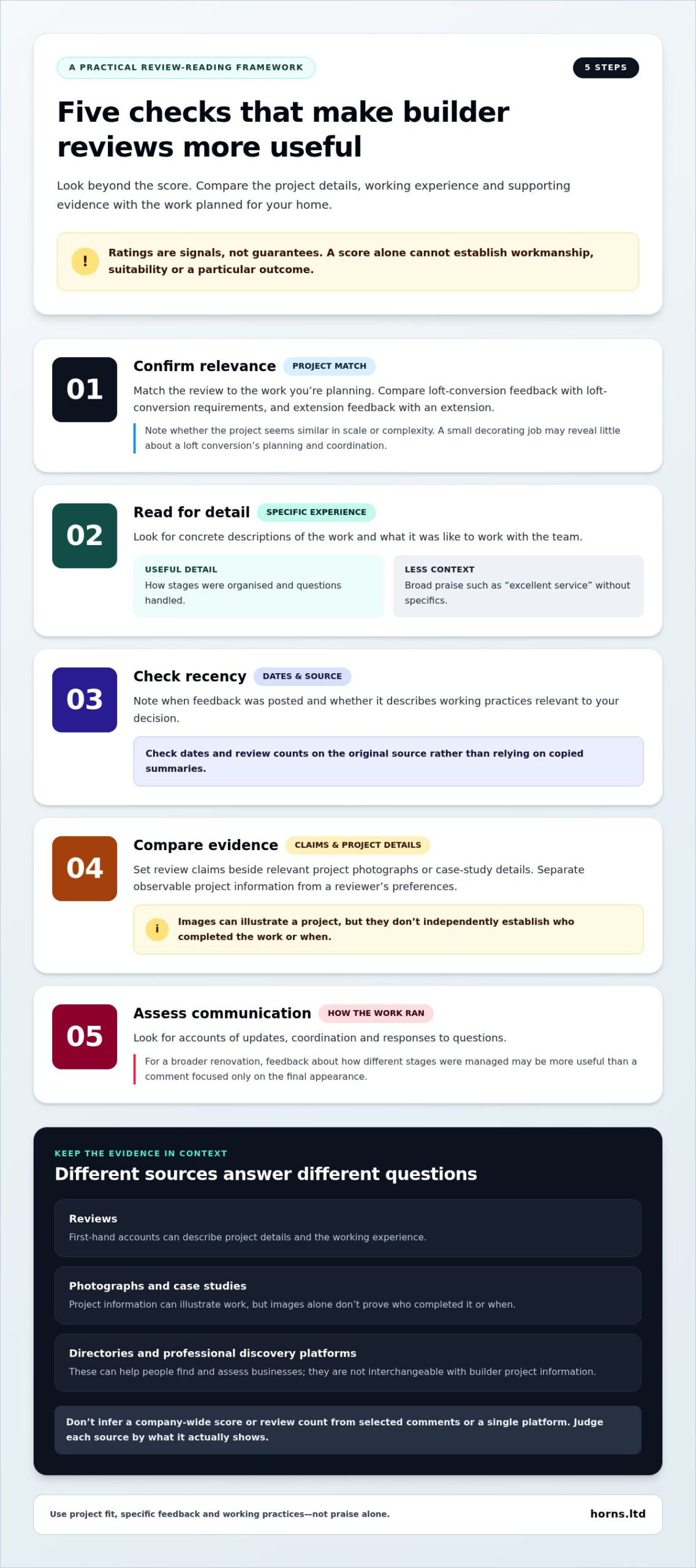
- 1. Confirm relevance. Match the review to the work you’re planning. Compare loft-conversion feedback with loft-conversion requirements, and extension feedback with an extension. Note whether the project seems similar in scale or complexity.
- 2. Read for detail. Look for concrete descriptions of the work and experience, such as how stages were organised or questions were handled. Separate these observations from general phrases like “excellent service” that offer little context.
- 3. Check recency. Note when feedback was posted and whether it describes working practices relevant to your decision. Check dates and review counts on the original source rather than relying on copied summaries.
- 4. Compare evidence. Set review claims beside relevant project photographs or case-study details. Treat images as illustrative, not proof on their own, and distinguish observable project information from a reviewer’s preferences.
- 5. Assess communication. Look for accounts of updates, coordination and responses to questions. For a broader renovation, feedback about how different stages were managed may be more useful than a comment focused only on the final appearance.
Match reviews to the work you are planning
Project type is only the first filter. Consider whether the feedback reflects a comparable scope: a single-room improvement and a full home refurbishment involve different levels of coordination. For a loft conversion, look for comments about that kind of work; for an extension, prioritise extension-related detail. If your plans span several stages, note whether a review explains how those stages connected.
Read for detail, dates, and consistency
Specific references to planning, site organisation, communication and completion are easier to assess than repeated superlatives. Recurring themes can be useful, but similar wording alone doesn’t prove that accounts are independent or representative. Check the original review page for dates and totals, and compare information across sources where available. Recency helps show whether feedback reflects current working practices, while project relevance shows whether those practices relate to your needs.
For a professional benchmark on conduct and practice in the built environment, the RICS Professional Standards provide useful context, but they don’t replace project-specific review evidence. You can also explore Horns Construction’s renovation work and consider how its support from initial design and planning through completion relates to your requirements.
Compare Islington Builder Reviews with Project Evidence and Working Practices
A stronger assessment emerges when you read feedback alongside evidence of how a project is presented and managed. Islington builders reviews can describe a customer’s experience, while photographs may show visible aspects of the finished work and a clear scope can explain what a project involved. These sources answer different questions, so don’t treat one as a substitute for the others. Consider the home itself, too: access, neighbour coordination and the property’s layout can shape how work is organised. Evidence is most useful when it helps you understand both the result and the process behind it.
| Evidence to compare | What it may help you assess | What it can’t establish alone |
|---|---|---|
| Review evidence | How a customer describes the work, communication and coordination. | That the same experience will apply to every project. |
| Project photographs | Visible details and the type of work shown. | Who completed the work or when it was done. |
| Scope clarity | Whether the work’s described boundaries resemble your requirements. | How every decision or responsibility was handled in practice. |
| Communication | Whether feedback discusses updates, questions and coordination. | A complete picture based on one account alone. |
| Project-stage support | How information describes support across stages of work. | That a particular process guarantees a particular outcome. |
What project photographs and case studies add
Look for images that relate to the work you’re considering, and captions or case-study details that explain the project’s context. A photograph of a finished room may offer inspiration, but it doesn’t show the full scope, sequence of work or customer experience. Distinguish design inspiration from documented examples of completed work. Unless a project is specifically identified and supported by evidence, don’t assume its location, date or authorship.
How to compare project communication and scope
Clear scope descriptions help you see whether a company’s stated approach addresses the work your home needs. Reviews that explain how questions were answered, responsibilities set out or stages coordinated can add useful perspective. Communication matters because decisions and practical arrangements arise throughout a project, not only at the end. A detailed account of updates and coordination can complement comments on the finish.
Apply that comparison to your own property. A review may mention smooth coordination, but access arrangements or proximity to neighbours could be especially relevant to your home. Note which evidence speaks to a comparable constraint, which is general and which remains unclear. This gives you a more rounded view of project fit without treating photographs, testimonials or promotional descriptions as proof they cannot provide.
A Review-Based Shortlist for Building Work in Islington
Turn your research into a shortlist by applying the same criteria to each company. Give more weight to evidence that matches your project, describes the working experience in useful detail, sets out a clear scope and offers insight into communication. A high rating without relevant context may be less helpful than a measured account of work similar to yours.
Keep the property in view as you compare. Islington homes can present different practical considerations, so note whether your project involves restricted access, a particular layout or coordination with neighbours. Planning and conservation questions depend on the individual property and proposed work. Identify what needs checking rather than assuming the same requirements apply across the borough.
- Project match: Does the feedback relate to the same type of work and a comparable scope?
- Useful detail: Does it explain what the customer experienced, rather than relying on general praise?
- Clear scope: Is there enough information to understand what the project involved?
- Communication: Does the account describe how updates, questions or coordination were handled?
Apply the same criteria to lofts, extensions, and refurbishments
For a loft conversion, prioritise feedback about a similar conversion scope rather than unrelated work. For an extension, look for accounts that discuss coordination and the project’s requirements. If you’re planning a full refurbishment, feedback covering several stages may offer more insight than comments focused on one finished room. Compare like with like, then record where the evidence is strong and where it leaves questions.
Use reviews to prepare for a project conversation
Before discussing your plans, summarise the intended work, your priorities and any property-specific considerations. Note questions prompted by reviews, such as how project stages are explained or how communication is organised. This turns online feedback into a practical starting point, not a verdict. Horns Construction supports residential projects from initial design and planning through completion, bringing those stages into the context of your requirements.
For broader company context, the London construction companies guide offers another perspective as you assess your shortlist. You can also explore Horns Construction’s London residential project services and compare its loft conversions, house extensions and full home refurbishments with the work you have in mind. Keep your comparison grounded in your project, your property and the evidence you can assess.
Horns Construction: Connect Islington Reviews with Your Project Requirements
Reviews can help you understand how other homeowners describe their experience, but the final question is whether a company’s residential services align with the work your home needs. Horns Construction is a London residential renovation company undertaking house extensions, loft conversions and full home refurbishments. Its project support runs from initial design and planning through completion, giving homeowners a project-wide context to consider alongside review evidence.
That context doesn’t replace project-specific assessment. Use islington builders reviews to identify questions about scope, communication or coordination, then compare those observations with your property’s requirements. A review describes one homeowner’s experience; it isn’t proof of a particular rating, local project history or guaranteed outcome.
When Horns Construction may suit an Islington project
Start with the defined work. If you’re planning a loft conversion, house extension or full refurbishment, consider how that scope aligns with Horns Construction’s residential services. Then account for the details that make your project distinct, such as the layout, access and priorities for the finished home. A suitable fit depends on how the scope and project support relate to those requirements, not on a broad claim or an unverified review score.
Support from design and planning through completion can be relevant when your project involves multiple stages and decisions. Treat this as a description of the company’s project approach, not a promise about timing, price or results. Keep your evaluation grounded in what you need and the information available about how the work is framed.
What to take into your next project discussion
A concise brief makes it easier to discuss practical requirements. Note the type of property, the work you’re considering, your main priorities and any constraints you already know about. Bring review observations that raised useful questions, and identify project examples you’d like to discuss. Distinguish documented details from inspiration images or general promotional material.
- Property and scope: Summarise the home and the intended extension, loft conversion or refurbishment.
- Priorities: Record the design, practical needs and project considerations that matter most to you.
- Review questions: Note specific points about communication, coordination or project stages that you want to understand.
- Evidence: Keep relevant review details and examples together. Don’t assume an example is local or comparable unless its context supports that.
If refurbishment is part of your plans, the London home refurbishment guide offers further context for considering the work. A clear brief helps you explore how the project’s scope and stages fit together before making a decision. For a calm next step, discuss your residential project with Horns Construction.
Turn Your Shortlist into a Clear Project Brief
Turn your research into a brief that reflects how you want your home to work, not just what you’ve seen in other people’s reviews. Write down your priorities, the decisions you still need to make and the practical details that may shape the work. This gives you a grounded basis for discussing your plans and assessing whether the proposed approach suits your property.
As you weigh islington builders reviews, keep your own requirements at the centre. Feedback can inform your questions, but your project’s scope and the way you want it managed should guide your decision. Horns Construction is a privately owned London renovation company working on residential extensions, loft conversions and full home refurbishments, with project support spanning initial design and planning through completion.
If you’re ready to explore how your plans could take shape, discuss your residential project with Horns Construction. A considered conversation can help you move from online research towards a clear next step for your home.
Frequently Asked Questions
What should I look for in Islington builders reviews?
Look for reviews that explain what the customer commissioned and what they experienced during the work. Feedback about an extension, for example, is more relevant to an extension project than praise for a small repair. Notice whether the reviewer gives concrete observations about communication, organisation or the finished work. The phrase islington builders reviews may surface different kinds of feedback, so check the original context before drawing conclusions.
Are online builder reviews enough to choose a builder?
No. Reviews offer one perspective, but they can’t describe every detail of a future project. Compare them with the written scope and the way proposed stages and responsibilities are explained. For work in a London home, note property-specific factors such as access or how the work may affect your household, and include those in your assessment. Use reviews to inform your questions, not replace careful consideration of the project itself.
How can I tell whether a builder review is genuine?
You usually can’t establish authenticity from a comment alone. Read it on its original platform, where its date and surrounding context may be visible, and look for a description that makes clear what work the author is discussing. Specific detail can make feedback easier to evaluate, but it isn’t proof of identity or authenticity. Treat unclear authorship, project descriptions or dates as limits on how much weight you give the review.
Should I trust a builder with mixed reviews?
Mixed reviews call for closer reading, not automatic rejection or endorsement. Separate specific concerns, such as unclear updates, from differences in personal preference about design or finish. Check whether the comments describe work comparable to yours and whether similar concerns appear across separate accounts. If a platform shows a response, consider what it addresses while remembering that a response is only one part of the available information.
Do recent builders reviews matter more than older reviews?
Recent feedback can indicate how customers describe their experience more currently, while older comments may help reveal longer-running themes. Compare dates with the project type and detail rather than relying on recency alone. A newer review about unrelated work may be less informative for your plans than an older, detailed account of a similar project. Check dates and any quoted review totals against the original platform.
Can builder reviews tell me whether a project will finish on time?
No review can reliably predict the schedule for a different property and scope. A customer may describe how timing worked on their project, but that account isn’t a forecast. For your project, discuss how stages, expectations and updates will be set out, and how changes or dependencies will be communicated. That conversation can clarify the proposed approach without treating another homeowner’s timeline as a promise.
Why do reviews for the same builder differ?
Reviews can differ because customers commission different work and bring different priorities to the experience. Someone focused on design choices may describe a project differently from a homeowner whose main concern was coordination. A loft conversion and a full refurbishment also involve distinct scopes, so compare accounts with that difference in mind. Look for concrete patterns and assess each comment in its project context rather than averaging away the detail.