
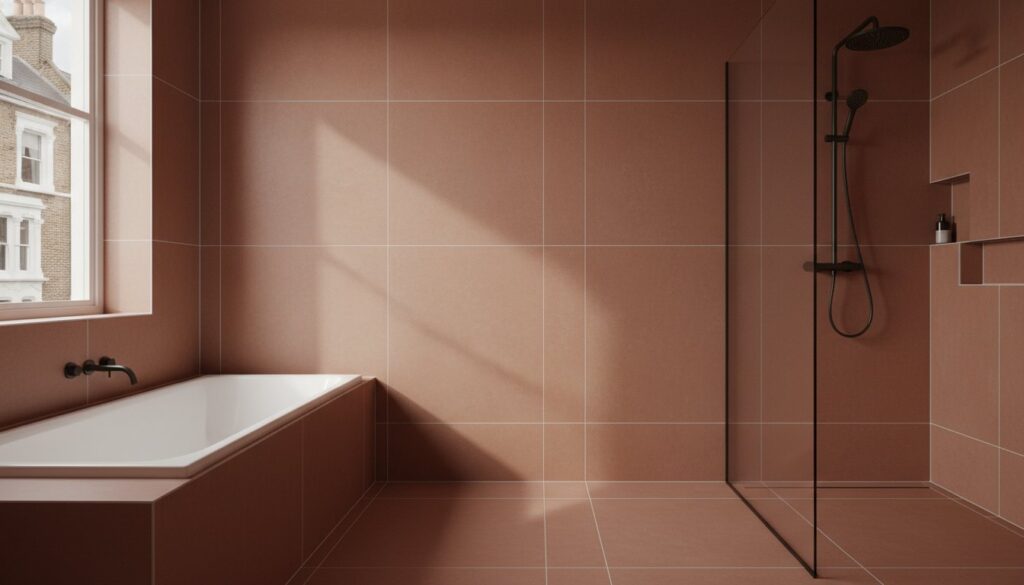
A masterfully tiled floor is not merely a surface; it’s a silent symphony of structural integrity and artistic intent where every millimetre serves a purpose. When you invest in premium tiling services london, you aren’t just buying materials, you’re commissioning a legacy for your home. You’ve likely felt the anxiety of choosing between delicate natural stone and durable porcelain, or perhaps you’ve worried that London’s historic Victorian sub-floors might cause your new installation to crack within a year. These concerns are the mark of a homeowner who values perfection over a quick fix.
We understand that true luxury lives in the details that most people never see, from the precision of the substrate to the seamless integration of underfloor heating. This guide reveals how the 2026 shift toward warm, earthy tones and large-format tiles can be executed with the engineering rigour required by modern waterproofing regulations. You’ll discover the technical secrets behind a flawless finish that adds enduring value to your property and transforms your living space into a sanctuary of timeless design. We’ll explore how meticulous sub-floor preparation and the latest material innovations ensure your home remains as structurally sound as it is visually captivating.
Key Takeaways
- Understand why London’s historic timber joists require specialised uncoupling membranes to prevent fractures before a single tile is laid.
- Evaluate the performance characteristics of modern porcelain against natural stone to achieve a balance of aesthetic grandeur and long-term durability.
- Discover how expert tiling services london synchronise with structural engineering and plumbing first-fix stages during comprehensive home refurbishments.
- Learn the importance of precision “setting out” and adhesive chemistry in achieving a symmetrical, laser-levelled finish that avoids unsightly edge cuts.
- Appreciate the transition from simple decorative tiling to masterful surface engineering that preserves the integrity of your property’s architectural value.
What Defines Professional Tiling Services in London?
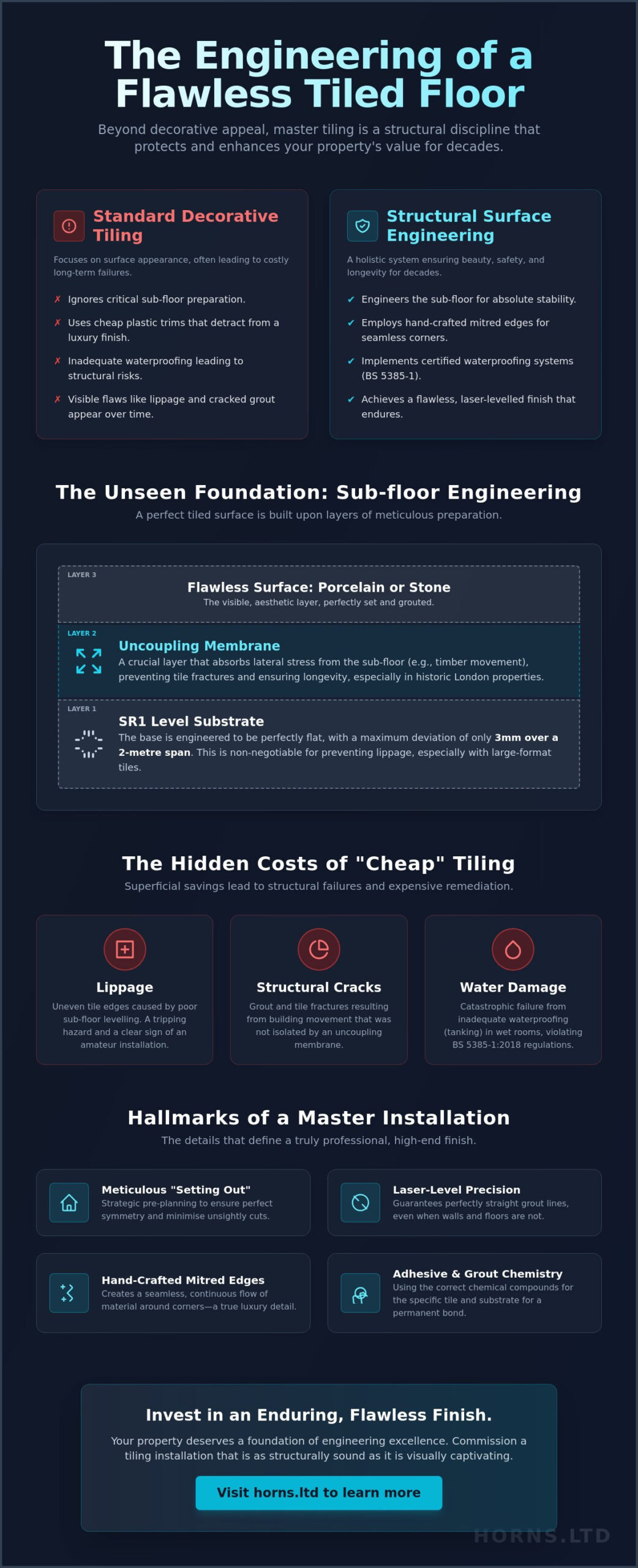
Professional tiling in a city as architecturally diverse as London requires more than just a steady hand. It demands an intimate understanding of how buildings breathe and move. While many view tiling as a purely decorative final touch, we treat it as structural surface engineering. This distinction is vital for the longevity of your home. A decorative approach might look acceptable for a few months, but structural engineering ensures the finish remains flawless for decades. Our approach to tiling services london begins with the substrate, acknowledging that every Victorian terrace or industrial loft conversion presents unique challenges. We don’t just lay tiles; we create an enduring foundation where technical mastery meets an uncompromising artistic vision.
Precision is the heartbeat of our process. We employ laser-levelling technology to ensure that every row is perfectly horizontal, even when the original walls are not. Grout consistency is equally paramount; it isn’t merely a filler but a functional component that must be mixed to the exact chemical specifications of the adhesive and tile. This level of detail is what separates a standard renovation from a masterful finish that respects the heritage and modern potential of London’s unique properties.
The Aesthetic Impact of Master Tiling
The visual rhythm of a room is dictated by its grout lines. When symmetry is perfected through meticulous planning, a small ensuite can feel expansive and airy. In high-end bathroom finishes, we favour hand-crafted mitred edges over standard plastic or metal trims. This allows the material to wrap around corners with effortless continuity, maintaining the stone’s natural flow. Master tiling is the seamless fusion of material knowledge and geometric precision. Understanding the history and types of tiles allows a craftsman to respect the inherent properties of the medium, ensuring the final layout respects the room’s natural focal points and architectural lines.
Why “Cheap” Tiling Costs More Long-Term
Economy tiling often ignores the critical, invisible layers beneath the surface. In London’s wet rooms, inadequate tanking is a recipe for catastrophic water damage. Current regulations, specifically BS 5385-1:2018, mandate continuous certified waterproofing systems in shower areas. Skipping these steps leads to lippage, where tile edges sit at different heights, or cracked grout lines that signal structural failure. These aren’t just aesthetic flaws; they’re indicators of a compromised installation. Investing in a service backed by a comprehensive construction guarantee protects your property from the hidden costs of remediation. True value is found in a finish that doesn’t just look perfect today but remains resilient against the passage of time. Precision alignment and grout consistency are the hallmarks of a professional who values your home’s structural health as much as its beauty.
Sub-floor Preparation: The Engineering Behind a Flawless Finish
A flawless surface is an illusion sustained by the invisible strength of the layers beneath it. In the context of tiling services london, the substrate is often a complex puzzle of historical architecture and modern material science. We don’t simply tile over what exists; we engineer a foundation that guarantees the longevity of your investment. Adhering to the technical standards set by The Tile Association (TTA) is the baseline for any professional installation. Whether we’re encountering the seasoned timber joists of a period property or the fresh, moisture-rich screed of a new extension, the preparation phase remains the most critical chapter of the project.
The science of uncoupling membranes, specifically systems like DITRA, serves as a vital buffer between the tile and the substrate. These membranes neutralise lateral stresses, preventing the inevitable movement of a building from translating into unsightly fractures in your porcelain or stone. Achieving SR1 level floor flatness is our non-negotiable benchmark. This industry gold standard permits a maximum deviation of only 3mm over a 2-metre span, a requirement that becomes even more stringent when installing contemporary large-format tiles. Without this precision, “lippage” becomes an unavoidable flaw, ruining the clean lines of a modern interior. In expansive, open-plan kitchen extensions, we strategically integrate movement joints to accommodate thermal expansion, ensuring the floor remains a singular, cohesive masterpiece despite the shifting environment.
Addressing London’s Structural Challenges
London’s unique housing stock presents specific engineering hurdles. This is particularly evident in West London loft conversions, where the introduction of significant weight from natural stone requires a rigid, reinforced sub-structure to prevent deflection. Moisture management is equally paramount. In accordance with BS 5385-1:2018, we implement certified tanking systems in all wet areas to prevent structural decay. For period property refurbishments, we often spend more time levelling uneven substrates than laying the tiles themselves, as a perfectly plumb wall is the only way to achieve true grout line symmetry.
Integrating Underfloor Heating (UFH)
Modern luxury often involves the integration of underfloor heating, where the tile acts as a high-performance thermal mass. We utilise specialised S1 or S2 flexible adhesives designed to withstand the rapid temperature fluctuations of electric and wet UFH systems. Our craftsmen employ specific trowel techniques to ensure 100% adhesive coverage, eliminating air pockets that could cause “cold spots” or tiles to debond. If you’re planning a sophisticated home transformation, our team can help you coordinate these technical requirements with your broader design vision, ensuring a finish that is as warm and inviting as it is technically superior.
Selecting Materials: From Victorian Path Tiles to Modern Porcelain
Choosing the right material is an exercise in both alchemy and architecture. While the substrate provides the structural skeleton, the tile serves as the soul of the room, defining its character and resilience. In the high-traffic environments of a busy capital, porcelain has emerged as the definitive choice for those seeking longevity without compromising on elegance. Unlike ceramic, which is more porous and prone to chipping under the pressures of daily life, porcelain is fired at higher temperatures to create a dense, glass-like structure. This makes it nearly impervious to water and stains, a critical factor when commissioning tiling services london for kitchens or hallways that must withstand the city’s relentless pace.
Beyond modern synthetics, natural stone remains the pinnacle of organic luxury. Materials like Carrara marble, Belgian blue limestone, and slate offer a tactile depth that manufactured products can’t fully replicate. However, choosing stone requires an honest appraisal of the maintenance reality. These are living materials; they’re porous and require professional sealing to prevent deep-seated staining. For those living in period properties, Victorian geometric tiles represent a sacred heritage. Restoring or replicating these intricate patterns in a London hallway demands a specialist’s eye for symmetry, ensuring that every small mosaic piece aligns with the building’s original architectural intent.
The Rise of Large Format Porcelain
The 2026 design landscape is dominated by the pursuit of continuity. Large format tiles, often exceeding 1200mm in length, create a “slab” effect that minimises grout lines and expands the perceived volume of a space. Handling these grand pieces requires specialised equipment, including mechanical suction frames and precision water-cooled cutting tables. We insist on “back-buttering” every large format tile. This technical step involves applying a thin layer of adhesive to the back of the tile itself as well as the floor, ensuring 100% mechanical bond strength. This level of care is particularly transformative in bespoke kitchen renovations in London, where seamless transitions between cooking and dining areas are paramount.
Natural Stone Maintenance and Care
If you choose the path of natural stone, understanding slip resistance is vital for safety. We evaluate materials based on their R-value; an R9 rating is suitable for dry living areas, while wet rooms and outdoor patios require R11 or higher to ensure stability underfoot. The finish you select also dictates the room’s atmosphere. Honed finishes provide a contemporary matte look that’s currently trending for its “spa-like” serenity, while polished stone offers a traditional, high-gloss grandeur. Regardless of the aesthetic, we apply premium impregnating sealers that bond with the stone’s molecular structure, protecting your investment from the inside out.
The Horns Installation Process: A Step-by-Step Technical Guide
Excellence in tiling services london is achieved through a deliberate, technical choreography that begins long before the first bag of adhesive is opened. We treat the installation not as a series of manual tasks, but as a controlled engineering process. Every phase is designed to mitigate the risks inherent in London’s diverse building stock, ensuring that the final aesthetic is supported by an invisible framework of precision. From the chemical composition of the bonding agents to the geometric logic of the layout, our methodology is defined by an uncompromising attention to detail.
Adhesive selection is a critical decision point that many overlook. We don’t use “standard” adhesives; we match the chemical properties of the bonding agent to both the specific tile material and the underlying substrate. Whether it’s a high-flexibility S2 adhesive for timber-framed loft conversions or a rapid-set formula for moisture-sensitive natural stone, the bond must be absolute. This technical matching prevents the debonding and hollow sounds that often plague inferior installations, representing the hallmarks of elite tiling services london.
Setting Out: The Art of Symmetry
Setting out is a mathematical ritual. We don’t simply find the centre of a room; we calculate the visual balance of the entire floor to avoid “slivers”. These tiny, distracting tile fragments at the edges signal a lack of professional foresight. By using high-precision laser levels, we project the entire grid onto the substrate, adjusting for architectural quirks before a single tile is set. This level of planning is essential for our bathroom fitters London teams, where complex plumbing fixtures and bespoke niches require absolute geometric alignment to achieve a high-end finish.
During the installation, we employ advanced “Level and Wedge” mechanical systems to eliminate lippage entirely. These clips hold the tiles in perfect tension while the adhesive cures, preventing the microscopic shifts that can ruin the clean lines of a large-format layout. It’s this commitment to technical perfection that ensures your floor remains a smooth, monolithic surface that is as pleasant to walk on as it is to behold.
Grouting and Final Protection
The final seal is what protects the structural work from the elements. While cementitious grouts are traditional, we often recommend epoxy grout for its uncompromising durability. Epoxy is non-porous, chemically resistant, and nearly impossible to stain, making it the gold standard for wet rooms and high-traffic kitchens. We meticulously colour-match our grouts to the tile’s primary tones, creating a visual continuity that allows the material’s natural beauty to lead the narrative. Post-installation, we use specialised pH-neutral cleaners to remove grout haze without compromising the tile’s surface integrity. If you require a finish that transcends the ordinary, consult our master tilers to discuss your project’s technical requirements.
Integrating Tiling into Full-Scale London Refurbishments
A truly masterful renovation is a symphony of timing and technical synchronicity. When you commission tiling services london as part of a wider project, the integration begins long before the first tile is buttered. We coordinate our tiling schedules with the precision of the plumbing and electrical first-fix stages. This ensures that pipework is recessed to the exact depth required for bespoke niches and that electrical feeds for underfloor heating are perfectly positioned. By managing the entire process, we eliminate the friction that often occurs between independent trades, ensuring that the structural groundwork perfectly supports the artistic finish.
This holistic approach to a home refurbishment allows us to maintain total accountability for the final result. In complex house extensions, we must account for the structural load-bearing capacity of the new floor. Large-format stone tiles can add significant weight to a structure. Our engineering teams calculate these loads during the design phase, ensuring that the sub-structure is rigid enough to prevent the microscopic deflections that cause grout failure. We recently executed a project where 20mm porcelain slabs transitioned seamlessly from an internal kitchen to an outdoor patio, creating a singular, monolithic living space that blurred the boundaries of the home.
Project Management and Efficiency
The greatest risk to a premium finish is the “blame game” between separate contractors. When the builder, plumber, and tiler operate in isolation, errors in floor levelling or pipe positioning often go unnoticed until it’s too late. Our model eliminates this risk. By providing a single point of contact, we ensure consistent quality across every room, from the master suite to the guest cloakroom. The Horns guarantee isn’t just about the tiles; it’s about total accountability for the entire architectural narrative of your build.
Bespoke Finishing and Custom Details
Luxury is defined by the details that standard tiling services london often overlook. We specialise in creating custom-tiled niches with mitred edges that provide a seamless look without the need for intrusive trims. For modern wet rooms, we integrate “infinity” drains that disappear into the floor pattern, maintaining the tile’s visual rhythm. We can also embed discreet LED lighting into tiled features, casting a soft, architectural glow that evokes the serenity of a premium hotel spa. These finishing touches require a level of craftsmanship that only comes from a deep respect for the medium. To transform your vision into a tangible reality, discover how you can elevate your home renovation with master-level tiling from Horns Construction.
Elevating Your Vision into Architectural Reality
Transforming a London residence requires more than just aesthetic flair; it demands a deep respect for the engineering that lies beneath the surface. We have explored how the intersection of structural preparation and precise material selection creates a finish that doesn’t just look exquisite but endures the test of time. From the rigour of SR1 levelling to the artistic symmetry of a perfectly set out layout, every detail contributes to a home’s lasting value. True luxury is found when technical fidelity meets uncompromising design, ensuring that your investment remains a source of pride for generations.
With over 20 years of London construction experience, Horns Construction specialises in West London residential refurbishments where quality is non-negotiable. Our team provides full project management; we oversee every element from the initial architectural design to the final, immaculate grout line. When you’re ready to invest in tiling services london that prioritise technical mastery and artistic precision, Request a Comprehensive Quote for Your London Tiling Project. We look forward to helping you create a space that reflects your highest standards for perfection.
Frequently Asked Questions
How much do tiling services in London cost per square metre?
The total investment for a project depends on the material complexity and the state of the underlying substrate. While porcelain and natural stone require different adhesive chemistries, the most significant variable is often the structural preparation required to ensure a level, SR1-standard surface. We provide bespoke estimates that reflect the technical requirements of your specific architectural space rather than offering generic rates.
How long does it take to tile a standard bathroom in a London terrace?
A meticulous installation typically spans between three and seven days depending on the scope of the structural work. This timeline accounts for essential phases such as sub-floor reinforcement, the application of certified tanking systems, and the precise curing periods required for high-performance adhesives. We prioritise technical fidelity over speed to ensure a finish that remains flawless for decades.
Do I need to buy the tiles myself, or will Horns provide them?
We offer the flexibility to either source premium materials through our established networks or work with tiles you’ve personally selected. Our experts provide essential guidance on material suitability, ensuring your chosen tiles possess the correct slip resistance and durability ratings for their intended environment. This collaborative approach ensures your aesthetic vision aligns with our engineering standards.
Can you tile over existing tiles to save time and money?
We strongly advise against tiling over existing surfaces if you’re seeking a premium, long-term result. This “tile-on-tile” method often conceals underlying structural failures and adds unnecessary weight and height to the floor. Stripping back to the original substrate allows us to verify the integrity of the joists and apply the necessary waterproofing systems required by modern building regulations.
What is an uncoupling membrane, and do I really need one?
An uncoupling membrane is a technical layer designed to neutralise lateral movement between the sub-floor and the tile. In London’s period properties, where timber floors naturally expand and contract, this membrane is vital to prevent the tiles from fracturing. It acts as a buffer, ensuring the structural shifts of the building don’t compromise the artistic precision of your floor.
How do I choose the right grout colour for my project?
The choice of grout colour defines the visual rhythm of the room. A matching tone creates a monolithic, expansive appearance that’s ideal for modern large-format porcelain. Conversely, a contrasting shade can highlight the intricate geometry of Victorian mosaics. We recommend epoxy grouts for their superior stain resistance and colour longevity in high-moisture environments like wet rooms.
Is it possible to tile over underfloor heating immediately?
Tiling can proceed once the heating system is installed, but the system must not be activated until the adhesive and grout have fully cured. Turning on the heat too early can cause the adhesive to dry prematurely, leading to a brittle bond and potential debonding. We provide a specific commissioning schedule to gradually introduce heat, protecting the structural bond from thermal shock.
What is the difference between a tiler and a bathroom fitter?
A tiler focuses exclusively on the precision application of surface materials, whereas a bathroom fitter manages the entire structural and mechanical ecosystem. As comprehensive bathroom fitters, we oversee the plumbing first-fix, electrical integration, and waterproofing alongside our tiling services london. This holistic oversight ensures that every fixture and drain aligns perfectly with the geometric grid of your tiles.