

What if the key to getting through a kitchen renovation isn’t finding more space, but planning the space and utilities you already have? If “temporary kitchen for during renovation” is on your list, start with practical questions: where will you prepare food, keep essentials cool and find a safe, convenient socket? With a little forethought, everyday meals can remain manageable without letting temporary arrangements take over your home.
It’s understandable to worry that cooking elsewhere will disrupt family routines, especially when space, water or power is limited. A workable setup doesn’t need to replicate your finished kitchen. It needs to suit your household, the room available and the sequence of renovation work.
This guide explains how to choose a suitable location, organise simple cooking and food storage, and plan around access to water and electricity. You’ll also find ways to coordinate mealtimes with the renovation schedule, reduce avoidable interruptions and keep the temporary area separate from dust and active construction. Considering these details together can help you create a more orderly routine while the work progresses.
Key Takeaways
- Choose a temporary kitchen setup to match your available space, utilities and household cooking needs.
- Compare a minimal arrangement with more fully equipped options before deciding what will make daily meals manageable.
- Prepare in sequence: confirm the work area, select a location, check utility access and gather only the essentials you’ll need.
- Plan a temporary kitchen for during renovation work by checking how the project schedule may affect access to cooking, water and appliances.
- Set realistic expectations: a temporary setup can support meals at home, but won’t offer every convenience of a finished kitchen.
Why plan a temporary kitchen before your renovation begins?
A temporary kitchen is a short-term area for cooking and food preparation while building work disrupts your usual kitchen. It might be a simple corner with a microwave and clear surface, or a more organised setup with food storage and convenient water access. Planning ahead helps you choose what will genuinely support your household, instead of moving equipment without a clear purpose.
A kitchen brings together several everyday tasks: preparing food, cooking, washing up and storing provisions. The kitchen is designed around these functions, so losing access to even part of it can make ordinary routines harder. Before settling on an arrangement, consider the renovation scope, your household’s habits, the space available elsewhere and which utilities can safely be used.
Start with safe power, practical food storage and a clear preparation surface. These essentials give you a useful basis for planning a temporary kitchen for during renovation work, without expecting a short-term setup to match the finished room.
When will you need a temporary kitchen?
A full kitchen shutdown may leave you without cooking, food storage or washing-up facilities, making a separate setup especially useful. If work is limited to one area or fitting stage, you may be able to keep some appliances or surfaces in use. Access can still change as the project progresses, so check rather than assume.
Kitchen replacement work can affect the room directly. A house extension or full refurbishment may also change how you move through or use nearby spaces. Ask the project team which rooms, appliances and services are expected to remain usable, and when that may change. Confirm the plan before moving equipment or food.
What should your temporary kitchen help you do?
List the routines you want to preserve: making simple meals, getting drinking water, storing food appropriately and washing up. A household that mainly needs breakfast and hot drinks may need less equipment than one that prepares most meals at home. Ask household members which routines matter most, then choose equipment and space to match.
Keep expectations practical. A temporary setup is there to make disruption more manageable, not to reproduce every convenience of a finished kitchen. Knowing what it needs to do, and what it can’t do, helps you choose a proportionate arrangement and prepare for stages when access is limited.
How to choose a temporary kitchen setup for your home
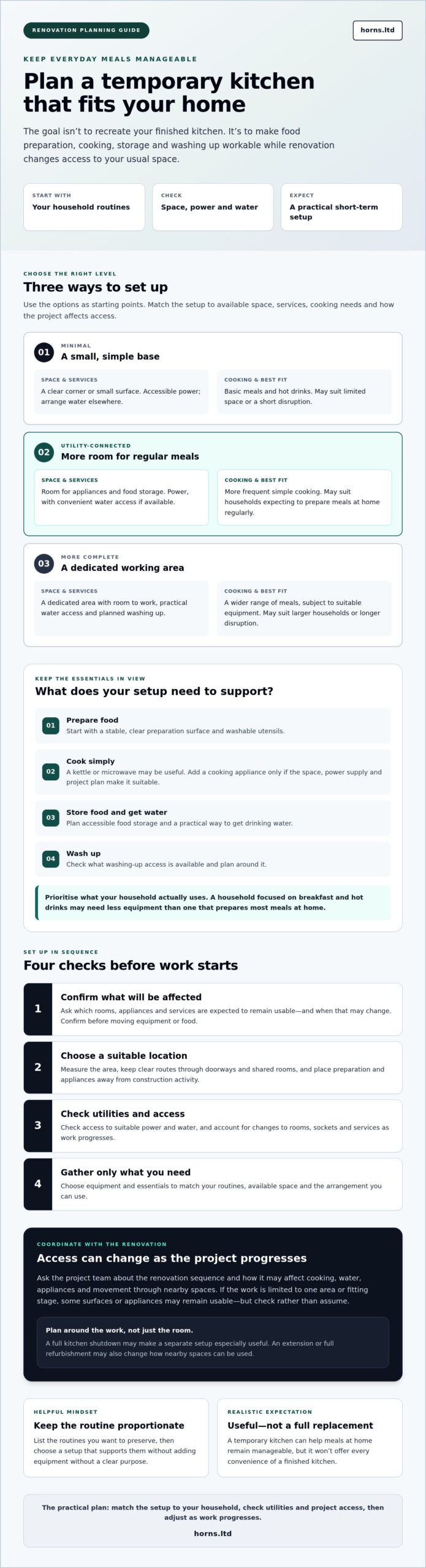
Choose a setup based on what your household needs to do, not the number of appliances you can fit in. A kettle and microwave may cover simple meals in a small space. Regular cooking, more people or a longer period without the main kitchen may call for additional storage and a suitable cooking appliance. The renovation plan matters too, since access to rooms, sockets and water can change as work progresses.
Use this comparison to identify a starting point, then check the details against your home and project schedule.
| Setup | Space needed | Services | Cooking capacity | Likely to suit |
|---|---|---|---|---|
| Minimal | A clear corner or small surface | Accessible power; water arranged elsewhere | Basic meals and hot drinks | Households with limited space or a short disruption |
| Utility-connected | Room for appliances and food storage | Power, with convenient water access if available | More frequent simple cooking | Households that expect to prepare meals at home regularly |
| More complete | A dedicated area with room to work | Power, practical water access and planned washing-up | A wider range of meals, subject to suitable equipment | Larger households or longer periods of kitchen disruption |
Which appliances and essentials are worth prioritising?
Begin with a stable preparation surface, washable utensils and accessible food storage. A kettle, microwave or compact refrigerator may be useful. Add a cooking appliance only if the space, power supply and project plan make it suitable. There’s no universal kit: a household that mainly needs quick breakfasts may not benefit from equipment intended for more involved cooking. For broader project considerations, see this guide to kitchen renovation planning in London.
How should you assess space, sockets, and water?
Measure the proposed area and keep clear routes through doorways and shared rooms. Place food preparation and appliances away from construction activity, and check that the setup won’t obstruct doors, walkways or everyday circulation. Note socket locations and the requirements of each appliance. If you’re unsure whether the electrical arrangement is suitable, ask a qualified electrician rather than relying on extension leads or assumptions.
Decide where drinking water will come from, how washing up will work and where waste will go. Don’t assume temporary plumbing is available. Confirm these arrangements with the project team, including any expected changes to access or utilities. If you’re planning kitchen work, discussing the project sequence with Horns Construction may help you identify what to confirm for your home.
Is a temporary kitchen practical? Compare the trade-offs
A temporary kitchen can make renovation easier to live through, but it won’t reproduce every convenience of a finished room. You may have fewer appliances, less worktop space and a narrower choice of meals. Washing up can take longer, and storing ingredients may mean making more trips to the fridge or another part of the home.
How practical a temporary kitchen is depends on the renovation’s duration, your household size and the services available. A short disruption with reliable power and nearby food storage may be manageable with a simple setup. A larger household facing extended disruption or interruptions to water and electricity may need a more flexible meal plan.
What are the advantages and limitations of cooking at home?
Cooking at home can preserve familiar routines and give you more choice over ingredients and mealtimes. You may also be able to use groceries already in the house, provided you have suitable storage and a safe way to prepare food. Simple meals made with a microwave or another appropriate appliance can help keep the arrangement manageable.
There are limits. Restricted preparation space can make even straightforward meals awkward, and having few appliances may narrow your options. Washing up may require a separate arrangement, adding time and effort. A temporary kitchen for during renovation work can be useful, but it won’t suit every household or project. Consider whether the setup supports the meals you expect to make, rather than assuming it will replace your usual kitchen.
When might another meal plan work better?
If space is extremely limited, essential services will be unavailable, or household care routines make improvised cooking difficult, relying on the temporary setup every day may not be realistic. Noise, building activity and the need to keep routes through the home clear can also affect where and when you can prepare food.
You don’t have to choose between cooking every meal at home and eating elsewhere throughout the renovation. A mixed approach may be more comfortable: prepare simple meals when safe access is available, and use takeaway or food prepared elsewhere at other times. Before work begins, ask the project team when cooking access or utilities may be interrupted. Plan an alternative for those periods, then adjust it as the work sequence becomes clearer.
How to set up a temporary kitchen before work starts
Set up your temporary kitchen before the main room becomes difficult to use. Coordinating with the renovation team can help you avoid moving appliances twice or putting food and equipment where building activity will interfere with them. For projects affecting several rooms, this guide to full home refurbishment planning offers wider context.
- Confirm the work area. Ask which parts of the kitchen will be inaccessible, when work is expected to affect utilities and whether access may change as the project progresses. If several rooms are involved, confirm how workers and materials will move through the home.
- Choose a suitable location. Find a clean, accessible area away from the active work zone and stored building materials. Check that appliances and supplies won’t block doorways, walkways or everyday household movement.
- Check utilities and appliance placement. Identify usable sockets and water access, and make sure the surface is stable and appropriate for your appliances. Follow each appliance’s instructions, allow for any ventilation it requires and keep equipment away from water and construction dust. Ask a qualified professional to assess electrical or plumbing arrangements if needed.
- Organise only the essentials. Move the food and equipment you expect to need during the disruption, rather than transferring the whole kitchen. Set aside basic cookware, utensils, cleaning supplies and frequently used pantry items. Agree how the household will share the space and handle daily cleanup.
Prepare the location and household essentials
Keep the arrangement simple and easy to maintain. A clear preparation surface, washable utensils and frequently used supplies can be more useful than crowding a spare room with rarely used items. Agree where food will be stored, when people can use the area and who will tidy it after meals. A shared plan helps prevent temporary equipment from spreading into routes everyone needs.
Keep appliance use and the work area safe
Place appliances on a stable surface and manage cables so they don’t trail across walkways or into the renovation zone. Don’t overload sockets or rely on extension leads that aren’t suitable for the appliance. Keep food, cables and equipment clear of dust, water and active building work, and stop using the area if it becomes unsafe or inaccessible.
If you’re planning kitchen fitting, discuss the work sequence with Horns Construction so you can plan around expected access and service changes.
Coordinate your temporary kitchen with the renovation team
A temporary kitchen only works as planned if it fits the project sequence. Access to cooking areas, water and appliances may change as kitchen fitting or wider renovation work progresses, so confirm the expected stages directly with the team. Treat dates and arrangements as project-specific, and ask how you’ll be told if the sequence changes.
Before work starts, make a simple household plan. Note which meals you can prepare during each stage, what you’ll do if a service is temporarily unavailable, and where essential food and equipment will be kept. This gives everyone a clear reference without assuming the same setup will remain practical throughout the work.
What should you confirm with your contractor?
Ask when the kitchen is expected to become inaccessible and when cooking, water or appliance access may change. Clarify which routes through the home must remain clear, including access for workers and materials, and agree how updates will be shared if plans shift. These details help you adjust meal preparation and household routines before a change disrupts them.
How can you make the transition back easier?
Keep essential kitchen items together until the main space is ready, rather than unpacking everything as soon as work appears complete. Before resuming normal use, confirm how cleaning, appliance reconnection and access will be handled. Ask the team to clarify when the kitchen is practically ready for everyday use, since timing and arrangements depend on the project.
Horns Construction offers kitchen fitting and residential renovation services, with project support from planning through completion. The team can discuss how kitchen work may affect access and sequencing. If you’re planning kitchen work in London, discuss your renovation plans with Horns Construction and confirm the practical arrangements for your home.
Make renovation planning work for everyday life
A well-planned temporary kitchen for during renovation work can help keep meals manageable, but the right arrangement depends on your home, household routines and the project sequence. Decide what you need to prepare, store and wash up, then confirm when access to the kitchen, water and appliances may change. A simple backup meal plan can help when routines are disrupted.
Horns Construction provides kitchen fitting, plumbing, electrical and full home refurbishment services. The company also brings over 20 years of experience in residential building work. Discussing the work sequence early can help you plan around project-specific access and service arrangements.
If you’re preparing for kitchen work in London, discuss your renovation plans with Horns Construction. Planning the practical arrangements in advance can help you approach the work with greater confidence and look forward to using your renewed kitchen.
Frequently Asked Questions
How do I set up a temporary kitchen during a renovation?
Start by confirming which rooms, services and appliances will remain available during the work. Choose a clean spot outside the active building area, then add only the equipment and utensils your household needs. Check appliance instructions and whether the available power is suitable. Decide where food will be stored and where washing up will happen. A temporary kitchen for during renovation work should also fit the project sequence, so confirm access changes with your renovation team.
What do you need in a temporary kitchen?
Most households need a stable preparation surface, drinking water, basic utensils and a practical way to store food. A kettle, microwave or compact refrigerator may help, but choose appliances only after checking their instructions, power needs and the space available. There’s no single essential kit for every home. Consider how long the main kitchen may be unavailable and which meals your household usually prepares before moving equipment.
Can you cook in a room while renovation work is happening?
You may be able to cook in a separate, suitable room if it is outside the active work zone and has appropriate services. Keep appliances and food away from dust, water and building activity, and leave walkways clear. Don’t assume a spare room is safe or has suitable power. Follow appliance instructions, agree boundaries and access with the renovation team, and ask a qualified electrician about concerns with the electrical setup.
Where should you put a temporary kitchen during a renovation?
Choose a clean, accessible area outside the work zone, with enough room to move safely and use the appliances you’ve selected. Before settling on a spot, consider socket locations, ventilation, water access and household traffic. In London homes where space may be constrained, check that the setup won’t block doorways or shared routes. Confirm access and practical arrangements with your project team before moving food or equipment.
How long will I need a temporary kitchen during renovation?
The duration depends on the scope of the work, its sequence and when access to the kitchen or its services is affected. A limited fitting stage may disrupt routines differently from a full kitchen refurbishment or wider home renovation. Ask your contractor which stages are likely to restrict use and how changes will be communicated. Treat any initial programme as project-specific, not as a guaranteed date, and adjust your meal plan as the work progresses.
Is it safe to use a microwave or kettle in a temporary kitchen?
It can be suitable if each appliance is used as instructed and the location has an appropriate power supply. Place appliances on a stable, dry surface away from dust, water and active building work, and keep cables clear of walkways. Don’t overload sockets or use an extension lead that isn’t suitable. If you’re unsure whether the electrical arrangement is appropriate, stop and ask a qualified electrician before using the appliance.
What can I eat when my kitchen is being renovated?
Choose simple meals that match the equipment, food storage and services you can safely access. Depending on the setup, you might prepare food with a microwave or kettle, or combine straightforward home meals with takeaway or meals prepared elsewhere. Keep the plan flexible in case water, power or room access changes. Before work begins, identify an alternative for periods when safe cooking access isn’t available, then adapt it to your household’s needs.