

Could a single omitted detail on a document be the difference between a seamless architectural transformation and a project that spirals into financial uncertainty? You’ve likely spent months envisioning the perfect West London extension, only to feel a wave of apprehension when that first multi-page PDF arrives. It’s natural to feel overwhelmed by technical jargon like ‘Provisional Sums’ or to worry about the hidden costs of London’s unique logistics, such as the £130.75 per tonne landfill tax or the rising fees for scaffolding permits.
Understanding exactly what to check on a builder’s quote is the only way to transform a vague estimate into a technical blueprint that guarantees a fixed-price agreement and a premium finish. You deserve a partnership built on transparency and meticulous planning, where every structural nuance is accounted for before the first brick is laid. This guide will show you how to dissect a construction quote with the precision of a master craftsman, ensuring your 2026 project follows CDM regulations and remains protected from the volatility of the current market. We’ll explore the essential elements of a professional quote, from VAT verification to the specific logistics of West London planning, giving you the confidence to sign a contract that protects your investment and your vision.
Key Takeaways
- Understand the vital distinction between a non-binding estimate and a fixed-price quote to secure the legal integrity of your architectural investment.
- Discover exactly what to check on a builder’s quote to ensure every material specification and labour cost reflects the uncompromising quality your London home deserves.
- Learn to structure milestone-based payment schedules that protect your capital by aligning financial outlays with verified physical progress on site.
- Identify the subtle red flags and tactical omissions in low-ball offers that often signal future disputes or hidden cost variations.
- Account for the intricate logistical demands of West London, including scaffolding permits and landfill taxes, to ensure your final price remains truly all-inclusive.
The Essential Distinction: Builder’s Estimate vs. Fixed Quote
In the delicate dance of high-end London renovation, the words we choose carry the weight of your investment. A verbal estimate is a fleeting shadow, a rough approximation that holds no legal standing and offers no sanctuary when project complexities arise. It’s often little more than an educated guess based on previous works, lacking the granular detail required for a sophisticated architectural transformation. For a homeowner, relying on a casual figure is a significant risk, as it allows costs to drift upward without a contractual ceiling.
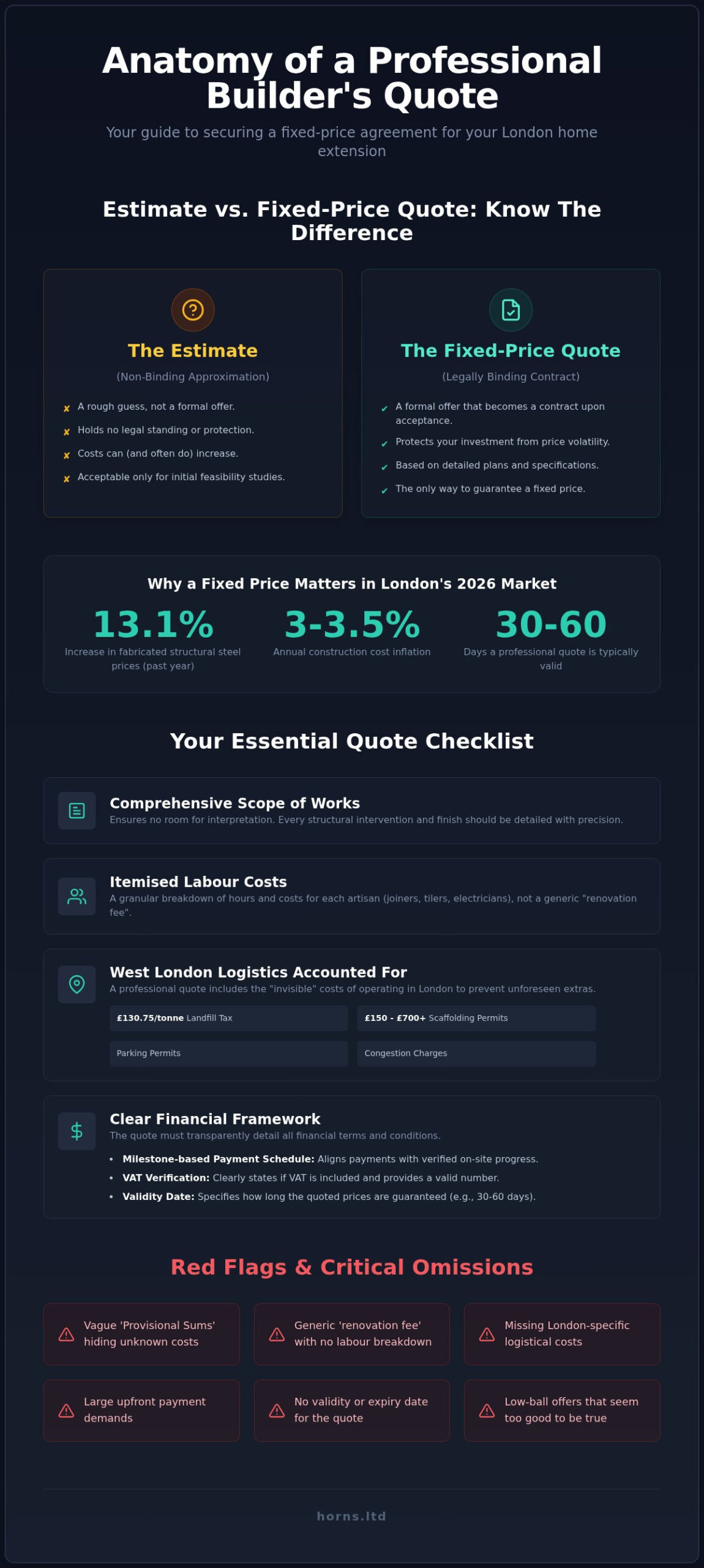
A professional quote is an entirely different instrument. It’s a formal offer that, once accepted, becomes a legally binding contract under UK law. While a Cost estimate serves as a useful starting point for initial conversations, it’s the fixed quote that protects your capital. In the current 2026 climate, where fabricated structural steel prices have risen by 13.1% in the past year alone, a fixed price agreement acts as a vital shield against material price volatility. It ensures that the builder, rather than the client, absorbs the impact of sudden market shifts once the document is signed.
What Constitutes a Legally Binding Quote?
When an Estimate is Acceptable (And When It’s Not)
Estimates have a place in the earliest stages of a project. They are helpful tools for initial feasibility studies or when you’re first conceptualising a home refurbishment. At this stage, you’re exploring possibilities rather than finalising blueprints. However, as the project matures into the “Discovery Phase,” a site survey becomes mandatory to uncover the hidden realities of your property’s skeleton.
For complex structural works, such as a bespoke house extension, an estimate is dangerously insufficient. These projects demand a professional tender based on full architectural drawings and structural engineer calculations. Transitioning from a ballpark figure to a detailed quote is the moment your vision gains the protection of professional accountability, ensuring the final result matches the uncompromising standards of your lifestyle.
Evaluating the Scope: Materials, Labour, and London Logistics
A premium construction quote is far more than a simple price list; it’s an architectural manifest that mirrors the technical complexity of your vision. When you’re determining what to check on a builder’s quote, the itemisation of labour must be your first priority. You should expect to see a granular breakdown of every artisan involved in the transformation. This includes the precise allocation of hours for master joiners, expert tilers, and specialised bathroom fitters. Without this level of detail, you risk paying a generic “renovation fee” that masks the actual cost of high-tier talent and craftsmanship.
The logistical landscape of London in 2026 presents unique financial pressures that a standard quote often overlooks. A truly comprehensive document must account for the “invisible” costs of operating in West London. This includes the £130.75 per tonne landfill tax for waste removal and the varying fees for scaffolding pavement licences, which can range from £150 to over £700 depending on the borough. If your quote fails to mention parking permits for tradesmen or congestion charges, these will inevitably surface as stressful “unforeseen extras” mid-project. A builder who understands the local terrain will include these as standard, protecting you from bureaucratic surprises.
Material Transparency and Prime Cost Sums
Vague descriptions like “standard finish” or “good quality” have no place in a high-end contract. Every material, from the grade of insulation to the specific structural joists, should be explicitly listed. For bespoke elements such as a kitchen renovation, builders often use Prime Cost (PC) Sums. This is a fixed allowance for items that haven’t been finalised yet. It’s vital to ensure these sums are realistic. If a PC Sum for kitchen units is set too low, it won’t cover the premium brands and custom cabinetry your aesthetic demands, leading to a significant budget deficit later on.
Compliance, CDM 2015, and Insurance
Your safety and legal protection are non-negotiable. A professional quote must confirm that the project will be managed in accordance with CDM 2015 (Construction Design and Management) regulations. You must also verify that the builder carries a minimum of £5 million in Public Liability insurance, though many premium London firms now carry £10 million as standard to reflect property values. Finally, check if Building Control fees are included. These are often separate costs paid directly to the local authority or an approved inspector, and clarity here ensures your financial planning remains impeccable. If you value this level of technical fidelity, partnering with a dedicated team at Horns Construction ensures every detail is captured before the first brick is laid.
The Financial Framework: Payment Schedules and VAT Clarity
A builder’s quote is a financial covenant that governs the rhythm of your project. Beyond the total figure, the architecture of the payment schedule is what to check on a builder’s quote to ensure your capital remains protected. In the refined world of London property, a quote should never be an invitation for a builder to use your funds as an interest-free loan. Transparency in cash flow is the hallmark of a professional partnership; it ensures that every pound released is a direct reflection of tangible value added to your home.
VAT clarity is a non-negotiable pillar of this framework. With the standard VAT rate for residential renovations remaining at 20% in 2026, failing to confirm whether a quote is ‘Inclusive’ or ‘Exclusive’ of tax can lead to a devastating 20% budget deficit. It’s also vital to verify the builder’s VAT registration status, particularly if their turnover exceeds the £90,000 threshold. For those restoring properties that have stood empty for over two years, ensure your quote reflects the reduced 5% rate, as this represents a significant saving that should be passed directly to you.
Defining a Fair Payment Schedule
A balanced schedule avoids the peril of large upfront deposits. While a 10% to 25% initial payment is standard for mobilisation and the procurement of bespoke materials, anything higher should be viewed with caution. Instead, payments must be tied to physical milestones that signify real progress on site. A premium schedule typically includes stages such as:
- Mobilisation: Procurement of structural materials and site setup.
- Structural Completion: Often termed “roof-tight” for extensions or loft conversions.
- First Fix: Completion of internal plumbing and electrical cabling.
- Second Fix and Snagging: Final installation of fixtures and aesthetic finishes.
You should also look for a retention fee, usually between 2.5% and 5% of the total project value. This sum is held back until the final “snagging” list is completed to your satisfaction, providing a vital incentive for the builder to maintain their artistic standards until the very last day.
Provisional Sums: The Budget Buffer
In complex London refurbishments, certain costs cannot be locked down until the building’s hidden layers are peeled away. This is where ‘Provisional Sums’ appear. A Provisional Sum is a ‘best-guess’ allowance for work that cannot be fully priced until the site is opened. While legitimate for groundworks or unknown structural repairs, these sums must be carefully managed. A professional builder will provide a realistic allowance rather than a low-ball figure, and you should always request a cap or a defined process for how these costs will be finalised to prevent quiet budget creep.
Identifying Red Flags and Omissions in Construction Quotes
A bargain in the world of high-end London architecture is often a siren song leading to structural and financial compromise. When you’re assessing what to check on a builder’s quote, a price that sits significantly below the market average shouldn’t be viewed as a saving, but as a strategic omission. This “low-balling” technique is a common industry tactic where a builder provides an artificially thin scope of work, only to introduce a cascade of “variations” once your home is already dismantled. True value lies in a quote that respects the technical reality of the project, not one that hides costs to secure a signature.
Vague language is the primary weapon of an unprofessional contractor. Terms like “making good” or “basic finish” are dangerously subjective and almost certainly lead to disputes. To a master craftsman, “making good” involves seamless structural integration and museum-grade plastering; to a budget builder, it might mean a hasty layer of filler. Without a defined programme or timeline, a quote is merely a list of intentions. A professional document must outline the sequence of works, ensuring you aren’t left with a dormant site and an open-ended completion date.
Commonly Forgotten Line Items
The integrity of a project is often found in the “invisibles” that less experienced builders fail to mention. Meticulous waste management is a prime example. With the 2026 landfill tax set at £130.75 per tonne, the removal of heavy masonry and soil is a significant financial undertaking. If skips, wait-and-load services, or hazardous waste disposal aren’t explicitly listed, you’ll likely face these costs as unexpected extras. Similarly, temporary works are vital for protecting your lifestyle and property. A premium quote will include specific provisions for:
- Temporary Works: Dust screening and heavy-duty protection for existing flooring.
- Professional Fees: Allowances for structural engineer calculations or party wall surveys if not already handled.
- Site Welfare: Provisions for site toilets and secure tool storage, particularly in restricted West London plots.
The Red Flag Checklist
Professionalism is reflected in the medium as much as the message. A quote delivered on a single sheet of paper or via a casual WhatsApp message suggests a lack of administrative rigour that will inevitably translate to the building site. You must also verify the builder’s VAT registration number, especially if the project value suggests a turnover above the £90,000 threshold. Refusal to provide insurance certificates, specifically Public Liability and Employers’ Liability, is a non-negotiable deal-breaker. Finally, look for a “Defects Liability Period.” A builder who doesn’t offer a formal six to twelve-month snagging warranty isn’t standing behind the longevity of their work. If you’re seeking a partner who prioritises transparency and technical excellence, request a comprehensive, fixed-price quote from Horns Construction today.
Beyond the Paper: Choosing a Partner for Your London Renovation
A builder’s quote is a silent testament to their operational philosophy. When you’re determining what to check on a builder’s quote, look past the final sum to the very structure of the document itself. A meticulously itemised tender suggests a partner who values technical hűség and engineering precision. Conversely, a sparse or fragmented document often mirrors a chaotic site presence. In the high-stakes environment of West London, where architectural complexity is the standard, choosing a construction company with a proven local track record ensures that the unique challenges of the borough’s heritage and logistics are already woven into the financial fabric of the project.
The Horns Construction Quoting Process
At Horns Construction, we believe that transparency is the foundation of artistic excellence. Our process begins with an exhaustive site survey and structural feasibility check, ensuring that your vision is grounded in engineering reality from the outset. Unlike traditional models where the architect and builder operate in silos, our integrated design-build approach ensures that every architectural nuance is priced with absolute fidelity. This comprehensive method eliminates the “unknowns” that often plague luxury renovations, providing you with a fixed-price agreement that respects both your investment and your aesthetic aspirations.
Next Steps for Your Project
When you sit down to compare three quotes, ensure you are evaluating them “apples-for-apples.” Verify that each builder has accounted for the same grade of materials and the same logistical overheads, such as the 2026 landfill taxes and parking permits, which we’ve detailed in previous sections. Before committing your signature, ask your builder how they manage site safety under current regulations and who will be your dedicated point of contact. If you’re ready to move beyond guesswork and secure a definitive, itemised plan for your home, we invite you to book a consultation for a professional quote that reflects the uncompromising standards of your West London property.
Securing Your Architectural Legacy with Precision
A builder’s quote is far more than a financial document; it’s a technical manifesto and a roadmap for your home’s transformation. By mastering what to check on a builder’s quote, you’ve equipped yourself to distinguish between a vague estimate and a legally binding commitment that protects your capital from market volatility. You now understand that true value lies in the meticulous itemisation of master craftsmanship and the explicit inclusion of West London’s specific logistical demands, from skip permits to landfill taxes. These details aren’t just numbers; they’re the foundation of a project defined by integrity rather than compromise.
With over 20 years of expertise in premium extensions and loft conversions, Horns Construction remains dedicated to the art of transparent building. Our milestone-based payment structures ensure your project moves with a dignified rhythm, where every pound released reflects tangible, high-end progress. We invite you to Request a Detailed, Fixed-Price Quote from Horns Construction to begin your journey toward a flawlessly executed home. Your vision deserves a partner who values perfection and technical hűség as much as you do. Let’s create something timeless together.
Frequently Asked Questions
What is the difference between a quote and an estimate in the UK?
A quote is a definitive, legally binding offer that becomes a fixed contract price once accepted. An estimate is merely an educated guess that holds no legal weight and is subject to change as the project evolves. When determining what to check on a builder’s quote, the presence of a “fixed price” guarantee is the most vital distinction for securing your architectural investment against future fluctuations.
Should a builder’s quote include VAT?
A professional document must explicitly state whether the figures are inclusive or exclusive of VAT. For most residential renovations in 2026, the standard rate is 20%, though properties vacant for over two years may qualify for a reduced 5% rate. If a builder omits this detail and they are registered, you could face an unexpected 20% increase in your final bill once the works are completed.
How much deposit should I pay a builder before work starts?
A fair deposit for mobilisation and the procurement of bespoke materials typically ranges between 10% and 25% of the total project value. You should be cautious of builders who demand higher upfront sums without tying them to specific procurement milestones. Milestone-based payments ensure that subsequent funds are only released as tangible progress is verified on your property, protecting your capital throughout the build.
What are ‘Provisional Sums’ in a building contract?
Provisional Sums are best-guess allowances for specific project elements that cannot be fully priced until the site is opened or structural layers are revealed. These are often legitimate for groundworks or hidden repairs in heritage London properties. However, a transparent builder will provide a realistic figure based on experience rather than a low-ball allowance that inevitably leads to quiet budget creep as the project matures.
How many quotes should I get for a home extension in London?
Requesting three detailed quotes is the industry standard for a sophisticated home extension. This allows you to evaluate each professional “apples-for-apples” while avoiding the administrative burden of managing too many tenders. Focus on the depth of the itemisation and the builder’s familiarity with West London’s unique logistical constraints rather than simply choosing the professional with the lowest bottom-line figure.
What happens if a builder goes over their original quote?
If you have secured a fixed-price quote, the builder is contractually bound to that figure unless you request a change in the scope of work. Unforeseen structural issues discovered after the site is opened may lead to legitimate variations, but these must be agreed upon in writing before any work proceeds. This protection is precisely why knowing what to check on a builder’s quote is essential for your peace of mind.
Does a builder’s quote include skip hire and waste removal?
A comprehensive quote should include skip hire and waste removal as standard, itemised line items. With the 2026 landfill tax set at £130.75 per tonne, these costs are substantial and must be accounted for from the outset. Ensure your quote also covers London-specific logistics, such as the varying borough fees for placing skips on public pavements or the use of specialised wait-and-load services.
How long is a builder’s quote usually valid for in 2026?
Most premium builders guarantee their pricing for a period of 30 to 60 days. In the current economic climate, construction cost inflation in London is forecast at 3% to 3.5% for 2026, driven largely by persistent labour shortages. A validity date protects the builder from rising material costs while giving you a defined window to finalise your architectural plans and secure your project financing.