

What if the most beautifully presented portfolio in your inbox is actually the greatest hidden risk to your period property’s structural soul? In a city where architectural heritage meets a tightening 2026 regulatory environment, the stakes of vetting a construction company in london have never been higher. You’ve likely felt that unsettling knot of anxiety when considering the potential for project abandonment or the subtle, relentless creep of a budget. It’s a valid concern. Your home is an intimate expression of your lifestyle, a sanctuary that demands more than just a standard contractor.
This guide provides the exact, multi-layered framework you need to identify and verify a premium builder who treats your vision with the reverence it deserves. We’ll navigate the complexities of the 1 October 2026 Building Safety Levy and the latest competence requirements of the Building Safety Act. By the end, you’ll possess the clarity to move past the noise. You’ll be ready to secure a partnership that delivers your project to the highest architectural standards and provides lasting peace of mind for years to come.
Key Takeaways
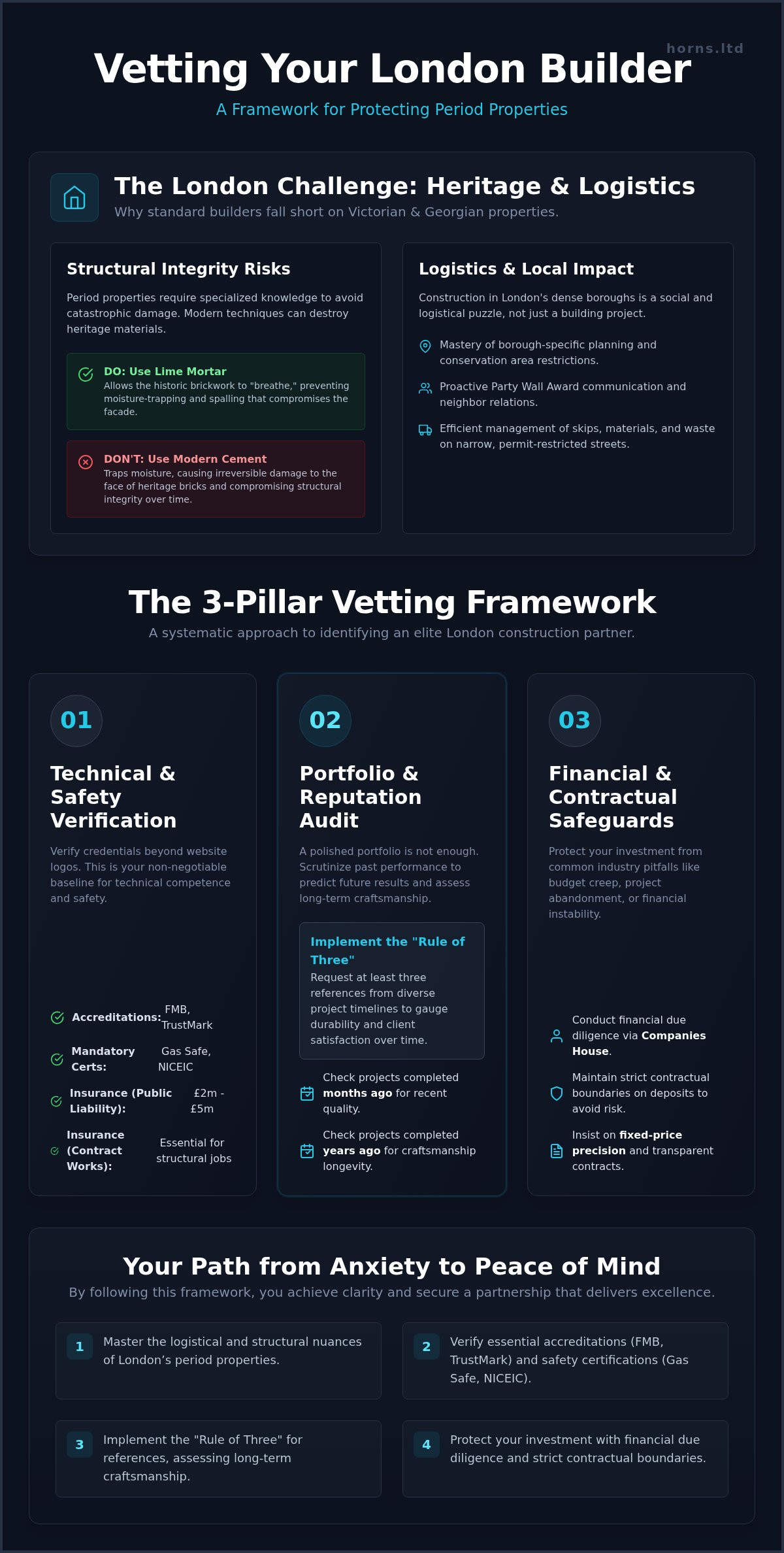
- Master the logistical and structural nuances of London’s Victorian and Georgian properties to ensure your builder possesses the specialized expertise required for heritage conservation.
- Verify essential accreditations such as FMB and TrustMark, alongside mandatory safety certifications like Gas Safe and NICEIC, to guarantee technical fidelity.
- Implement a rigorous “Rule of Three” when vetting a construction company in london, requesting references from projects completed months and years ago to assess long-term craftsmanship.
- Protect your investment by conducting financial due diligence via Companies House and maintaining strict contractual boundaries on deposits to avoid common industry pitfalls.
- Transition from anxiety to peace of mind by partnering with a specialist who integrates transparency and fixed-price precision into every stage of your home’s transformation.
The Unique Challenges of Construction Vetting in London
London is far more than a collection of postcodes. It is a living, breathing museum of architectural evolution where every street presents a distinct set of technical hurdles. From the grand stucco-fronted terraces of Kensington to the red-brick Victorian villas of Ealing, the city’s housing stock demands a level of reverence that a standard “general builder” simply cannot provide. When you begin the process of vetting a construction company in london, you aren’t merely looking for a contractor; you’re seeking a steward for a historical asset. Each of the 32 boroughs operates with its own specific planning nuances and conservation area restrictions, making local experience a non-negotiable requirement for a project that remains on schedule and within the bounds of the law.
Period Property Risks and Structural Integrity
Victorian and Georgian terraces were never intended for the expansive, open-plan living we desire in 2026. Carving out a modern kitchen or executing a sophisticated loft conversion involves complex steel-to-timber connections that must respect the building’s original load-bearing logic. A premium builder understands that using modern cement on heritage brickwork is a catastrophic mistake. It traps moisture and causes the face of the brick to spall, eventually compromising the facade. Instead, true specialists insist on traditional lime mortar, allowing the structure to breathe as it has for over a century. Ensuring your contractor maintains these heritage standards while strictly adhering to UK Building Regulations is the hallmark of a professional who prioritizes longevity over a quick finish.
Logistics and Local Impact Management
In high-density enclaves like Chiswick or Fulham, the construction site doesn’t exist in a vacuum. It’s a temporary guest in a close-knit neighborhood where space is at a premium. Vetting a construction company in london requires a deep dive into their logistical maturity. You must assess their ability to manage skip placements on narrow, permit-restricted streets without alienating the community. The most refined firms treat noise and dust management as a core technical discipline rather than an afterthought. They recognize that a proactive communication strategy regarding Party Wall Awards and site cleanliness is vital. Preserving your reputation with your neighbors is just as important as the precision of the joinery being installed inside your home. A specialist firm with 20 years of local experience doesn’t just build; they manage the delicate social and physical environment of the London streetscape.
Verifying Technical Credentials and Mandatory Accreditations
Technical fidelity is the invisible foundation of a premium renovation. When vetting a construction company in london, you’re looking for more than a collection of logos on a website. You’re seeking a verifiable commitment to accountability. The “Big Three” accreditations—the Federation of Master Builders (FMB), TrustMark, and the National Association of Building Contractors (NABC)—represent a builder’s willingness to undergo independent inspection and financial scrutiny. These aren’t just subscriptions; they’re rigorous benchmarks that protect your investment against the industry’s common pitfalls. A builder who operates without these credentials is asking you to carry the entirety of the risk on your own shoulders.
Beyond the aesthetic finish, safety is a non-negotiable technical requirement. Gas Safe registration and NICEIC certification for electrical work are mandatory legal standards. Equally critical is the firm’s insurance profile. A reputable London builder must carry Public Liability and Employer’s Liability insurance with limits between £2m and £5m to reflect the high-value nature of metropolitan real estate. For complex structural alterations, ensure they possess “Contract Works” or “All Risks” insurance. This specific coverage protects both the existing period fabric of your home and the new works in progress, providing a safety net that standard policies often lack.
How to Use Official Registers for Verification
Don’t take a contractor’s word at face value. Use the FMB “Find a Builder” database to confirm active, current membership. You should also verify individual qualifications for site leads, such as NVQs or CSCS cards, which prove the craftsmen on your property possess the requisite technical mastery. Cross-referencing Gas Safe ID numbers against the business registration is a vital step, much like the advice from Bromley Council suggests for ensuring homeowner security. If you value a partner who welcomes this level of scrutiny, consider how our full home refurbishment process prioritizes technical fidelity from the very first meeting.
CDM 2015 Regulations and Homeowner Responsibility
Many homeowners are unaware that under the Construction (Design and Management) Regulations 2015, they hold specific legal duties to ensure their project is managed safely. A professional builder will alleviate this burden by providing a comprehensive Health and Safety file and site-specific risk assessments. They must present a clear “Construction Phase Plan” before any work begins on your property. This document isn’t mere paperwork; it’s a blueprint for safety that details exactly how structural risks, noise, and dust will be mitigated. A builder who cannot produce this plan is not just cutting corners; they’re exposing you to significant legal and physical risk.
Auditing Portfolio and Reputation: Beyond the Star Rating
A digital portfolio is a curated narrative, often masking the complexities of the actual build. When you’re vetting a construction company in london, you must look past the high-resolution renders and “staged” final shots that dominate social media. True quality reveals itself in the years following completion, not just the day the photos are taken. I recommend the “Rule of Three” for references. Ask to speak with clients from six months ago to judge the recent team performance; two years ago to see how the finish has aged; and five years ago to verify structural maturity. A builder who can provide a client from half a decade ago is one who has nothing to hide regarding their long-term technical fidelity, a philosophy shared by high-end firms like Vancouver Custom Homes that specialize in bespoke residential developments.
Digital reviews can be manipulated, but patterns are harder to hide. Look for recurring themes in the critiques rather than isolated incidents. A single delay might be an outlier, but a pattern of payment disputes or “budget creep” indicates a structural failure in the business itself. While the Common Minimum Standards for Construction provide a baseline for public works, you should expect even higher benchmarks for your private residence. A premium builder’s reputation is built on the silent recommendation of a project that remains flawless years after the scaffolding has come down.
Conducting an Effective Reference Call
When you speak to a previous client, move beyond generalities. Ask specifically if the final invoice matched the initial quote, excluding your own design changes. Inquire about the builder’s responsiveness when things inevitably went wrong. Every project has challenges; the mark of a premium firm is how they resolve them. Did they handle the snagging process with the same enthusiasm as the initial demolition? A builder who disappears once the final large payment is made is not a partner you want for a period property refurbishment. You’re looking for a firm that views aftercare as a core part of their service, not a burden.
The Live Site Inspection Checklist
A live site is a window into a company’s soul. Visit an active project in an area like Chiswick or Ealing to observe the team in their natural environment. Look for site organization: are materials stored efficiently or scattered across the pavement? Checking for proper scaffolding safety and material storage efficiency is vital. Observe the team culture. Is there a dedicated project manager present, or is the site run by a “hands-on” owner who is spread too thin? Professional attire and punctuality on a London residential site aren’t just about optics. They indicate a disciplined culture that respects your home and your time.
Financial Due Diligence and Contractual Safety
Financial health is the silent architect of project stability. When vetting a construction company in london, you must move beyond the aesthetic surface and examine the business’s structural integrity with the same rigour you would apply to a structural survey. Start your investigation at Companies House. A company that has operated under the same registration for a decade or more demonstrates a resilience that new, unproven entities lack. Be particularly wary of “phoenixing,” the practice of dissolving a company to escape debts only to rise again under a nearly identical name. This is a significant red flag that suggests a fundamental lack of accountability and professional ethics—principles that define the operations of leading firms like Black Bear Construction.
Your contract should be a shield, not a mere formality. Insist on using standard industry agreements such as the Joint Contracts Tribunal (JCT) or the Federation of Master Builders (FMB) contracts. These documents provide a balanced legal framework that protects both parties. A critical component of this is the payment schedule. You shouldn’t pay more than 10-15% as an initial deposit. Subsequent payments must be tied to verifiable site milestones, ensuring you only pay for work that is physically present. Include a “Retention” clause, typically 2.5-5% of the total project value, to be held back until the final snagging is completed to your absolute satisfaction.
Analysing Quote Transparency
A premium builder provides a fixed-price quote rather than a vague estimate. An estimate is a moving target; a quote is a contractual commitment. Review the document for “Prime Cost” (PC) sums and “Provisional Sums.” While sometimes necessary for unknown elements in period properties, an overabundance of these allows for significant budget creep. Ensure VAT is clearly itemized and that the business is VAT-registered. This financial clarity is essential for Mastering Home Refurbishment in London and maintaining control over your investment through every phase of the build.
Insurance-Backed Guarantees (IBGs)
The promise of a ten-year guarantee is only as strong as the company making it. If a builder ceases trading, their personal guarantee vanishes instantly. An Insurance-Backed Guarantee (IBG) is different. It’s an independent policy that honours the warranty even if the contractor is no longer in business. Verify the provider and the duration of the cover to ensure your home remains protected through the decades. If you are seeking a partner who values this level of financial transparency, our West London refurbishment specialists are ready to provide the rigorous documentation your project deserves.
Partnering with a Vetted Specialist: The Horns Construction Standard
Vetting a construction company in london is often perceived as a defensive necessity, yet at Horns Construction, we view it as the beginning of a collaborative masterpiece. Transparency isn’t merely a policy; it’s woven into the very fabric of our initial consultations. We don’t just present a portfolio; we invite you to scrutinize our technical lineage and the precision of our previous works. With over 20 years of experience in the London residential market, our firm has navigated the evolution of building standards while remaining steadfast in our commitment to structural excellence. Our design-to-completion service ensures that your vetting process covers both the architectural vision and the manual precision required to execute it. This integrated approach eliminates the friction between design and reality, providing a seamless transition from concept to completion.
In an era of fluctuating material costs and economic shifts, our fixed-price transparency serves as a sanctuary of financial certainty. We believe that a premium home refurbishment shouldn’t be subject to the whims of construction inflation. By providing a definitive project breakdown from the outset, we absorb the operational risks that often plague less experienced contractors. This model isn’t just about numbers. It’s about the peace of mind that comes from knowing your vision is protected by a firm with the operational scale and historical longevity to deliver on its promises. We treat every project as a unique work of art, demanding a level of dedication that transcends the standard builder-client relationship.
Our Presence in West London
Our deep-rooted expertise in West London allows us to navigate the specific planning nuances of boroughs like Hammersmith and Fulham with effortless precision. We have curated a legacy of successful House Extensions in London, where heritage preservation meets contemporary innovation. This local knowledge extends beyond planning departments to our exclusive network of vetted trade specialists and structural engineers. Whether it’s a Victorian terrace in Chiswick or a period villa in Ealing, we understand the soul of the building and the regulatory landscape that governs its transformation. Our presence in these affluent residential enclaves is a testament to our ability to manage complex logistics while maintaining the highest standards of site etiquette.
The Next Steps in Your Vetting Journey
The path to a transformed home begins with a conversation rooted in technical fidelity and aesthetic aspiration. We encourage you to request a comprehensive project breakdown that details every phase of our craftsmanship. To truly appreciate the Horns standard, we invite you to arrange a visit to one of our active Kitchen Renovation London projects. Witnessing our team’s discipline and the site’s organization firsthand will provide the final layer of confidence you require. When you’re ready to elevate your living environment to a premium architectural standard, Book a Consultation with Horns Construction and experience a partnership defined by uncompromising quality.
Securing the Architectural Future of Your Period Home
Vetting a construction company in london is the most significant investment you’ll make before the first brick is ever laid. By prioritizing technical fidelity through rigorous accreditation checks and demanding the transparency of a fixed-price contract, you transform a potential risk into a controlled, artistic process. True craftsmanship is always validated by the passage of time; look for builders who offer references spanning years, not just months. This meticulous approach ensures that your home’s evolution is handled with the reverence it deserves.
Horns Construction brings over 20 years of London residential experience to every project we undertake. We operate as dedicated specialists in period property refurbishments, ensuring the structural soul of your home is preserved with modern engineering precision. Our commitment to your peace of mind is absolute, supported by comprehensive JCT contracts and full insurance indemnity that reflect our professional scale. Your vision demands a partner who welcomes scrutiny and delivers excellence without exception.
When you’re ready to move beyond uncertainty and begin your home’s transformation, book a professional site survey and consultation with Horns Construction. Your project deserves the stewardship of a team that refuses to compromise on quality. Let’s create something timeless together.
Frequently Asked Questions
What is the single most important document to check when vetting a London builder?
A signed JCT or FMB standard contract is the most critical document because it provides the legal framework for your entire architectural journey. It defines the scope, payment milestones, and dispute resolution processes with a level of precision that protects your investment. Without this formal shield, you lack a verifiable defense against budget creep or project abandonment, leaving your home’s structural integrity to chance.
How can I tell if a construction company’s reviews are fake or manipulated?
Fake reviews often share a suspicious lack of technical detail or appear in sudden clusters within a short timeframe. Genuine feedback usually describes specific challenges, the team’s problem-solving abilities, or the nuances of the period property’s transformation. If every review reads like a generic marketing brochure without mentioning real-world construction progress, it’s a significant red flag in your process of vetting a construction company in london.
Is it normal for a construction company to ask for a large deposit upfront?
It’s not normal for a reputable firm to request more than 10-15% of the total project value as an initial deposit. Large upfront payments often indicate that a builder is using your funds to bridge the financial gaps of a previous client’s project. Professional firms maintain the liquid capital required to initiate work and only request subsequent payments as verifiable milestones are physically achieved on your site.
What should I do if a builder isn’t registered with the Federation of Master Builders (FMB)?
If a builder isn’t FMB-registered, you must verify their membership in other elite bodies such as TrustMark or the NABC. These organizations conduct the independent site inspections that ensure technical fidelity and craftsmanship. If they lack any major accreditation, you should demand a deeper dive into their structural history and current insurance indemnity limits to ensure they meet the 2026 standards for premium London builds.
How do I verify if a construction company has sufficient insurance for a London loft conversion?
You must request a current insurance certificate and specifically check for “All Risks” or “Contract Works” coverage. Standard Public Liability is often insufficient for a loft conversion, as it may not cover damage to the existing period structure during the structural alterations. A premium builder will gladly provide their broker’s contact details so you can verify their current indemnity limits and policy exclusions directly.
What are the warning signs of a ‘cowboy builder’ during the quoting stage?
Warning signs during the quoting stage include a refusal to provide a fixed-price breakdown or a preference for “cash-in-hand” arrangements to avoid VAT. A quote that is significantly lower than competitors usually suggests they’ve omitted essential structural elements or heritage materials. This lack of transparency is a primary indicator that the firm lacks the professionalism required for a high-end, high-stakes London refurbishment.
Can I vet a construction company by visiting their previous projects in person?
Visiting a previous project is an essential step in vetting a construction company in london. It allows you to see the reality behind the curated portfolio photos and observe the team’s site discipline in a real-world environment. Pay close attention to the quality of the joinery and the builder’s commitment to site organization, as these details reveal their true dedication to an uncompromising architectural finish.
How does the Party Wall Act affect which builder I should hire in London?
The Party Wall Act requires a builder who is proficient in managing the delicate legal and structural logistics of working near neighboring boundaries in high-density areas. You should hire a firm that has a proven strategy for coordinating with Party Wall surveyors and neighbors. Their ability to document the condition of adjacent properties and minimize vibration is vital for maintaining the social and physical harmony of your street.