
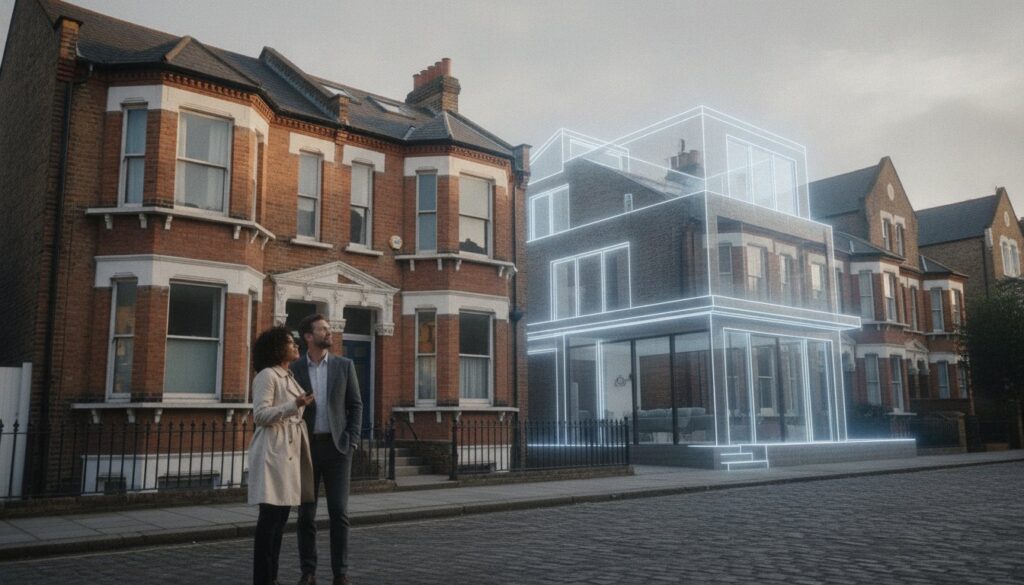
Would you willingly gift the Treasury over £46,000 in Stamp Duty just for the right to change your postcode, or would you rather channel that capital into a masterfully crafted extension that elevates your daily life? In the current 2026 market, the cost of moving vs extending in london has become a pivotal question for the discerning homeowner who refuses to compromise on quality or location. You likely feel a deep connection to your neighborhood, yet the walls of your current residence may no longer accommodate your evolving aspirations. It’s a common dilemma where the desire for more space meets the exhausting reality of property chains and exorbitant transaction fees.
This strategic guide offers a sophisticated comparison between the dead costs of relocation and the investment costs of bespoke home enhancement. You’ll discover how a meticulously designed loft conversion or a light-filled kitchen extension can serve as a canvas for your personal style while significantly compounding your property’s value. We provide a clear decision-making framework to help you evaluate the financial nuances of 2026, ensuring your next move is one of architectural legacy rather than mere transactional necessity.
Key Takeaways
- Identify the “dead costs” of relocation, such as the 2026 Stamp Duty rates, which provide no return on your capital compared to home investment.
- Gain a precise financial framework to analyze the cost of moving vs extending in london, allowing you to distinguish between non-recoverable expenses and equity-building improvements.
- Explore why London’s scarcity of premium properties makes a bespoke house extension a more strategic choice for preserving community ties while expanding your living space.
- Learn how to leverage the “price per square metre” advantage in London’s most sought-after postcodes through high-quality loft conversions and kitchen refurbishments.
- Use our two-step audit to calculate your home’s equity potential “as is” versus “extended,” providing total clarity for your 2026 property strategy.
The Financial Reality of Moving in London: Calculating the Dead Costs
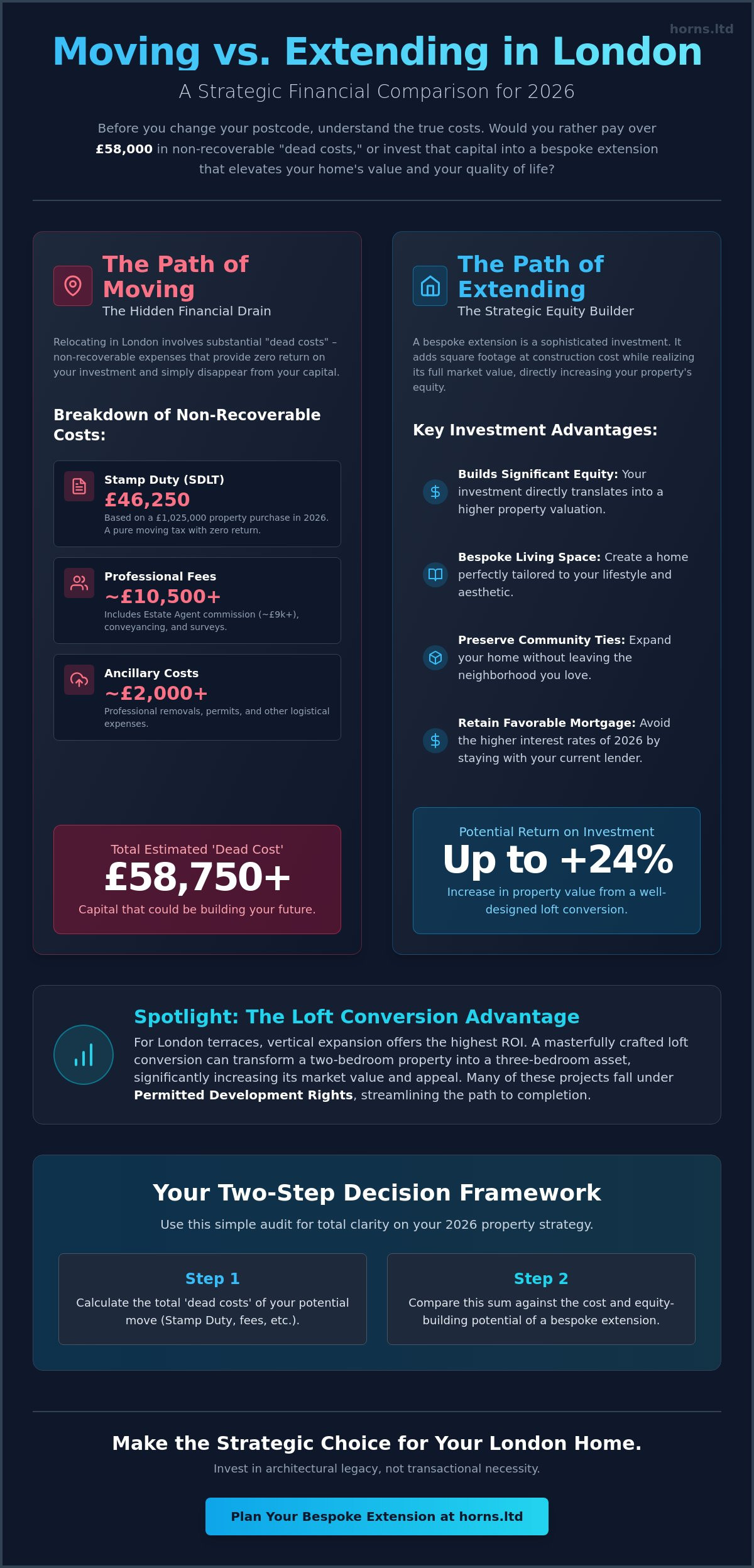
Relocating within the capital often feels like a fresh start, yet the financial mechanics behind the transition tell a more sobering story. When we examine the cost of moving vs extending in london, we must first confront the “dead cost” trap. These are the non-recoverable expenditures that vanish into the ether of taxes and fees, leaving no trace on your property’s equity or your family’s quality of life. For a median London home, these exit and entry costs can easily consume a significant portion of your hard-earned capital. It’s money that simply disappears.
Professional fees alone represent a quiet erosion of wealth. Estate agent commissions, typically hovering around 1.5% of the sale price, can claim over £9,000 from a modest £640,000 residence; to understand how these charges are structured, you can learn more about Commission-based residential property sales and property management fees. When you add conveyancing, surveys at approximately £1,500, and mortgage arrangement fees, the total becomes a heavy anchor. These aren’t investments in your future. They’re the price of admission to a new postcode. The stress of managing these transactions often outweighs the perceived benefit of the move.
The Stamp Duty Thresholds of 2026
The 2026 Stamp Duty Land Tax (SDLT) regime remains the most formidable barrier for those seeking more space. For a move to a property valued at £1,025,000, the tax bill alone reaches a staggering £46,250. This is a pure “moving tax” that offers zero return. It’s a psychological burden that many homeowners find difficult to justify. Why gift such a vast sum to the Treasury when that same capital could fund high-specification Loft conversions in the United Kingdom or a bespoke kitchen extension? In London’s premium brackets, the cost to exit your current home often eclipses the cost of a transformative refurbishment.
Ancillary Moving Expenses: Removals and Re-decorating
Logistics in London present their own expensive theatre. From professional removal teams costing around £2,000 to the hidden dance of parking permits and congestion charges, the move itself is a drain. Once the keys are in hand, the “New Home Tax” begins. Every new residence demands immediate secondary spending on curtains, flooring, or minor repairs to suit your aesthetic. It’s rarely a true upgrade. Often, it’s a lateral step that leaves you financially leaner. The cost of moving vs extending in london reveals that while moving is a transaction, extending is a creation. You’re not just buying space; you’re crafting it to your exact standards.
The Investment Logic of Extending: Building Equity in London
While relocation drains your capital through taxes, a bespoke house extension functions as a sophisticated financial instrument. In London’s premium postcodes, the price per square metre can reach dizzying heights, often far exceeding the actual cost of construction. By choosing to build rather than buy, you’re essentially purchasing additional square footage at wholesale construction rates and immediately realizing retail market value. This arbitrage is the cornerstone of London property wealth. When you weigh the cost of moving vs extending in london, you’ll find that extending isn’t just about space; it’s about protecting your existing mortgage rate while amplifying your home’s worth. Staying put allows you to retain favorable rates secured in previous years, avoiding the higher interest environment of 2026.
Loft Conversions: The Highest ROI for London Terraces
Vertical expansion remains the most potent way to increase value. Adding a master suite with a meticulously designed ensuite can elevate a standard terrace from a two-bedroom property to a three-bedroom asset, potentially adding up to 24% to the total valuation. These loft conversions often fall under Permitted development rights, streamlining the path to architectural excellence without the uncertainty of full planning permission. It’s a technical triumph that respects the original Victorian or Edwardian silhouette while providing the modern volume your lifestyle demands. In West London especially, where land is scarce, capturing the unused void of a roof is the ultimate strategic move.
Kitchen Extensions and the Open-Plan Lifestyle
The kitchen has evolved into a multi-functional sanctuary. Expanding this space through a side-return or rear extension allows for the open-plan fluidity that defines contemporary London living. High-end kitchen renovations serve as the heart of a full home refurbishment, integrating indoor-outdoor transitions that make small urban footprints feel expansive. This isn’t a mere renovation; it’s a structural masterpiece that serves both your daily joy and your long-term financial security. If you’re ready to explore how your current plot can be reimagined, consulting with a specialist residential builder can provide the clarity you need to begin. You aren’t just adding a room. You’re redefining the way your family interacts with the home.
Structural Feasibility vs. Market Scarcity: Can You Find Better?
The 2026 London property market presents a profound paradox. While the desire for more space often prompts a search for a new residence, the inventory of truly exceptional homes remains remarkably thin. This scarcity creates a high-stakes environment where finding a property that surpasses your current home in both architectural character and geographical convenience is an arduous task. When you weigh the cost of moving vs extending in london, you must consider the “Compromise Purchase.” Buyers frequently find themselves settling for properties with inferior natural light or less desirable orientations simply because the market lacks better alternatives. Your current Victorian or Edwardian residence likely possesses a structural soul that is increasingly difficult to find on the open market.
Staying put allows you to preserve the social capital you’ve spent years building. The value of a perfect school catchment, a predictable commute, or the established rhythm of your local high street is nearly impossible to quantify. Relocating often means starting this social investment from scratch. Furthermore, even if you find a suitable candidate, the official Stamp Duty Land Tax rates for 2026 turn every move into a significant financial penalty. Why pay for the privilege of a lateral step when you could orchestrate a vertical or horizontal leap within your own four walls?
The Risk of the London Property Chain
The fragility of the London property chain is a constant source of atmospheric anxiety for homeowners. Market observations suggest that roughly 1 in 3 property chains collapse before completion, often due to factors entirely outside your control. Such failures result in a total loss of “dead costs” like surveys and legal fees. In contrast, an extension project places the timeline firmly in your hands. You trade the volatility of a stranger’s mortgage offer for the meticulous certainty of a professional construction contract. It’s a shift from being a passive participant in a market to becoming an active creator of your own sanctuary.
Planning and Permitted Development
Modern architectural solutions have made it easier to unlock the untapped potential of period homes. Many sophisticated home refurbishments now utilize Permitted Development rights to bypass the more restrictive planning routes, allowing for significant rear or side-return extensions. By engaging a skilled structural engineer, you can reimagine your home’s footprint, removing restrictive partitions to create the voluminous, light-filled spaces that define premium London living. This technical precision ensures that your home’s original heritage is not just preserved, but enhanced, providing a bespoke fit that no speculative developer could ever offer. You aren’t just adding square footage; you’re refining the very essence of your living experience.
Quality of Life & Disruption: A Practical Comparison
The emotional weight of relocation is often overlooked in the clinical calculation of the cost of moving vs extending in london. Moving house is frequently cited as one of life’s most taxing experiences, involving the systemic upheaval of roots and the clinical process of packing a lifetime into cardboard boxes. Conversely, a home extension introduces a temporary period of focused activity within your sanctuary. While the presence of artisans and the hum of creative progress may feel intrusive, it’s a constructive disruption. You aren’t losing your home; you’re witnessing its architectural evolution. Modern project management ensures this process is a controlled symphony, protecting your daily rhythm while the new structure takes shape around you.
The decision to stay is also a decision to preserve your social capital. Your children’s established friendships, the reliable local bistro, and the familiar morning light in your garden are irreplaceable assets. Moving forces you to gamble on these vital life elements in a new, unknown environment. Extending allows you to remain anchored in the community you love while sculpting your residence to meet your growing aspirations. It’s a choice that favors stability over the chaotic uncertainty of the open market.
Bespoke Design vs. Off-the-Shelf Housing
Buying a new property usually means inheriting another person’s aesthetic choices or a developer’s generic template. It’s a compromise. Extending offers a level of architectural precision that a lateral move simply cannot match. You have the rare opportunity to tailor every millimetre to your family’s unique dynamics. Whether you require a soundproofed home office for the digital landscape of 2026 or a dedicated multi-generational living suite, the artisanal approach ensures the result is a masterpiece of function and form. This is the true “Grand Designs” experience, where you remain the protagonist in your own neighborhood, creating a space that feels like a meticulously crafted work of art rather than a mass-produced product.
The Timeline of Transformation
Time is your most precious asset. A typical London property move, from the initial listing to the final exchange of keys, often stretches across a 6-9 month cycle of profound uncertainty. In contrast, a well-orchestrated extension project typically spans 4-6 months of focused, predictable activity. Phased renovations allow you to remain in your residence, maintaining family stability while the transformation unfolds room by room. The final aesthetic flourishes, often delivered by specialist bathroom fitters, provide that sense of tactile quality and completion that turns a construction site into a refined retreat. If you’re ready to bypass the stress of the market and create a home that truly reflects your standards, speak with our expert team today to begin your architectural journey.
The Horns Construction Framework: Making Your Final Decision
Making the final choice requires a detached, analytical view of your assets and aspirations. When evaluating the cost of moving vs extending in london, you’re not just comparing two prices; you’re choosing between a transactional exit and a creative investment. We’ve developed a rigorous five-step framework to provide the clarity you deserve. This process moves beyond simple spreadsheets, focusing instead on the long-term architectural and financial legacy of your home.
- The “Dead Cost” Audit: Calculate your non-recoverable moving expenses. Sum up the 2026 Stamp Duty rates, estate agent commissions, and legal fees to see exactly how much capital would disappear during a move.
- The Equity Potential: Secure a professional valuation of your home “as is” versus its potential value after a masterfully executed extension. This reveals the true ROI of staying.
- The Neighborhood Check: Evaluate the intrinsic value of your current school catchment, local amenities, and the social ties that make your street feel like home.
- The Feasibility Study: Consult a premium builder on the structural possibilities of your plot. Can a loft conversion or a side-return extension provide the volume you crave?
- The Lifestyle Audit: Determine if your current house has the “bones” for your dream life. If the structural soul is there, the space can be reimagined.
When Moving is the Right Choice
There are instances where relocation is the logical path for a sophisticated homeowner. If your property has already reached the “ceiling value” of your street, further investment might not yield a proportional financial return. Similarly, if your primary driver is a desire for significantly more garden space or a fundamental change in geography, construction cannot solve those specific constraints. Recognizing when a property has reached its maximum structural potential is essential. It’s about knowing when to preserve and when to begin a new chapter elsewhere.
Why West London Homeowners Choose Horns Construction
For those who decide to stay, the journey from vision to reality requires a partner who understands the nuances of high-end residential building. With a 20-year legacy in the capital, Horns Construction doesn’t just build extensions; we create architectural legacies. Our “Design-to-Completion” philosophy reduces the burden on the client, ensuring that every joinery detail and structural beam meets our maximalist standards. We specialize in turning what would have been “moving money” into tangible dream home equity. By choosing to extend, you aren’t just avoiding a tax; you’re commissioning a work of art that will serve your family for generations. We treat every project with the reverence it deserves, ensuring the result is both technically flawless and emotionally resonant.
Defining Your Architectural Legacy in 2026
The choice between a lateral relocation and a vertical architectural evolution is a defining moment for your residence. You’ve seen how the 2026 tax landscape can erode your hard-earned capital, whereas a masterfully executed extension transforms that same investment into enduring home equity. It’s about more than square footage; it’s about the emotional continuity of staying in a neighborhood you love while refining your home to meet your highest standards. When you analyze the cost of moving vs extending in london, the decision becomes a matter of crafting a legacy rather than managing a transaction.
Horns Construction brings over 20 years of London renovation expertise to this journey, specializing in the unique structural demands of high-value West London postcodes. Our comprehensive Design-to-Build service ensures that every detail is handled with the meticulous care your home deserves. Consult with our West London experts to see if your home is ready for an extension. Your current property has the potential to become the sanctuary you’ve always envisioned, anchored in tradition and elevated by modern precision.
Frequently Asked Questions
Is it cheaper to extend or move house in London in 2026?
Extending is generally the more financially prudent choice for London residences valued over £900,000. By avoiding non-recoverable transaction fees and the heavy burden of Stamp Duty, you can reinvest that same capital directly into the structural and aesthetic quality of your current home. This strategy transforms a potential loss into a tangible increase in your property’s equity and long-term market value.
How much value does a kitchen extension add to a London home?
A high-specification kitchen extension typically increases a London property’s value by 10% to 15%. Beyond the raw square footage, a modern, light-filled kitchen-diner serves as the primary emotional driver for premium buyers. It’s an investment that redefines the home’s social heart while ensuring your residence remains competitive in the sophisticated 2026 market.
What are the main “hidden costs” of moving house in London?
Beyond the obvious tax implications, hidden costs include professional surveys, legal fees, and the logistical theatre of London removals. Many homeowners also overlook the “New Home Tax,” which involves the immediate secondary spending required to personalize a new space. These expenses are “dead costs” that offer zero return on investment compared to the lasting value of a bespoke extension.
Do I need planning permission for a loft conversion in West London?
Many loft conversions fall under Permitted Development rights, which allow for significant vertical expansion without a full planning application. However, if your residence is a listed building or situated within one of West London’s many Conservation Areas, formal consent is mandatory. A professional feasibility study can determine the exact regulatory path for your specific roofline and neighborhood.
How long does a typical house extension take to complete?
A standard London extension generally requires a construction phase of 4 to 6 months. This timeline accounts for the meticulous structural work and the artisanal finishes that define a premium build. While the duration depends on project complexity, professional management ensures the process is a controlled evolution rather than a source of chaotic disruption for your family.
Will I have to move out during a full home refurbishment?
You don’t necessarily have to move out, as many refurbishments can be managed through a phased approach that preserves your living quarters. However, for extensive structural changes or full utility overhauls, a short period of alternative accommodation can often accelerate the build schedule. We work closely with clients to tailor the construction rhythm to their specific lifestyle needs.
What is the ROI of a loft conversion vs. a basement conversion in London?
Loft conversions typically offer a superior Return on Investment because the cost per square metre is significantly lower than the complex engineering required for a basement. While a basement adds dramatic volume, a loft provides a faster, more cost-effective way to increase bedroom count. Both options leverage London’s high land values to create substantial equity growth.
How do 2026 Stamp Duty rates affect the move vs. extend debate?
The 2026 tax regime heavily skews the cost of moving vs extending in london in favor of home improvement. With Stamp Duty rates reaching 10% and 12% in the higher brackets, the tax bill alone for a move often equals the price of a high-end extension. Choosing to stay allows you to bypass this financial penalty and focus your resources on architectural excellence.