
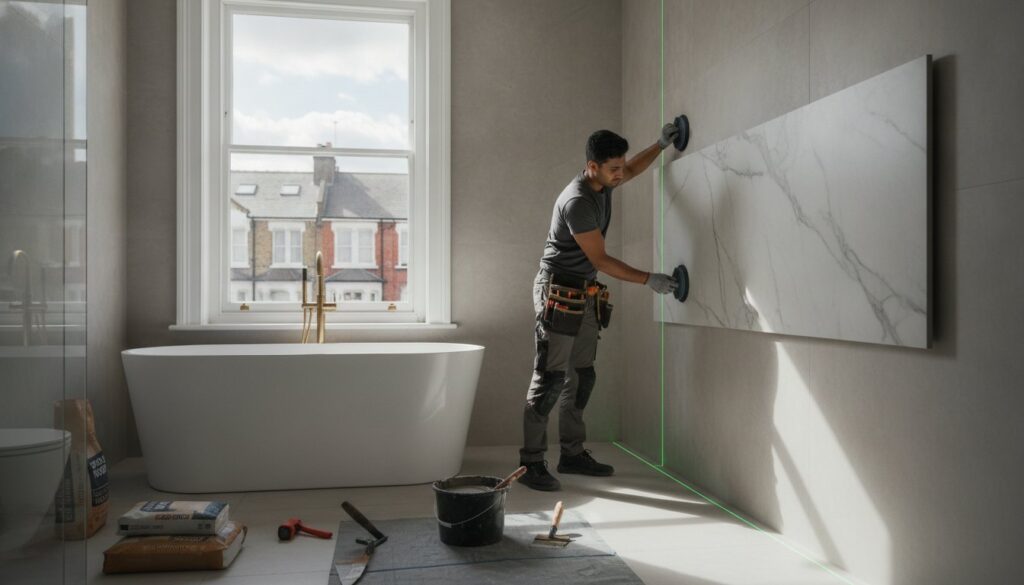
The most expensive bathroom installation in London isn’t necessarily the one with the highest initial quote; it’s often the one that begins with a weekend of ambitious DIY. While the desire to craft your own sanctuary is understandable, the reality of the DIY vs professional bathroom installation cost in 2026 involves a complex tapestry of structural integrity, legal compliance, and the relentless precision required for wet environments. You likely appreciate the quiet luxury of a perfectly executed space, yet the anxiety of potential leaks or the logistical weight of London skip permits can cloud the path forward.
We promise to reveal the true financial and structural implications of your choice, helping you make the most sophisticated investment for your home. This guide provides a clear preview of the hidden expenses inherent in self-managed projects, such as the 14% inflation in high-grade material costs and the mandatory Part P electrical certifications. By understanding the justification for professional mastery, you’ll discover how to secure a bathroom that doesn’t just function, but adds enduring value to your London property through meticulous craftsmanship and technical fidelity.
Key Takeaways
- Identify the 2026 baseline for standard and premium bathroom projects in London, specifically tailored to the architectural nuances of Victorian and period properties.
- Analyze the real DIY vs professional bathroom installation cost by factoring in often-overlooked expenses like specialized tool hire and recent material inflation.
- Recognize the legal and structural risks of non-professional fitting, focusing on Part P electrical compliance and the common pitfalls of self-applied waterproofing.
- Utilize a skill-based decision matrix to assess whether your vision requires a simple cosmetic update or a full, professionally managed structural refurbishment.
- Learn how a precision-engineered installation protects your home from long-term damage while significantly increasing the tangible value of your London property.
The True Cost of a New Bathroom in London: 2026 Market Overview
Creating a sanctuary within the bustling energy of the capital requires more than just a selection of beautiful tiles. It demands a sophisticated understanding of the 2026 market landscape. Refining the DIY vs professional bathroom installation cost requires looking beyond the price tag of a bathtub and into the intricate tapestry of expenses that define a London renovation. A standard bathroom today emphasizes functional elegance and durable ceramics, while a premium project transcends utility to become a bespoke masterpiece, featuring hand-finished natural stone, smart integrated lighting, and architectural fixtures that command attention.
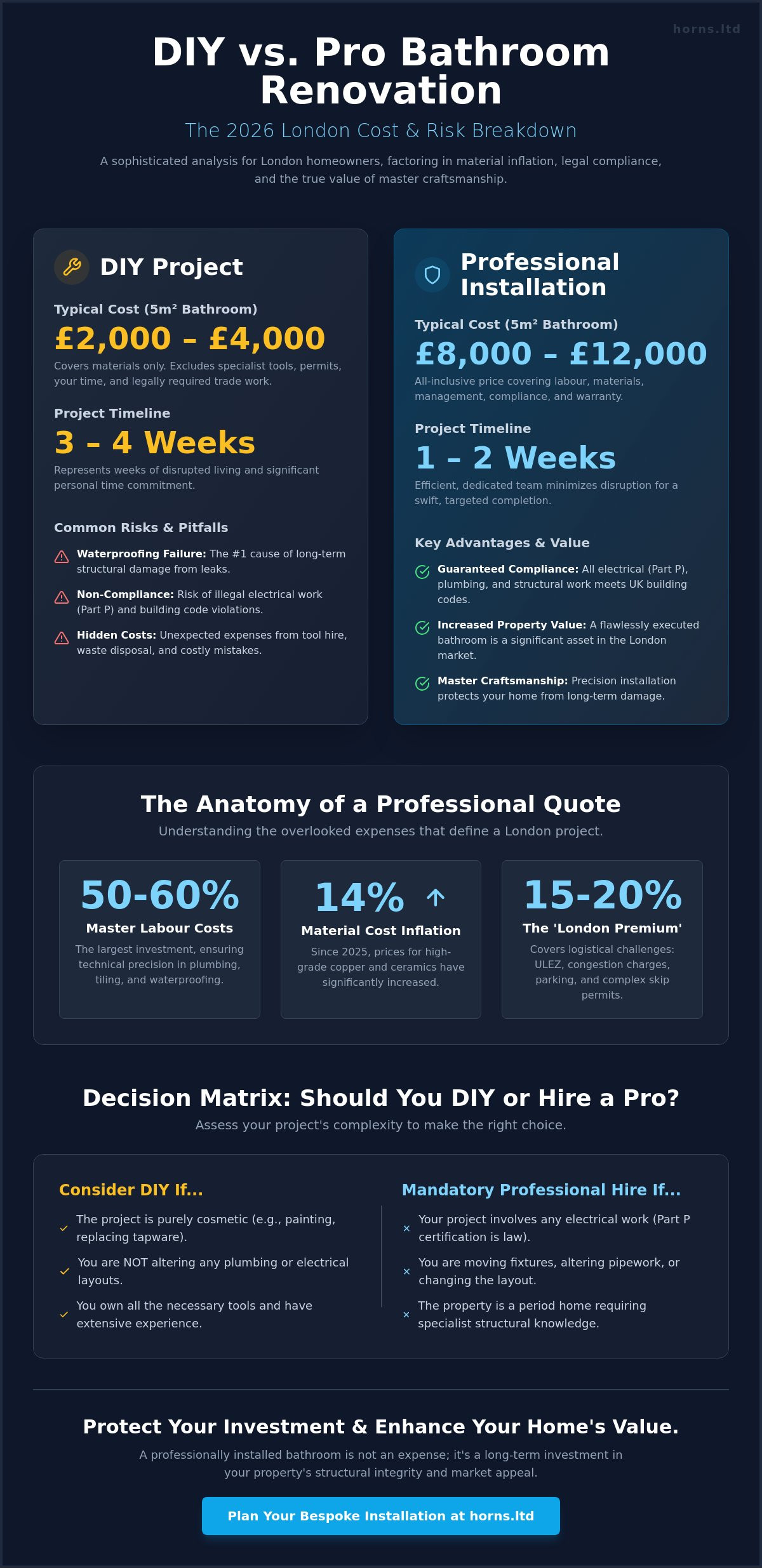
The financial architecture of a professional project is heavily weighted toward the human element. Labour typically accounts for 50-60% of a professional quote, reflecting the immense value of master craftsmanship in a city where precision is paramount. This investment in skill ensures that the technical soul of the room, the plumbing and waterproofing, is as flawless as its visible surface. Material inflation has also reshaped budgets since early 2025, with copper piping and high-grade ceramics seeing a 14% increase in cost, making every measurement and cut more critical than ever before.
London Price Premiums: Beyond the Materials
London properties, particularly the iconic Victorian terraces of West London, present unique challenges that defy standard UK pricing models. These period homes often hide centuries of structural shifts, requiring a delicate touch to preserve architectural integrity while modernizing lead pipework or leveling uneven floor joists. Logistics in the capital add further layers of complexity. Trade quotes must account for ULEZ charges, the Congestion Charge, and the ever-increasing cost of parking permits. Waste management is equally demanding; skip hire permits in dense residential areas are expensive and often time-limited, frequently necessitating “wait and load” services to keep the project moving without obstructing the narrow streets. The ‘London Premium’ typically manifests as a 15-20% increase over national averages, reflecting the unique logistical and regulatory demands of the capital.
Material Cost Projections for 2026
The materials of 2026 reflect a growing devotion to both aesthetics and environmental stewardship. Eco-conscious fixtures, including high-pressure, water-saving showerheads and dual-flush systems that meet stringent efficiency standards, now represent a significant portion of the hardware budget. While off-the-shelf vanity units offer a degree of convenience, the trend toward bespoke cabinetry allows for a seamless integration of form and function, tailored to the specific dimensions of a London home. Compliance with UK building codes ensures that these structural modifications remain safe and legal, preventing the costly “correction tax” that often follows an uncertified DIY attempt. Choosing professional installation means investing in this technical fidelity, ensuring your bathroom remains a source of pride for decades.
DIY vs. Professional Bathroom Installation: A Financial Breakdown
Analyzing the DIY vs professional bathroom installation cost requires a clear-eyed look at the 5m² family bathroom, a staple of London residential architecture. On the surface, the allure of a self-managed project is purely fiscal. However, the initial savings often dissolve when confronted with the specialized requirements of a high-performance wet environment. While a professional fit-out in London for 2026 often starts between £8,000 and £12,000, the DIY route typically demands £2,000 to £4,000 in materials alone. This figure excludes the professional trades legally required for electrical and complex plumbing alterations, which can quickly narrow the price gap.
Professional installers bring more than just skill; they bring significant purchasing power. Homeowners typically pay full retail prices at high-street showrooms. In contrast, established firms leverage long-standing trade discounts on premium ceramics, brassware, and specialized adhesives that are simply inaccessible to the public. These savings often offset a portion of the labour fees. One must also calculate the opportunity cost. A DIY installation frequently stretches over three to four weeks of disrupted living and manual toil. A dedicated team completes a targeted bathroom fit or a Full Home Refurbishment in roughly 10 working days, returning your sanctuary to you with clinical efficiency.
The DIY Expense Sheet: What Most Homeowners Forget
The true cost of a self-fitted bathroom is often hidden in the “sundries” and specialized equipment. Achieving a professional finish requires more than a standard toolkit.
- Tool Hire: Renting professional-grade SDS drills for tile removal, PEX crimpers for secure pipework, and bridge-saw tile cutters for large-format porcelain can easily add £400 to your budget.
- Waterproofing: High-performance tanking kits are non-negotiable. Compromising here to “save” money is a catastrophic mistake that leads to structural rot and expensive remedial work.
- Consumables: High-modulus silicone, rapid-set flexible adhesives, and anti-mould grouts represent a significant, often unbudgeted, investment.
- The Mistake Margin: Professional logic dictates budgeting a 15% contingency for ruined tiles or incorrectly cut copper piping.
The Professional Quote: What You Are Actually Buying
When you engage a master craftsman, you are purchasing the seamless coordination of multiple trades. A lead installer manages the delicate dance between plumbers, Part P electricians, and tilers, ensuring no moment is wasted. This management includes securing official building regulations approval, which is essential for maintaining your property’s legal standing and future resale value. You are also buying the security of comprehensive Public Liability Insurance, a shield against the unforeseen that no DIY project can offer. For those seeking a result that mirrors their own high standards, exploring Expert Bathroom Fitters in London provides the clarity needed to choose excellence over compromise. If you value technical precision and artistic vision, consider how Horns Construction transforms these functional spaces into enduring works of art.
Structural Risks and Compliance: Where DIY Becomes Dangerous
The allure of self-mastery often fades when the first drop of water penetrates a subfloor. While the initial DIY vs professional bathroom installation cost might seem lower, the structural risks inherent in wet room technology and heavy masonry are profound. Waterproofing, or tanking, is a master’s discipline; trade observations indicate that DIY waterproofing attempts fail approximately 40% of the time. These failures often remain hidden for months, leading to silent rot within the joists of a London home before the damage becomes visible on the ceiling below.
This leads to the Correction Tax. When a DIY project fails, the cost to remedy the damage is typically double the original professional fee. You aren’t just paying for a new installation; you’re paying for the forensic removal of failed materials, the disposal of contaminated waste, and the repair of water-damaged timber. Master craftsmanship isn’t merely an aesthetic choice; it’s a protective measure for your most valuable asset.
Building Regulations and Resale Value
Modern London property transactions demand technical transparency. A lack of completion certificates for plumbing or electrical work can stall a sale indefinitely or lead to aggressive price negotiations from buyers. We prioritize rigorous pressure testing and precise drainage slopes to ensure your system performs flawlessly under the unique pressure of London’s water mains. Professional installation includes a ‘Certificate of Compliance’ essential for London property valuations.
Common DIY Failures in Period Homes
West London’s period properties present a labyrinth of lead piping and ancient cast-iron stack pipes. One common error is tiling directly onto old floorboards, which inevitably leads to cracked grout as the timber breathes and moves. The Horns Construction approach involves the installation of marine-grade plywood subfloors and bespoke structural bracing to create a rigid, immutable foundation. This technical fidelity ensures that your artistic vision is supported by engineering that lasts for generations.
The Decision Matrix: Should You DIY or Hire a Pro?
Refining the DIY vs professional bathroom installation cost involves more than just comparing receipts. It’s about evaluating the value of your own time and the permanence of the result. If you’re pondering the DIY route, apply the ‘Tiling Test.’ Can you achieve perfect symmetry with 600x600mm porcelain tiles across a non-square Victorian room? Precision is non-negotiable. Then consider the ‘Soldering Standard.’ A single microscopic flaw in a joint behind a finished wall can remain undetected until the structural damage is irreversible. For a cosmetic refresh, such as updating brassware or repainting, DIY offers a poetic way to connect with your home. However, when the project involves a full structural refurbishment, the complexity grows exponentially.
Many homeowners fall for the ‘Hybrid’ myth, believing they can save money by performing the demolition or prep work themselves. Most elite London fitters refuse these arrangements. They won’t provide a guarantee when they don’t control the substrate’s integrity. Calculating the long-term DIY vs professional bathroom installation cost also means looking at rental yields. In the competitive London market, a designer bathroom with flawless technical fidelity often commands a 5% to 10% premium in monthly rent compared to standard, DIY-finished units.
When DIY Makes Sense (and When It Doesn’t)
Safe DIY tasks include painting, fitting towel rails, or basic vanity assembly. The ‘Hard No’ list is absolute. Gas-fired water heaters, sub-floor tanking, and main fuse box work must be left to certified specialists to ensure safety and legal compliance. To understand how these elements fit into a larger architectural vision, explore our guide on Mastering Home Refurbishment in London.
Evaluating Professional Quotes
When evaluating quotes, treat a price significantly below market averages as a red flag. It often signals a lack of insurance or an intent to bypass building regulations. A fixed-price contract is superior to a day-rate for bathroom installs. It protects you from ‘quote creep’ during the 6 to 8 days of a standard professional fit. Before work begins, ask your builder about their waste disposal process and how they intend to protect your home’s existing period features. If you’re ready to invest in a bathroom that reflects your dedication to quality, Horns Construction offers the technical mastery your London property deserves.
Bespoke Bathroom Installation with Horns Construction
For over 20 years, we’ve dedicated ourselves to the architectural evolution of West London’s most prestigious residences. We don’t view a bathroom as a mere collection of fixtures, but as a sanctuary where technical fidelity meets artistic vision. When evaluating the DIY vs professional bathroom installation cost, one must consider the value of a legacy. Our approach transcends the “standalone swap” offered by many contractors; we specialize in full home refurbishments where the bathroom is integrated into the home’s structural and aesthetic narrative. This commitment to master craftsmanship ensures that every joint, tile, and hidden pipe reflects a standard of excellence that a self-managed project simply cannot replicate.
Managing a renovation in the heart of London requires more than just mechanical skill; it demands a sophisticated understanding of urban logistics. We assume the entire burden of “London Logistics” on your behalf. From securing restrictive West London skip permits to navigating ULEZ compliance and coordinating multiple specialist trades, our end-to-end management provides a seamless experience. Our process begins with RIBA-standard planning, ensuring that every design choice is backed by engineering precision, and continues through to the final, meticulous polish of your bespoke brassware.
A Meticulous Approach to Luxury Bathrooms
Our reputation is built on what remains invisible to the eye. We place an uncompromising focus on “tanking” and sub-floor preparation, creating an impermeable foundation that prevents the silent degradation of your property’s structure. While a DIY enthusiast might overlook the nuances of substrate movement, we treat it as a primary engineering challenge. This technical rigor allows us to provide the Horns Guarantee, a promise of longevity that protects your investment for decades. Clients also benefit from our exclusive access to premium, trade-only suppliers, allowing for the integration of high-spec finishes and bespoke cabinetry that command attention. We recently applied this philosophy to a cramped Fulham ensuite, transforming it into a spa-like retreat by subtly reconfiguring the structural footprint to maximize light and movement.
Start Your London Renovation Today
Choosing a professional partner means choosing the peace of mind that comes with a single, authoritative point of contact. We provide transparent, comprehensive quotes that account for every technical requirement, eliminating the “quote creep” that often plagues less rigorous projects. If you’re ready to elevate your home with a space that reflects your appreciation for the finer things, we invite you to begin the journey. Our team is prepared to translate your vision into a reality that adds tangible, enduring value to your property. Book a consultation for your West London bathroom refurbishment and discover the difference that two decades of master craftsmanship can make.
Securing the Future Value of Your London Home
The choice between a self-managed project and an expert fit-out defines the longevity of your residence. While the initial DIY vs professional bathroom installation cost might suggest short-term savings, the reality of 2026 market inflation and the high risk of structural failure makes professional mastery the safer investment. True luxury lies in the technical fidelity that prevents leaks and the architectural precision that honors period properties. We’ve seen that the “correction tax” for failed DIY work can be devastating, making early professional intervention the smartest financial move.
At Horns Construction, we bring over 20 years of West London experience to every high-end period property renovation. We handle full project management from design to completion, ensuring your vision is executed with surgical precision and artistic flair. Your bathroom should be a masterpiece of form and function, an enduring sanctuary that grows in value alongside your home. Request a Bespoke Bathroom Refurbishment Quote from Horns Construction and begin the transformation of your private retreat today.
Frequently Asked Questions
Is it worth DIYing a bathroom to save money in 2026?
DIYing a bathroom rarely yields true financial benefits when one considers the “correction tax” for technical errors and the lack of professional certification. While the initial DIY vs professional bathroom installation cost seems attractive, the requirement for specialized tool hire and the risk of waterproofing failure often erodes those perceived savings. For a space requiring technical fidelity, the peace of mind offered by master craftsmanship is an essential component of a premium home investment.
How much does a professional bathroom fitter charge per day in London?
Professional bathroom fitters in the UK typically charge between £180 and £350 per day, though London rates often sit at the higher end of this spectrum due to increased overheads like ULEZ and parking permits. These figures reflect the skilled nature of the trade and the intensive labor required to ensure a perfect finish. Laborers assisting in the more manual aspects of the project generally command rates between £110 and £165 per day.
Do I need planning permission for a bathroom refurbishment in London?
Planning permission is typically not required for internal bathroom refurbishments in London properties. However, you must still adhere to building regulations covering ventilation, drainage, and electrical safety to ensure the room is legally compliant. If your project involves a listed building or significant structural changes to a flat, it’s vital to consult with local authorities to ensure all architectural modifications are permitted before work begins.
What are the most expensive parts of a bathroom renovation?
Labor is the most significant expense in a London renovation, often accounting for 60% to 70% of the total project budget. Beyond the human element, high-grade ceramics and copper piping have seen a 14% price increase since early 2025, significantly impacting the material costs. Specialized waterproofing systems and bespoke cabinetry also represent substantial investments that ensure the room’s longevity and unique aesthetic appeal.
Can I do my own plumbing in the bathroom?
You can legally perform basic plumbing tasks, but complex alterations to drainage or water supply systems must meet Part G and Part H of the building regulations. Professional plumbers ensure that every joint is pressure-tested and that all fittings meet WRAS approval for water efficiency. Entrusting these technical details to an expert prevents the catastrophic structural damage often caused by slow, undetected leaks from amateur pipework.
While this guide focuses on the UK market, the necessity of licensed expertise is universal; for instance, in Western Sydney, Hydrauflo Plumbing provides the professional plumbing and drainage services required to ensure your renovation is structurally sound and leak-free.
How long does a professional bathroom installation take compared to DIY?
A professional team typically completes a full installation in 6 to 8 working days, whereas a DIY project often spans 2 to 4 weeks of significant disruption. Professionals maintain a disciplined rhythm by coordinating multiple trades like plumbing and tiling simultaneously. This efficiency returns your sanctuary to you quickly, whereas self-managed projects frequently stall due to the learning curve of specialized tools or unforeseen technical challenges.
What is Part P, and why does it matter for my bathroom?
Part P is a section of the building regulations that mandates all electrical work in “special locations” like bathrooms be carried out by a registered professional or notified to building control. This regulation exists to prevent electrical shocks and fires in wet environments where the risk is significantly higher. Failure to provide a Part P certificate can complicate the future sale of your London property and may even invalidate your home insurance.
How much value does a new bathroom add to a London property?
A meticulously executed bathroom can increase a London property’s value by approximately 4% to 5%, while also significantly boosting rental yields. When weighing the DIY vs professional bathroom installation cost, consider that a designer finish acts as a hallmark of quality for prospective buyers. It transforms a functional necessity into a compelling architectural feature that distinguishes your home in the competitive West London market.