

What should a family-run building company in London bring to a home project beyond skilled workmanship? If you’re searching for “family-run building company london”, you’re likely looking for more than a name on a quote. You want to know who will guide the work, answer your questions and keep each stage clear.
That expectation is understandable. An extension, loft conversion or full refurbishment involves important decisions, and confidence grows when responsibilities, scope and next steps are explained from the outset. A good working relationship should feel personal and organised, with a clear path from early design and planning through construction and completion.
This guide explains what accountable project support looks like, how to assess whether a building company’s services fit your plans, and what to clarify as a London residential project takes shape. Horns Construction is based in West London and serves residential customers across London, supporting projects from initial design and planning through to completion. Use the practical steps below to match your project to the right service and prepare for a focused discussion about the work.
Key Takeaways
- A family-run identity may suggest a personal working style, but it isn’t proof of quality. Look for clear communication and accountable project management.
- Understand how a residential project can move from early discussion and design through planning, construction and completion.
- Assess whether a family-run building company london is a fit by comparing its services and project support with your work, coordination needs and communication preferences.
- Prepare details about your property, goals, priorities and constraints so the project scope and tailored quote reflect the work involved.
- Horns Construction supports London homeowners with loft conversions, house extensions and full home refurbishments.
What does a family-run building company in London mean for your project?
“Family-run” describes how a business is owned or organised, not the quality or outcome of its work. A family business may involve relatives in ownership, management or day-to-day operations, but the label alone doesn’t tell you who will oversee your build, how decisions are made or whether the team has the technical capability your project requires.
A family-run building relationship may offer closer communication, but project quality still depends on clear responsibilities, suitable expertise and careful coordination. Personal service can make it easier to discuss decisions, while complex residential work still calls for sound planning and skilled delivery. A loft conversion, house extension or full refurbishment may involve several trades and connected design choices. Approachability should complement, not replace, practical management.
What homeowners may value in a family-led building relationship
Homeowners often want a clear point of contact who understands the brief and can explain what happens next. Continuity can also help preserve design intent as plans become construction decisions. When questions arise on site, understanding the purpose behind a layout, finish or detail can help keep decisions connected to the original brief. These are useful expectations to discuss, not automatic features of every family-run firm. Ownership structures and working practices differ, so ask how communication and responsibility will work on the project.
Why London project context matters
The working process should reflect the property and the proposed work. A home’s layout, access for materials and trades, and the scope of an extension or refurbishment can all affect sequencing and coordination. Horns Construction is based in West London and serves residential customers across London. Its local experience provides relevant context, while the details of each home and project still need to shape the plan.
For a more detailed view of what to consider across residential building projects, read our London construction company guide. The practical test is whether the working relationship makes communication, decisions and responsibilities understandable, and whether the team’s services align with the scale and nature of the work. A personal connection can make a demanding build feel more considered, but its value comes from how it is carried through the project.
How a London building company should guide a residential project
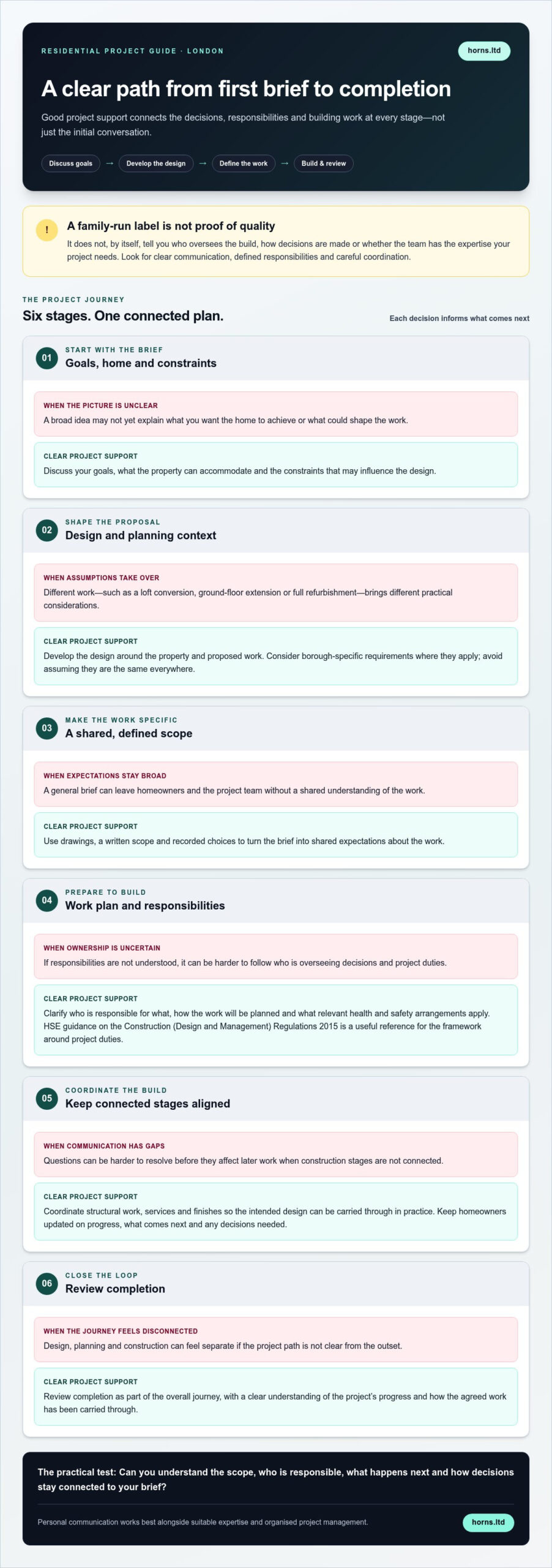
A well-managed residential build moves through connected stages, with each decision informing the next. In brief: discuss your goals, develop the design, clarify the scope and responsibilities, plan the work, coordinate construction, then review completion. The precise route depends on the property and proposed work, but you should be able to understand which stage the project is at and what decisions are coming up.
When considering a family-run building company london, look at how the team turns an initial conversation into an organised process. A clear point of contact and recorded decisions make it easier to follow progress, raise questions and understand how a change may affect the agreed scope.
From initial design and planning to a defined scope
Early discussions should establish what you want to achieve, what the property can accommodate and which constraints could shape the design. A loft conversion has different practical considerations from a ground-floor extension or a full refurbishment. Drawings, a written scope and recorded choices help translate a broad brief into shared expectations about the work.
Planning context can vary by property and location, so consider borough-specific requirements where they apply rather than making assumptions. A building company can connect design and construction planning, while project responsibilities and relevant health and safety arrangements should be understood. The Health and Safety Executive’s guidance on the Construction (Design and Management) Regulations 2015 is a useful reference for understanding the framework around construction project duties.
Keeping decisions and communication connected during construction
Once work begins, clear updates help you understand what has progressed, what comes next and whether a decision is needed. Construction stages depend on one another: structural work, services and finishes need to be coordinated so the intended design can be carried through in practice. On an extension, loft conversion or refurbishment, gaps in communication between stages can make it harder to resolve questions before they affect subsequent work.
Horns Construction supports residential projects from initial design and planning through to completion, connecting those stages within the project journey. This gives homeowners a basis for discussing how the brief, scope and construction work relate, rather than treating design as separate from the realities of building.
If you’re shaping plans for a residential project, explore Horns Construction’s building services to consider the work involved.
How to assess whether a London building company fits your project
The right fit depends on the work your home needs, the services involved and how the project will be coordinated, not on company size or a “family-run” label alone. Assess a family-run building company london homeowners are considering on practical grounds: do its services and project support align with the scope, from early design to completion?
Match the building company to the type of work
Different projects call for different planning. A loft conversion requires the roof space and intended layout to inform design and construction decisions. An extension needs to bring the proposed layout together with structural requirements and relevant planning considerations. A whole-home refurbishment can involve several trades, so the work needs to be sequenced in a way that keeps the wider scope connected.
Horns Construction undertakes loft conversions, house extensions and full home refurbishments, supporting residential projects from initial design and planning through completion. Use the comparison below to consider what matters for your project.
| What to compare | What your project may need | Horns Construction fit |
|---|---|---|
| Project type | Services aligned with a loft conversion, extension or whole-home refurbishment. | These three residential project types are part of Horns Construction’s work. |
| Design support | A clear connection between your goals, design decisions and the proposed scope. | Project support begins at initial design and planning. |
| Coordination | Relevant trades and construction stages considered as parts of one project. | Support continues through the project to completion. |
| Communication | Defined responsibilities and a consistent route for updates and decisions. | Discuss how your brief and project stages will be managed together. |
| Completion | A shared understanding of the work included and how the project concludes. | Completion forms part of the supported project journey. |
Compare project support, not just the service headline
A service name tells you what type of work a company undertakes, but not how design, planning and construction connect. Look for a clear account of the project stages, defined responsibilities and a communication route that keeps decisions linked to the agreed scope. Company size alone doesn’t determine capability; relevant project experience and coordination matter.
The Federation of Master Builders directory provides another reference point for finding building firms. For more context on the detail involved in whole-home work, explore our London home refurbishment guide.
What to clarify before a London residential building project begins
A well-prepared brief gives the building team a clearer picture of what you want, what the property can accommodate and which decisions still need to be made. It also helps shape the project scope and a quote tailored to the work and site conditions, rather than relying on assumptions. Before discussing plans with a family-run building company london homeowners are considering, gather the details that will help turn your ideas into a practical starting point.
Prepare a clear brief for your London home project
Start with how you want the finished space to work. For a loft conversion, that might mean a new bedroom or a more usable work area. For an extension, it could be a larger kitchen and living space. Separate essential outcomes from preferences so priorities are clear from the outset.
A concise checklist can help:
- Goals: Describe the intended use of the new or improved space and the outcomes that matter most.
- Property details: Note the property type, relevant features and any known constraints. Gather existing drawings and photographs if available.
- Priorities: Record preferred layouts, finishes and features, separating must-haves from elements you may adapt.
- Access: Describe entrances, stairs, parking or other conditions that may affect how people and materials reach the work area.
- Household considerations: Share how the home is used and any practical needs to account for during construction.
- Timing considerations: Identify important dates or periods that could influence planning, without assuming a fixed schedule.
Understand scope, decisions and next steps
The same design ambition can involve different work depending on the property, access and existing conditions. Design choices also affect sequencing. Moving a kitchen layout, for example, may require associated trades to be coordinated differently from a straightforward finish update. Making the intended scope and known constraints visible early helps establish shared expectations before construction begins.
Horns Construction supports clients from initial design and planning through to completion, connecting the early brief with the work that follows. As the project develops, keep a record of agreed choices, open questions and changes to the scope. This makes it easier to see how decisions relate to the plan and what the next step involves.
If you’re considering an extension, our London house extension planning guide offers further context for shaping your brief. With your priorities and property information gathered, you can discuss the project more clearly. Discuss your residential project with Horns Construction.
Plan your London project with Horns Construction
Choosing a building partner means finding a suitable match between your home, your plans and the support required to carry them through. Horns Construction is a West London-based residential renovation company serving homeowners across London, with services covering loft conversions, house extensions and full home refurbishments.
If your search began with “family-run building company london”, keep the practical questions in view: does the work align with your project, and can the stages be clearly connected? Ownership alone doesn’t show how a build will be managed. A clear understanding of the brief, scope and communication process helps you assess the working relationship based on what matters to your home.
One connected approach to residential building work
A significant home project involves decisions that influence one another. A loft conversion, extension or full refurbishment may involve shaping the design, planning the work and coordinating construction so the intended outcome stays connected to the practical demands of the property.
Horns Construction supports clients from initial design and planning through project completion. This joined-up journey provides a starting point for discussing how the early brief relates to the work ahead, rather than treating design, planning and construction as unrelated steps. The appropriate scope depends on the home and the work involved.
Take the next step with a clear project brief
To begin a useful project conversation, outline where the property is, what you’re hoping to change and how you want the finished space to work. You might be considering more usable space in the roof, a new connection between the home and garden, or a coordinated refurbishment across several rooms. Include relevant property details, priorities and any known constraints.
These details help shape a project-specific scope and tailored quotation. They also give you a clearer basis for discussing design choices, the work required and how the project can progress from planning towards completion. You don’t need every detail settled before starting the conversation; a clear sense of your goals is a valuable first step.
When you’re ready to explore your plans, discuss your London residential project with Horns Construction.
Take the next step towards a well-planned London project
Choosing a family-run building company london homeowners can work confidently with means looking beyond the ownership label. Clear communication, defined responsibilities and relevant experience are what help create a considered working relationship. A well-prepared brief, including your goals and property details, can also make it easier to discuss scope and next steps.
Horns Construction is based in West London and serves residential customers across London, with experience in loft conversions, house extensions and full home refurbishments. Support from initial design and planning through project completion brings those stages into one connected journey, shaped around the details of your home and intended work.
Ready to explore what your plans may involve? Discuss your London home project with Horns Construction. A clear conversation about your property and desired outcome can be the first step towards a practical, well-considered plan.
Frequently Asked Questions
What does a family-run building company do differently?
A family-run building company is typically owned or operated by members of the same family, but that structure doesn’t guarantee a particular standard of service. Homeowners may value direct communication, continuity and access to decision-makers, though working practices differ between firms. Focus on practical expectations: who will be your point of contact, how responsibilities are defined and how the team will keep you informed as decisions and construction work progress.
How do I choose a building company for a London home project?
Choose a company whose services and project support align with the work your London home needs. If you’re searching for a family-run building company london, look beyond the ownership label. Consider relevant experience, design and planning support, coordination, communication and how completion is handled. Define your goals and share available property information so the scope can be discussed clearly. The right fit depends on the project and the working approach, not company size alone.
Can a family-run building company manage a large extension or refurbishment?
It can, provided its relevant experience, services and project coordination suit the scope of the work. Ownership structure alone doesn’t determine whether a firm can support a substantial project. For an extension or full refurbishment, the design, required trades, site conditions and sequence of work all matter. Horns Construction undertakes house extensions and full home refurbishments, with support from initial design and planning through project completion.
What services does Horns Construction provide in London?
Horns Construction provides residential building and renovation services across London, including loft conversions, house extensions and full home refurbishments. Other services include kitchen and bathroom fitting, plumbing, electrical work, painting and decorating, carpentry and joinery, and tiling. The relevant work depends on your project brief. Describing your property, intended changes and priorities helps establish which services relate to the scope you want to discuss.
What should I prepare before discussing a building project?
Prepare a short description of your goals, property and priorities. Explain how you want the space to work, which outcomes are essential and what choices remain flexible. Gather photographs, existing drawings or other useful property details if available. Note access conditions, household considerations and any important timing constraints. This information helps the building company understand the project context and discuss a scope and tailored quotation based on the work involved.
How does a building company manage a project from design to completion?
A residential project generally develops from initial discussions and design into planning, an agreed scope, construction and completion. The precise process depends on the property and work required. Clear responsibilities, recorded decisions and regular communication help connect the original brief with construction choices as the project progresses. Horns Construction supports clients from initial design and planning through to final completion, linking these stages within the residential project journey.
Does Horns Construction work on homes across London?
Yes. Horns Construction is based in West London and serves residential customers across London. Its work includes loft conversions, house extensions and full home refurbishments, alongside related fitting and trade services. If you’re considering work on a London property, outline its location, the changes you have in mind and your desired outcome. Those details provide a helpful starting point for discussing the project scope and the support it may require.