

What if the most productive renovation budget conversation starts before you discuss the numbers? Getting buy-in from your partner on renovation costs can feel difficult when you have different ideas about what’s essential, what would be a welcome upgrade, and what feels affordable. The key is to agree on what you want the renovation to achieve before weighing individual choices.
It’s understandable if the conversation feels personal. A concern about spending may reflect a need for financial security, while enthusiasm for a particular feature may be tied to comfort or how you hope to use your home. With an unclear project scope, it’s even harder to know what you’re deciding together.
This guide will help you discuss costs calmly, listen to each other’s priorities, and separate essential work from optional improvements. You’ll learn how to define shared outcomes, clarify the scope, and shape a realistic plan you both understand. Whether you’re considering a London home refurbishment, extension or loft conversion, a carefully staged discussion can make decisions feel clearer and more collaborative.
Key Takeaways
- Begin with the change you both want in daily life, rather than debating individual features or costs.
- Write down the rooms, repairs, finishes and project boundaries to make the scope clearer before weighing options.
- Treat financial caution as a valid concern; clarify what feels uncertain before trying to settle the budget.
- For getting buy-in from your partner on renovation costs, take the conversation one decision at a time and agree a practical next step together.
- Use your shared priorities as the starting point for a renovation brief and the design and planning discussions that follow.
Start With What You Both Want the Renovation to Change
Partners can value different outcomes without either person being unreasonable. One may want a more beautiful kitchen; the other may be focused on making the home work better for everyday family life. Before comparing ideas or discussing money, make room for both perspectives. Getting buy-in from your partner on renovation costs starts with understanding what each of you hopes the work will change.
Try describing the daily routine you’d like to have after the renovation. In a London home, one partner might picture an extension that gives the family more room to eat together, while the other sees a loft conversion as a way to create a quieter space to work or relax. These goals may point to different projects, but the underlying needs, such as usable space or privacy, could overlap.
How to describe the renovation goal without starting with a number
Ask each other, “What problem do we want this project to solve?” Then translate broad wishes into practical outcomes. “A brighter home” might mean more natural light in a particular room; “less clutter” could mean better storage; “more space” might mean a room that can serve several purposes. Describe the outcome first, without committing to a design or a particular solution.
Summarise the common ground in a sentence or two before moving on. This is a small but useful process of negotiation: each person explains what matters, listens, and looks for an outcome they can both support. For example, “We want a more comfortable family space with room for storage” gives you a shared reference point for later decisions.
Which renovation priorities matter most to both of you?
Next, separate essential work from improvements chosen mainly for appearance or convenience. Each partner can rank priorities independently before comparing lists. This makes it easier to see where you agree, where preferences differ, and which choices could wait. Avoid treating a lower-ranked preference as unimportant; it may matter, but not as much as a repair or change that affects daily use.
- Shared needs: outcomes both of you consider important, such as gaining practical family space.
- Individual preferences: choices one person favours, such as a particular finish or layout detail.
- Ideas that can wait: improvements you may revisit once the main priorities are clearer.
Keep essential repairs distinct from optional upgrades so that different kinds of decisions don’t become tangled. Some ideas also depend on the property’s layout, structure or project feasibility. Mark these as questions for the planning stage rather than treating them as agreed solutions. This distinction helps you identify what you both want while leaving room for a considered assessment of how best to achieve it.
Make Renovation Costs Easier to Discuss by Clarifying the Scope
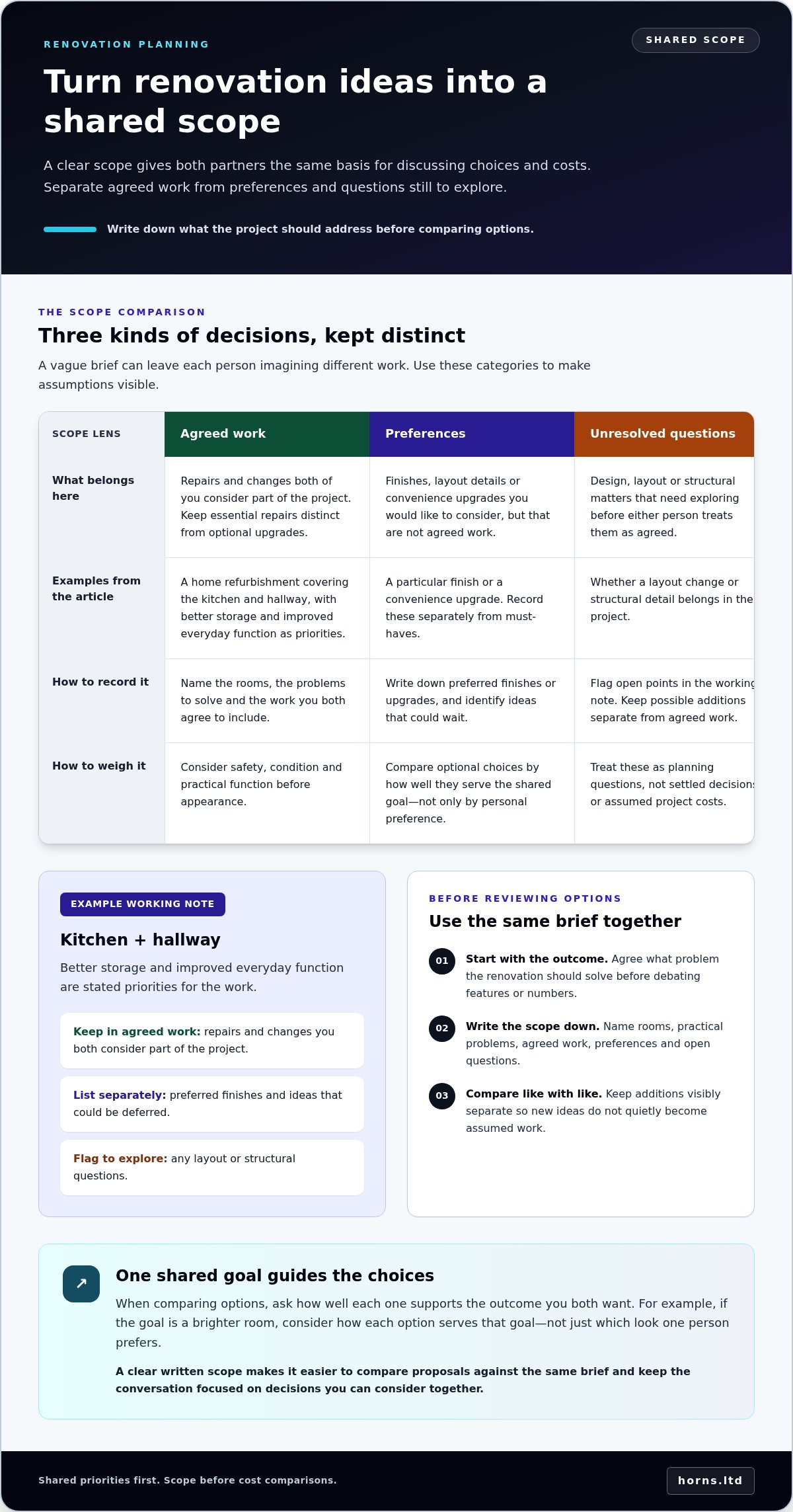
A vague project brief makes a budget conversation harder because you may be imagining different work. One partner might picture refreshing a kitchen’s finishes, while the other assumes the plan includes replacing fittings or changing the layout. Until you agree what the project covers, it’s difficult to compare options or talk confidently about costs. A clear scope turns an abstract discussion into a set of decisions you can consider together.
A shared scope gives you both the same basis for every renovation decision. It doesn’t need to be a finished design. Start with a working note that describes the rooms involved, the practical problems to solve and the boundaries of the project. This can make getting buy-in from your partner on renovation costs feel less like a debate about competing assumptions and more like a review of the same plan.
What should a couple agree before reviewing a renovation plan?
Write down what the work is intended to address, then organise the details into clear categories. For example, a home refurbishment might cover the kitchen and hallway, with better storage and improved everyday function as priorities. Record must-haves separately from preferred finishes and ideas that could be deferred. Note open questions, too: a layout change or structural detail may need exploring before either of you treats it as part of the agreed work.
- Rooms and problems: Name each area and the issue the work should resolve.
- Agreed work: List repairs and changes you both consider part of the project.
- Preferences: Record finishes or convenience upgrades you’d like to consider.
- Unresolved questions: Flag design, layout or structural matters still to be explored.
Keep possible additions visibly separate from agreed work. That distinction helps prevent a new idea from quietly becoming an assumed part of the project. Written details also make it easier to compare proposals against the same brief. The US Federal Trade Commission’s consumer advice on Finding a trustworthy contractor includes putting project details in writing; UK homeowners should treat it as general consumer guidance, not UK-specific advice.
How to compare essential work with optional upgrades
Review safety, condition and practical function before focusing on appearance. If a repair is needed, discuss it separately from a preferred finish; then compare optional choices by how well they serve the shared goal. For a brighter room, for instance, consider how each proposed option supports that outcome rather than choosing solely because one person prefers its look. Keep decisions open where design development or assessment of the property could affect the scope.
Once you’ve agreed what belongs in the brief and what remains a possibility, you’ll have a more useful starting point for planning. Explore residential renovation planning as you turn shared priorities into a clearly defined project.
Address the Fear That a Renovation Will Cost More Than You Can Manage
Financial caution deserves to be heard, not treated as resistance one partner needs to overcome. A renovation can feel daunting if the project is still taking shape, because each person may be weighing a different version of the work and its implications. For getting buy-in from your partner on renovation costs, start by understanding what feels risky to them before presenting another option.
An early project discussion is a starting point for decisions, not a final, defined project quote. It can help you clarify what you want to achieve, but the details of the work and the property need to be understood before the project is fully defined. Keeping that distinction clear avoids giving either partner false certainty.
What if one partner thinks the renovation is too expensive?
Ask what sits behind the concern. Is it the overall financial commitment, the possibility of the scope changing, disruption to everyday life, or the need to retain financial flexibility? Listen without immediately countering. Reflect the concern in your own words, then check you’ve understood it: “You’re worried that we might commit before we know exactly what’s involved.” Feeling heard can make it easier to examine options together.
Then consider whether the shared goal could be approached through a narrower scope or staged decision-making. For instance, you might distinguish work that is central to the agreed outcome from improvements that can remain under consideration. This isn’t a promise that a smaller project will cost less or be more suitable; it’s a way to identify choices you can assess without asking either person to dismiss what matters to them.
How to discuss uncertainty without making promises
Make uncertainty visible. A simple record can separate what you know from what remains open and what needs project-specific assessment:
- Known: the rooms involved and the practical outcomes you both want.
- Undecided: finishes, layout choices or possible additions.
- To assess: details affected by the property’s condition, structure or design.
For London homes, the existing property and the chosen scope can influence how a project is planned. An extension or loft conversion, for example, involves different considerations from a room refresh, and the discussion should reflect the actual home rather than assumptions made before its requirements are understood. Don’t present uncertain items as settled facts. Note the assumption, agree what information would help clarify it, and revisit the decision as the project develops.
This approach keeps the conversation grounded: you’re not being asked to approve an undefined commitment, but to decide what you need to understand next. Calmly naming the unknowns can help both partners take part without promising a final cost, a particular saving or a specific outcome before the project is properly assessed.
Use a Calm, Step-by-Step Conversation to Reach a Shared Decision
A focused conversation is easier to manage than trying to settle every renovation choice in one sitting. Choose a time when neither of you is rushed, then work through one decision at a time. Getting buy-in from your partner on renovation costs is not about winning an argument; it’s about making sure both of you understand the priorities, concerns and next steps.
- Choose a suitable time. Set aside space to talk without distractions or pressure to decide immediately.
- Restate your shared goals. Begin with the outcomes you’ve identified as important to both of you.
- Review the scope. Look at the agreed work, optional choices and open questions together.
- Surface concerns. Give each person time to explain what still feels uncertain.
- Agree one next step. Decide what information or discussion would help you move forward.
Keep a shared note of questions and decisions as you go. A brief record can distinguish what you’ve agreed from what you’re still considering, preventing an assumption from later being mistaken for a commitment. If you’re thinking about work across several rooms, divide the conversation into manageable topics rather than moving between finishes, repairs and possible additions all at once. A whole-home project may also benefit from reading this London home refurbishment guide as you shape your discussion.
Questions that help both partners feel heard
Ask each other: “Which outcome matters most to you, and why?” and “What concern would you like us to resolve before we progress?” Listen to the answer before proposing a solution. Then summarise what you’ve heard and confirm where you agree. Write down any point that remains open rather than pressing for a decision before you’re both ready.
How to turn agreement into a practical brief
Capture the shared goals, priority work, optional choices and unresolved questions in a concise brief. It can guide design discussions and project planning, while making clear which details still need development. If gaining space is central to your plans, the London house extension planning guide offers a relevant starting point for considering an extension.
Once your priorities are written down, Horns Construction can support residential projects from initial design and planning through completion. Discuss your renovation plans with Horns Construction when you’re ready to explore the next stage.
Move From Shared Priorities to a Renovation Plan You Can Both Support
Once you’ve agreed what you want your home to do better, put that agreement to work. A shared brief gives design and planning discussions a clear starting point: it shows what matters to both of you, where you have preferences, and which questions still need to be explored. This helps keep decisions connected to the reasons you chose to renovate, rather than letting the project drift into a series of unrelated choices.
What a useful shared renovation brief should contain
Keep the brief concise enough to revisit easily, but specific enough to guide the next conversation. Include:
- Agreed outcomes: the changes you want to make to everyday life at home.
- Essential work: the repairs or practical improvements you both consider priorities.
- Preferred choices: finishes or features you’d like to explore, without treating them as fixed decisions.
- Items that may be deferred: ideas you can return to after the core scope is clearer.
- Open questions: decisions that depend on further design or project information.
For example, a couple planning a full home refurbishment might agree that better storage and a more functional kitchen are central goals, while leaving particular finishes open. That distinction lets the design discussion respond to the shared purpose of the work, while preserving room to refine the details. A practical brief doesn’t need to settle every choice; it needs to show which decisions are settled and which are not.
How project support can help couples keep decisions aligned
As a project develops, keeping the agreed priorities and decisions visible can help both partners stay involved. Revisit the brief as design and planning progress, note when new information affects a choice, and make sure an optional idea is not mistaken for agreed work. That simple discipline supports getting buy-in from your partner on renovation costs because decisions remain tied to a scope you’ve both discussed.
Horns Construction supports residential projects from initial design and planning through to completion. For homeowners in London, that support can apply to a full home refurbishment, a house extension or a loft conversion, with the agreed brief providing a shared foundation for the work ahead.
When you’ve aligned on your priorities, you can Discuss your renovation plans with Horns Construction and explore how they can inform the next stage of planning.
Take Your Shared Priorities Into the Next Stage
Getting buy-in from your partner on renovation costs begins with a shared understanding of what you want the work to achieve. Agree on the outcomes that matter, clarify the project scope, and keep essential work distinct from preferences that can be explored later. When uncertainty arises, record what’s known and what still needs careful consideration rather than treating assumptions as decisions.
A clear brief gives you both a steadier foundation for design and planning. Horns Construction brings more than 20 years of experience in residential building work across London, supporting projects from initial design and planning through completion. Whether you’re considering a full home refurbishment, an extension or a loft conversion, your agreed priorities can help guide the conversation that follows.
When you’re ready to explore the next stage together, discuss your renovation plans with Horns Construction. With a shared purpose and a thoughtful plan, you can move forward as partners, with a clearer sense of what you’re building towards.
Frequently Asked Questions
How do I talk to my partner about renovation costs?
Start with the change you both want the renovation to make, then discuss what work might achieve it. Getting buy-in from your partner on renovation costs is easier when you’re listening to each other’s priorities, not debating different assumptions about the project. Give each person time to explain what matters and what feels uncertain. Record agreed points and open questions in a shared brief so your next discussion can focus on the same scope.
What if my partner does not want to renovate?
Ask what is behind your partner’s hesitation before trying to persuade them. They may be concerned about disruption, an unclear scope, financial uncertainty, or whether the work will solve a real problem. Reflect their concern to check you’ve understood it, then discuss how it relates to your reasons for renovating. If you still disagree, identify what information or decision would help you revisit the conversation together without pressure.
How can we agree on a renovation budget together?
First agree on the outcomes and scope, so you’re considering the same version of the project. List essential work separately from optional improvements, then note which decisions need more information about the property or design. Discuss what level of commitment feels manageable to both of you. Treat early cost indications as provisional if the scope is still developing, rather than assuming they represent a final figure for the defined work.
Should we get renovation plans before discussing costs?
You can talk about goals and broad priorities before detailed plans exist. Start by identifying the rooms, problems and outcomes that matter, then use design and planning discussions to clarify what work may be involved. A more clearly defined scope makes later cost conversations more specific, but it’s sensible to keep unresolved details visible. Record what you’ve decided and what remains open, so both partners understand how the project is taking shape.
How do we handle different renovation priorities?
Write down and rank your priorities separately, then compare the lists. Look for shared needs first, such as improving how a room functions, before discussing preferences that differ. Consider whether practical alternatives can meet the same outcome and which choices could wait. For London homeowners planning a refurbishment, extension or loft conversion, property layout and project feasibility may shape the options. The goal is a fair shared scope, not identical preferences.
Can a renovation be completed in stages to make decisions easier?
Some projects may be suitable for staged decisions or work, but this depends on the property, scope and how different elements connect. Discuss which outcomes need to be addressed together and which choices might remain open for later. Don’t assume staging will automatically reduce the overall commitment or suit the project. A clear brief helps you identify the questions to explore during design and planning before agreeing how the work should proceed.
How can we make renovation decisions without arguing?
Choose a time when neither of you is rushed, and focus on one decision at a time. Use a shared note to capture the agreed outcome, each person’s concerns and unanswered questions. If the discussion becomes personal, pause and return to the project brief when you’re both ready. This keeps the focus on decisions rather than assumptions about each other’s motives, and gives you a clear record to revisit calmly.