

What makes a London renovation successful: a striking finish, or a home that works better for the people who live there? The most useful home renovation success stories London homeowners can learn from show both the visible changes and the choices behind them. They explain how the brief, the property and the project scope came together.
It’s natural to look for inspiration while weighing whether an extension, loft conversion or refurbishment could improve daily life and respect a home’s character. The right option depends on what you want to change, the space you have and the work involved. This article looks at how to compare renovation approaches and turn ideas into a practical brief for a London home.
You’ll find ways to assess project examples, compare different scopes and prepare for a renovation discussion. Horns Construction supports residential projects from initial design and planning through to completion, including house extensions, loft conversions and full home refurbishments.
Key Takeaways
- Judge a renovation by how well the finished home meets its brief, suits the property and supports everyday life.
- Explore home renovation success stories london for ideas, then check how each project’s priorities and scope compare with your own.
- Compare extensions, loft conversions and full refurbishments by the change you want to make, not just the appearance of a finished project.
- Build a focused brief by noting your property context, household priorities, intended scope and practical questions.
- Horns Construction supports residential projects from initial design and planning through completion.
What makes a London home renovation a genuine success?
A successful renovation is more than a polished set of photographs. It fulfils the homeowner’s brief, responds to the property and works in everyday life. To assess a project, consider what needed to change, what the design retained and how the completed work serves the people who live there.
London homes vary in layout, architectural details and available space. A solution that suits one property may not work for another, even when the homes appear similar. The most useful home renovation success stories london explain the reasoning behind the work, not just what the finished rooms look like.
A clear project account connects the starting brief with the property context, key decisions, completed scope and outcome. Photographs can show finishes and layout, but they can’t explain every part of the work. Look for captions and descriptions that identify what was actually done and avoid treating an attractive “after” image as proof that a particular need was met.
How the homeowner’s brief shapes the finished result
Start with how the home needs to function. Perhaps you want more usable space, a different flow between rooms, additional storage or an updated kitchen. These priorities point towards different kinds of work. For example, an extension adds to the home’s footprint, while a loft conversion makes use of roof space. A refurbishment focuses on some or all of the existing home.
When reading a case study, check whether it explains the need that prompted the work, the scope selected and the result shown. If the account only presents a finished interior, use it for visual ideas rather than as evidence that the same solution will suit your home.
Why London property context matters
A home’s layout and existing features can shape both what changes and how the finished work looks. A renovation may need to make rooms more practical while retaining details the homeowner values. The right balance depends on the individual property, rather than a general assumption about its age or location. If a property is listed, its designation may affect renovation decisions. The term refers to buildings recognised for their special architectural or historic interest.
What distinguishes a renovation success from a beautiful set of photographs? It’s a transformation with a clear purpose, a scope suited to the property and an outcome that can be seen in the completed work. Use that standard to assess each project example.
London renovation success stories: the brief, the build and the result
A useful project story makes the decisions understandable. It describes what the homeowner wanted, how the property influenced the work, what was included and what the finished project demonstrates. This context is more informative than a polished photograph alone, which cannot show why a layout or finish was chosen.
When reviewing home renovation success stories london, compare the stated brief with the work shown. Captions should identify the actual work in a photograph, and claims about scope or outcomes should match the project account. Before-and-after images can help you understand a transformation when they show the same project and are presented with accurate descriptions.
A house extension shaped around the household’s priorities
An extension example should explain the household’s priorities, such as adding usable space or changing how rooms connect. Then look for a clear description of the completed scope and the choices made for that particular home. Don’t assume a specific motivation or result unless the project account supports it. For an overview of considerations involved, explore this London house extensions guide.
When viewing a photograph, check what it actually shows. A caption can identify a completed rear extension, for example, if that description matches the image and project details. Keep expectations grounded: a photograph can show the finished design, but it cannot establish a measurable change to natural light, usable area or property value.
A full refurbishment that responds to the existing home
Refurbishment examples are most helpful when they specify which rooms and trades were included. Look for details about how the recorded decisions relate to the existing layout or features. A polished finish alone does not tell you whether structural work took place or which parts of the original home were retained. The London home refurbishment guide offers a broader view of this project type.
For a property with historic designation, the relevant consent considerations can also form part of planning the work. Historic England provides guidance for owners of listed buildings, including advice on choosing the right project direction.
Across both project types, connect the homeowner’s brief, the property context and the completed scope. This makes an example useful beyond inspiration: it helps you identify which priorities and questions to bring to your own renovation plans.
What London renovation examples reveal about choosing the right project direction
A project category is a useful starting point, not a recommendation. An extension adds space beyond the existing footprint; a loft conversion makes use of roof space; a full refurbishment reworks some or all of the home already there. Which direction makes sense depends on your priorities, the property and the scope developed for it.
This distinction makes home renovation success stories london more useful than a gallery of attractive rooms. Compare the brief with the work completed, and separate outcomes described in the project account from assumptions based on photographs.
| Project type | Typical purpose | What a project example should document |
|---|---|---|
| House extension | Adding space to the home | The household’s brief and the confirmed extension scope |
| Loft conversion | Making use of roof space | The work completed and how it relates to the intended use |
| Full refurbishment | Reworking existing rooms or the wider home | Which rooms and trades were included, and the finished scope |
Use the table to compare project types, not to assume that one approach will suit every London home. A meaningful example describes its own brief and scope. Without that context, it may offer ideas but can’t show whether the same work is right for a different property.
When an extension or loft conversion aligns with the brief
If your priority is additional accommodation or more usable space, an extension and a loft conversion involve different parts of the home. Think about which area of the property your brief focuses on and what you want that space to do. The choice depends on the household’s needs and the property, not a universal rule that one option is better. A project example can clarify the type of work involved, but it can’t establish that the same scope will suit another home. For more on loft projects, see the West London loft conversion guide.
When a full refurbishment is the more relevant example
Refurbishment may be a closer comparison when your priorities concern existing rooms rather than adding space. Look for a clear account of the areas included and any kitchen, bathroom, decorating, joinery or tiling work described. These details help you understand the project’s actual breadth without assuming that every refurbishment includes the same trades or produces the same results.
An extension changes the home’s footprint; a refurbishment reworks how existing space is finished or used. Neither is automatically the better choice. The most relevant example is one whose brief and completed scope help you think through the decision in front of you.
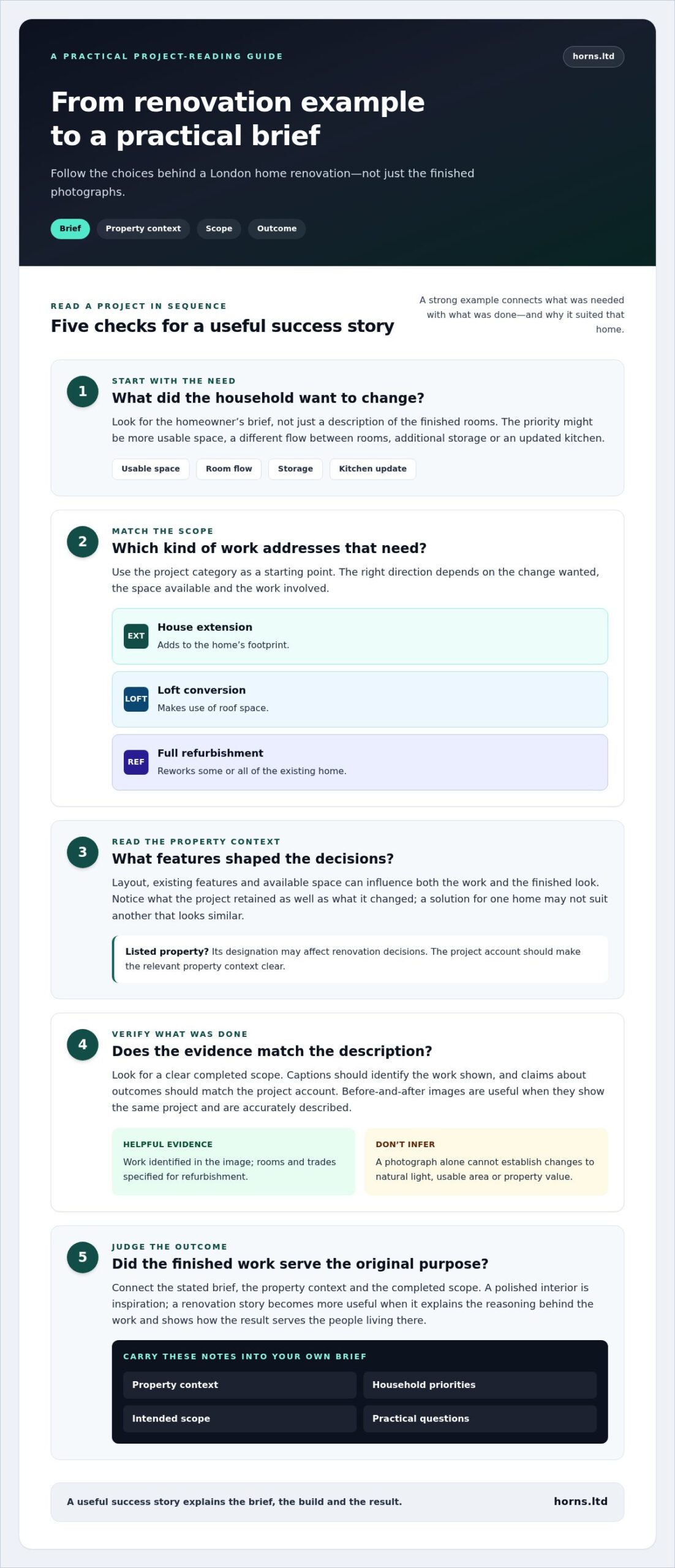
How to learn from renovation success stories before planning your project
Inspiration is most useful when it helps you define what your own home needs. Rather than copying a finished look, compare the property context, homeowner priorities and completed scope. These steps can turn appealing images into a clearer starting point for a renovation discussion.
Turn an inspiring project into a useful brief
- Name the outcome you want. Describe the change in everyday terms, such as needing more usable space, improving the flow between rooms or updating an existing kitchen.
- Separate function from appearance. Note practical requirements, such as layout or storage, alongside preferences for materials, colours and finishes. This separates what the home needs to do from how you’d like it to look.
- Compare the property context. Consider whether the example has a similar layout, existing features or available space. A project that looks relevant may have a different starting point or scope.
- Record questions and priorities. List what matters most, what you hope to retain and which project details you’d like to understand. These notes keep the discussion focused on your home, not someone else’s finished design.
The home renovation success stories london worth studying explain the brief and work completed, not just the appearance of the final rooms. Use that information to make your own priorities more specific.
Read case-study evidence with care
Separate project details, such as the rooms or trades included, from editorial description and your own interpretation of a photograph. Images can help you assess a finish or layout, but they don’t establish the full scope or prove a particular improvement. Before-and-after images are most informative when they show the same project and captions identify the work represented.
A focused brief gives a renovation discussion a useful foundation. Horns Construction supports residential projects from initial design and planning through completion, connecting your intended scope with the work being considered. Bring together your priorities, observations and questions before discussing how they could translate to your home.
Explore how Horns Construction supports renovation projects
Plan your London renovation with Horns Construction
A renovation starts with a clear view of what you want your home to do differently. Project examples can help you frame that ambition, but the right direction depends on your property, priorities and the work involved. Horns Construction works on residential projects in London, including house extensions, loft conversions and full home refurbishments, with support from initial design and planning through to completion.
Bring your ideas and priorities into an initial project discussion
Start with the home as it is now and the changes you’re considering. Identify the rooms or areas that matter most, what you want to improve in daily life and any features you hope to retain. It helps to separate practical needs, such as a different layout or more space, from preferences about finishes and appearance.
These details give the project discussion a considered starting point. The potential scope can be discussed in relation to the individual home and brief, rather than copied from a photograph or assumed from another project. You might bring notes on:
- the rooms or areas you’re considering changing
- your main practical priorities and design preferences
- the parts of the home you want to keep or work around
- questions raised by renovation examples you’ve seen
That preparation connects inspiration with the decisions a real project requires. It also gives you a clearer way to discuss what may be included, without assuming a fixed price, timescale or outcome before the project details are understood.
Explore the renovation approach that fits your home
If your brief centres on adding space, a house extension or loft conversion may be relevant to explore. If you want to update or rework existing rooms, a full home refurbishment may be a closer fit. These are starting points for discussion, not universal recommendations; the home and its requirements shape the appropriate scope.
Horns Construction supports these residential projects from initial design and planning through completion. The home renovation success stories london readers find most useful prompt questions about their own property rather than encourage them to copy another homeowner’s choices. Begin by identifying your goals, the parts of your home you want to change and the scale of work you’re considering.
Discuss your London renovation with Horns Construction
Shape a renovation around the way you live
The most useful home renovation success stories london do more than showcase a finished interior. They show how a clear brief, the character of a property and a considered scope come together to create a home that works for everyday life. Use examples as prompts, then define the priorities and practical changes that matter in your own home.
Whether you’re considering a house extension, loft conversion or full home refurbishment, the right direction depends on your property and goals. Horns Construction supports residential projects from initial design and planning through completion, helping bring the project into focus from early decisions to finished work.
Start with what you want your home to do differently, then discuss a scope that addresses your brief. Discuss your London renovation with Horns Construction.
Frequently Asked Questions
What makes a home renovation successful?
A successful renovation meets the homeowner’s brief, responds to the property and supports everyday needs. A useful project account explains the priorities behind the work, the completed scope and the evidence for its stated result. Photographs can show finishes and design choices, but they can’t explain the full project on their own. Look for context that connects the original need with the decisions made and the finished home.
Can I use London renovation success stories to plan my own project?
Yes. London renovation success stories can help you identify ideas and define what you want from your own home. Treat them as inspiration, not a blueprint: a similar-looking project may involve a different property, brief or scope. Note what appeals to you, what practical need it appears to address and what work the account documents. Then use those observations to frame a project discussion around your home and priorities.
How do I know whether an extension or refurbishment suits my home?
Start with the change you want to make. An extension may be worth exploring if your brief centres on adding space, while a refurbishment may better match goals focused on existing rooms. Neither option is automatically right for every home. Consider the property’s layout, your household’s priorities and the scope involved. Comparing examples with similar aims can help you clarify the questions to discuss as you consider a project direction.
What should a renovation case study include?
A helpful renovation case study describes the homeowner’s brief, relevant property context, work completed and decisions that shaped the scope. Before-and-after photographs can help readers understand visible changes, especially when captions identify the work and the images show the same project. Results and client quotations should be included only when supported by project information and approved for publication.
Can a London home renovation preserve the character of the property?
A renovation can take a home’s existing character into account, but the approach depends on the property and agreed scope. A project account may show how decisions relate to an existing layout or particular features when those details are documented. Look for evidence of what was retained or changed instead of assuming the same treatment suits every home. The aim is to shape the work around the individual property and brief.
How does Horns Construction support a home renovation project?
Horns Construction supports residential renovation projects from initial design and planning through to completion. Its services include house extensions, loft conversions and full home refurbishments, as well as kitchen and bathroom fitting and related trades. The scope is shaped around the property and homeowner’s brief. To discuss your London home, talk to Horns Construction about the changes you’re considering.