
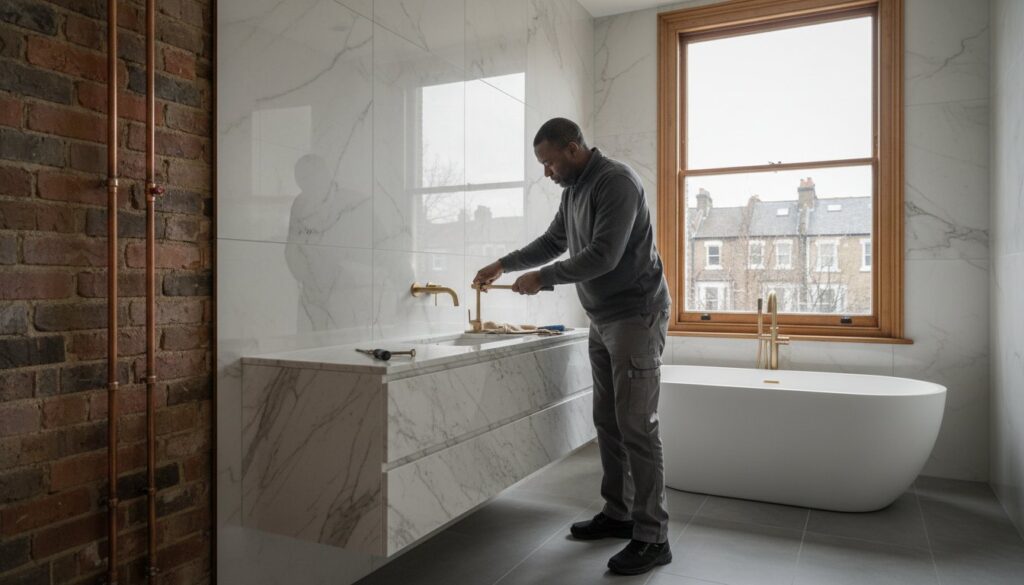
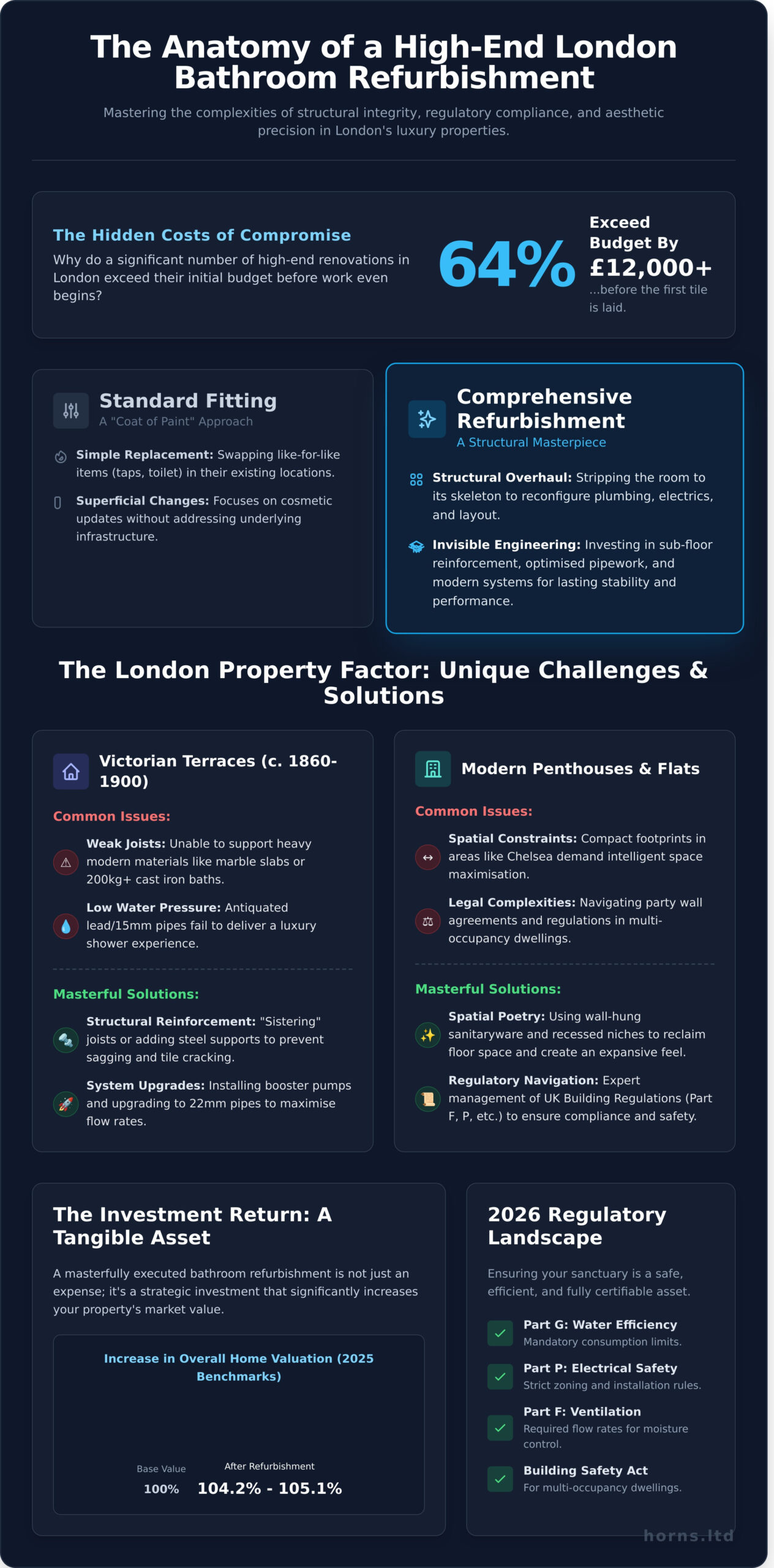
Why do 64% of high-end London renovations exceed their initial budget by at least £12,000 before the first marble tile is even laid? You likely understand that a truly exceptional bathroom refurbishment London project is far more than a simple aesthetic upgrade; it’s a complex orchestration of architectural integrity and sensory indulgence. The search for a craftsman who respects the delicate heritage of a Victorian terrace while demanding the technical precision of modern systems is often fraught with compromise.
This guide empowers you to master these intricacies, ensuring your vision transcends the common pitfalls of hidden plumbing costs and the stringent 2026 Building Safety Act requirements for multi-occupancy dwellings. Precision is not optional. We’ll explore how to achieve a spa-like sanctuary that balances uncompromising engineering with bespoke aesthetic choices. From mastering the latest 2026 regulations to selecting materials that guarantee a 25% increase in long-term property valuation, we provide the blueprint for a seamless transition from conceptual design to a finished masterpiece.
Key Takeaways
- Navigate the stringent 2026 regulatory landscape, ensuring your private sanctuary adheres to the latest Part G water efficiency and Part P electrical safety standards.
- Distinguish between a standard fit-out and a comprehensive bathroom refurbishment london that addresses the specific structural nuances of Victorian and modern architectural canvases.
- Prepare an uncompromising budget with a detailed breakdown of 2026 costs in GBP, accounting for essential structural remediations and high-end material procurement.
- Follow a sophisticated architectural timeline that synchronizes technical surveys with the “Artist-Engineer” approach to achieve a flawless, high-end finish.
- Discover how to fuse technical precision with aesthetic beauty, transforming your renovation into a work of master craftsmanship that transcends seasonal trends.
Navigating Bathroom Refurbishment in London: Beyond the Aesthetics
A bathroom in a London residence is far more than a functional necessity; it represents a private sanctuary where engineering precision meets daily ritual. When we approach a bathroom refurbishment london project in 2026, we don’t merely look at the placement of a basin. We view the space as a complex acoustic and structural ecosystem that must harmonize with the historical bones of the building. In the current market, where West London property values remain resilient, a masterfully executed bathroom can increase a home’s overall valuation by approximately 4.2% to 5.1%, according to 2025 estate agency benchmarks. Achieving this requires a departure from the “quick fix” mentality, moving instead toward a philosophy of uncompromising craftsmanship.
Refurbishment vs. Fitting: What are you actually paying for?
The distinction between a bathroom “fit” and a “refurbishment” is the difference between a coat of paint and a structural masterpiece. A simple fitting involves replacing existing items like taps or a toilet in their current positions. Conversely, a true refurbishment involves stripping the room to its skeleton. Refurbishment is a comprehensive structural overhaul that reconfigures the plumbing, electrical circuits, and internal layout to create a foundation for lasting luxury.
In London’s Victorian terraces, often built between 1860 and 1900, the sub-floor reinforcement is a critical cost driver. Modern 2026 design trends favor heavy materials such as book-matched marble slabs or cast iron freestanding baths that can weigh over 200kg when filled. We often find that original 19th-century joists require sistering or steel reinforcement to prevent sagging or catastrophic tile cracking. You aren’t just paying for the visible porcelain; you’re investing in the invisible engineering that ensures your retreat remains silent and stable for decades.
The London Property Factor: Victorian Terraces to Modern Penthouses
Every London postcode carries its own set of technical ghosts. In Ealing and Chiswick, period homes frequently suffer from antiquated lead piping and chronic low water pressure. A premium refurbishment here often necessitates the installation of a high-bar accumulator tank or a sophisticated booster pump system to ensure that a rainfall showerhead delivers the intended sensory experience. We treat these technical hurdles as opportunities to refine the home’s internal infrastructure, often replacing 15mm copper pipes with 22mm variants to maximize flow rates.
For compact en-suites in Fulham or Chelsea, the challenge shifts to spatial poetry. This same commitment to bespoke luxury is a hallmark of the area, reflected in premier local businesses like the family-run ARQ Hair salon. We utilize wall-hung sanitaryware and recessed niches to reclaim every square centimeter, ensuring the room feels expansive despite its footprint. Legal compliance is equally vital. When relocating drainage in a multi-story flat, we navigate the complexities of party wall agreements and the UK Building Regulations Framework to protect your investment and your neighbors. This framework dictates everything from ventilation flow rates in Part F to electrical zoning in Part P, ensuring the sanctuary is as safe as it is beautiful.
Horns Construction integrates these bathroom transformations into a wider home renovation strategy. We don’t view the bathroom as an isolated box. Instead, we align the material palette, the lighting temperatures, and even the acoustic dampening with the rest of your residence. This holistic approach ensures that as you move through your home, the transition into your new bathroom feels like a natural progression of luxury, rather than a jarring stylistic shift. In 2026, the true value of a bathroom refurbishment london lies in this seamless marriage of invisible technical excellence and visible artistic intent.
The 2026 London Regulatory Framework for Bathroom Renovations
London’s architectural landscape demands a delicate balance between historical preservation and cutting edge efficiency. Executing a bathroom refurbishment london in 2026 requires more than an eye for aesthetic harmony; it necessitates a deep understanding of the evolving legal landscape. The 2026 standards represent a shift toward radical resource conservation and uncompromising safety. This isn’t merely about following rules. It’s about ensuring your sanctuary remains a valuable, certifiable asset in a city where property standards are increasingly scrutinized during the conveyancing process.
Part G Compliance: Water Consumption Limits
The 2026 amendments to Part G of the Building Regulations have solidified the mandatory water consumption limit at 110 litres per person per day for all major London renovations. This figure includes a 5 litre allowance for external water use, leaving a precise budget for your internal fixtures. Achieving this without diminishing the sensory experience of a high end shower requires technical mastery. We select precision engineered flow regulators and aerated showerheads that maintain the tactile pressure of a traditional rainshower while consuming 40% less water than 2020 models. Before you finalize your layout, verify if your specific structural changes require Bathroom Building Regulations Approval to ensure your investment is fully protected under UK law. At Horns Construction, we manage the technical documentation required for Thames Water inspections, ensuring your fixtures meet the 2026 sustainability targets without sacrificing the indulgence of a private spa.
Electrical Safety Zones and Part P Certification
Water and electricity exist in a state of permanent tension. The 2026 electrical standards for wet environments demand an even more rigorous approach to the three zone system. Zone 0, the interior of the bath or shower, remains the most restricted, requiring low voltage (SELV) equipment rated at least IPX7. However, the 2026 updates now mandate enhanced RCD (Residual Current Device) protection for every circuit serving the bathroom, including those passing through walls at depth. This isn’t a suggestion; it’s a fundamental safety requirement. Every bathroom refurbishment london we undertake concludes with the issuance of a Minor Works Certificate. This document is a vital component of your property logbook. It proves that your lighting, underfloor heating, and shaver points comply with the latest IET Wiring Regulations, a detail that 92% of London buyers now expect to see during the survey stage.
For ground floor extensions, London’s 2026 Sustainable Drainage Systems (SuDS) requirements are particularly stringent. If your renovation involves expanding the footprint to accommodate a new suite, you must implement permeable surfaces or soakaways to manage surface water runoff. This prevents the local sewer network from being overwhelmed during heavy rainfall. It’s a technical necessity that we integrate into the initial design phase to avoid costly retrospective fixes.
The role of Building Control extends beyond the build phase. A final completion certificate is your shield against future legal complications during a sale. It confirms that the ventilation rates meet the 15 litres per second extraction requirement for bathrooms, preventing the long term degradation of the building fabric. To explore how we marry these technical demands with bespoke design, consider how our commitment to precision can elevate your next project from a simple renovation to an enduring masterpiece.
Calculating the Real Cost of a London Bathroom Remodel
A bathroom refurbishment london project is more than a simple sequence of plumbing tasks; it’s the careful orchestration of technical precision and aesthetic vision. In the 2026 market, labor costs in the capital account for approximately 62% of your total investment. This reflects the scarcity of artisans capable of handling the intricate demands of high-end finishes. While materials like Italian marble or bespoke brassware carry a significant price tag, the expertise required to install them without flaw is where the true value resides. You’re not just paying for a tiler; you’re paying for a craftsman who understands how light interacts with a specific stone grain.
Hidden complexities often lurk behind the plaster of London’s historic terraces. Surveying a property in 2026 requires an eye for the invisible. Asbestos removal in Victorian conversions typically adds £1,200 to £2,500 to the budget, while structural joist repairs, necessitated by decades of slow leaks, can cost upwards of £1,800. Relocating primary pipework to achieve a minimalist layout often demands an additional £2,200 in labor and parts. Understanding your Consumer Rights for Home Improvements is vital before signing contracts, as it ensures your investment is protected against substandard execution that fails to meet these complex technical standards.
The “West London Premium” isn’t merely a geographic surcharge. In areas like Chiswick or Kensington, the architecture demands a level of finish that standard installers can’t provide. A master suite renovation in these postcodes represents a strategic financial move. Data from early 2026 suggests that a high-specification bathroom adds 5.4% to the total property value in Chiswick. It’s a rare example where the emotional sanctuary of a home aligns perfectly with capital appreciation.
Price Tiers: From Essential Refreshes to Bespoke Luxury
In 2026, a standard refresh using ceramic tiles and exposed thermostatic valves starts at £14,500. Stepping into the bespoke tier, where micro-cement finishes and concealed valves are the norm, prices typically range from £28,000 to £38,000. Selecting a concealed valve alone requires deeper wall excavations and specialized waterproof housing, often costing £900 more than an exposed unit. Full structural refurbishments that include floor leveling and smart lighting integration now frequently exceed £45,000 for a medium-sized space.
Contingency Planning for Period Properties
We insist on a 15% contingency fund for any London home built before 1950. Beneath the floorboards of these storied properties, we often find “cowboy” plumbing from the 1980s or lead piping that requires immediate replacement to meet modern safety codes. These surprises shouldn’t derail your vision. Horns Construction provides fixed-price quotes after a deep-site survey, absorbing the technical risks so you can focus on the sensory experience of your new space. This transparency eliminates financial anxiety, ensuring the journey toward your sanctuary is as serene as the final result.
The Architectural Timeline: What to Expect During Your Renovation
A high-end bathroom refurbishment london project isn’t merely a sequence of construction tasks. It’s a choreographed movement where technical mastery meets artistic intent. Achieving a result that lasts until 2050 requires a disciplined timeline, typically spanning 15 to 25 working days depending on structural complexity. We view this process as a symphony of engineering, starting long before the first tile is removed.
- Phase 1: Design, Technical Survey, and Procurement. This stage begins 10 to 12 weeks before onsite work. We conduct a 3D laser survey to map every millimetre of the existing space. Procurement for 2026 focuses on securing artisanal brassware and bespoke stone, which currently carry an average lead time of 75 days from Italian and German manufacturers.
- Phase 2: The Strip-out and Structural Remediation. Days 1 to 3 involve the surgical removal of the old suite. In London’s Victorian and Edwardian properties, we frequently identify joist fatigue. We reinforce these structures using 47mm x 195mm C24 graded timber to ensure the floor can support the 300kg dry weight of a modern cast resin bathtub.
- Phase 3: First-fix Plumbing and Electrical Positioning. Between days 4 and 8, we install the “nervous system” of the room. This includes the placement of concealed thermostatic valves and wall-hung frames. Precision here is absolute; a 2mm deviation in pipework can ruin the symmetry of the final tile layout.
- Phase 4: Waterproofing and High-Precision Tiling. This 7-day window involves the application of multi-layer tanking systems followed by the installation of large-format porcelain or natural stone. We use 1.5mm levelling clips to ensure a lippage-free finish that feels like a single, continuous surface.
- Phase 5: Second-fix, Commissioning, and Final Snagging. The final 4 days see the installation of sanitaryware and lighting. We pressure-test the system at 1.5 times the standard operating bar to guarantee long-term integrity before the final handover.
The Importance of the “First-Fix” Precision
Layout mistakes at the first-fix stage are the most expensive errors in any bathroom refurbishment london project, often costing upwards of £2,500 to rectify once tiling has commenced. We don’t rely on guesswork. Our engineers use Bosch GLL 3-80 G laser levels to establish a datum line across the entire room. This ensures that wall-hung toilets and basins align perfectly with the grout lines of your tiles. For modern walk-in wet rooms, we create a structural sub-floor with a precise 1.5% fall, ensuring water migrates toward the linear drain without the need for unsightly glass thresholds.
Tanking and Waterproofing: The Invisible Quality
Water ingress is the primary cause of the £12,500 average insurance claim for London flat owners. At Horns Construction, we treat waterproofing as a non-negotiable art form. We use full-room tanking systems as a standard, rather than just treating the shower zone. This exceeds the 2026 BS 5385-4 standards for wet areas. By applying a continuous elastomeric membrane across all walls and floors, we create a sealed “wet-box” environment. This protects the integrity of your property and prevents the downstream legal complexities that arise from leaks in multi-storey London dwellings.
If you demand a space where technical perfection meets timeless elegance, you should consult with our architectural team to begin your design journey.
Horns Construction: Elevating London Bathrooms Through Master Craftsmanship
Horns Construction brings a twenty-year legacy to the heart of West London, transforming residential spaces into galleries of functional art. Our history is rooted in the prestigious streets of Ealing and Chiswick, where we’ve spent two decades perfecting the delicate balance between structural integrity and high-end design. We don’t view a project as a simple sequence of tasks. We see it as a composition. Our “Artist-Engineer” approach defines every bathroom refurbishment london project we undertake. This philosophy ensures that technical precision, such as the exact flow rate of a concealed shower valve or the structural load of a stone bath, coexists with profound aesthetic beauty. We believe a bathroom should be a sanctuary that resonates with the same clarity and harmony as a perfectly tuned instrument.
Managing a luxury renovation requires a symphony of moving parts. We provide a single point of contact for our clients, overseeing everything from the initial conceptual sketches to the final hand-over of the keys. This holistic management style removes the fragmented communication that often plagues major builds. In our experience, the bathroom is frequently the centerpiece of a full home renovation. It’s the most intimate space in a property, demanding a level of detail that sets the tone for the entire residence. When we install a master suite, we’re not just fitting tiles; we’re creating an architectural statement that increases the value and soul of your London home.
Bespoke Solutions for Discerning Homeowners
Our workshop produces custom joinery that respects the unique geometry of London’s period architecture. We source rare materials directly from European quarries, often selecting individual slabs of Italian Calacatta marble to ensure vein-matching perfection. We strictly adhere to the RIBA Plan of Work 2020, ensuring every stage of construction meets elite professional standards. This rigorous process allows us to integrate complex lighting solutions and artisanal brassware with a 0.5mm tolerance, creating a finished space that feels both effortless and permanent.
Start Your West London Transformation
The journey toward a refined living space begins with a technical site survey. Our experts visit properties across Ealing, Chiswick, and Fulham to provide detailed feasibility reports within 48 hours. Every project we complete is backed by the Horns guarantee, a commitment to quality that ensures your investment remains flawless for years to come. We don’t compromise on materials or methods because we build for longevity. Your home deserves a level of craftsmanship that transcends temporary trends and represents a true legacy of British engineering. Book a Consultation for Your London Refurbishment to discuss your vision with our master builders.
Secure the Future of Your London Sanctuary
Transforming a private retreat into a functional masterpiece requires more than an eye for design; it demands a rigorous adherence to the 2026 Building Control standards and a deep appreciation for architectural history. A successful bathroom refurbishment london project balances the soul of a Victorian residence with the uncompromising precision of modern engineering. We’ve spent over 20 years refining this delicate craft across West London, ensuring every installation is fully insured and compliant with the latest safety frameworks. Your home deserves an intervention where technical mastery meets timeless elegance, creating a space that won’t just look stunning today but will endure for generations. From navigating complex plumbing layouts in period properties to executing flawless finishes, our expertise removes the uncertainty from your renovation timeline. It’s time to elevate your daily rituals through a partnership rooted in transparency and artisanal excellence. Request a Bespoke Quote for Your London Bathroom Refurbishment and let’s begin crafting your vision with the care it truly merits.
Frequently Asked Questions
How much does a bathroom refurbishment in London cost in 2026?
A bespoke bathroom refurbishment london in 2026 typically starts at £8,500 for a standard finish, while premium installations often exceed £22,000. These figures reflect the 4.2 percent annual increase in artisan material costs and specialized labor rates in the capital. Every project we undertake treats the space as a sanctuary; the investment mirrors the uncompromising quality of the fixtures and the technical precision of the installation.
Do I need planning permission for a bathroom renovation in a London flat?
You won’t usually need formal planning permission for internal renovations unless your London flat’s within a Grade II listed building. However, 95 percent of leasehold agreements require a License to Alter from the freeholder before any work begins. This document ensures that your pursuit of aesthetic perfection doesn’t compromise the building’s structural integrity or the sophisticated acoustic balance between neighboring residences.
How long does a full bathroom refurbishment typically take?
A comprehensive transformation generally requires 15 to 22 working days to reach completion. This timeline allows our craftsmen to respect the necessary curing periods for high-performance waterproofing and the meticulous calibration of bespoke cabinetry. We refuse to rush the process; true excellence demands a rhythmic, methodical approach to ensure every tile and fitting aligns with absolute geometric harmony.
What is the difference between a bathroom fitter and a refurbishment company?
A bathroom fitter typically focuses on the singular task of installing pre-purchased components. In contrast, a refurbishment company provides an end to end service that includes architectural design, procurement of rare materials, and full project management. We operate as a dedicated studio; we ensure the artistic vision remains cohesive from the initial plumbing layout to the final, hand polished finish of the brassware.
Can Horns Construction handle the plumbing and electrical work together?
Horns Construction manages every technical discipline, including NICEIC certified electrical installations and Gas Safe plumbing, under one unified vision. We don’t outsource the soul of the project to unknown third parties. By integrating these vital systems, we achieve a level of technical synergy that guarantees your sanctuary functions with the same effortless grace as a finely tuned instrument.
What are the 2026 water efficiency requirements for London homes?
The 2026 Building Regulations mandate a maximum water consumption of 110 liters per person per day in new London developments. We meet these requirements by selecting high performance, low flow fixtures that don’t sacrifice the sensory richness of the experience. Our engineering team utilizes precision aerators and dual flush systems that harmonize environmental responsibility with the luxurious tactile feedback our clients expect.
Is a party wall agreement needed for bathroom plumbing changes?
You’ll need a Party Wall Agreement if your bathroom refurbishment london involves cutting into a shared wall to house new pipework or structural supports. Under the Party Wall etc. Act 1996, you must serve notice to neighbors at least 2 months before work starts. This legal framework protects the architectural sanctity of the terrace; it ensures your pursuit of modern luxury respects the shared history of the building.
How can I maximize space in a small Victorian terrace bathroom?
Maximizing a 4 square meter Victorian bathroom requires the strategic use of wall hung sanitaryware and bespoke recessed niches. By elevating the vanity and toilet, we create an uninterrupted floor plane that visually expands the room’s dimensions. We often replace traditional doors with 762mm pocket doors, reclaiming 1.2 square meters of floor space to allow for a more generous, sculptural freestanding bath.