

Did you know that failing to appoint a Principal Designer for your West London renovation doesn’t just risk your timeline, but can legally shift the entire burden of site safety directly onto your own shoulders? It’s a sobering reality for many homeowners who find that the pursuit of architectural perfection often clashes with the rigid, uncompromising world of statutory compliance. You’ve likely spent months obsessing over the acoustic properties of your new listening room or the hand-finished joinery in your study; it’s frustrating when the cdm regulations feel like an impenetrable barrier of jargon and red tape.
We understand that you demand the same level of precision in your legal obligations as you do in the craftsmanship of your home. This 2026 professional guide promises to demystify your responsibilities under the Construction (Design and Management) Regulations 2015, giving you the absolute confidence that your project is built on a foundation of safety. We’ll explore the vital roles your contractors must play, the documents required to avoid heavy HSE fines, and how to select a team that values technical excellence as much as you do.
Key Takeaways
- Discover why every residential project in London, regardless of scale, must adhere to the cdm regulations to ensure uncompromising site safety and absolute legal compliance.
- Learn how the appointment of a Principal Designer during the initial design phases provides the necessary expert oversight to harmonise safety with your architectural vision.
- Understand the “Transfer of Duties” mechanism, a vital legal protection that ensures homeowners are shielded from professional liability throughout the renovation process.
- Identify the essential documentation, such as the F10 notification and the Health and Safety File, required to maintain the enduring value and safety of your West London estate.
- Explore how integrating CDM compliance into a bespoke design-and-build workflow creates a seamless transition from conceptual artistry to a secure, high-end reality.
What are the CDM Regulations 2015 for Residential Projects in London?
The Construction (Design and Management) Regulations 2015 represent the definitive legal framework for health and safety in the UK building sector. For a homeowner in West London, these rules aren’t merely administrative hurdles; they’re the invisible scaffolding that ensures a project remains a masterpiece of precision rather than a site of avoidable risk. Since 6 April 2015, every residential renovation, from a bespoke kitchen extension in Chelsea to a sophisticated basement excavation in Kensington, must adhere to these standards. The cdm regulations mandate that safety is woven into the very fabric of the design process, ensuring that risks are mitigated long before a single brick is laid or a joist is cut.
The core objective of these rules is the seamless integration of health and safety into the management of construction. It’s a move away from the chaotic building sites of the past toward a model of disciplined choreography. In London’s high-stakes property market, where structural integrity is paramount, the regulations provide a structured approach to identifying hazards. Whether you’re planning a glass-roofed loft conversion or a multi-level subterranean suite, the law ensures that every professional involved, from the architect to the specialist contractor, understands their specific safety obligations.
The Evolution of Safety in London Construction
Historically, domestic projects enjoyed a degree of exemption, but the 2015 revision removed this veil of informality to protect homeowners and workers alike. This shift moved the industry from a reactive “fix it on site” mentality to a proactive, design-led philosophy. In the dense urban tapestry of London, where Victorian terraces stand millimetres apart and narrow streets limit access, the margin for error is non-existent. Managing a complex basement dig in a £4 million townhouse requires a level of engineering foresight that rural projects rarely demand; the cdm regulations provide the necessary rigour for such high-density environments.
Key Terminology for Homeowners
Understanding the lexicon of compliance is the first step toward a successful build. A “Domestic Client” is any individual having construction work carried out on their own home, or the home of a family member, which isn’t done as part of a business. The “Pre-construction Phase” involves the delicate art of planning and design, while the “Construction Phase” covers the actual physical manifestation of those plans. CDM 2015 is the legal framework that organises safety roles for every UK building site. By defining these roles clearly, the regulations ensure that quality and safety are never compromised by ambiguity.
Understanding Key Roles: The Principal Designer and Contractor in West London
Since the 2015 update to the cdm regulations, the legal framework for domestic renovations has mirrored the rigour of commercial construction. A standard high-end project involves five primary duty holders: the client, the designer, the principal designer, the contractor, and the principal contractor. For a homeowner, these roles aren’t just administrative hurdles. They represent a structured symphony of safety and technical excellence. While the homeowner is the “Client,” the HSE guidance for domestic clients specifies that your duties usually transfer to the professionals you appoint. At Horns Construction, we embrace these responsibilities with the same uncompromising precision we apply to bespoke acoustic engineering, ensuring your home remains a sanctuary from the first day of site preparation.
The Principal Designer: Safety by Design
Your architect or lead designer typically adopts this role during the initial 12 to 16-week design phase. It’s a position defined by foresight. The Principal Designer doesn’t just sketch aesthetics; they identify and eliminate potential risks before a single brick is laid. In the dense architectural fabric of West London, this involves intense co-ordination with structural engineers who understand the unique challenges of London’s Victorian and Edwardian properties. When we modify a 120-year-old Victorian terrace, the Principal Designer ensures the structural integrity of party walls is never compromised. They translate complex safety requirements into actionable design solutions, ensuring the cdm regulations serve as a blueprint for quality rather than a mere checklist.
The Principal Contractor: Managing the Site
Once the project moves from the screen to the soil, the Principal Contractor takes command. They’re responsible for the physical behaviour of the site, managing a diverse team of sub-contractors including plumbers, electricians, and specialist joiners. In compact Chiswick gardens or narrow Kensington mews, space is a finite luxury. We manage these constraints by providing dedicated welfare facilities and conducting daily site inductions within a 40-square-metre footprint. A clear Construction Phase Plan is vital here. It dictates how we’ll handle logistics in busy residential postcodes, ensuring that 100% of site activities align with the highest safety standards.
We assume these pivotal roles to provide a seamless, uncompromising service that protects your investment and your peace of mind. If you’re looking for a partner who treats every structural detail as a work of technical art, our team is ready to guide you through the complexities of the build process.
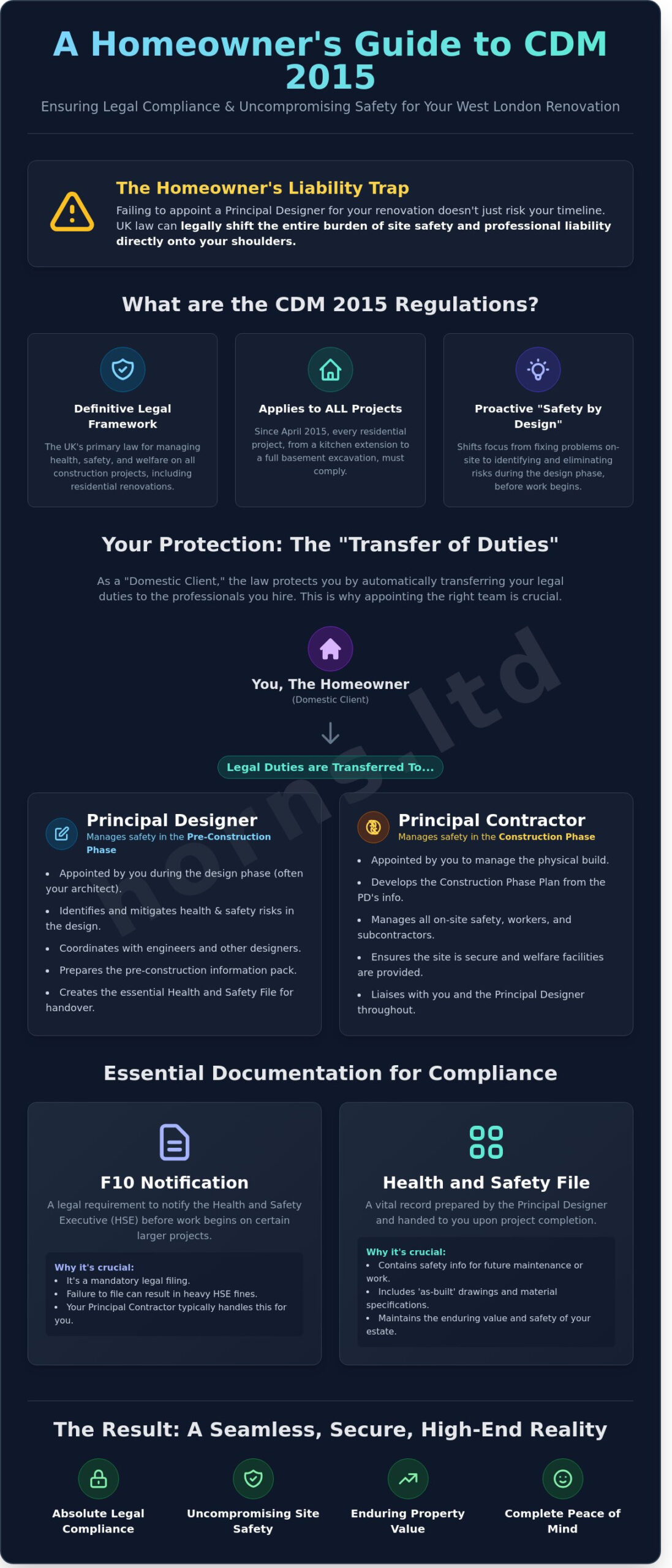
Domestic vs. Commercial Duties: Why Your London Renovation is Protected
The architecture of a London home is more than just stone and timber; it’s a sanctuary of personal expression and acoustic harmony. When you embark on a high-end renovation, the legalities of the cdm regulations might seem like a dissonant chord in an otherwise perfect symphony. However, the law is designed to protect the domestic client from the burden of technical liability. It’s a framework that respects your role as a patron of craft rather than a site manager, ensuring your focus remains on the aesthetic and functional evolution of your property.
The Automatic Transfer of Responsibility
Homeowners often worry about the personal liability of a building site, yet the law provides a sophisticated safety net. Under the 2015 rules, your duties automatically transfer to the principal contractor or the designer. It’s a seamless transition that occurs by default. You don’t need to be an expert in site safety to enjoy the transformation of your living space. According to the official CDM 2015 guidance for homeowners, these responsibilities shift the moment a professional is engaged. For bespoke London refurbishments exceeding £250,000, appointing a Principal Designer in writing is a mark of true sophistication. It ensures every aesthetic choice is backed by rigorous safety planning. You gain the freedom to focus on the artistry of the finish while experts handle the legal architecture.
Special Considerations for London Property Developers
Distinguishing between a domestic project and a commercial venture is vital for your legal security. If you’re renovating a Victorian terrace in Hammersmith for your family, you’re a domestic client. If that same property is a buy-to-let investment intended for the rental market, the cdm regulations treat you as a commercial client. This shift occurs because the work is conducted in the course of a business. Commercial projects require a more robust paper trail, including a detailed Construction Phase Plan and a comprehensive Health and Safety File. In 2023, nearly 15% of London residential projects fell into this commercial category due to the city’s active investment market. Choosing a firm that understands this nuance is essential. It prevents legal friction and protects your investment’s long-term value, ensuring the project meets the same uncompromising standards as a professional development.
Essential Documentation: The Health and Safety File and F10 Notifications
The creation of a refined living space requires more than just architectural vision; it demands a meticulous record of every structural decision and technical detail. Under the cdm regulations, two specific pillars of documentation ensure both the safety of your project and the long-term value of your property: the F10 Notification and the Health and Safety File. These are not merely bureaucratic hurdles but essential safeguards that preserve the integrity of your home’s legacy.
When is a Project Notifiable to the HSE?
Not every minor renovation requires formal notification, yet many ambitious London projects cross the threshold without the homeowner realising. You must notify the Health and Safety Executive (HSE) if construction work is scheduled to last longer than 30 working days and involve more than 20 workers at any one time. Alternatively, if the total volume of labour exceeds 500 person-days, the project becomes notifiable. A typical £300,000 basement conversion in Kensington or a substantial wrap-around extension in Richmond often hits these numbers within the first twelve weeks of work. Your Principal Contractor usually submits the F10 form, but the ultimate responsibility to ensure this notification is live rests with you as the client.
The Value of the Health and Safety File
Think of this file as the definitive logbook for your home’s technical and structural systems. It captures the “as-built” reality of the project, including the exact location of utility lines, the specific materials used in the facade, and the maintenance requirements for high-end plant equipment. This document represents the uncompromising precision of your build. During the conveyancing process, approximately 85% of specialist London solicitors now request this file to prove the property meets modern safety standards. Without it, a future sale or a secondary refurbishment could be significantly delayed or devalued.
The information gathered in the final handover includes:
- Detailed “as-built” drawings that reflect the final structural state rather than the initial intent.
- Technical data sheets for all installed equipment, such as bespoke heating systems or acoustic treatments.
- A clear register of materials used, ensuring future contractors know exactly what lies behind the plasterwork.
- Specific maintenance schedules to ensure the longevity of the home’s mechanical systems.
Securing these documents protects the architectural and emotional investment you have made. To ensure your next project meets these exacting standards and maintains its value, explore how we approach bespoke architectural excellence through disciplined project management.
Uncompromising Safety: How Horns Construction Navigates CDM in West London
At Horns Construction, we believe a home renovation is a symphony where technical precision and artistic vision must coexist. We don’t view the cdm regulations as a restrictive framework. To us, they’re the essential rhythm that ensures the safety of every craftsman and the longevity of every structure we touch. Our commitment to architectural excellence means we integrate legal compliance into the very first sketch of your design-and-build project in Ealing and across West London.
Choosing a partner who manages both design and execution provides you with a single point of accountability. This holistic stewardship eliminates the friction often found between separate architects and builders. We take full responsibility for your legal and structural needs, allowing you to focus on the creative evolution of your space. Your home refurbishment becomes a masterpiece of form, underpinned by the silent, sturdy confidence of functional safety. It’s a bespoke service where engineering meets art.
A Tailored Approach to London Renovation
West London’s Victorian and Edwardian architecture requires a specialist’s touch. Since 2004, we’ve managed the unique risks inherent in these period properties, where 100-year-old masonry meets modern structural demands. Our team develops a robust Construction Phase Plan for every project, from £150,000 kitchen extensions to £1.5 million full-scale renovations. We ensure that safety protocols never compromise the aesthetic elegance of your cornicing or the flow of your open-plan living area. Every risk is mitigated before the first hammer falls, often working closely with qualified structural engineers near me who specialise in London’s complex building requirements.
Starting Your Project with Confidence
Clarity is the cornerstone of a successful build. Our initial consultation defines every role and responsibility under the cdm regulations, removing the ambiguity that often plagues domestic projects. With 20 years of experience in the London market, we’re already aligning our processes with the anticipated 2026 regulatory standards. This forward-thinking approach ensures your investment is protected against future legislative shifts and structural failures. Contact Horns Construction today to discuss your West London project and begin the journey toward a home that is as safe as it is beautiful.
Elevating Your Vision Through Uncompromising Safety Standards
Navigating the complexities of the cdm regulations isn’t merely a legal obligation for your 2026 renovation; it’s a fundamental commitment to the enduring value of your property. By appointing a Principal Designer and Contractor early in the process, you ensure that every architectural detail in your Ealing or Chiswick home is supported by a robust Health and Safety File. This meticulous documentation protects your investment and ensures that your domestic project meets the same rigorous standards as the most prestigious commercial developments in London. It’s about creating a legacy of safety that lasts as long as the structure itself.
At Horns Construction, we’ve spent over 20 years perfecting the art of high-end residential builds across Fulham and West London. We manage the entire lifecycle of your project, from the initial design concepts to the final safety certification, with the precision of a master craftsman. Our approach transforms the technical requirements of the 2015 regulations into a seamless part of a bespoke building experience. You deserve a home that reflects your pursuit of excellence without the burden of regulatory stress. Begin your uncompromising home transformation with Horns Construction and experience the peace of mind that comes from two decades of specialist expertise. We look forward to crafting a space where timeless elegance and absolute safety coexist in perfect harmony.
Frequently Asked Questions about CDM Regulations
Do CDM regulations apply to a small kitchen extension in London?
Yes, the cdm regulations apply to every kitchen extension in London, regardless of the project’s scale or complexity. Since April 2015, the law encompasses all domestic building projects to ensure a foundation of safety. Even a modest £50,000 renovation requires a clear health and safety structure. You must ensure your builders provide a written Construction Phase Plan before they strike the first blow on site.
Who is legally responsible for health and safety on a domestic building site?
Legal responsibility for health and safety typically rests with your Principal Contractor and Principal Designer. Under the 2015 framework, a homeowner’s duties automatically transfer to these appointed professionals unless a specific written agreement states otherwise. This ensures that the technical mastery of the build is matched by a rigorous commitment to site welfare. Your role is to appoint competent experts who respect the sanctity of the architectural process.
What is an F10 notification and does my project need one?
An F10 is a formal notification sent to the Health and Safety Executive when a project exceeds 500 person days of labour. It’s also required if work lasts longer than 30 working days and has more than 20 workers on site simultaneously. For a standard 12 week extension, your contractor should handle this digital filing. It acts as a transparent declaration that your project adheres to the highest standards of professional oversight.
Can I be fined as a homeowner if my contractor ignores CDM regulations?
Homeowners are rarely fined directly, provided they’ve appointed a Principal Designer and Contractor to manage the cdm regulations. However, if you fail to appoint these roles, you could technically inherit their legal liabilities. The HSE issued 541 prosecutions in 2022/23 across various sectors. Appointing a specialist team ensures your investment remains a sanctuary of art and design rather than a legal burden.
What is a Health and Safety File and why do I need it after the build?
The Health and Safety File is a curated collection of technical drawings, material specifications, and maintenance manuals delivered upon completion. It serves as the definitive biography of your home’s structural evolution. You’ll need it for any future repairs to ensure engineers understand the hidden complexities of your property. Without this document, simple maintenance can become a dangerous and costly exercise in guesswork.
How do I know if my builder is CDM compliant?
A compliant builder will always present a bespoke Construction Phase Plan before arriving on site. They should offer evidence of their Public Liability Insurance, typically covering at least £5 million, and provide detailed risk assessments. If a contractor can’t explain their safety protocols with precision, they lack the meticulous mindset required for high-end domestic architecture. True craftsmanship is never separated from the discipline of safety.
Does CDM apply to DIY projects or only professional builds?
CDM duties only apply when you hire a professional to carry out the work. If you’re undertaking a 100% DIY project with no external labour, the regulations don’t impose duties on you. However, as soon as you hire a single tradesperson for a day, the legal framework activates. Most London projects involve at least one professional, meaning the standards of the 2015 Act almost always apply to your renovation.
What happens if I want to sell my London home and don’t have the CDM paperwork?
Missing CDM paperwork can stall a property transaction or lead to a significant reduction in the final sale price. During the conveyancing process, a buyer’s solicitor will request the Health and Safety File to verify the integrity of recent works. In a competitive market where 30% of sales fall through, having a complete documentary trail proves your home is a masterpiece of both form and legal compliance.