
A truly exceptional home is a symphony where every note must be played in perfect unison. You likely recognise that the inherent complexity of a London renovation often creates a cacophony of miscommunication and escalating costs. It’s exhausting to act as the weary mediator between an architect’s ethereal vision and a builder’s practical reality, especially when the 2024 planning landscape feels increasingly restrictive. This definitive guide to design and build london demonstrates how to restore harmony to your project by unifying architectural integrity and structural craftsmanship under one roof.
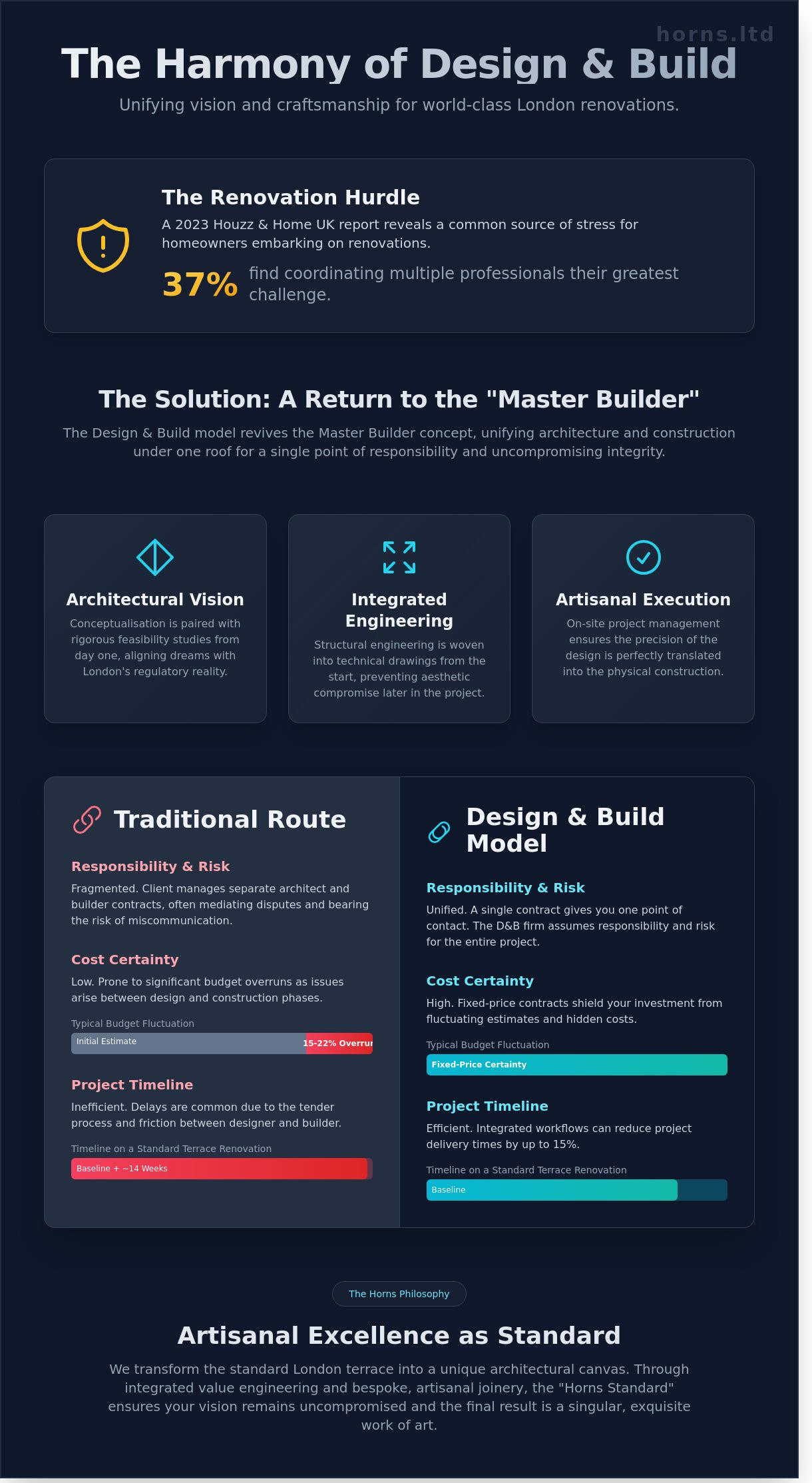
The 2023 Houzz & Home UK report highlighted that 37% of homeowners find coordinating multiple professionals to be their greatest renovation hurdle. We’ll show you how to transcend these common anxieties by adopting a model that provides fixed-price certainty and the artisanal quality required for a world-class residence. This article examines the specific stages of the integrated process that protect your time and ensure your vision remains uncompromised from the initial concept to the final, exquisite handover.
Key Takeaways
- Understand the modern resurgence of the “Master Builder” concept, where a single point of responsibility ensures your vision is executed with uncompromising architectural integrity.
- Discover why the design and build london model offers superior cost certainty through fixed-price contracts, shielding your investment from the fluctuating estimates of traditional routes.
- Navigate the complexities of West London’s regulatory landscape, from managing Permitted Development rights to securing permissions in boroughs like Ealing, Chiswick, and Hammersmith.
- Learn how the “Horns Standard” transforms a standard London terrace into a unique architectural canvas through artisanal carpentry and bespoke joinery.
- Explore the temporal and financial logic of integrated value engineering, which eliminates hidden architectural tender costs to protect your project’s timeline and budget.
What is Design and Build? The “Master Builder” Concept in London
The design-build model represents a return to the “Master Builder” philosophy, a tradition where the roles of architect and contractor are unified. It replaces the fragmented, often adversarial relationship between separate entities with a single-point-of-responsibility contract. Historically, the Master Builder was the sole creator; they possessed the technical acumen of an engineer and the aesthetic soul of an artist. In modern London, this integrated approach has seen a significant resurgence as homeowners seek a more cohesive journey. Choosing a bespoke design and build london firm means the client enters into a partnership with one team that manages every nuance from the first sketch to the final polish.
London’s property market demands this level of integration. The city’s architectural fabric, woven with Victorian terraces and sensitive conservation areas, leaves no room for error. By consolidating design and construction, the homeowner transfers the burden of risk to the expert. It’s a profound emotional shift. Instead of managing a complex supply chain or mediating between a designer and a builder, the client focuses on the manifestation of their vision. It’s about peace of mind. The expert takes ownership of the timeline, the budget, and the structural integrity, ensuring the final result is a singular, uncompromising work of art.
The Core Components of an Integrated Project
Success in the design and build london landscape relies on the seamless fusion of three pillars. First, architectural conceptualisation must be paired with rigorous feasibility studies to ensure dreams align with the reality of London’s 27 different planning authorities. Second, structural engineering isn’t a secondary phase; it’s integrated into the technical drawings from day one to prevent aesthetic compromise. Finally, on-site project management ensures artisanal execution. This ensures that the precision of the initial design isn’t lost during the physical construction, maintaining the purity of the original intent through every brick and beam.
The RIBA Plan of Work in a Design-Build Context
The RIBA Plan of Work 2020 provides the framework for this journey, yet the design-build model refines it for modern efficiency. Stages 0 through 4, covering strategic definition to technical design, are compressed through overlapping workflows. This integration can reduce project delivery times by up to 15% compared to traditional procurement methods. The lead designer acts as a structural guardian throughout the build phase. They ensure that as the project moves from paper to reality, the design intent remains untarnished. This continuity prevents the common “value engineering” traps that often dilute the quality of high-end residential projects when handled by disconnected parties.
Traditional vs. Design-Build: Selecting the Right Path for Your Renovation
Selecting the path for a London property renovation requires an understanding of how vision translates into tangible reality. The traditional route often resembles a fragmented ensemble where the architect and the contractor play from entirely different scores. In contrast, the design and build london model operates as a single, meticulously conducted orchestra. By unifying the creative and technical phases from the very first sketch, homeowners frequently avoid the 15% to 22% budget overruns that typically plague traditional tenders. This model doesn’t just offer a service; it offers a commitment to architectural fidelity that protects the integrity of your original concept.
Time remains the most precious commodity in the capital’s property market. A unified model can reduce the total project timeline by approximately 14 weeks on a standard Victorian terrace renovation. This efficiency stems from the elimination of the “Architect vs. Builder” friction. When the team designing a structural glass extension is the same team responsible for its installation, technical ambiguity vanishes. There’s no delay while waiting for a third-party consultant to approve a minor structural adjustment; the solution is engineered in-house, keeping the programme moving without compromising on the artisan quality of the finish.
When is the Traditional Route Better?
Some projects demand a level of experimental artistry that defies standard timelines or commercial logic. If you’re commissioning a high-concept architectural statement with no budgetary constraints, the traditional route allows for endless, unhurried iteration. It also suits the rare homeowner who possesses the technical expertise to dedicate 25 hours a week to acting as their own project manager. However, for most residential projects exceeding the £200,000 threshold, the logic of a unified approach becomes undeniable. It represents the tipping point where the risks of fragmented communication begin to outweigh the perceived benefits of separate consultants.
The Logic of Single-Point Accountability
The true luxury of a design-build partnership lies in the removal of “finger-pointing.” If a bespoke marble slab arrives with a hairline fracture or a custom joinery unit doesn’t align with the sub-floor, there’s no debate between the designer and the installer about who holds the liability. This total accountability streamlines the procurement of rare materials and ensures a natural integration with complex home refurbishment projects. Every detail, from the acoustic properties of a listening room to the tactile finish of a hand-forged handle, is managed under one roof. This holistic oversight ensures that the technical precision of the build matches the emotional resonance of the design.
Navigating London’s Regulatory Landscape: Planning, Party Walls, and Permissions
London’s architectural canvas is bound by a rigorous framework of statutes that demand more than just vision; they require surgical precision. In West London boroughs like Ealing, Chiswick, and Hammersmith, the path to expansion is often a delicate negotiation between ambition and preservation. Navigating Permitted Development rights for a rear extension or a loft conversion isn’t a simple administrative task. It’s an exacting process where the 2015 General Permitted Development Order dictates strict limits on volume, often capped at 40 cubic metres for terraced homes and 50 for semi-detached properties. A sophisticated design and build london partner acts as a conductor, synchronising technical drawings with the uncompromising requirements of Thames Water build-over agreements. These agreements are essential for any work within 3 metres of a public sewer, ensuring that new foundations don’t jeopardise the city’s vital infrastructure.
Conservation Areas and Listed Buildings
In the prestigious enclaves of Fulham and Chelsea, the dialogue between Victorian heritage and modern functionality is particularly complex. Local planning officers frequently apply Article 4 Directions, which remove certain Permitted Development rights to protect the original fabric of the streetscape. Success requires a deep respect for Edwardian proportions and the craftsmanship of the past. We focus on preserving intricate brickwork and original chimney stacks while introducing high-performance acoustic glazing that mirrors the aesthetic of traditional sash windows. It’s a method that ensures the home remains a sanctuary, blending timeless elegance with the technical demands of 21st-century living.
The Party Wall Process: A Tactical Advantage
The Party Wall Act 1996 serves as the cornerstone of residential development in London’s densely packed terraces. It’s a legal necessity that often dictates the project’s momentum. By involving structural engineers and specialist surveyors at the earliest design stage, we bypass the common two month delays that occur when neighbours feel overlooked. This proactive approach is a hallmark of a refined building process, where every detail is considered before the first brick is laid.
- Serving formal notices at least two months prior to commencing structural work to ensure legal compliance.
- Executing detailed schedules of condition to record the pre-existing state of adjacent properties, protecting all parties involved.
- Utilising vibration monitoring during heavy excavations to ensure the structural integrity of shared boundaries remains uncompromised.
This meticulous preparation transforms a potential legal hurdle into a managed, transparent sequence. It allows for the creation of expansive living spaces through a design and build london methodology that respects the harmony of the neighbourhood. By treating the regulatory process as an integral part of the design, we ensure that the transition from blueprint to reality is as seamless as the finishes within the home itself.
The Financial and Temporal Logic: Managing Budgets and Timelines
True luxury requires a foundation of absolute transparency. In the traditional architectural model, a chasm often opens between the creative vision and the final contractor’s invoice. This misalignment typically results in a 15% to 22% budget creep during the tender stage. By choosing a unified design and build london approach, you eliminate this volatility. We integrate value engineering into the earliest sketches. We don’t just select materials for their visual poetry; we assess their procurement lead times and installation complexity before a single brick is laid. This meticulous foresight ensures that the aesthetic integrity of your home remains uncompromising without falling victim to fiscal expansion.
Many clients ask if this integrated model is more expensive. It’s a valid question. While the initial proposal may seem higher than a fragmented quote, it represents the true cost of excellence. Traditional tenders often rely on “provisional sums” for complex elements like bespoke joinery or integrated acoustic systems. These are essentially placeholders that expand as the project progresses. Our method provides a definitive figure, protecting your investment from the costs of late-stage adjustments and planning oversights. It’s the difference between a speculative estimate and a professional commitment.
Achieving Fixed-Price Certainty
Precision is our hallmark. We produce detailed specifications that cover every millimetre of the project. This depth of design ensures that budget accuracy isn’t a guess but a mathematical certainty. When planning your investment, it’s helpful to review established house extensions London cost frameworks to understand how high-end specifications influence final valuations. By defining every finish and fixture at the outset, we remove the ambiguity that fuels inflation. We believe that financial clarity is as essential as structural integrity.
Timeline Management in a Crowded City
London’s geography presents unique challenges. Logistics in boroughs like Kensington or Westminster require meticulous planning. Parking permits can exceed £65 per day per vehicle, and restricted access for waste removal can add weeks to a poorly managed schedule. We mitigate these risks by overlapping the design and procurement phases. For a full home refurbishment in 2026, expect a timeline of 10 to 14 months. This includes the critical path from planning approval to the final first-fix installation, ensuring that every craftsman arrives exactly when the site is ready for their specific artistry. We don’t just build; we orchestrate a complex sequence of events with rhythmic precision.
The Horns Philosophy: Artisanal Excellence in London Residential Construction
We don’t view a Victorian terrace or a Georgian townhouse as a mere structure of brick and mortar. To our team, every London property represents a unique architectural canvas, waiting for a narrative of light, texture, and precision. This perspective defines our approach to design and build london projects. We’ve spent 20 years rooted in West London, honing our structural expertise in neighbourhoods where every centimetre of space is precious and every historic facade demands respect. Our philosophy is built on the belief that a home should be a masterpiece of functional art, not a mass-produced commodity.
The “Horns Standard” represents an uncompromising commitment to quality that’s most visible in our carpentry and joinery. We don’t settle for off-the-shelf solutions. Instead, we employ a maximalist approach to engineering, ensuring that every joint is perfect and every finish is flawless. Our craftsmen marry modern innovation, such as advanced thermal modelling and smart home integration, with traditional building techniques that have stood the test of time. It’s a delicate balance between the efficiency of the new world and the soul of the old.
Bespoke Design for Modern Living
True luxury lies in the seamless integration of form and function. We specialise in custom kitchen and bathroom installations that feel like an organic extension of the building’s architecture rather than an afterthought. We favour hand-finished materials, from reclaimed timber to hand-poured concrete, because they possess a tactile depth that synthetic alternatives lack. You can explore the level of detail we bring to these spaces in our guide to kitchen renovation London, where we showcase how structural excellence meets aesthetic purity.
Starting Your London Journey
The transition from a vision to a physical reality begins with a deep-dive feasibility consultation. We look beyond the surface to understand the structural DNA of your property. During the first 30 days of a Horns project, we focus on rigorous planning, site surveys, and refining the architectural brief. This period is dedicated to ensuring your vision is grounded in engineering reality, preventing delays before the first hammer hits a nail. We don’t rush this process; we believe in the value of a measured, dignified pace that ensures longevity. If you’re ready to transform your London property into a bespoke sanctuary of artisanal excellence, our team is prepared to lead the way. Let’s build something that lasts for generations.
Crafting Your Architectural Legacy in West London
Choosing a unified approach to design and build London residences transforms a complex renovation into a seamless creative journey. It’s about more than just construction; it’s the meticulous orchestration of space, light, and material. By aligning the master builder philosophy with modern engineering, you bypass the friction of fragmented communication. This ensures your vision remains untarnished from the initial sketch to the final artisanal detail. We’ve spent over 20 years refining this process across West London, mastering the specific architectural nuances of Ealing, Chiswick, and Fulham refurbishments.
Navigating the intricacies of planning permissions and party wall agreements requires a partner who treats technical precision as a fine art. Our fixed-price contracts provide total peace of mind, removing the financial ambiguity that often haunts traditional projects. Your home represents a significant life investment and deserves a commitment to uncompromising quality and timeless elegance. Let’s create a sanctuary that resonates with your personal style and stands as a testament to bespoke excellence.
Book a Personal Design Consultation for Your London Home
We look forward to bringing your vision to life with the care and precision it deserves.
Frequently Asked Questions
What is the main benefit of a design and build company in London?
The primary advantage of a design and build London firm lies in the seamless fusion of architectural vision and structural execution under a single, accountable entity. This unified approach eliminates the fragmented communication that often plagues traditional builds, ensuring your bespoke residence is crafted with uncompromising precision from the first sketch to the final hand-polished finish. It transforms a complex construction process into a curated experience where the designer and master craftsman work in perfect harmony.
Does design and build include planning permission applications?
Yes, a comprehensive design-build service encompasses the entire planning permission and permitted development application process. Expert teams navigate the intricate requirements of London’s 33 local authorities, ensuring every submission adheres to specific borough guidelines and conservation area restrictions. By managing these legal complexities, the firm protects the artistic integrity of the design while securing the necessary approvals required for your project’s commencement.
How much does a design and build project cost in London per square metre?
High-end residential projects in the capital typically range from £2,500 to over £5,000 per square metre, according to 2024 industry benchmarks for premium refurbishments. These figures reflect the artisanal quality of the materials and the technical mastery required for bespoke finishes in challenging urban environments. Every project is a unique investment in timeless elegance, where the final cost is dictated by the complexity of the engineering and the rarity of the chosen finishes.
Can I use my own architect with a design and build firm?
You can certainly introduce your own architect to a design-build firm, though the most harmonious results often emerge from an integrated, in-house team. This collaborative model allows the builder to provide technical feedback during the creative phase, which prevents costly revisions and ensures the design remains structurally viable. It’s a method that respects the architect’s creative soul while grounding the project in the realities of master craftsmanship and engineering excellence.
How long does a typical London house extension take with a design-build team?
A typical London house extension requires between 12 and 24 weeks for the construction phase, following a 3 to 6 month design and planning period. These timelines are dictated by the meticulous nature of bespoke work and the logistical constraints of narrow urban sites. A dedicated design and build London team orchestrates every trade with rhythmic precision to ensure the beauty of the final space is delivered without unnecessary delay or compromise.
What is a Party Wall Agreement and do I need one?
A Party Wall Agreement is a legal requirement under the Party Wall etc. Act 1996 if your construction work affects a shared wall or involves excavating within 3 or 6 metres of a neighbour’s structure. You’ll need to serve formal notice to your neighbours at least two months before work begins on site. This essential document safeguards the structural integrity of both properties and fosters a respectful relationship with the surrounding community during the transformative building process.
Is design and build suitable for listed buildings in London?
Design and build is exceptionally well suited for London’s listed buildings, provided the firm possesses the requisite expertise in heritage conservation and traditional craftsmanship. These sensitive projects demand a delicate balance between preserving historical soul and introducing modern technical excellence. Success relies on a deep understanding of historic materials and a collaborative relationship with local conservation officers to ensure every intervention respects the building’s timeless character and architectural heritage.