
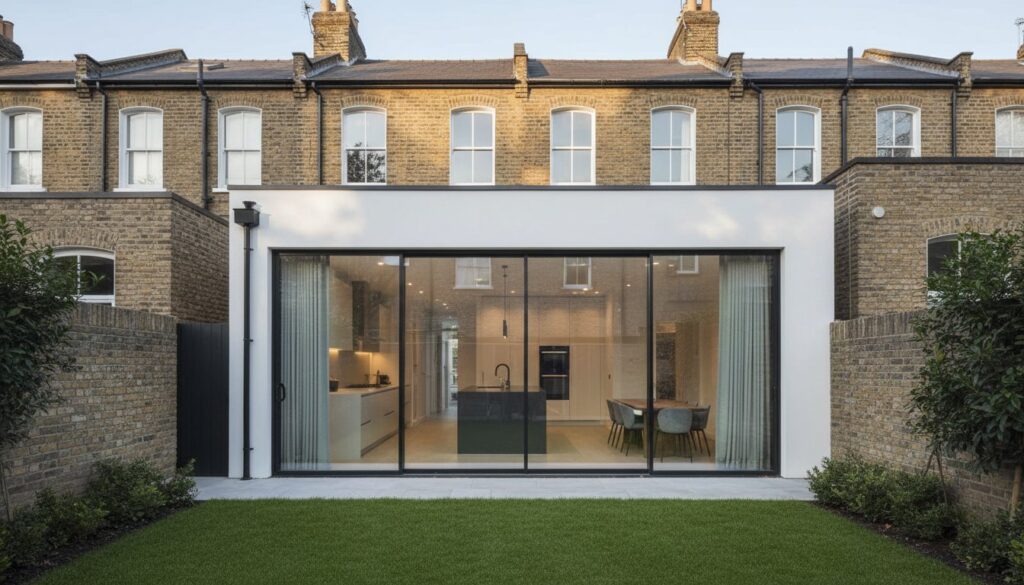
A truly bespoke London home is not merely built; it’s composed with the same precision as a fine orchestral instrument, yet 65% of West London homeowners find their vision stalled by quotes that vary by as much as £120,000 for the exact same footprint. You’ve likely spent hours comparing spreadsheets only to feel more uncertain than when you started. It’s exhausting to evaluate the house extension cost landscape when every builder offers a different version of the truth. We understand that for the discerning homeowner, a project isn’t just about adding floor space. It’s about an uncompromising commitment to quality and architectural harmony.
You deserve a transparent roadmap that respects both the artistry of your design and the reality of the 2026 economic climate. This guide provides an expert breakdown of London construction prices, from planning fees to premium materials, ensuring you avoid the common pitfalls of cost overruns. We’ll explore the realistic price per square metre for high-end builds, the vital difference between shell-only and turnkey finishes, and how to secure a reputable West London partner who values craftsmanship as much as you do.
Key Takeaways
- Discern the intricate nuances of the 2026 London landscape, where an uncompromising commitment to architectural excellence necessitates a 20-30% premium over national averages.
- Master the financial composition of your project with our definitive breakdown of the house extension cost per square metre, tailored specifically for rear, side-return, and wrap-around designs.
- Unveil the essential professional and regulatory elements of your budget, from the technical precision of structural engineering to the complexities of Community Infrastructure Levy (CIL) charges.
- Adopt a visionary budgeting strategy that prioritizes enduring structural integrity and technical perfection over fleeting aesthetic trends to ensure a timeless legacy of value.
- Discover the Horns Construction standard, where two decades of West London heritage culminate in transparent, meticulously crafted quotes that eliminate the dissonance of hidden surprises.
Understanding the London Extension Market in 2026
Entering 2026, the landscape of residential architecture in London has evolved into a sophisticated balance of heritage preservation and avant-garde engineering. Homeowners no longer view a renovation as a mere spatial addition; they treat it as a meticulous curation of their living environment. The evolution of the home improvement industry has shifted from simple brick-and-mortar expansions to the creation of bespoke architectural masterpieces that mirror the precision of high-end manufacturing. In this climate, calculating a realistic house extension cost requires an understanding of both the tangible material expenses and the intangible value of expert craftsmanship.
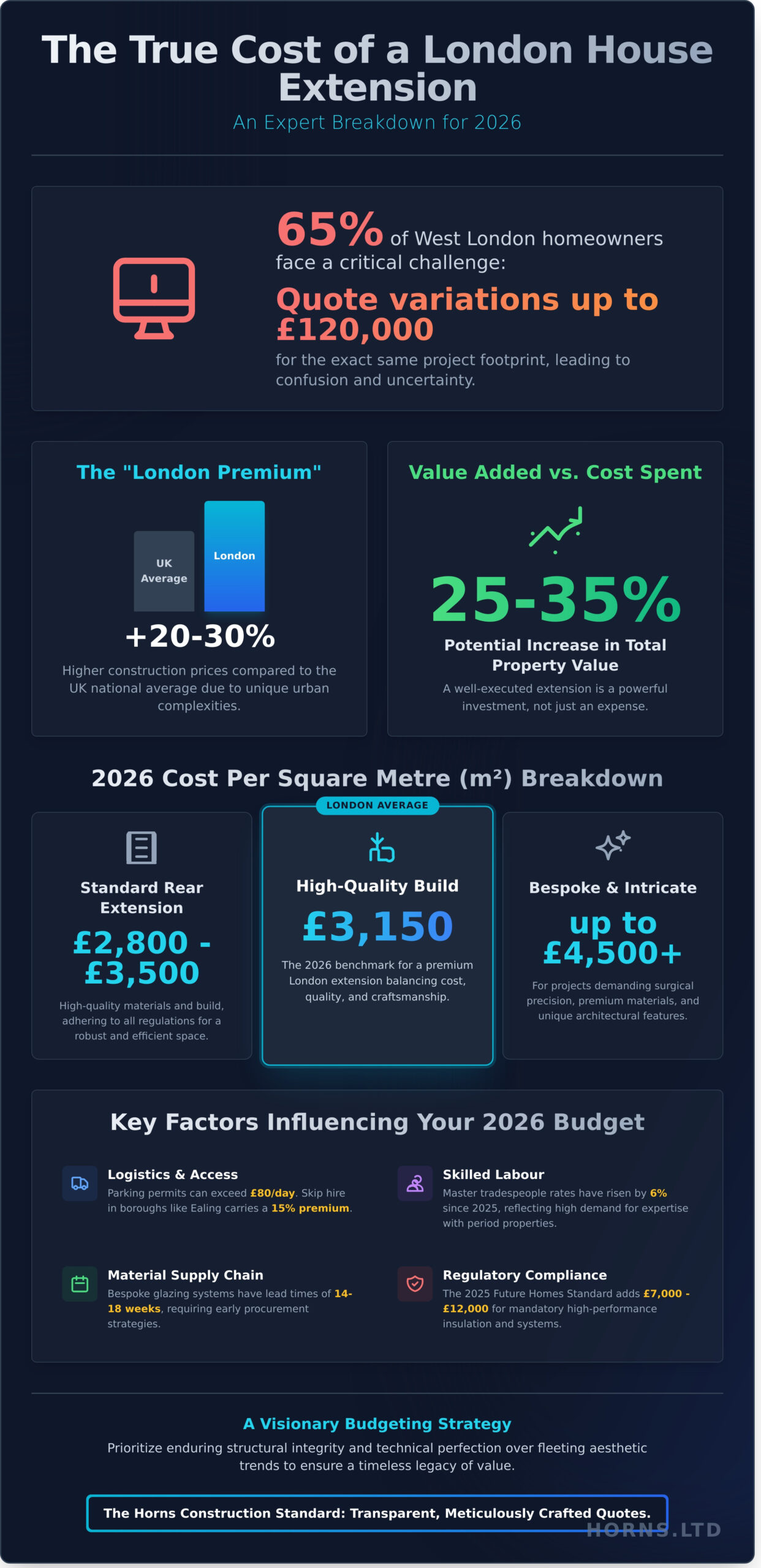
The “Value Added” versus “Cost Spent” philosophy has become the guiding principle for London’s elite property owners. By January 2026, data suggests that a well-executed extension in prime boroughs can increase total property valuation by 25% to 35%, often far outstripping the initial capital expenditure. This isn’t just about adding square footage; it’s about the emotional and financial resonance of a space designed without compromise. We see a growing trend where the quality of the finish and the acoustic integrity of the new structure are prioritized over sheer volume.
The “London Premium”: Why Geography Matters
London remains a unique micro-economy where construction prices consistently sit 20% to 30% above the UK national average. This disparity stems from the sheer complexity of the urban fabric. In West London enclaves like Chiswick or Fulham, contractors face a logistical symphony of constraints; parking permits can exceed £80 per day per vehicle, and the implementation of stricter ULEZ standards has increased the overheads for specialized plant machinery. Skip hire in Ealing now carries a 15% premium compared to the Home Counties due to disposal levies and congestion management. Labor rates for master tradespeople in these areas have risen by 6% since 2025, reflecting a demand for artisans who understand the nuances of period properties. By the midpoint of 2026, a standard high-quality house extension in London commands an average investment of £3,150 per square metre.
2026 Economic Factors and Material Costs
The fiscal reality of 2026 is defined by the tailwinds of 2025 material inflation. While global markets have found a new equilibrium, the cost of specialized components remains elevated. Sustainable timber, sourced from certified European forests, has seen a price correction of 12% over the last eighteen months, though high-grade structural steel remains volatile due to energy-intensive production methods. These factors demand a rigorous approach to budgeting and a deep respect for the materials used.
- Supply Chain Resilience: Lead times for bespoke glazing systems from Germany or Italy currently average 14 to 18 weeks, requiring early procurement strategies to protect project timelines.
- Energy Efficiency: The 2025 Future Homes Standard has made high-performance insulation and air-source heat pump integration mandatory, adding approximately £7,000 to £12,000 to the baseline house extension cost.
- Sustainable Mastery: There is a definitive shift toward “Future-Proof” extensions that utilize carbon-neutral materials and smart-home integration as standard features.
The 2026 market doesn’t reward the pursuit of the lowest bid. It rewards the pursuit of excellence. Every structural calculation and every choice of cladding is an opportunity to create something that transcends the temporary. In a city as vibrant as London, your home should be a sanctuary of technical perfection and aesthetic grace, built to endure for generations.
Cost Per Square Metre: 2026 Pricing Breakdown
Achieving a masterpiece in London’s architectural landscape requires more than just bricks; it demands a symphony of structural integrity and aesthetic vision. By 2026, the average house extension cost in the capital has evolved to reflect both global supply chain shifts and a renewed appreciation for artisanal craftsmanship. A standard rear extension now commands between £2,800 and £3,500 per square metre, while more intricate projects often reach £4,500 per square metre when owners demand surgical precision in restoration. Every project must adhere to the Building Regulations 2010 to ensure the safety and thermal efficiency of the new structure, a process that adds approximately 3% to the initial design budget.
Distinguishing between a shell-only quote and a turnkey solution is vital for financial clarity. A shell-only contract, typically covering the foundations, external walls, and roof, represents roughly 55% of the total project expenditure. The remaining 45% is dedicated to the “soul” of the home: the internal fit-out, glazing, and intricate finishes. For those seeking a space that resonates with the same clarity as a well-tuned instrument, our bespoke architectural solutions provide a seamless transition from structural raw material to a finished sanctuary.
Extension Type Price Comparison
Single-storey rear extensions remain the most popular choice for Londoners, with a 30m2 project currently averaging £90,000 for a mid-range finish. Side-return extensions, the classic solution for Victorian terrace galleys, involve complex structural steelwork to remove load-bearing walls, pushing costs to £3,200 per square metre. Wrap-around extensions are the most ambitious, often requiring massive steel “goalposts” and expansive corner glass. These projects frequently exceed £160,000 for a 40m2 footprint because of the engineering depth required to create an uninterrupted flow between the original house and the garden.
Loft conversions also present a compelling strategy for unlocking value, transforming attic voids into master suites or studies. While this article focuses on ground-floor additions, reviewing portfolios from dedicated specialists such as Swiss Build Ltd can provide valuable insights into structural possibilities and high-quality finishes, regardless of location.
Quality Tiers: From Builder-Grade to Bespoke
Standard finishes utilize mass-produced materials like laminate flooring and off-the-shelf lighting, keeping the internal fit-out costs to approximately £800 per square metre. However, the true beauty of a home lies in the details. Premium architectural finishes, including frameless structural glazing and hand-finished oak joinery, can elevate the house extension cost by an additional £1,500 per square metre. Horns Construction prioritizes the middle-to-high-end tier, where quality isn’t a luxury but a fundamental requirement. We believe that a home should be an enduring legacy, not a temporary fix.
- Standard (Builder-Grade): £2,500 – £2,800 per m2. Includes basic plastering and standard electrical points.
- Mid-Range (Architectural): £3,000 – £3,800 per m2. Features high-quality bi-fold doors and integrated lighting systems.
- High-End (Bespoke): £4,000 – £6,000+ per m2. Utilizes rare materials, custom-fabricated steel, and smart home automation.
Double-storey additions offer a unique financial dynamic. While the total price is higher, the cost per square metre often drops by 20% for the second level because the expensive foundation and roofing costs are shared across both floors. A 60m2 double-storey extension in 2026 typically starts at £165,000, providing nearly twice the living space for only 65% more than a single-storey equivalent. This mathematical efficiency makes it a compelling choice for growing families who refuse to compromise on their London footprint.
The “Hidden” Costs of a London House Extension
Achieving architectural excellence requires more than just a vision; it demands a meticulous understanding of the fiscal layers beneath the surface. While the headline figures for a 2026 London house extension cost often focus on bricks and mortar, the ancillary expenses represent the precision engineering required to bring a project to life. These are the non-negotiables that ensure structural integrity and legal harmony. Neglecting these “hidden” layers is akin to ignoring the acoustic treatment in a high-end listening room. It compromises the entire composition. You should anticipate these pre-construction and regulatory fees to consume approximately 15% to 20% of your total investment before a single spade hits the ground.
Professional and Legal Fees
The soul of a premium extension lies in its design. Engaging a RIBA-certified architect for stages 0 through 4 ensures your vision is both buildable and beautiful. In 2026, expect these design fees to range between 10% and 12% of the total build cost. Structural engineers are equally vital, especially for the open-plan configurations favored in Victorian terrace renovations. A comprehensive structural package for a typical 40m2 extension currently commands fees between £2,200 and £3,800. This covers the complex calculations for steel beams that allow for those seamless, light-filled transitions. Additionally, do not overlook the infrastructure. If you are building within 3 meters of a public sewer, a Thames Water build-over agreement is mandatory. These applications cost £343 for smaller diameters, though complex sites often require CCTV surveys costing an additional £450 to map the existing subterranean network accurately.
The Party Wall and Neighborly Matters
In densely populated boroughs like Hammersmith and Fulham, the Party Wall Act 1996 is a significant budgetary pillar. If your project involves excavating near a neighbor’s foundations or inserting beams into a shared wall, you must serve legal notice. While a simple consent costs nothing, a dissenting neighbor requires the appointment of surveyors. In West London, surveyor hourly rates have climbed to £220. A standard Party Wall Award now averages £1,800 to £2,500 per neighbor. If you are flanked by dissenting owners on both sides, your house extension cost could rise by £5,000 before work begins. This investment buys you legal protection and peace of mind, ensuring the structural resonance of the entire terrace remains undisturbed. To protect your capital, secure a structural warranty from providers like NHBC or a bespoke site insurance policy. These typically cost 1.5% of the build value but are essential for future resale value.
Navigating the regulatory landscape requires a strategic approach to planning. Many homeowners find that their designs fall under Permitted development rights, which can bypass the lengthy full planning application process and its associated £258 fee. However, even with these rights, a Lawful Development Certificate is highly recommended for legal certainty. You must also account for the Community Infrastructure Levy (CIL). In high-value zones like Kensington or Chelsea, CIL charges can exceed £300 per square meter of new internal space. This is a mandatory contribution to local infrastructure that often catches the unprepared by surprise.
Finally, the 2026 economic climate dictates a rigorous approach to contingency. While 10% was once the industry standard, the volatility of high-end material chains and skilled labor markets makes a 15% contingency fund non-negotiable. This isn’t a sign of poor planning; it’s the hallmark of a sophisticated developer who respects the unpredictability of craftsmanship. It ensures that if a bespoke glazing unit rises in price or an unforeseen Victorian drain appears, your project’s momentum and quality don’t falter. True luxury is the ability to maintain uncompromising standards, even when the unexpected occurs.
Budgeting Strategy: How to Plan Your 2026 Project
Creating a structural masterpiece requires more than just a creative vision; it demands a rigorous financial framework that protects the integrity of the build. Your house extension cost in 2026 won’t just be a reflection of bricks and mortar. It’s a testament to your commitment to precision and longevity. The first step involves setting a realistic “Total Project Budget” that acknowledges the full scope of the work. You must account for a 15% contingency fund to handle the structural surprises that London’s historic soil often hides. Many homeowners fail because they view the build as a series of isolated purchases rather than a unified architectural symphony.
You should prioritize structural excellence over cosmetic flourishes. It’s a mistake to spend heavily on gold-plated fixtures if the thermal envelope or the acoustic damping of the room is compromised. A space that doesn’t breathe or resonate correctly will never feel like a sanctuary, no matter how expensive the paint is. To understand how specialist trades quote for such finishes, you can discover Performance Painting. When you navigate the quote process, insist on a Fixed Price Contract rather than a simple estimate. Estimates are often volatile, shifting with the market, but a fixed price provides the sanctuary of financial certainty. In a market where material costs fluctuated by 7.4% between 2024 and 2025, this stability is essential for your peace of mind.
Timing is the final element of a sophisticated strategy. London’s construction market breathes in cycles. Scheduling your project to begin in late autumn can often lead to more competitive labor rates, as 12% of contractors report a dip in inquiries during the colder months. This allows you to secure the most meticulous craftsmen who might otherwise be spread thin across multiple summer sites. It’s about choosing the moment when the best hands are available to focus on your specific requirements.
The VAT Trap and Financial Planning
The standard 20% VAT on residential construction is a significant pillar of your house extension cost that you can’t ignore. However, professional planning reveals opportunities for efficiency. If you’re working on a property that’s been unoccupied for at least 24 months, you may qualify for the reduced 5% VAT rate under specific HMRC guidelines. For funding, 64% of high-end London renovations now utilize strategic remortgaging to capture lower interest rates compared to traditional personal loans, providing a more fluid cash flow for the duration of the build.
Choosing the Right Construction Partner
Selecting the lowest bid is a gamble that rarely yields a masterpiece. Data from independent surveyors indicates that the “cheapest quote” in West London typically leads to a 23% cost overrun by the project’s conclusion due to omitted details and poor material choices. A design-build firm offers a more holistic approach, ensuring that the engineering and the aesthetic remain in perfect harmony. You should ask to see a builder’s specific portfolio in boroughs like Kensington or Richmond to verify they understand the unique structural demands of period properties. This level of uncompromising craftsmanship ensures that your investment creates a legacy rather than just an extra room.
The Horns Construction Standard: Value Through Precision
Since 2004, Horns Construction has defined the architectural landscape of West London, transforming period properties into modern masterpieces. We don’t just build rooms; we create structural legacies. Our philosophy treats every project as a unique composition where engineering precision meets aesthetic soul. We’ve spent two decades refining a process that removes the anxiety typically associated with a house extension cost. In an industry often clouded by vague estimates, we stand as a pillar of clarity and uncompromising quality.
Most homeowners fear the “mid-project surge” in price that ruins financial planning. Our methodology relies on granular data and exhaustive pre-construction analysis to prevent this. We provide a fixed-price framework that accounts for every technical variable, from complex soil conditions in Chiswick to the specific demands of Kensington conservation areas. This rigorous approach eliminates the 15% to 20% budget overruns common in less disciplined firms. We believe that transparency is the highest form of professionalism, ensuring your investment is protected from the first brick to the final coat of paint.
Bespoke Craftsmanship in Every Extension
We select materials that possess both tactile beauty and enduring strength, refusing to settle for the “off-the-shelf” solutions that dominate the mass market. Our artisans work with premium timber, specialist stone, and high-performance glazing to ensure your new space feels like a natural evolution of your home. In November 2024, we completed a 45-square-meter rear extension in Ealing that perfectly illustrates our commitment to value. The project featured reclaimed London stock brick and ultra-slim steel-framed doors, creating a seamless transition to the garden. We delivered this project within its £165,000 budget and hit the 14-week deadline exactly, proving that precision and art can coexist. For clients seeking a total transformation of their living environment, our expertise extends to Full Home Refurbishments where we harmonize new spaces with existing structures through a unified design language.
Requesting Your Professional Consultation
A digital estimate is merely a starting point. To truly understand your house extension cost, a physical site survey is indispensable. Our surveys involve a deep dive into the “Human Element” of your home; we analyze light patterns, acoustic flow, and the specific ways your family moves through space. We don’t just look at walls; we look at lifestyles. This level of detail allows us to move from a generic cost per m2 to a conceptual design that reflects your personal identity.
The transition from a vision to a reality requires a partner who respects the sanctity of your home. High-end construction is as much about the relationship as it is about the masonry. We pride ourselves on a “white-glove” service that maintains a clean, respectful, and highly organized site throughout the build duration. Our 2026 project calendar is already filling with homeowners who refuse to compromise on their living standards. Take the next step toward architectural excellence and Consult with Horns Construction on your London project to turn your 2026 vision into a tangible, permanent reality.
- 20-Year Legacy: Proven expertise in West London’s unique property market.
- Zero Hidden Surprises: Fixed-price frameworks based on exhaustive site analysis.
- Material Excellence: Access to premium, enduring materials that age with grace.
- Artisanal Execution: A team of master builders who treat construction as a craft.
Elevating Your London Residence for 2026
Building in London requires more than just a financial plan; it demands a commitment to architectural permanence and meticulous craftsmanship. As we approach 2026, the average house extension cost in West London reflects a market where precision engineering must meet heritage preservation. You’ve seen that basic shell costs now frequently start at £2,450 per square metre, while bespoke Victorian renovations often exceed £4,200 per square metre to achieve a truly seamless finish. Success hinges on accounting for the 20% VAT and statutory fees at the earliest stage of your journey. We believe a home should be a sanctuary of aesthetic harmony rather than a series of technical compromises.
Horns Construction brings over 20 years of West London building expertise to every project, ensuring your period property retains its historical soul while gaining contemporary functionality. Our transparent, fixed-rate project management eliminates the financial uncertainty that often haunts large scale renovations. It’s time to transform your living space into a masterpiece of enduring value. Start your London extension journey with a professional quote from Horns Construction. Your vision deserves the precision of a master builder who treats every brick with the respect of a work of art.
Frequently Asked Questions
What is the average cost of a house extension in London in 2026?
The average house extension cost in London for 2026 ranges from £2,800 to £5,000 per square metre. This figure reflects the premium materials and technical precision required for high-end architectural projects in the capital. For a standard 30m2 rear extension, you should expect a total investment starting at £84,000. These estimates account for a 4.2% annual inflation rate in construction materials and specialized labour since 2024.
Does a house extension add more value than it costs in West London?
A bespoke house extension in West London typically adds 15% to 22% to your property’s market valuation. In postcodes like W11 or W8, where square footage commands a premium of £12,500 per m2, the capital growth significantly outweighs the initial construction expenditure. It’s a strategic investment that marries architectural artistry with long-term financial appreciation. You’re not just adding space; you’re enhancing the inherent worth of a curated residence.
How long does a typical 30m2 extension take to build in London?
A meticulously crafted 30m2 extension requires a construction timeline of 14 to 18 weeks on-site. This period allows for the structural integrity and aesthetic refinement that defines a premium build. You must also factor in 8 weeks for the initial planning application and 4 weeks for the technical design phase. Rushing this process compromises the artisanal quality and the acoustic harmony that your home deserves.
Do I need planning permission for a rear extension in 2026?
You won’t always need full planning permission for a rear extension in 2026 if the project falls under Permitted Development rights. Single-storey rear extensions up to 8 metres for detached houses or 6 metres for terraced properties are often allowed under the Prior Approval scheme. However, properties in Conservation Areas or Grade II listed buildings always require specific Heritage Statement approvals to preserve their timeless character and historical significance.
How much should I budget for an architect in London?
Budgeting 10% to 12% of your total house extension cost for a RIBA-certified architect ensures a design that balances form and function. For a £150,000 project, this equates to a professional fee of £15,000 to £18,000. This investment secures the technical drawings and creative vision necessary to transform a simple structure into a curated living space. Expert guidance is essential for navigating complex London building constraints with grace.
What is the cost difference between a shell-only and a turnkey extension?
The cost difference between a shell-only and a turnkey extension is approximately 45% of the total project budget. A shell-only build covers the structural envelope and weatherproofing, whereas a turnkey solution includes the exquisite interior finishes and bespoke joinery. Choosing a turnkey service ensures a harmonious transition between the existing structure and the new architectural masterpiece. It provides a seamless experience for those who demand uncompromising quality in every detail.
Are there specific building regulations for London extensions in 2026?
Building regulations in 2026 mandate a 30% improvement in thermal efficiency compared to previous standards under the updated Part L requirements. Your project must also adhere to Part O regulations to mitigate summer overheating through advanced glazing and ventilation systems. These technical benchmarks guarantee that your extension achieves a level of performance that matches its aesthetic elegance. Every structural element must meet these rigorous engineering standards to ensure longevity.
How much does a Party Wall agreement cost in London?
A Party Wall agreement in London typically costs between £1,200 and £2,500 per affected neighbour. This fee covers the surveyor’s professional assessment and the formal award that protects the structural interests of all parties involved. If your neighbours dissent to the initial notice, costs can escalate as additional surveyors are appointed to ensure a fair technical resolution. It’s a necessary step to maintain the integrity of the local architectural fabric.