
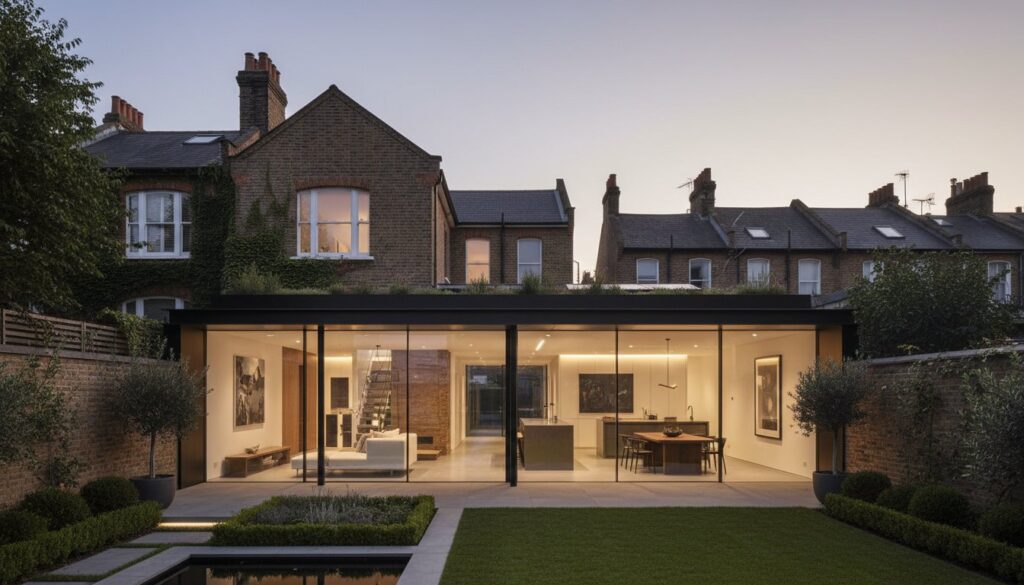
What if the most profound way to honour a Victorian terrace’s history isn’t to preserve it in amber, but to introduce a glass and steel dialogue that breathes new life into its silent brickwork? In a city where every square metre is a precious legacy, the decision to invest in house extensions often feels caught between the desire for modern light and the rigid constraints of London planning offices. You understand that a home is more than a shelter; it’s a meticulously composed environment where the resonance of the past must harmonise with the technical precision of the present. It’s a delicate balance that many attempts fail to strike, often resulting in jarring additions that lack both soul and structural integrity.
This definitive 2026 guide promises to navigate you through the complexities of the capital’s architectural landscape, ensuring your vision is realised through a professionally managed build that respects your daily rhythm. We’ll explore the sophisticated engineering and artisanal craftsmanship required to achieve a 25% uplift in property value while avoiding the pitfalls of substandard contractors. From the initial conceptual sketch to the final, hand-finished detail, you’ll discover how to transform your residence into a timeless masterpiece of form and function.
Key Takeaways
- Discover why bespoke house extensions represent a more sophisticated financial evolution for your London property than relocation in the 2026 landscape.
- Navigate the intricate regulatory requirements of West London’s Conservation Areas and the latest Permitted Development rights with absolute confidence.
- Learn to harmonise the structural bones of Victorian heritage with modern glass and steel through the lens of a “Sympathetic Design” philosophy.
- Demystify the RIBA construction stages to ensure your architectural journey is defined by meticulous planning and uncompromising engineering precision.
- Uncover how the Horns Construction philosophy transforms a structural addition into a timeless work of art that reflects an exclusive and refined lifestyle.
Defining House Extensions in the 2026 London Landscape
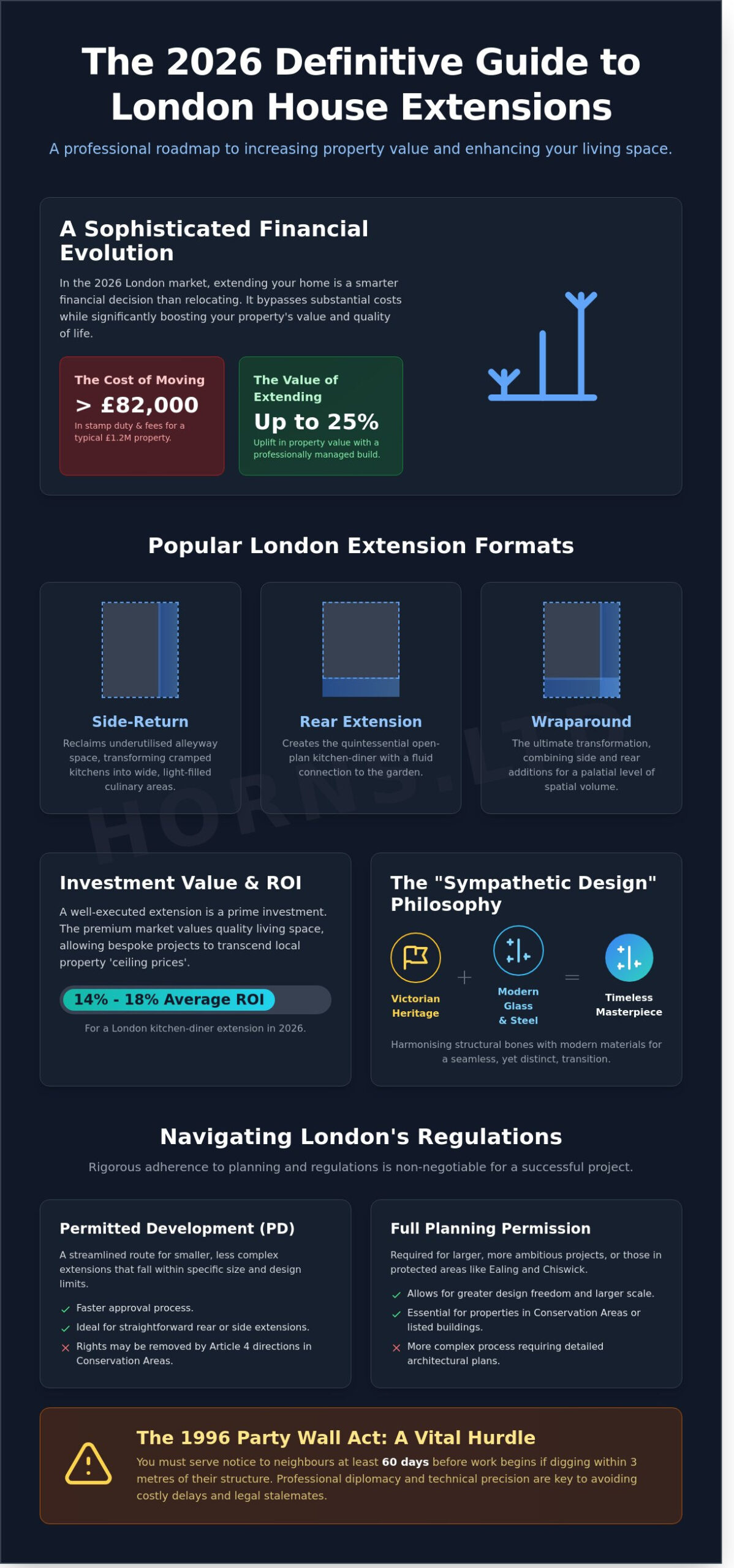
A house extension represents more than a mere addition of square metres; it’s a meticulous structural evolution, a reimagining of your home’s soul to meet the demands of a modern era. In the 2026 London market, where moving costs for a £1.2 million property can easily exceed £82,000 in stamp duty and legal fees, the decision to refine your existing sanctuary is a mark of both financial intelligence and artistic vision. Understanding What is a House Extension in this context requires looking beyond the bricks. It’s about the interplay of light and volume. Urban residential design in 2026 prioritises the psychological liberation that comes from expansive glass and vaulted ceilings. These aren’t just rooms; they’re vessels for life, designed with structural precision and a commitment to timeless elegance.
London’s density demands a sophisticated approach to space. We don’t just build walls; we orchestrate a structural symphony that harmonises with the original Victorian or Edwardian bones of the property. The 2026 homeowner seeks an uncompromising quality that transcends the generic. They’re looking for a bespoke environment where the transition from old to new is seamless, yet distinct in its craftsmanship.
The Most Popular Extension Formats for London Homes
- Side-return extensions: These projects reclaim the underutilised “alleyway” space common in Victorian terraces. By incorporating this narrow strip, we transform a cramped kitchen into a wide, light-filled culinary stage.
- Rear extensions: This format creates the quintessential open-plan kitchen-diner. It’s the most common method for establishing a direct, fluid connection between the interior living space and the garden.
- Wraparound extensions: The ultimate transformation for corner plots and end-terraces. By combining side and rear additions, we fundamentally alter the property’s footprint, offering a level of spatial volume that feels truly palatial.
For homeowners seeking a more streamlined approach to expanding their living space, a single storey extension often provides the perfect balance between architectural refinement and practical functionality, particularly when navigating the complex planning requirements of London’s conservation areas.
Investment Value: How Extensions Affect London Property Prices
Current 2026 data suggests that a well-executed kitchen-diner extension in London yields an average ROI of 14% to 18%. While adding a bedroom remains a potent value-driver, the premium market now places a higher valuation on the quality of living space. In neighbourhoods like Ealing and Fulham, “ceiling prices” are a critical consideration. A terrace in Fulham might hit a valuation ceiling at £2.4 million; however, bespoke architectural quality allows a property to break these barriers. Generic, “cookie-cutter” builds don’t hold their value. It’s the hand-crafted details, the uncompromising material choices, and the architectural integrity that ensure your investment remains a legacy for generations. Choosing a high-end house extension isn’t just about utility; it’s about securing your financial future through superior design.
Navigating London’s Planning and Building Regulations
Creating a masterpiece requires more than just vision; it demands a rigorous adherence to the invisible frameworks that define London’s architectural integrity. The 2026 regulatory environment for house extensions prioritises both aesthetic preservation and environmental responsibility. Homeowners must balance their creative ambitions with London’s Planning and Building Regulations to ensure their investment remains a lasting legacy. In boroughs like Ealing and Chiswick, where Victorian and Edwardian character is fiercely protected, the margin for error is non-existent. These Conservation Areas often operate under Article 4 directions, which strip away standard rights to ensure that every brick and window frame respects the historical narrative of the streetscape.
The 1996 Party Wall Act remains a vital hurdle for London’s densely packed terrace and semi-detached properties. You must serve notice to neighbours at least 60 days before work begins if you’re digging within 3 metres of their structure. It’s a process that demands professional diplomacy and technical precision. Failure to secure a Party Wall Award can halt a project indefinitely, transforming a dream of expansion into a legal stalemate.
Permitted Development vs. Full Planning Permission
Permitted Development (PD) rights offer a streamlined path for many house extensions, provided they meet strict 2026 criteria. For a terraced home, you’re limited to an increase of 40 cubic metres, while detached homes allow for 50 cubic metres. Materials must match the existing dwelling perfectly to maintain visual harmony. If your design involves a wrap-around extension or exceeds 4 metres in height, a full planning application becomes a mandatory requirement. A Certificate of Lawfulness serves as the definitive 2026 benchmark for confirming your project’s legal immunity from future enforcement actions.
The Critical Role of the Structural Engineer
London sits upon a challenging foundation of heavy clay that shrinks and swells with seasonal moisture changes. This geological reality requires foundations that often reach depths of 2.5 metres to ensure the structural soul of your home remains uncompromised. When creating the expansive, open-plan environments favoured in modern design, the engineer’s role is to calculate the precise load-bearing requirements of steel RSJs. These elements must support the weight of history above while facilitating the airy freedom of the new space.
- Thermal Precision: New 2026 standards require wall U-values of 0.15 W/m²K to minimize energy loss.
- Subterranean Stability: Piled foundations are now used in 35% of London extensions to bypass unstable topsoil.
- Acoustic Integrity: Sound insulation between floors must now meet a 45dB reduction standard to ensure internal serenity.
Every calculation and every material choice reflects a commitment to uncompromising quality. Just as we refine every millimetre of an acoustic chamber, your bespoke architectural vision requires a similar devotion to technical perfection and structural honesty. Achieving this balance ensures your extension isn’t merely an addition, but a seamless evolution of your living environment.
Architectural Styles: Balancing Heritage with Modernity
Creating a masterpiece requires a profound respect for the past. When planning house extensions in London, the “Sympathetic Design” philosophy serves as our compass. It isn’t merely about copying old patterns; it’s about a deep, artistic understanding of Victorian and Edwardian bones. We treat the original structure like a rare instrument, ensuring every new addition resonates with the same frequency as the weathered London stock brick. This approach avoids the jarring discord of poorly conceived additions, focusing instead on a curation of materials that honour the building’s history while embracing the requirements of a modern lifestyle.
Extending Victorian and Edwardian Terraces
Preserving the intricate Flemish bond brickwork or the subtle ornamentation of a period cornice requires a craftsman’s eye. The most successful projects often employ the “hidden” extension technique, where the street-level facade remains untouched to preserve the historical narrative of the neighbourhood. This meticulous approach allows for the seamless integration of bespoke kitchen extension ideas that transform cramped, dark rear quarters into expansive, light-filled culinary sanctuaries. By matching original lime mortars and sourcing reclaimed bricks, the extension feels like a natural evolution rather than a modern intrusion.
Modern Glazed Extensions and Bi-fold Integration
Choosing a bold contrast can elevate a property from a simple dwelling to a modern art piece. The use of structural glass and slender steel frames creates a sophisticated dialogue between eras. These frameless glass box extensions offer an uncompromising view of the garden, blurring the lines between interior comfort and exterior beauty. For those navigating the complexities of the Official UK Government Planning Permission Guidelines, a modern design often finds favour when it clearly distinguishes the new from the old. Selecting a frame colour like Anthracite Grey or Deep Bronze complements the yellow and red tones of traditional London brick, creating a visual harmony that feels both contemporary and timeless.
Internal flow determines the emotional success of house extensions. A new space shouldn’t feel like a disconnected limb; it must feel like a natural continuation of the home’s rhythm. In the narrow plots typical of Kensington or Fulham, we overcome light deprivation through precision-engineered roof glazing. These apertures invite the sky into the living space, ensuring that even the deepest parts of the floor plan feel vibrant. It’s about achieving an acoustic and visual balance where every square inch serves a purpose, much like the precision found in a high-end audio component. By using level thresholds, the transition from the reclaimed oak flooring of the Victorian lounge to the stone terrace of the garden becomes a fluid, effortless experience.
The Journey: From Initial Concept to Final Handover
Crafting bespoke house extensions in the heart of London requires more than just structural engineering; it demands a choreographed sequence of precision and artistic vision. We view the construction process as a definitive manuscript, adhering strictly to the RIBA Plan of Work 2020. This framework ensures that every phase, from Stage 0 (Strategic Definition) to Stage 6 (Handover), is executed with surgical accuracy. Pre-construction feasibility isn’t merely a checklist; it’s the foundation of architectural integrity. By conducting rigorous site surveys and soil analysis early on, we mitigate the risks that often lead to delays in 92% of unmanaged London builds.
The Design and Feasibility Phase
Translating your lifestyle needs into architectural blueprints is a delicate balance of form and function. We focus on spatial dynamics, ensuring your new environment feels like a natural evolution of your home rather than a secondary addition. During this stage, we provide an accurate house extension cost forecast to prevent the budget creep that affects 65% of domestic projects. Our selection of materials prioritises longevity; we source reclaimed London stock bricks and sustainable hardwoods that age with grace and dignity, developing a rich patina over decades of use.
Construction Management and Site Behaviour
Managing house extensions in densely populated London streets requires a masterclass in logistics. Every Horns Ltd. project is assigned a dedicated Project Manager who acts as a conductor for a symphony of trades. Whether it’s coordinating master carpenters or Gas Safe engineers, our schedule is designed to minimise disruption to your daily life. We maintain a clean, organised, and respectful site, acknowledging that we’re working within your sanctuary and alongside your neighbours. Our site protocols exceed standard health and safety requirements, reflecting our culture of excellence and quiet professionalism.
The final “snagging” phase is where our uncompromising commitment to a flawless finish truly shines. We don’t believe in “good enough.” Instead, we spend the final 14 days of a project scrutinising every joint, finish, and fixture to ensure they meet our artisanal standards. This meticulous attention to detail ensures that the transition from construction site to living space is seamless and celebratory.
Crafting Your Bespoke London Extension with Horns Construction
Horns Construction has spent two decades refining the architectural fabric of West London. Since 2004, we’ve approached every project not as a mere building task, but as an orchestral performance where engineering precision meets an uncompromising artistic vision. We understand that a home in London is more than a property; it’s a sanctuary that must resonate with the character of its inhabitants. Our philosophy is rooted in the belief that structural integrity and aesthetic beauty are inseparable. We don’t just add square footage; we compose living environments that elevate the daily experience of those within them.
Our 20 year legacy across Hammersmith, Fulham, and Chiswick is built on a foundation of technical mastery and a deep respect for the heritage of the capital. We recognize that the unique constraints of West London’s Victorian and Edwardian terraces require a delicate touch and a sophisticated understanding of spatial dynamics. Our team treats every brick and every beam with the reverence of a master craftsman, ensuring that the final result is a seamless extension of your home’s original soul.
Our Commitment to High-End Architectural Refinement
We’ve consciously decided to never engage in “standard” builds. Instead, we specialise in bespoke architectural transformations that reflect a client’s specific lifestyle and aesthetic preferences. Our network of specialist tradespeople includes master stonemasons, precision joiners, and expert metalworkers who share our obsession with detail. This collective expertise allows us to execute complex designs that other firms might find daunting. You can explore the depth of our craftsmanship by viewing our portfolio of house extensions London, where each project serves as a visual narrative of our commitment to excellence.
Why West London Homeowners Choose Our Expertise
Navigating the complex planning landscapes of Ealing, Chiswick, and beyond requires more than just technical knowledge. It demands a nuanced understanding of local conservation guidelines and a professional rapport with planning departments. We provide a transparent, high-end residential building service that removes the friction from the construction process. Our projects, often involving investments upwards of £250,000, are managed with a level of rigour that ensures your vision is delivered on time and within the specified parameters. We manage the delicate balance between ambitious design and the practical realities of London’s dense urban environment. If you’re ready to begin your home’s architectural transformation, Contact Horns Construction for a consultation to discuss how we can bring your vision to life with uncompromising house extensions.
Refining Your London Sanctuary for 2026
A home in London is an evolving canvas that requires a precise orchestration of heritage preservation and modern engineering. Navigating the 2026 planning landscape demands a deep understanding of local regulations, particularly when you’re balancing the timeless elegance of West London’s period architecture with contemporary requirements. The journey from initial concept to final handover relies on a synergy between architectural vision and technical precision. It’s about ensuring the soul of the building remains intact while its utility expands for a new era.
Realising these bespoke house extensions is a process that transforms a technical blueprint into a living masterpiece. Horns Construction brings over 20 years of London building expertise to every site, specialising in the nuances of West London period properties. We provide comprehensive project management from the first design sketch to the final handover, ensuring every material choice and structural detail reflects an uncompromising commitment to quality. Your residence deserves a legacy of craftsmanship that transcends the ordinary and stands the test of time.
Discuss your bespoke London extension with our experts to begin the refined transformation of your property today.
Frequently Asked Questions
Do I need planning permission for a house extension in London in 2026?
You’ll need planning permission if your project exceeds Permitted Development limits or if your London borough has restricted rights via Article 4 directions. In 2026, approximately 45% of house extensions in conservation areas require full consent to maintain the city’s historic aesthetic. We guide you through this bureaucratic maze with technical authority and an eye for architectural heritage.
How much does a typical house extension cost per square metre in London?
A typical high-end house extension in London requires an investment of £3,000 to £5,000 per square metre. This range accounts for the premium materials and the specialist labour needed to achieve a finish that transcends the ordinary. We don’t just build rooms; we create bespoke environments where every millimetre is considered and every material is chosen for its tactile and visual longevity.
How long does a house extension usually take to build?
The build phase usually requires 14 to 22 weeks of dedicated craftsmanship. This duration allows us to execute the structural changes and the intricate interior detailing with the patience they deserve. We view the construction timeline as a necessary gestation period for your home’s new identity; rushing the process only compromises the final acoustic and aesthetic harmony.
Can I stay in my house during the extension construction?
You can remain in your property during construction, though 75% of our clients find relocating for the most intensive 5 weeks provides a more serene experience. Living through a major renovation requires patience as the soul of your home undergoes a profound transformation. We manage the site with absolute cleanliness to minimise the inevitable disruption to your daily life and peace of mind.
Will a house extension add significant value to my London property?
A professionally designed extension adds between 15% and 25% to the market value of a London home. This increase isn’t merely a financial metric; it’s a reflection of the enhanced lifestyle and spatial elegance your property now offers. High-quality additions often yield a return on investment that far exceeds the initial capital outlay, especially in prime postcodes.
What is a Party Wall Agreement and do I need one for my extension?
A Party Wall Agreement is a legal necessity under the 1996 Act if your extension sits on a boundary or requires excavation within 3 or 6 metres of a neighbour. You must serve notice at least 2 months before work begins to maintain legal and social harmony. It’s a vital step in protecting the structural integrity of the entire terrace or semi-detached block.
What are the main differences between a side-return and a wraparound extension?
A side-return extension occupies the narrow path alongside your rear kitchen, while a wraparound combines this with a rear addition to form an L-shape. Side-returns typically add 1.5 metres of width to a room, whereas a wraparound can increase your floor plan by 25 square metres or more. The choice depends on your desire for natural light versus sheer volume.
Does Horns Construction handle the design and planning stages as well as the build?
Horns Construction manages the entire journey, from the first architectural drawing to the final structural sign-off. We operate as a single point of responsibility, ensuring that the design’s artistic intent is perfectly translated into the physical build. Our clients value this holistic approach as it eliminates the friction often found between separate architects and builders during complex projects.