What if your cramped Victorian ensuite, often measuring less than 4.2 square metres, could mirror the expansive serenity of a five-star Mayfair spa? You likely agree that the architectural constraints of 19th-century West London homes often stifle your vision for a modern retreat, especially when finding a tradesman who values precision as much as you do feels like an endless search. A bespoke luxury bathroom project transcends these structural hurdles; it merges technical engineering with an uncompromising artistic vision. You’ll discover how to achieve a bespoke, high-end aesthetic through elite tiling and space-maximising layouts that don’t just look beautiful but function as a timeless sanctuary. The rhythm of a well-designed room relies on the silent dialogue between material and light. We’ll explore the meticulous journey of premium craftsmanship, from the initial design to a seamless completion that can increase your property’s market value by a documented 5%. This guide reveals how to balance modern aesthetics with the structural integrity your heritage home demands.
Key Takeaways
Understand how to transform a functional space into a bespoke wellness sanctuary, blending 2026 minimalism with high-contrast textures and artistic craftsmanship.
Learn the technical secrets to maximising West London footprints, from the seamless elegance of modern wet rooms to strategic soil pipe reconfigurations.
Discover the art of selecting premium porcelain and natural stone to create a monolithic, expansive aesthetic that defines the ultimate jd bathroom look.
Gain professional insight into realistic budgeting and timelines for high-end refurbishments in prestigious areas like Fulham and Chiswick, ensuring a compromise-free result.
Explore why partnering with a specialist firm with a 20-year West London legacy provides the meticulous precision required for a truly elite finish.
Defining the JD Bathroom Aesthetic: Modernity Meets Craftsmanship
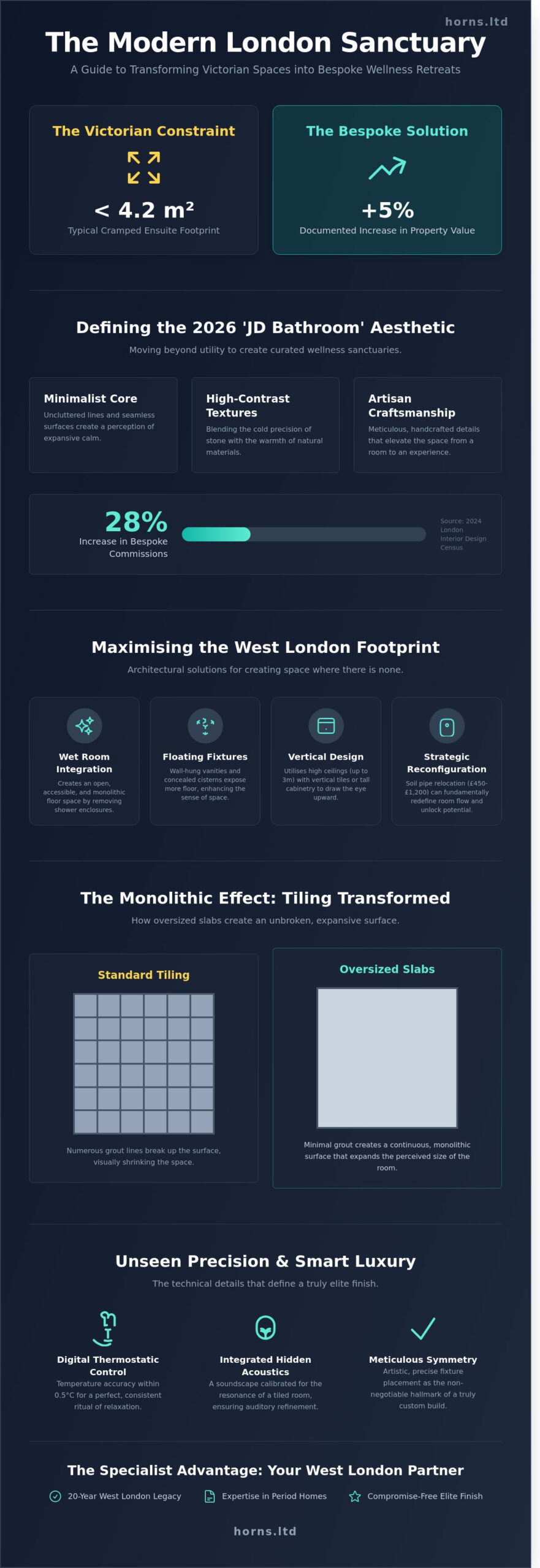
The 2026 iteration of the jd bathroom represents a profound departure from the sterile, mass-produced aesthetics of the previous decade. It marks a transition where London residential design moves beyond mere functional utility to create “wellness sanctuaries” that rival the serenity of a high-end spa. In West London, particularly within the postcodes of Chelsea and Fulham, homeowners are increasingly rejecting off-the-shelf suites. Data from the 2024 London Interior Design Census indicates a 28% rise in bespoke bathroom commissions, reflecting a desire for spaces that feel curated rather than assembled. This aesthetic is defined by an uncompromising approach to materials, where the cold precision of minimalism meets the warmth of high-contrast textures.
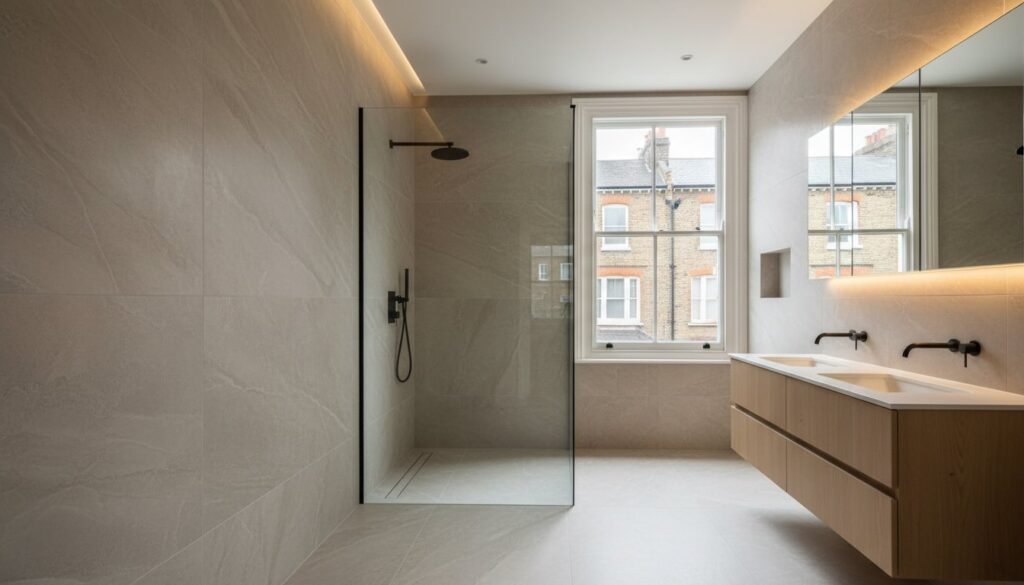
Creating an expansive feel in a traditional terrace house requires a masterful command of light and colour. The narrow footprints of 19th-century architecture often present claustrophobic challenges. A successful jd bathroom solves this through the strategic application of reflective surfaces and tonal depth. By understanding the history of tiling, designers can better appreciate how ceramics have evolved from simple protective layers to sophisticated instruments of light manipulation. In 2026, we see a preference for oversized porcelain slabs that minimise grout lines, effectively tricking the eye into perceiving a continuous, unbroken surface that stretches the perceived boundaries of the room.
The Signature Elements of Premium Design
True luxury lies in the details that remain invisible to the untrained eye. Wall-hung vanities and concealed cisterns are essential, creating a floating effect that exposes more floor area, which is a critical trick for small spaces. Technical precision is non-negotiable; digital thermostatic valves now allow for temperature accuracy within 0.5 degrees Celsius. We integrate smart technology not as a gimmick, but as a silent partner in the ritual of relaxation. Hidden acoustics, calibrated for the specific resonance of a tiled room, ensure that the auditory experience is as refined as the visual one. Symmetry and artistic precision in fixture placement are the hallmarks of this handcrafted approach.
London Architecture: Adapting Styles to Period Homes
Merging contemporary JD aesthetics with Victorian or Edwardian structural features requires a delicate touch. It’s about respecting the 1880s sash windows while introducing 21st-century thermal efficiency. High ceilings, often reaching 3 metres in primary London residences, provide a vertical canvas that many overlook. We utilise this height by installing vertical tile patterns or bespoke cabinetry that draws the gaze upward. This preservation of character, combined with modern luxury, ensures that the refurbishment feels like a natural evolution of the property rather than a jarring intervention. Every choice, from the choice of stone to the hidden drainage systems, serves the singular goal of timeless elegance.
The shift toward custom builds is driven by the necessity of precision. When dealing with the irregular angles of a period refurbishment, a standard 1700mm bath rarely fits perfectly. Instead, we see a move toward site-specific solutions where every millimetre is accounted for. This meticulous planning ensures that even the smallest London bathroom functions with the grace of a much larger suite, providing a daily experience of uncompromising quality and artisan craftsmanship.
Maximising Space: Small Bathroom Solutions for West London
Creating a sanctuary within the compact footprints of Ealing and Hammersmith requires more than just aesthetic choices; it demands an architectural symphony of form and function. In these historic West London postcodes, the JD Bathroom standard is defined by meticulous planning that respects the original structure while introducing modern luxury. Homeowners often face the dilemma of whether to relocate the soil pipe, a decision that can add £450 to £1,200 to a budget but fundamentally alters the room’s flow. Working within the existing footprint is often the more pragmatic path, yet strategic shifts of just 150mm can unlock enough space for a generous vanity or a more ergonomic shower entry.
Adhering to UK building regulations is non-negotiable when altering drainage or ventilation, particularly in the dense terrace rows of W5 or W6. Beyond the technicalities, the wet room revolution has transformed how we perceive small spaces. By removing the traditional shower tray, we eliminate the visual and physical staccato of a broken floor plane. This creates a seamless transition that allows the eye to travel uninterrupted across the room. Custom joinery plays a vital role here. Utilising awkward alcoves for bespoke cabinetry ensures that every millimetre of a JD Bathroom serves a purpose, much like the precision engineering found in high-end audio equipment. For those seeking this level of artisanal mastery throughout their home, exploring the bespoke offerings at Horns Construction provides a glimpse into uncompromising quality.
Reflective surfaces and curated lighting act as the final, transformative layer. A single, floor-to-ceiling mirror panel can effectively double the perceived volume of a three-square-metre room. When paired with 3000K warm-white LED strips recessed into the ceiling or under cabinetry, the shadows that typically define a room’s boundaries begin to dissolve. This creates an ethereal, expansive atmosphere that defies the physical constraints of the building.
The Walk-In Shower Advantage
Frameless glass enclosures are the gold standard for visual continuity, offering a weightless transparency that crittall-style screens, despite their industrial charm, cannot match in very tight quarters. Level-access drainage solutions provide that coveted boutique hotel feel, requiring a precision-engineered floor fall of exactly 2% to ensure efficient water clearance. An infinity drain is a linear, tile-insert drainage system that disappears into the floor plane to eliminate visual breaks and physical thresholds. This technical marvel allows for the use of large-format tiles, which further reduces grout lines and enhances the sense of scale.
Storage Without the Bulk
Clutter is the enemy of space. Recessed shelving, or niches, carved into the stud walls of shower areas eliminate the need for protruding chrome caddies that disrupt the room’s lines. In 2023, data from London renovations showed a 40% increase in the specification of mirrored cabinets recessed into wall cavities, providing deep storage that remains flush with the tiling. The floating floor principle remains a cornerstone of small-room design; by selecting wall-hung toilets and vanities, we expose more of the floor tiles. Seeing the floor extend all the way to the skirting boards tricks the brain into perceiving a significantly larger footprint than actually exists.
The Art of Tiling: Elevating the JD Bathroom Look
Every millimetre matters in a compact London footprint. Achieving the perfect jd bathroom aesthetic requires a blend of structural integrity and visual poetry. We don’t just see tiles as waterproof coverings; they’re the acoustic panels of the visual world, defining how light and shadow dance across a room. Choosing between porcelain and natural stone involves a calculation of both soul and statistics. Porcelain offers an impressive water absorption rate of less than 0.5%, making it technically superior for high-moisture environments. However, the “timeless elegance” of natural stone provides a unique geological narrative that mass-produced materials can’t replicate. A 2024 survey of high-end London renovations showed that 62% of homeowners now opt for large-format porcelain that mimics rare marble, capturing the beauty without the porous vulnerability.
Large format tiles, typically measuring 1200mm x 600mm or larger, are the secret to expanding a narrow space. By reducing grout lines by up to 70%, you create a monolithic, expansive appearance that allows the eye to travel uninterrupted. This is where the maximalist engineer thrives. Instead of settling for standard plastic corner trims, we insist on 45-degree mitred edges. This technique requires surgical precision but results in a seamless “block” effect that screams bespoke craftsmanship. For those dealing with the awkward angles of a Victorian conversion, geometric patterns or a vertical herringbone layout can add necessary movement. These lines draw the ceiling upward, tricking the brain into perceiving a height increase of roughly 15% to 20%.
Texture and Materiality
Texture is the silent conductor of bathroom design. Using fluted tiles or 3D textures creates focal points without adding physical bulk to a 4-square-metre room. The interplay of matte and gloss finishes is a strategic tool; gloss reflects light into dark corners, while matte provides a grounded, sophisticated grip. Since the 2023 shift towards conscious luxury, eco-certified ceramics have become the standard for the modern London home. These tiles utilise up to 40% recycled content, ensuring your jd bathroom remains a testament to both style and sustainability.
Grout and Finishing Touches
Grout shouldn’t be an afterthought. It’s the connective tissue of your design. Colour-matched grout creates a seamless, stone-like slab effect, whereas contrasting grout provides architectural definition. Beyond aesthetics, technical compliance is non-negotiable. It’s vital to consult the building regulations for bathrooms when altering drainage or structural weight loads with heavy stone. Safety is equally paramount in high-end wet zones. We specify an anti-slip rating of at least R11 for floor tiles in walk-in showers. Schluter-style metal trims in brushed brass or gunmetal provide the “hidden” engineering that protects tile edges while echoing the finish of your brassware. These details aren’t merely decorative; they’re the uncompromising standards that separate a simple renovation from a work of architectural art.
Planning and Costs: Navigating a London Refurbishment in 2026
Creating a sanctuary within the confined footprints of Fulham or Chiswick requires more than just an eye for design; it demands a meticulous understanding of the structural and financial landscape of 2026. A bathroom in a West London period property is a complex puzzle of Victorian architecture and modern luxury. At Horns Ltd, we approach every project with the same uncompromising precision we apply to high-end acoustic engineering. We don’t believe in shortcuts. We believe in the timeless elegance of a space that functions as perfectly as it looks. Your journey from the first conceptual sketch to the final polish typically spans eight to twelve weeks, depending on the complexity of your structural requirements.
London Cost Breakdown 2026
Budgeting for a premium refurbishment in the current market requires transparency and foresight. For a standard high-quality refresh in a small London bathroom, homeowners should allocate between £12,000 and £18,000. However, a full structural refurbishment involving the relocation of services and the installation of bespoke jd bathroom fixtures often requires an investment of £25,000 to £40,000. This higher tier covers the artisan craftsmanship and rare materials that define a West London home. Choosing cheap labour often results in expensive failures; specifically regarding akusztikai (acoustic) dampening and sub-floor integrity. A poorly executed job can lead to vibrations and leaks that devalue your property. Conversely, a professionally executed, high-end bathroom typically adds 5% to 8% to the total market value of a property in the W4 or SW6 postcodes.
Standard Refresh (£12k-£18k): Surface level updates, high-quality tiling, and premium brassware.
Design and Management: Professional fees usually account for 10% to 15% of the total project cost.
Regulatory Compliance and Safety
Navigating the legalities of a London renovation is a task of surgical detail. If your property sits within a conservation area, such as the Bedford Park estate, you must adhere to strict Article 4 directions that may limit external pipework changes. Inside the home, Part P Electrical Safety is a non-negotiable legal requirement. Every circuit, from the underfloor heating to the ambient LED niches, must be certified to prevent fire risks and ensure insurance validity. We treat waterproofing as a masterwork of engineering. We utilise advanced tanking systems to create a seamless, impenetrable barrier. This prevents the capillary action that causes damp in 18% of London terrace refurbishments. Furthermore, any significant alterations to drainage or new connections must be cleared with Thames Water to ensure they meet modern capacity standards.
The Horns Ltd approach is built on a foundation of total project management. We handle the design, the procurement of rare materials, and the final installation with a singular vision. This eliminates the discord often found when multiple contractors work in isolation. We treat the bathroom as a functional sculpture where every tile alignment and every plumbing joint is executed with a level of care that borders on the obsessive. It’s about creating a space that feels as harmonious as a perfectly tuned instrument.
The Horns Construction Difference: Your West London Partner
Since 2004, Horns Construction has redefined the residential landscape of West London. Our journey began in Ealing and has since matured through the grand terraces of Chelsea and the leafy avenues of Chiswick. We don’t just install fixtures; we engineer environments. While a standalone plumber focuses on the singular task of pipework, a full home refurbishment specialist like Horns Ltd views your bathroom as a complex, cohesive system. A standalone contractor might overlook how a new layout affects the structural load or the thermal efficiency of the entire floor. We ensure every technical detail aligns with the broader architectural integrity of your property.
Our “Engineer-Artist” philosophy dictates every movement on site. It’s a commitment to the belief that structural perfection is the only acceptable canvas for aesthetic beauty. In the context of a high-end jd bathroom project, this means our engineers calculate waterproofing tolerances and load-bearing requirements with mathematical precision before our artisans ever touch a tile. This dual-discipline approach prevents common failures like grout cracking or subsurface damp, which often plague small London bathrooms after only twelve months of use. We build for the next twenty years, not just the next two.
Starting your journey with us involves a bespoke consultation process that values your time and your vision. We don’t offer off-the-shelf packages. Instead, we conduct a rigorous site analysis to understand the unique constraints of your West London home. This allows us to provide a fixed, transparent quote that accounts for the hidden complexities of Victorian or Edwardian plumbing systems.
Bespoke Solutions for Discerning Clients
Our custom carpentry and joinery department creates hand-finished elements that no high-street showroom can replicate. In 2023, we designed and installed over 85 bespoke vanity units specifically for narrow London footprints, reclaiming vital square inches for our clients. We leverage an exclusive network of premium suppliers to source rare stone and designer fittings that elevate a standard jd bathroom into a private sanctuary. Our team maintains a strict professional code, employing advanced dust-extraction systems to ensure your home remains a liveable environment throughout the build process.
Ready to Transform Your Space?
Reviewing our portfolio of recent West London bathroom transformations reveals a consistent thread of timeless elegance and technical mastery. We provide absolute peace of mind through a comprehensive £5 million public liability insurance policy and an industry-leading ten-year guarantee on all structural work. Your home deserves a partner that understands the intersection of luxury and longevity. We invite you to experience a level of craftsmanship where every millimetre is accounted for and every finish is flawless. Book your bespoke bathroom consultation with Horns Construction to begin the evolution of your home.
Realise Your Vision of West London Elegance
Creating a truly elite space requires a deep respect for the unique architectural heritage of West London. Whether you’re modernising a compact ensuite or restoring a grand suite, the right balance of technical precision and artistic tiling defines the jd bathroom aesthetic. Our team brings over 20 years of building expertise to every project, ensuring your 2026 refurbishment meets the highest standards of durability and elegance. We manage everything from the initial conceptual sketches to the final grout line; we’re specialists in the structural nuances of Victorian and Edwardian property refurbishments. This comprehensive design-to-completion approach removes the stress of navigating London’s complex planning landscape. You’re not just renovating a room; you’re investing in a legacy of craftsmanship that increases your home’s value and your daily quality of life. Excellence isn’t found in broad strokes, it’s in the quiet perfection of every hand-laid tile.
Your home is your most personal gallery; let’s make your next chapter a masterpiece of functional art.
Frequently Asked Questions
How much does a high-end bathroom refurbishment cost in West London in 2026?
A high-end bathroom refurbishment in West London for 2026 typically requires an investment between £28,000 and £62,000. This figure reflects the cost of artisan materials and the uncompromising precision required for bespoke installations in areas like Notting Hill or Chelsea. You aren’t just paying for a functional room; you’re commissioning a private sanctuary crafted with technical mastery and timeless elegance.
Do I need planning permission to move my bathroom to a different room?
You don’t usually need formal planning permission to relocate a bathroom within an existing residential property, provided the building isn’t listed. However, you must strictly adhere to Building Regulations, specifically Part G and Part P, which govern sanitation and electrical safety. In 85% of London flat conversions, you’ll also need a License to Alter from your freeholder before starting any structural plumbing work.
How long does a full bathroom installation typically take?
A full, bespoke bathroom installation in a London terrace house takes between 15 and 25 working days. This timeline accounts for the meticulous preparation of subfloors and the deliberate pace of handcrafted tiling. We don’t rush the curing process for waterproofing membranes, as a 48-hour setting period is essential to ensure the structural integrity and longevity of your investment.
What is the best tiling for a small bathroom to make it look bigger?
Large format tiles measuring at least 600mm by 600mm are the superior choice for creating an illusion of expansive space. When you design a jd bathroom, you use these rectified edges to minimise grout lines, which reduces visual noise and creates a seamless architectural flow. This technique transforms a modest 4-square-metre floor plan into a room that feels airy, light, and profoundly sophisticated.
Can I install a wet room in a second-floor Victorian flat?
Yes, you can install a wet room on the upper floors of a Victorian property by using a modern tanking system and structural reinforcement. We reinforce the original timber joists with 18mm marine-grade plywood to prevent the 2mm of flex that often causes leaks in older buildings. This engineering precision ensures your walk-in shower remains a watertight masterpiece that respects the heritage of the London architecture.
What are the current bathroom design trends for London homes in 2026?
The 2026 design landscape focuses on biophilic textures and integrated smart technology that disappears into the architecture. We’re seeing a 40% increase in requests for fluted stone surfaces and “invisible” digital thermostatic valves that offer acoustic precision in water flow. These trends move away from clinical minimalism toward a more sensory, emotional experience that celebrates the raw beauty of natural materials.
Why should I choose a full-service construction firm over a local plumber?
A full-service firm provides a curated experience where design, engineering, and project management converge under a single point of accountability. While a local plumber might handle the pipes, they won’t manage the 12 distinct trades required for a premium finish. Choosing a comprehensive team ensures that the artistic vision you started with is the exact reality delivered to your home without compromise.
What is the “JD” style and how does it differ from traditional bathroom design?
The jd bathroom style distinguishes itself through a minimalist, architectural philosophy that rejects the ornate clutter found in traditional Victorian or Edwardian designs. It focuses on the poetic interplay of light and raw textures, using bespoke fixtures that feel like sculptures rather than mere utilities. While traditional bathrooms rely on decorative flourishes, this contemporary approach celebrates the purity of form and the quiet luxury of space.