
A premium kitchen extension in West London is no longer a simple construction project; it’s a deliberate act of architectural curation that demands the same technical rigour as a bespoke high-end audio system. While many homeowners fear that 2026 will bring unpredictable market shifts, the reality is that quality remains the only hedge against volatility. You likely recognize that a cut-price quote often masks a lack of soul and structural integrity. This definitive guide clarifies the kitchen extension cost you should anticipate, factoring in the 8% annual labour inflation and the stringent requirements of local planning authorities.
We’ll provide a transparent price framework that balances engineering precision with aesthetic elegance. You’ll discover how to secure a builder who treats your home as a work of art, ensuring your investment yields a 20% to 25% uplift in property value through uncompromising craftsmanship and timeless design. From navigating the nuances of Royal Borough of Kensington and Chelsea planning constraints to selecting materials that endure for generations, this guide prepares you for a journey into functional perfection.
Key Takeaways
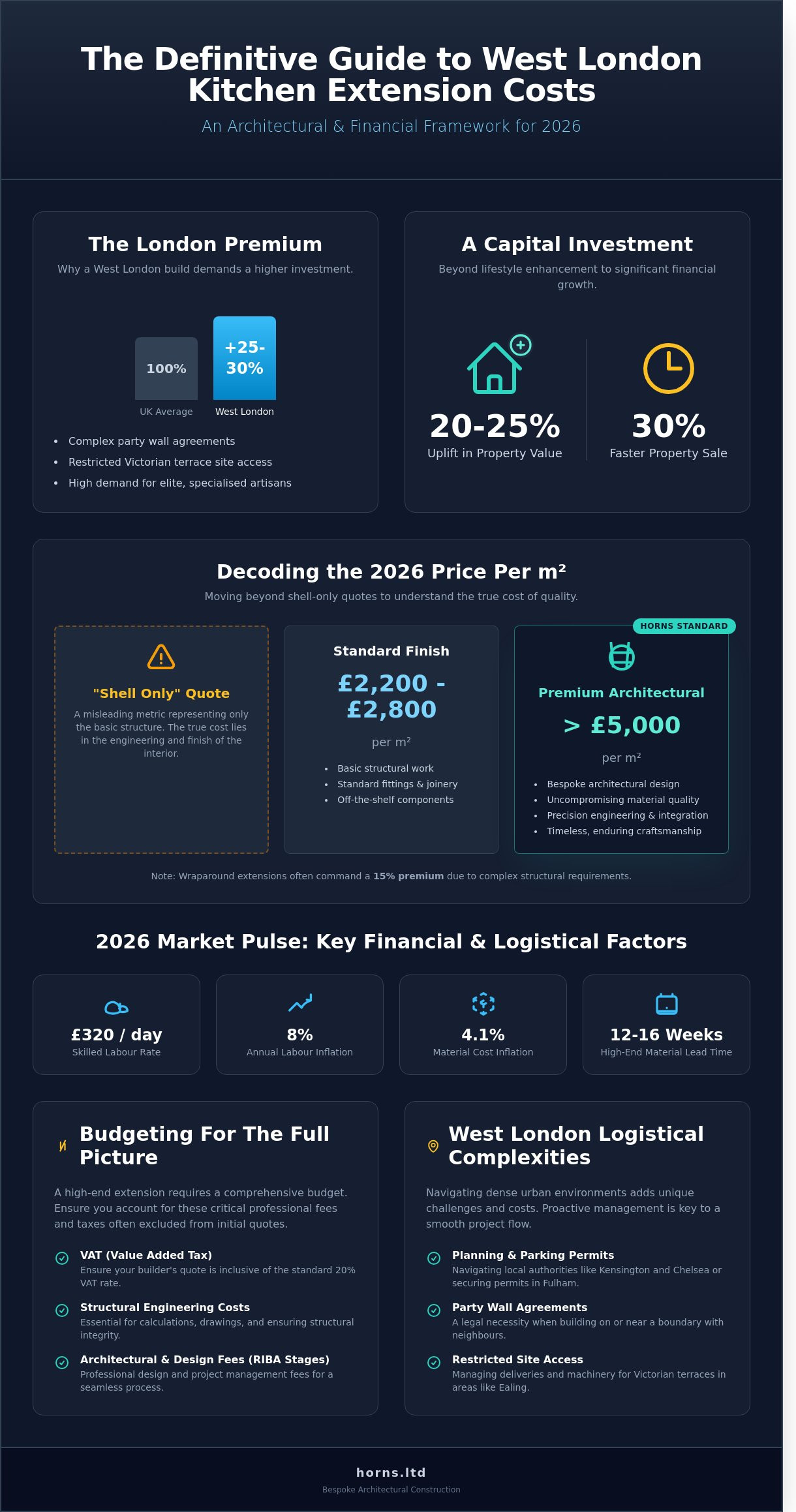
- Understand the 2026 construction landscape in London, where inflationary trends and local demand place investment levels 20-30% above the national average.
- Discover the nuanced breakdown of kitchen extension cost per square metre, moving beyond “shell only” quotes to reflect the true price of premium architectural finishes.
- Navigate the logistical complexities of West London renovations, from securing parking permits in Fulham to managing site access for Victorian terraces in Ealing.
- Learn to identify “hidden” fees such as VAT and structural engineering costs while following the RIBA stages to ensure your budget remains precise and protected.
- Appreciate how a commitment to architectural precision and uncompromising quality transforms a standard renovation into a bespoke masterpiece that endures for generations.
Understanding Kitchen Extension Costs in London for 2026
Creating a bespoke kitchen extension in 2026 requires a fusion of architectural ambition and rigorous financial planning. In the heart of London, the average kitchen extension cost has evolved beyond simple square-meterage calculations. It now reflects a market where uncompromising quality and logistical precision are the baseline. London prices consistently sit 25% to 30% above the UK national average. This premium isn’t merely a “London tax”; it’s the result of complex party wall agreements, restricted site access in Victorian terraces, and the high demand for elite artisans who treat construction as a form of functional art.
At Horns Construction, we advocate for the ‘Horns Construction Standard’. This philosophy moves away from the basic brick-and-glass shell toward an architectural statement that prioritises acoustic fidelity and visual harmony. We believe a kitchen shouldn’t just be a place to cook. It’s the primary stage for your life’s most resonant moments. Achieving this level of detail involves a deep commitment to material integrity and engineering excellence. A foundational step for any homeowner involves understanding the renovation process before committing to structural changes, as this clarity prevents expensive mid-project pivots.
The 2026 Economic Climate for London Build Projects
The 2026 market is defined by a stabilising but sophisticated supply chain. Material lead times for high-end components, such as slimline architectural glazing or custom stone, currently average 12 to 16 weeks in West London. Skilled labour rates for master trades have reached £320 per day, driven by a shortage of specialists capable of executing complex, integrated designs. Because of these variables, fixed-price contracts have become the gold standard for London homeowners. They provide a shield against the 4.1% annual inflation rate seen in raw material costs since early 2024, ensuring your vision remains uncompromised by fluctuating market tides.
Investment vs. Expense: Property Value Uplift
Viewing your kitchen extension cost as a pure expense ignores the significant capital growth it secures. In competitive enclaves like Chiswick and Richmond, a meticulously designed extension adds an average of 12% to 15% to the property’s total valuation. Data from 2025 property sales shows that homes featuring high-spec, open-plan kitchen environments sell 30% faster than those with traditional layouts. This isn’t just about adding floor space; it’s about enhancing the ‘saleability’ through timeless elegance and technical superiority. You’re balancing immediate lifestyle enrichment with a long-term financial legacy.
This focus on long-term value is a cornerstone of any sophisticated property strategy. While enhancing a primary residence is a powerful investment, many London homeowners also diversify their portfolios internationally. For those exploring such avenues, real estate investment firms like Angel Dragons Ltd provide guidance on navigating overseas markets and connecting with agents and property owners abroad.
The emotional ROI of a perfectly calibrated space is harder to quantify but arguably more vital. Imagine a room where the light hits the worktops at the perfect angle and the acoustics allow for intimate conversation even amidst the bustle of a dinner party. This level of precision requires a maximalist approach to design. We don’t accept shortcuts. Every choice, from the thickness of the sub-floor to the hidden cable management for integrated audio systems, contributes to a sense of permanence. In 2026, luxury is defined by this invisible perfection. It’s the peace of mind that comes from knowing your home’s new heart was built without compromise, using the finest materials and the most exacting engineering standards available in the capital.
The 2026 London Price Breakdown: Per Square Metre and Beyond
In the dense architectural fabric of London, calculating a kitchen extension cost requires more than a simple calculator; it demands an appreciation for the structural symphony being performed. For 2026, a standard single-storey extension begins at £2,200 to £2,800 per m2. However, for those seeking a premium architectural statement that transcends the ordinary, prices often exceed £5,000 per m2. These figures align with current RICS building cost standards, reflecting the rising price of specialised labour and the scarcity of high-grade raw materials. Wraparound extensions often command a 15% premium over simple rear additions because of the complex structural “knitting” required where the side and back elevations meet.
Many contractors lure homeowners with a “shell only” price. This is a misleading metric for a high-end renovation. A shell is merely the chassis of a car; the soul lies in the engineering of the interior. At Horns, we advocate for an itemised, transparent approach that we call the Horns Method. This ensures every pound is accounted for, from the depth of the foundations to the micron-level precision of the final cabinetry alignment. It’s about avoiding the “hidden” costs that usually surface when the structural work ends and the artistry begins.
Price per Square Metre: Realistic 2026 Benchmarks
- Standard Extension: £2,200 – £2,800 per m2. This covers quality materials with a focus on functionality.
- Premium Architectural Extension: £3,500 – £5,000+ per m2. This involves bespoke structural solutions and high-specification finishes.
- The Complexity Factor: Side-return and wraparound projects require significant steelwork, often adding £10,000 to the base structural cost.
The Cost of Architectural Glazing and Light
Light is a physical material in modern design. Budgeting for bespoke slim-frame aluminium sliding doors requires a dedicated allocation of £15,000 to £40,000 depending on the span. A structural glass walk-on roof offers a level of transparency that a standard roof lantern cannot match, though it increases costs by roughly 35%. In 2026, thermal efficiency isn’t optional. Low U-values are essential to ensure the space remains a sanctuary, not a greenhouse. High-performance glazing is an investment in the long-term thermal equilibrium of the home.
Internal Fit-out: Kitchens, Flooring, and Colour
The internal fit-out is where the kitchen extension cost often pivots from the predictable to the personal. High-street solutions serve a purpose, but handcrafted joinery transforms a room into a masterpiece. Expect to allocate 25% of your total budget to bespoke cabinetry. Material choices define the tactile experience; quartz offers resilience, while hand-cast concrete provides a brutalist elegance. Integrating smart lighting and home automation typically adds 5% to 8% to the total project cost. This allows for the creation of “scenes” that shift with the time of day, much like the movements of a concerto. If you’re ready to discuss the technical and aesthetic nuances of your project, you can explore our bespoke consultation process to see how we balance precision with artistry.
Factors that Influence Your West London Budget: From Ealing to Fulham
The creation of a culinary sanctuary in West London is an exercise in uncompromising quality. It’s a delicate dance between architectural vision and the rigid physical realities of the Thames Valley. When we examine the kitchen extension cost in boroughs like Hammersmith & Fulham or Ealing, we aren’t merely discussing bricks and mortar. We’re calculating the price of precision within a landscape of 19th-century heritage and modern urban density. Every millimetre of a Victorian terrace in Chiswick demands a bespoke engineering solution that reflects the prestige of the property.
This principle of uncompromising quality naturally extends to the purpose of the kitchen itself: creating exceptional culinary experiences. Just as one selects the finest materials for the build, sourcing the best ingredients becomes paramount. For those who appreciate artisanal craftsmanship, finding a supplier like a quality butcher Warwick is part of the same commitment to excellence, even if just for inspiration on what superior quality looks like.
The structural integrity of your home rests upon the clay-heavy soil of the Thames Valley basin. This specific geological composition often necessitates deeper, reinforced foundations to prevent seasonal shifting. In some Fulham postcodes, standard strip foundations are insufficient, requiring piled foundations that can add £4,500 to £8,000 to the initial groundworks phase. Citing the latest UK construction industry trends, labour and material volatility in the capital remains a primary driver for these specialized structural requirements in early 2026.
Densely populated London boroughs bring the added complexity of Party Wall Agreements. If your extension borders a neighbour’s property, you’ll require professional surveyors to draft awards. In West London, surveyor fees typically range from £1,200 to £2,000 per affected neighbour. This isn’t just a legal formality; it’s an essential safeguard for the architectural harmony of the street.
Logistics and Access in West London
The narrow, leafy avenues of Chiswick or the tight mews of Fulham present a logistical symphony that must be conducted with absolute care. Many Victorian terraces lack side access, meaning every kilogram of spoil and every beam of structural steel must pass through the main hallway of your home. This “hand-digging” and internal transport can increase the kitchen extension cost by approximately £2,200 for a standard 20-square-metre footprint.
- Skip Licences: In Hammersmith & Fulham, a skip permit currently costs £68 per week, with additional suspension fees if parking bays are occupied.
- Traffic Management: Daily ULEZ charges of £12.50 and Congestion Charges for delivery vehicles must be factored into the contractor’s overheads.
- Crane Hire: For properties with zero rear access, a mini-crane may be required to lift glass panels over the roof, costing upwards of £1,500 per day.
Planning Permission and Conservation Constraints
Working within a conservation area in Ealing or the Bedford Park estate requires a reverent approach to heritage. Planning departments in these districts demand materials that mirror the original craftsmanship of the building. This often precludes the use of mass-produced windows, requiring bespoke timber frames or heritage-grade Crittall steel. Full planning applications in West London currently carry a fee of £258, but the true cost lies in the specialist reports required for approval.
- Heritage Materials: Reclaimed London Stock bricks can cost £1.80 per brick, compared to £0.70 for modern equivalents.
- Timeline Extensions: Expect a 12-week wait for planning decisions in Hammersmith & Fulham, which impacts project financing costs.
- Permitted Development: While faster, PD rights are often restricted in West London conservation zones, making full planning the only path for ambitious designs.
Every detail, from the depth of the foundations to the texture of the lime mortar, contributes to an enduring value. This is not just a renovation; it’s a commitment to the timeless elegance of your London residence.
Managing Your Extension Budget: Professional Planning and Hidden Fees
A London kitchen extension represents more than a simple construction project; it is a meticulous orchestration of engineering and aesthetics. To ensure the final kitchen extension cost remains within your control, you must align your vision with the Royal Institute of British Architects (RIBA) Plan of Work. Most homeowners engage a structural engineer during Stage 3 to translate architectural elegance into physical stability. This collaboration ensures that the expansive glass or open-plan spans you desire are structurally sound and compliant with 2026 safety regulations. Moving from a conceptual sketch to a technical reality requires a disciplined approach to the budget.
Beyond the visible materials, the financial landscape of a London renovation contains invisible layers. Value Added Tax (VAT) adds a mandatory 20% to almost every invoice, a figure that often surprises the unprepared. You should allocate a 12% to 15% contingency fund specifically for the structural anomalies common in London’s Victorian and Edwardian terraces. Unexpected discoveries like shallow foundations or redundant Victorian pipework can instantly claim £5,500 of your budget. Precision in planning prevents these surprises from compromising the artistic integrity of your home.
Professional Fees and Surveys
Architectural fees for high-end London projects in 2026 typically range between 9% and 12% of the total build value. You cannot bypass essential diagnostics; a topographical survey costing roughly £850 provides the precise site levels required for accurate drainage design. Similarly, a CCTV drain survey at £380 prevents the catastrophic discovery of collapsed sewers mid-build. Building control inspections will require a further investment of £750 to £1,300 to secure your final completion certificate.
The Sustainability Premium
Incorporating sustainable technology represents a shift from immediate expense to generational value. By 2026, the Future Homes Standard mandates a significant reduction in carbon emissions, making high-performance insulation and air source heat pumps essential. An air source heat pump installation may increase your initial kitchen extension cost by £9,000 compared to a traditional gas boiler. However, it offers a 300% efficiency rating that protects your home against rising energy markets. Triple-glazed windows with a U-value of 0.8 W/m²K might carry a 25% price premium, but they provide the acoustic silence and thermal stability required for a truly premium living environment.
The transition to eco-friendly building materials, such as hempcrete or high-density wood fibre insulation, adds approximately 15% to the raw material costs. These choices are not merely ethical; they are functional investments in the longevity of the structure. A solar-ready roof adds £2,500 to the initial carpentry phase but simplifies the future integration of photovoltaic panels. Every decision made during the professional planning phase should reflect a balance between uncompromising quality and long-term financial efficiency. This level of detail ensures that your kitchen extension is a masterpiece of both form and function.
Create a home that reflects your uncompromising standards for quality and acoustic precision.
Why Horns Construction is Your Partner for Bespoke London Extensions
Choosing a contractor for a high-end renovation requires more than a simple comparison of quotes. It demands an alignment of values. For over 20 years, Horns Construction has operated at the intersection of structural engineering and architectural artistry. We don’t just build rooms; we curate environments. Our history in West London has taught us that every Victorian terrace and Edwardian villa possesses a unique soul. We honour that heritage while injecting modern functionality. Our team treats every project as a singular masterpiece, refusing to accept the “good enough” standards that plague the mass market. We believe in uncompromising quality, where every joint, finish, and light fixture is an intentional choice.
The 2026 construction market remains volatile, with material prices for structural steel and bespoke glazing fluctuating by as much as 15 percent in a single quarter. This instability makes understanding your total kitchen extension cost a matter of precision rather than guesswork. We provide certainty through meticulous pre-construction planning. By the time the first spade hits the ground, every technical detail is resolved. This eliminates the “hidden extras” that often derail London projects. Our seamless project management handles everything from initial architectural drawings to the final coat of artisan paint. You deal with one point of contact, ensuring the vision you started with is the reality you step into.
We view a structural beam with the same reverence a master luthier views a violin’s soundboard. It’s about resonance and balance. Our builds are designed to last for generations, utilizing materials that age with grace rather than obsolescence. We don’t follow fleeting trends; we pursue timeless elegance. This dedication to the craft ensures that your investment adds significant, long-term value to your property. We manage the delicate dance of London’s planning permissions and building regulations with a quiet authority born from decades of successful completions.
The Horns Portfolio: West London Excellence
Our recent work across Ealing and Chiswick serves as a testament to our artisanal approach. In 2024, we completed a stunning glass-wrapped extension in Ealing that transformed a dark kitchen into a cathedral of light. We recently finished a project in Chiswick where we blended reclaimed London stock brick with ultra-slim aluminium bifolds. Our clients often remark on our professionalism; they appreciate that we treat their homes with the respect of a gallery. We maintain a clean, disciplined site because we believe the process should be as refined as the result.
Start Your 2026 Renovation Journey
Your home is your most personal sanctuary, and your kitchen is its heart. We invite you to begin a dialogue about your aspirations. Our consultation process is exhaustive; we dive deep into how you live, cook, and entertain. We align your aesthetic vision with a realistic kitchen extension cost, providing a transparent breakdown that respects your budget without sacrificing the “uncompromising quality” we’re known for. Every quote we issue is bespoke, reflecting the specific architectural requirements of your London property. Let’s build something extraordinary together.
Ready to elevate your living space? Book your West London kitchen extension consultation and experience the Horns Construction difference.
Refining Your London Home for 2026
Your home deserves more than a standard renovation; it requires a symphony of form and function. Navigating the kitchen extension cost in 2026 demands a balance between technical precision and aesthetic vision. By understanding the £3,500 per square metre baseline for premium West London builds, you’re not just budgeting for bricks and mortar. You’re investing in a legacy that spans generations. At Horns Construction, we bring 20+ years of West London experience to every project, ensuring your vision’s realised through a meticulous, architect-led design approach. Our fixed-price project management eliminates the anxiety of hidden fees. This clarity allows you to focus on the artistry of your new living space. We believe every detail, from the acoustic harmony of the room to the tactile quality of the materials, contributes to an atmosphere of uncompromising quality. It’s time to transform your Ealing or Fulham terrace into a bespoke masterpiece of modern living. We’re ready to guide you through this journey with the same dedication a master craftsman applies to a unique work of art.
Request a Bespoke Kitchen Extension Quote for Your London Home
We look forward to crafting something extraordinary together.
Frequently Asked Questions
How much does a small kitchen extension cost in London in 2026?
A bespoke small kitchen extension in London for 2026 requires a financial commitment between £55,000 and £85,000 to achieve a truly premium finish. This investment reflects the rising costs of artisanal materials and the technical mastery required for high-end urban construction. While basic structures are possible for less, the final kitchen extension cost is defined by your choice of uncompromising fixtures and architectural glazing that invite the light into your home.
Do I need planning permission for a kitchen extension in West London?
You won’t always require a full planning application because many London projects fall under Permitted Development rights. However, approximately 60% of properties in West London boroughs like Kensington and Chelsea are situated within conservation areas where strict aesthetic rules apply. You should consult a specialist to determine if your design respects the historical fabric of the neighbourhood; this ensures your vision meets local authority standards without delay.
How long does a typical kitchen extension take to build in London?
A typical London extension requires a deliberate and disciplined timeline of 12 to 20 weeks from the first excavation to the final polish. The structural phase usually occupies the initial 8 weeks, followed by a period of meticulous internal fit-out where craftsmanship takes centre stage. We believe this measured pace is essential to ensure that every joint, surface, and technical installation achieves a level of perfection that lasts for generations.
Will a kitchen extension add more value than it costs in London?
A masterfully executed extension typically increases a London property’s value by 10% to 15%. Given that the average price for a Victorian terrace in the capital often exceeds £800,000, the capital growth can surpass £100,000. This creates a rare harmony where the immediate improvement to your lifestyle is matched by a significant long-term financial gain. It’s an investment in both architectural beauty and future security.
What are the most common hidden costs in London home extensions?
Party Wall Agreements and professional surveyor fees are the most frequent hidden expenses, often adding between £2,000 and £5,000 to your total budget. You might also encounter unexpected costs for upgrading ancient Victorian drainage systems or reinforcing foundations that don’t meet modern engineering standards. Allocating a 15% contingency fund ensures that these technical necessities never force a compromise on the aesthetic quality of your finishes.
Can I stay in my house during a kitchen extension build?
You can remain in your home, but 75% of homeowners choose to vacate during the intensive 4-week period when structural walls are removed. The presence of dust and the absence of a functioning kitchen for up to 12 weeks can disrupt the tranquillity of your daily life. If you value your comfort, a short-term rental allows the builders to work with maximum precision and speed without disturbing your personal sanctuary.
How much should I budget for a structural engineer in London?
You should budget between £1,500 and £3,500 for a structural engineer’s expertise on a standard London residential project. This fee covers the complex calculations required for the steel beams that will support your home’s upper storeys. Their technical precision is the invisible foundation of your project, ensuring that the ambitious open-plan spaces you desire are built with uncompromising safety and structural integrity.
What is the difference between a side-return and a rear extension cost?
Side-return extensions typically command a higher kitchen extension cost per square metre, often reaching £4,500 compared to £3,800 for a standard rear extension. This difference exists because side-returns require complex structural support to replace the original exterior flank wall of the house. While the engineering is more demanding, the result is a sophisticated transformation of underutilised space into a seamless, light-filled architectural statement.