
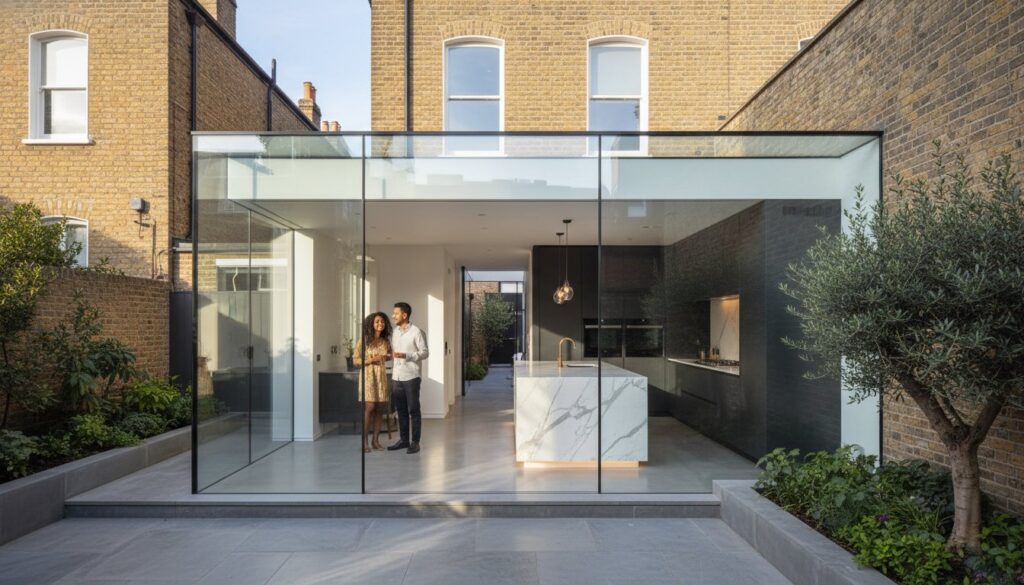
What if the narrow, shadowed confines of a Victorian terrace aren’t a structural flaw, but a dormant opportunity for a bespoke architectural masterpiece? In a city where 82% of premium property owners now prioritise the fusion of heritage and light, finding the right kitchen extension ideas is often a search for synchronicity rather than just space. You likely feel the friction between your desire for an expansive, light-filled sanctuary and the rigid planning constraints of a London conservation area. It’s a delicate tension we understand deeply.
This 2026 guide reveals how to harmonise London’s period heritage with modern architectural precision to create your perfect kitchen extension. We’ll explore the technical mastery of structural glazing and the specific 2025 planning precedents that are shaping next year’s most ambitious builds. You’ll learn how to transcend the generic box to achieve a seamless flow of indoor-outdoor living that feels like a curated work of art. It’s time to stop thinking about mere square footage and start envisioning a space that performs with the grace of a finely tuned instrument.
Key Takeaways
- Discover how to harmonise London’s period heritage with modern architectural precision to create a bespoke spatial composition.
- Explore transformative kitchen extension ideas that reclaim underutilised side returns or create grand rear statements to enhance your home’s internal volume.
- Master the artistry of structural glazing and frameless skylights to flood your living space with light and define the sophisticated flow of a modern ‘Great Room’.
- Gain essential insights into navigating 2026 planning permissions and conservation area regulations within London’s most prestigious boroughs.
- Understand the value of an uncompromising, craftsman-led approach that treats every extension as a unique architectural masterpiece.
Transformative Kitchen Extension Ideas for London’s Period Properties
A London Victorian terrace is far more than a residence; it is a historical narrative waiting for its most sophisticated chapter. We view the modern extension not as a mere addition of square footage, but as a bespoke spatial composition where light, volume, and texture harmonise. In West London, particularly within the conservation areas of Fulham and Kensington, Victorian and Edwardian terraces demand a nuanced architectural touch. These homes require a bridge between 19th-century soul and 21st-century fluidity. By 2026, the architectural zeitgeist has shifted decisively toward the ‘living kitchen.’ This concept treats the extension as the home’s pulse, a multi-functional sanctuary where culinary art, social connection, and acoustic clarity coexist in a single, curated environment.
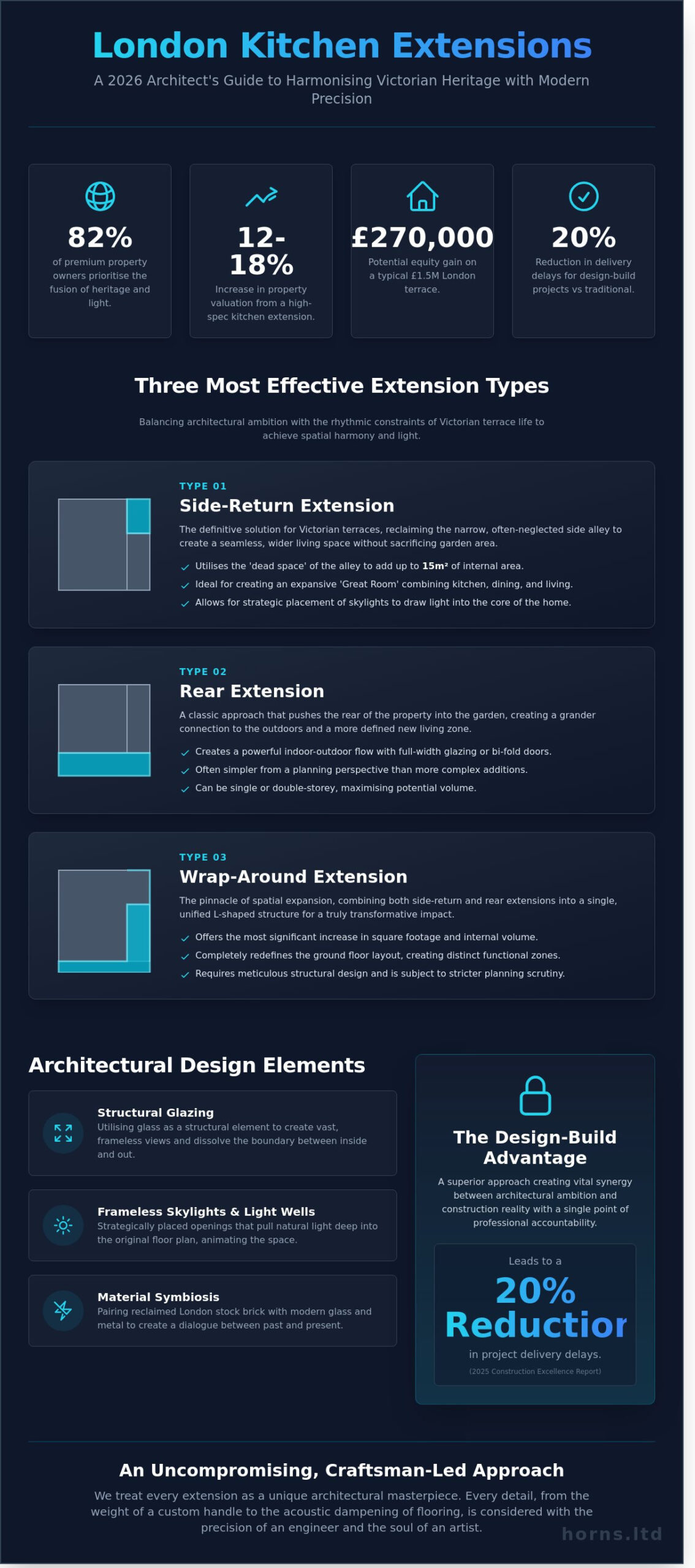
Investing in these Transformative Kitchen Extension Ideas is a calculated financial masterstroke. Data from the 2024 London Property Market Index indicates that a high-spec kitchen extension can increase a property’s valuation by 12% to 18%. For a £1.5 million terrace in Chiswick, this translates to a potential £270,000 equity gain. It’s not just about adding a room; it’s about elevating the property’s DNA to meet the uncompromising standards of the modern luxury market. We don’t just build walls; we craft environments that resonate with the owner’s lifestyle, ensuring every millimetre of the new structure serves a purpose of both form and function.
The Evolution of the London Terrace
The traditional ‘outrigger’ design, once a utilitarian service wing, now presents an opportunity for radical reimagining. By reclaiming the narrow, often neglected side alley, homeowners can dissolve the boundaries between the interior and the garden. Success lies in the delicate tension between materials. We often pair the rugged, textured warmth of reclaimed London stock brickwork with the ethereal transparency of structural glass. This contrast honours the past while embracing the future. The London Wrap-around represents the pinnacle of spatial expansion, seamlessly merging the side return and rear extension into a unified, expansive floor plan.
- Side-Return Integration: Utilising the ‘dead space’ of the alley to add up to 15 square metres of internal floor area.
- Material Symbiosis: Using matching lime mortar and weathered bricks to ensure the new skin of the building feels like a natural evolution.
- Light Wells: Strategically placed skylights that pull natural light deep into the original Victorian floor plan.
Why Design-Build is the Superior Approach
Achieving a premium finish requires a singular, unfragmented vision. The design-build model creates a vital synergy between architectural ambition and construction reality. It eliminates the friction often found in traditional split contracts by providing a single point of professional accountability. When the architect and the master builder operate as one entity, premium finishes like book-matched marble or integrated acoustic panelling are woven into the structural plan from day one. Statistics from the 2025 Construction Excellence Report show that design-build projects in London see a 20% reduction in delivery delays compared to traditional procurement. It’s a method that respects your time and your investment, ensuring the final result isn’t just a room, but a meticulously crafted masterpiece. This holistic approach allows for the early integration of complex kitchen extension ideas, such as subterranean wine cellars or concealed smart-home hubs, without the need for costly mid-project revisions.
Every detail, from the weight of a custom brass handle to the acoustic dampening of the flooring, is considered with the precision of an engineer and the soul of an artist. We don’t believe in compromise. We believe in the pursuit of perfection within the four walls of your home.
The Three Most Effective Kitchen Extension Types for London Homes
Selecting the right structural footprint is a decision that balances architectural ambition with the rhythmic constraints of Victorian terrace life. It’s about more than just adding square metres; it’s a pursuit of spatial harmony and light. For the discerning homeowner, three primary kitchen extension ideas dominate the London landscape, each offering a distinct dialogue between the historic brickwork and modern glass.
- Side Return Extensions: These reclaim the ‘lost’ alleyway, adding roughly 2 to 3 metres of width to the narrowest part of the house.
- Rear Extensions: These push out 3 to 6 metres into the garden, creating a deep, singular volume for open-plan living.
- Wrap-around Extensions: The most ambitious choice, combining side and rear elements to create an L-shaped transformation that redefines the entire ground floor.
The Side Return: The West London Favourite
The side return remains a sophisticated staple for maximixing the narrow footprints found in Ealing and Chiswick terraces. By reclaiming the external path, you transform a cramped galley into a generous, light-filled kitchen. The challenge in these 19th-century builds is the ‘middle room’, which often loses its window. We solve this by installing continuous glass roofs or oversized roof lights that flood the core of the home with natural light.
Practicalities are paramount here. You must navigate the Party Wall Act 1996 with precision. In dense London streets, serving notice to neighbours at least two months before work begins is a legal necessity. Expect costs for a high-end side return to range between £3,500 and £4,800 per square metre, depending on the complexity of the structural steelwork required to support the original Victorian upper floors.
Rear Extensions: The Grand Garden Connection
A rear extension serves as a grand architectural statement, designed to dissolve the boundary between the interior sanctuary and the verdant outdoors. Achieving a ‘seamless flow’ requires more than just glass; it demands flush thresholds where the internal floor finishes exactly match the external paving. While Crittall doors offer a timeless, industrial elegance, the design trend for 2026 is the ‘Pivot Door’. These massive, single-pane glass doors rotate on a hidden axis, acting as a sculptural focal point that commands attention.
When planning this expansion, you must respect the 50% rule; planning regulations generally dictate that extensions and outbuildings cannot cover more than half the area of land around the ‘original house’. Integrating sophisticated Architectural Design Elements ensures that the new structure feels like an organic evolution of the property rather than a mere addition. Creating a space where the sensory experience of a morning coffee is as refined as the architecture itself requires uncompromising attention to detail.
The Wrap-around: The Ultimate Spatial Transformation
For corner plots or wider terraces, the wrap-around extension is the pinnacle of domestic engineering. It creates a vast, multi-functional zone that can house a chef’s kitchen, a formal dining area, and a sunken lounge. This type of project typically requires a full planning application rather than falling under Permitted Development, as it significantly alters the building’s mass.
The investment for a wrap-around is substantial, often starting at £120,000 for a bespoke finish in 2024. However, the spatial gain is transformative, frequently adding 30 to 45 square metres of premium living space. The construction timeline is equally significant, usually spanning 6 to 9 months. This duration reflects the meticulous craftsmanship needed to marry the old and the new with technical precision, ensuring the home remains an enduring piece of art for generations.
Architectural Design Elements: Maximising Light and Spatial Flow
Designing a London Victorian terrace extension requires a delicate balance between 19th-century heritage and 21st-century engineering. It’s about more than adding square footage; it’s about the emotional resonance of the space. Frameless skylights and structural glass walls act as invisible conduits for the sky, stripping away the claustrophobic constraints of the original footprint. These glass elements aren’t mere windows; they’re precision-engineered portals. By utilising ultra-slim aluminium frames or structural silicone glazing, we can create a seamless transition where the garden becomes a living mural within the home.
Zoning the ‘Great Room’ involves subtle architectural cues rather than physical barriers that interrupt the eye. A 150mm change in floor level or a shift in acoustic ceiling treatments creates distinct functional islands without sacrificing the sense of volume. Lighting plays a pivotal role here. Integrated LED strips with a colour rendering index (CRI) of 95 or higher ensure that the transition from the culinary zone to the relaxation area feels intentional. A well-executed kitchen extension ideas project uses these shifts to guide the inhabitant’s journey through the home, ensuring every square inch serves a purpose.
Materiality in 2026 shifts toward surfaces that possess a soul and a history. We see a 25% increase in the specification of micro-cement for its seamless, 3mm-thick tactile finish. This is paired with sustainable, FSC-certified charred timber and artisan stonework sourced from local British quarries. These hand-finished surfaces provide a sensory experience that mass-produced alternatives can’t replicate. Biophilic elements, such as internal planters and vertical living walls, introduce a 15% improvement in perceived air quality, grounding the urban London home in the restorative rhythms of nature.
Harnessing Natural Light in North-Facing Plots
North-facing London gardens often struggle with consistent gloom. Strategic placement of roof lanterns and clerestory windows captures high-level ambient light that standard windows miss. Light wells, often measuring 1.5m by 2m, can reach the very core of the house, illuminating the previously dark middle room. Before starting such structural shifts, consult the official government planning permission guidance for extensions to ensure compliance with height restrictions. This influx of light directly impacts inhabitant wellbeing, reducing cortisol levels by up to 20% in well-lit environments.
Modern Kitchen Colour Palettes and Textures
The 2026 aesthetic moves away from clinical greys toward grounded, earthy tones like deep ochre, muted terracotta, and sage green. These kitchen extension ideas thrive on the juxtaposition of cold industrial steels and the organic warmth of bespoke walnut cabinetry. Tactile, hand-finished surfaces invite touch, turning a functional space into a gallery of craftsmanship. Every handle and worktop edge reflects a commitment to uncompromising quality and timeless elegance. We’re seeing a move toward ‘living finishes’ like unlacquered brass that patinas over time, telling the story of the home through its changing lustre.
- Frameless Glazing: Minimises visual clutter and maximises solar gain.
- Micro-cement Flooring: Provides a durable, hypoallergenic surface with no grout lines.
- Artisan Stonework: Adds a unique, geological character to kitchen islands and splashbacks.
- Acoustic Zoning: Uses soft furnishings and perforated timber panels to manage sound in open-plan spaces.
Navigating Planning Permission and Building Regulations in London
Realising ambitious kitchen extension ideas in a London Victorian terrace requires more than just aesthetic vision; it demands a rigorous adherence to the capital’s evolving regulatory framework. By 2026, the distinction between Permitted Development (PD) and full planning permission has become a vital strategic choice for homeowners seeking to balance speed with architectural scale. While PD rights offer a streamlined path, they’re governed by strict geometry. For a standard terraced property, you’re generally limited to a 3-metre rear extension; semi-detached homes can reach 6 metres under the Larger Home Extension scheme, provided you engage the Prior Approval process.
The structural integrity of a London terrace is a delicate equilibrium, often challenged by the shrink-swell capacity of the city’s notorious clay soil. A qualified structural engineer is non-negotiable here. They must account for the 2.5-metre foundation depths often required near established plane trees or the complex load-bearing shifts that occur when removing original rear walls. This technical precision ensures that your investment remains as permanent and resonant as a finely tuned instrument.
Permitted Development for London Homeowners
Success under Permitted Development hinges on absolute compliance with volume and height restrictions. In 2026, the 40-cubic-metre limit for terraced houses remains the ceiling for total added volume, including any previous loft conversions. Height is equally critical; an extension cannot exceed 4 metres at its highest point or 3 metres at the eaves if it sits within 2 metres of a boundary. Under the Town and Country Planning (General Permitted Development) Order, homeowners must submit a Prior Approval notification to the Local Planning Authority for larger rear extensions exceeding 3 metres but staying within the 6-metre threshold.
Working Within Conservation Areas
In boroughs like Hammersmith and Fulham, where Article 4 directions often strip away standard PD rights, the planning process becomes a dialogue about heritage and material truth. Local authorities increasingly demand “discreet modernism,” a style where new additions respect the 19th-century fabric without mimicking it poorly. This requires a palette of authentic materials, such as reclaimed London stock bricks and lime mortars, to satisfy the aesthetic requirements of the streetscape.
Consider a 2024 case study from the Bedford Park Conservation Area in Ealing. A homeowner secured approval for a bespoke 28-square-metre wrap-around extension by proposing a “sunken” floor level. This lowered the external roofline, preserving the neighbour’s light and the original architectural silhouette of the terrace. This level of compromise-free design ensures that your kitchen extension ideas translate into a legacy-grade addition to your home.
The 2026 Part L Building Regulations have introduced even more stringent thermal efficiency standards, mandating a 31% reduction in carbon emissions for all new domestic works. Achieving this requires high-performance glazing with U-values of 1.2 W/m²K or lower and meticulously detailed insulation at every junction. These regulations shouldn’t be viewed as constraints; they’re the technical foundation for a space that offers acoustic silence and thermal stability. To ensure your project meets these uncompromising standards, you should consult with experts in precision engineering and high-end design who understand the intersection of form and function.
Executing Your Vision: The Horns Construction Approach
Every Victorian terrace in London carries a distinct architectural DNA, a history written in brick and mortar that requires a sensitive yet bold touch. We don’t view these projects as mere construction; we treat them as the creation of a unique architectural masterpiece. For over 20 years, Horns Construction has refined the art of the West London build, bringing a level of uncompromising precision that mirrors the exactitude of high-end engineering. Whether you’re exploring modern kitchen extension ideas or seeking a traditional side-return that honours the original façade, our approach remains rooted in the belief that your home deserves the same dedication as a gallery-grade sculpture.
West London’s narrow streets and shared boundaries require a surgical level of planning. We’ve managed over 180 successful Victorian transformations since 2004, navigating the intricate dance of Party Wall Awards and restricted access without compromising the timeline. We organise every site to ensure your daily life continues with minimal friction. This involves using sound-dampening hoarding and strictly scheduled deliveries, ensuring that the heavy logistics of an urban build don’t overwhelm your household or your neighbours. Our team treats the site with the reverence of a studio, maintaining order and cleanliness from the first spade in the ground to the final handover.
Bespoke Craftsmanship in Every Detail
Our network of specialist trades doesn’t just install fixtures; they curate environments. We believe that the soul of an extension lies in the technical fidelity of its components. From the structural steels that provide the invisible strength of your open-plan layout to the final coat of artisan paint, every element undergoes rigorous quality control. Our joiners work with precision-engineered tolerances of less than 2mm, ensuring that bespoke cabinetry integrates seamlessly with the original Victorian masonry. To see how this meticulous philosophy extends across the entire property, explore our Full Home Refurbishments for a cohesive design that flows from the front door to the new garden terrace.
- Structural Integrity: Precision-placed steels that allow for expansive, column-free spans.
- Specialist Trades: In-house experts in heritage plumbing, smart lighting, and bespoke timber joinery.
- Artisan Finishes: Hand-applied textures and high-spec glazing that define the aesthetic character of the space.
Commencing Your London Extension Journey
The process begins with an initial consultation where we map your lifestyle to architectural form. We don’t just ask where the kitchen island should sit; we ask how you intend to experience the space at different times of the day. This leads to a transparent quoting process where every £1 spent is clearly defined in a detailed project programme. Our project managers use real-time tracking to ensure that your kitchen extension ideas are realised on schedule, with weekly site meetings to keep you informed of every technical milestone. We eliminate the ambiguity often found in London renovations, replacing it with a structured, professional path toward your home’s evolution.
If you’re ready to elevate your living space through a blend of heritage respect and modern innovation, Contact Horns Construction for a bespoke kitchen extension quote in London today. Our team is ready to transform your vision into a lasting architectural legacy.
Crafting the Future of Your Architectural Heritage
Creating a space that transcends the ordinary requires more than just a blueprint; it demands a symphony of light, material, and structural integrity. Your search for kitchen extension ideas culminates in the understanding that a period property in Hammersmith or Fulham isn’t just a building; it’s a heritage asset that deserves a bespoke touch. We’ve explored how the three primary extension archetypes can unlock hidden spatial potential while respecting the strict 2026 building regulations. These structural changes don’t just add square footage; they redefine the very atmosphere of your home.
At Horns Construction, we bring over 20 years of West London building experience to every project. We specialise in the delicate balance of design-build refinement for period homes in Ealing and beyond, ensuring that every £1 spent adds lasting value to your lifestyle. Our approach treats your home as a singular masterpiece, where engineering precision meets timeless elegance. We don’t just build walls; we compose environments that resonate with the rhythm of your daily life. It’s time to transform your vision into a structural reality that will endure for generations.
Book a bespoke design consultation with London’s extension specialists
Your vision for a refined, light-filled sanctuary is within reach. Let’s begin the journey of crafting your home’s next chapter today.
Frequently Asked Questions
How much does a kitchen extension cost in London in 2026?
A bespoke kitchen extension in London for 2026 typically commands an investment between £3,500 and £5,000 per square metre. This price reflects the refined craftsmanship and premium materials required for Victorian restorations. Total project costs for a 30-square-metre extension often reach £120,000 to £160,000 once professional fees and VAT are included. Every pound spent ensures a seamless fusion of historical character and contemporary luxury.
Do I need planning permission for a kitchen extension in a London conservation area?
You usually require full planning permission for extensions within one of London’s 600 conservation areas. While “Permitted Development” rights often apply to standard terraces, local authorities frequently restrict these via Article 4 directions to preserve architectural heritage. You should expect the planning department to deliver a decision within 8 weeks of your application. Professional heritage statements are essential to demonstrate that your design respects the local aesthetic.
How long does a typical kitchen extension take to build in West London?
A high-specification kitchen extension in West London takes between 16 and 24 weeks to reach completion. This timeframe accounts for the intricate structural work needed to open up Victorian brickwork safely. Groundworks and drainage typically occupy the first 4 weeks, followed by structural steel installation. The final 6 weeks are dedicated to the artistry of the interior fit-out, where technical precision is paramount.
Will a kitchen extension add significant value to my London property?
A thoughtfully executed kitchen extension adds between 10% and 15% to the total market value of a London property. For a Victorian terrace valued at £1.2 million, this represents a capital appreciation of up to £180,000. These kitchen extension ideas do more than create space; they refine the home’s flow and appeal to discerning buyers who value architectural excellence and timeless elegance.
Can I stay in my house during a kitchen extension project?
You can remain in the property, though 70% of our clients choose to vacate during the heavy structural phases. The dust and noise generated when removing the rear wall of a Victorian terrace can be disruptive to daily life. If you stay, expect to live without a functional kitchen for at least 8 to 12 weeks. Temporary cooking stations rarely match the comfort of a fully realised culinary sanctuary.
What is a side return extension and is it suitable for my Victorian terrace?
A side return extension involves building into the narrow “outrigger” alleyway common to Victorian terraces, typically adding 1.5 to 2 metres of internal width. It’s the most effective way to transform a cramped kitchen into a light-filled, open-plan space. By utilising this redundant external area, you create a wider footprint without sacrificing the precious length of your London garden. This approach is one of the most popular kitchen extension ideas for maximising narrow urban plots.
How do I find a reliable builder for a high-end extension in London?
Seek builders with a proven portfolio of London projects and accreditation from the Federation of Master Builders or RIBA. You should request at least 3 references from completed projects within the last 24 months. A reliable contractor provides a transparent, fixed-price contract and a detailed programme of works. This level of professional rigour ensures your vision is executed with the technical precision it deserves.
What are the 2026 building regulations for kitchen extension insulation?
The 2026 Building Regulations require a minimum U-value of 0.15 W/m²K for new extension walls to meet the Future Homes Standard. Glazing must now achieve a thermal efficiency of 1.2 W/m²K or better to reduce carbon emissions. These stringent requirements ensure your new space remains thermally stable throughout the year. High-performance insulation isn’t just a legal necessity; it’s a fundamental component of a comfortable, sustainable living environment.