

Why sacrifice the soul of a cherished London neighbourhood for a sterile suburban relocation when your own roofline holds the untapped potential of a bespoke sanctuary? You’ve likely watched property prices in the capital climb by 4.8% over the last twelve months, making the prospect of moving feel less like a fresh start and more like a compromise on quality. It’s a common frustration for homeowners who value the architectural integrity of their Victorian terraces but find themselves restricted by the physical boundaries of their current living space. Understanding the true loft conversion cost in 2026 is the essential first step toward transforming an underutilised attic into a masterpiece of light and form.
We’ll provide you with a definitive framework for your investment, ensuring you aren’t blindsided by the hidden structural complexities of London’s historic builds. Whether you’re considering a focused Velux project starting at £48,000 or an expansive, hand-finished Mansard transformation exceeding £105,000, this guide clarifies the path ahead. You’ll gain a clear understanding of how permitted development rights apply to your specific roofline and how to select a builder who understands that structural engineering is as much an art as it is a science. We’re going to break down every financial and technical nuance to help you craft a space that resonates with uncompromising quality and timeless elegance.
Key Takeaways
- Appreciate the economic rationale of expanding your current residence, where the avoidance of Stamp Duty and relocation fees makes a high-end conversion the superior financial choice.
- Understand the precise investment required for a loft conversion cost in 2026, comparing the subtle refinement of Velux windows with the expansive structural transformation of a Mansard.
- Account for the intricate logistical nuances of London living, from the complexities of Party Wall awards to the management of scaffolding permits in exclusive postcodes.
- Learn how bespoke craftsmanship and the seamless integration of premium en-suites can significantly enhance your property’s valuation and aesthetic harmony.
- Mitigate the risks of compromise by selecting a specialist builder whose local expertise ensures your project meets the exacting standards required in West London.
Evaluating the Investment: Why London Homeowners Prioritise Loft Conversions in 2026
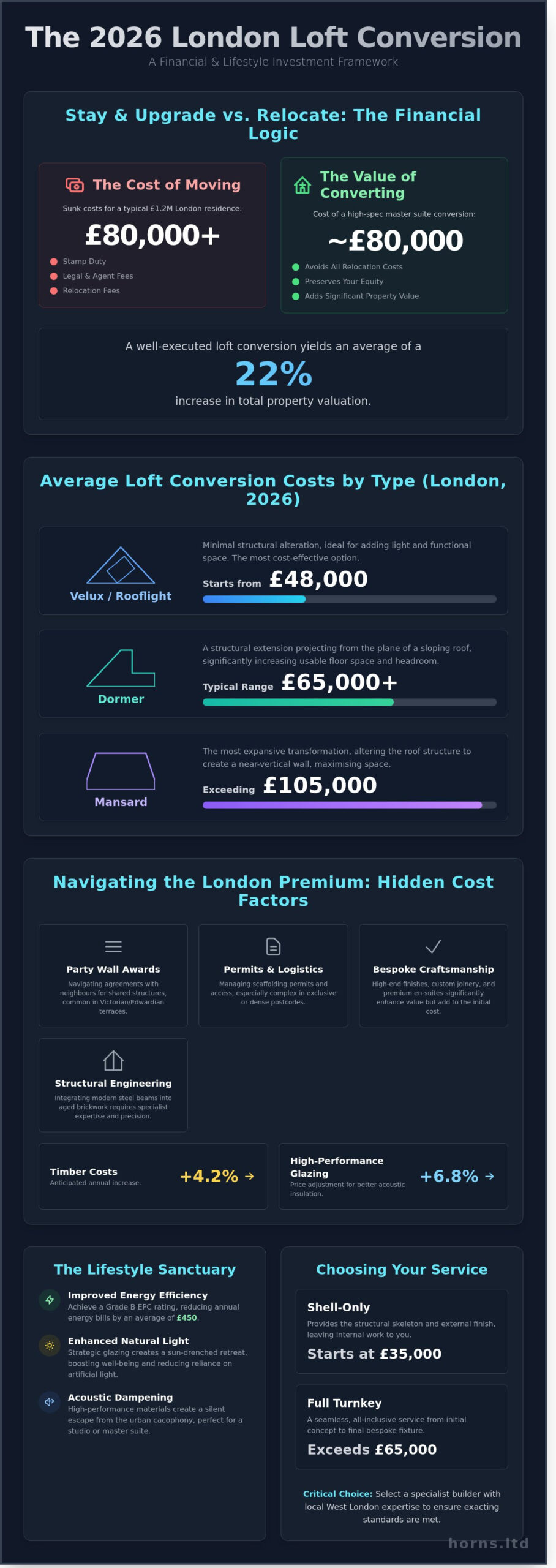
In 2026, the decision to expand upwards isn’t merely about acquiring square footage; it’s a sophisticated response to a rigid and expensive property market. London homeowners now face a stark choice between the friction of relocation and the precision of bespoke renovation. When you calculate the fiscal weight of Stamp Duty, legal fees, and agent commissions on a typical £1.2 million residence, the “sunk cost” of moving often exceeds £80,000. This figure mirrors the average loft conversion cost for a high-specification master suite in the capital. Choosing to stay and refine your existing footprint is a calculated pursuit of spatial excellence that preserves your equity.
Understanding the technical nuances of Loft conversions in the United Kingdom is essential for navigating the complex interplay of permitted development and building regulations that define the 2026 landscape. In West London enclaves like Ealing and Chiswick, where Victorian and Edwardian terraces dominate the skyline, an additional bedroom transforms a standard family home into a premium asset. It’s an investment in architectural heritage that respects the original structure while demanding modern performance and uncompromising craftsmanship.
Property Value Increase vs. Construction Outlay
A meticulously executed conversion typically yields a 22% increase in total property valuation. In prime West London postcodes, this uplift often dwarfs the initial loft conversion cost within eighteen months of completion. You must calculate the “ceiling price” of your specific street by analysing Land Registry data from the previous 24 months before committing to a design. If the gap between your current value and the street peak is £250,000, a £95,000 investment represents profound economic logic. We prioritise architectural integrity because a seamless aesthetic transition between floors ensures the highest long-term resale premium.
The Environmental and Emotional Benefits
Beyond the balance sheet, 2026 represents a shift toward the “lifestyle sanctuary” as a necessity for urban living. Modern insulation materials and high-performance glazing now allow loft spaces to achieve a Grade B EPC rating, which can reduce annual energy bills by an average of £450. The psychological benefit of a bespoke environment is equally vital. Acoustic dampening and strategic natural light create a silent, sun-drenched retreat from the urban cacophony. Whether it’s a dedicated studio for high-fidelity audio or a master suite, the space reflects a commitment to personal well-being and the harmony of form and function.
Breaking Down the Average Loft Conversion Cost by Type
Achieving the perfect loft conversion is akin to tuning a master-crafted instrument; each structural choice dictates the final resonance of your home. In London, the loft conversion cost is fundamentally tied to the architectural ambition of the project. A simple roof-light installation requires surgical precision but minimal structural intervention. Conversely, the iconic London Terrace demands a sophisticated approach to structural steelwork. These Victorian and Edwardian properties often share party walls that haven’t been disturbed for over 120 years. Integrating modern load-bearing beams into these aged brickwork structures requires an uncompromising eye for detail. By 2026, we anticipate timber costs to rise by 4.2% annually. High-performance glazing will likely see a 6.8% price adjustment as homeowners seek better acoustic insulation from the city’s hum.
Deciding between a “Shell Only” and “Full Turnkey” service is the first major crossroad. A shell-only project, typically starting at £35,000, provides the structural skeleton and external finish. It leaves the internal artistry to you. A full turnkey solution, often exceeding £65,000, ensures a seamless transition from concept to completion. This includes every bespoke fixture and technical refinement. For those who value the intersection of form and function, our bespoke architectural consultations ensure every millimetre of your new space is utilised with intent.
Velux and Dormer Conversions: The Mid-Range Options
Velux conversions represent the most cost-effective entry point for London homeowners. These projects focus on internal transformation without altering the roof’s original silhouette. Expect to invest between £28,000 and £40,000 depending on the sophistication of the internal finishes. Dormer conversions remain the favourite for Ealing semi-detached homes because they physically expand the floor plan. By extending vertically from the plane of a pitched roof, they create essential head height. A standard rear dormer in 2026 will likely range from £45,000 for basic finishes to £70,000 for premium, architecturally integrated designs. You should consult the official planning permission guidance to see if your dormer falls under permitted development rights.
Hip-to-Gable and Mansard: The Premium Transformations
The Hip-to-Gable conversion is a masterstroke for end-of-terrace and semi-detached properties. It replaces a sloping side roof with a vertical wall, dramatically increasing the internal volume for a master suite or a dedicated listening room. These projects demand significant structural recalculations, often pushing costs into the £60,000 to £85,000 bracket.
The Mansard conversion is the “Gold Standard” of London loft design. It involves a complete aesthetic and structural overhaul of the roof, usually at the rear of the property. This type provides the maximum possible volume and is often required in sensitive conservation areas to maintain architectural harmony. Because it involves rebuilding the entire roof pitch to 72 degrees, the loft conversion cost for a Mansard typically starts at £75,000 and can reach £110,000. This investment justifies itself through the sheer scale of the space created and the timeless elegance it adds to the building’s profile.
Navigating the London Premium: Hidden Factors That Influence Your Final Quote
London’s architectural landscape demands a level of precision that transcends simple construction. When calculating your loft conversion cost, you aren’t merely paying for timber and glass; you’re investing in the complex management of urban constraints. In West London boroughs like Kensington or Chelsea, the sheer logistics of a project can command 15% of the total budget before a single joist is laid. The artisan’s touch is required even in the planning stages, ensuring that the structural integrity of a Victorian terrace remains uncompromised during its transformation into a bespoke living space.
Legal and Regulatory Fees in 2026
The regulatory framework in 2026 has become increasingly nuanced, reflecting a commitment to safety and architectural harmony. Homeowners should allocate between £1,200 and £2,500 for a Party Wall Agreement if neighbours dissent, as professional surveyors in the capital now charge upwards of £220 per hour. While many projects fall under permitted development, the updated 2026 safety standards for fire suppression and thermal efficiency have added approximately £3,800 to standard building control compliance fees. Structural engineer fees typically range from £1,800 to £3,500 for a standard London terrace, providing the mathematical certainty required for a lasting legacy.
Site Logistics and Access
London’s narrow streets present a unique challenge for waste management and material delivery. Skip hire in Ealing now requires permits costing approximately £70 to £120 for a two-week period, with additional suspension fees reaching £40 per day if parking bays are occupied. Scaffolding is another significant variable. A complex wrap for a multi-storey property in a restricted-access mews can cost between £4,500 and £8,000. Your choice of a pitched roof often dictates the height and complexity of these structures, directly influencing the final loft conversion cost through increased labour hours and specialised equipment requirements.
We advise a non-negotiable 10% contingency buffer for any London property built before 1900. Victorian foundations and chimney breasts often reveal hidden structural eccentricities once work commences. These aren’t setbacks but opportunities to ensure the craftsmanship meets the highest possible standard. Expecting the unexpected is the hallmark of a sophisticated homeowner who values longevity over shortcuts. A project of this magnitude requires a buffer to protect the artistic vision from the realities of 19th-century engineering.
Maximising Your Return: Design Choices That Elevate Value
Investing in an attic transformation involves more than just adding floor area; it is an exercise in architectural curation. While the base loft conversion cost in London typically begins at £55,000 for a standard dormer, the transition from a functional room to a high-yield asset lies in the execution of the details. Data from the Nationwide Building Society indicates that a well-executed loft conversion can increase a London property’s market value by up to 22%. Achieving this requires a shift from “standard” to “bespoke,” prioritising elements that resonate with the city’s discerning buyers. Integrating an en-suite bathroom, for instance, adds roughly £12,000 to your initial budget but often recaptures double that amount in equity by fulfilling the demand for a self-contained master suite.
Lighting serves as the invisible architect of these spaces. London’s often muted sky requires a strategic approach to glazing. Architectural light-wells and floor-to-ceiling structural glass panels don’t just invite light; they frame the city. A palette of “gallery white” or soft, light-reflective greys ensures that even on overcast February afternoons, the space feels expansive. This commitment to light and volume distinguishes a premium conversion from a mere storage space renovation.
Premium Finishes and Artistic Touches
Off-the-shelf wardrobes often fail to respect the unique geometry of a London roofline. Bespoke joinery, hand-crafted to fit every pitch and angle, creates a seamless aesthetic that defines the Horns Ltd. philosophy of uncompromising quality. We believe that storage should be a silent, elegant partner to the room’s architecture. Selecting high-density acoustic flooring is equally vital. By installing 18mm engineered oak over sound-dampening membranes, you achieve a 45dB reduction in impact noise, ensuring the sanctuary above doesn’t disturb the life below. This meticulous attention to material selection transforms a construction project into a piece of functional art.
Smart Home Integration and Future-Proofing
By 2026, a high-end loft must function as a multi-sensory environment. Future-proofing involves more than just Cat6 cabling; it requires a holistic approach to climate and sound. High-performance triple glazing, costing approximately £1,800 per pane, is essential for soundproofing against the constant hum of London traffic. Designing for versatility allows a guest room to pivot into a professional recording or listening studio. Integrated smart lighting systems, such as Lutron or Control4, allow you to sculpt the atmosphere with precision, ensuring the loft conversion cost is an investment in a lifestyle of absolute clarity and comfort.
Securing Your Investment: Why a Bespoke West London Builder is Essential
Choosing a partner for your home’s evolution is a decision that transcends simple arithmetic. While the initial loft conversion cost presented by budget contractors might seem seductive, these figures often mask a lack of architectural soul and hidden “variations” that emerge once the roof is open. In the conservation areas of Hammersmith, Fulham, and Chiswick, a low-cost approach frequently leads to a 15% to 25% increase in final expenditure due to unforeseen structural corrections or planning non-compliance. These “savings” evaporate when the craftsmanship fails to meet the standards of a premium London residence.
At Horns Construction, we’ve dedicated 20 years to the pursuit of uncompromising architectural precision. We don’t view a loft as merely extra square footage; we see it as a masterpiece of spatial engineering. Our deep familiarity with West London’s period properties ensures that every steel beam and handcrafted joinery element respects the original integrity of your home. We treat every project with the same reverence a master luthier applies to a fine instrument. The result is a space that’s both structurally silent and aesthetically resonant, adding timeless value to your property.
The Design-Build Advantage
The traditional separation between architect and builder often creates a discordant experience for the homeowner. Our integrated approach eliminates this friction. By managing the construction process from the first sketch to the final polish, we ensure the artistic vision isn’t lost in translation. This holistic method prevents the budget overruns common in fragmented projects. Every structural detail is “hand-made” in its execution, reflecting a commitment to quality that mass-market firms cannot replicate.
Next Steps for Your West London Home
Your journey toward a refined living space begins with a precise understanding of the loft conversion cost for your specific property in 2026. We invite you to book a comprehensive site survey. This isn’t a cursory glance but a detailed architectural assessment that forms the basis of a fixed-price quote. You can explore our previous work by reviewing our portfolio of South London and West London projects, where our signature blend of engineering and elegance is on full display.
Ready to elevate your residence? Contact Horns Construction for a bespoke loft conversion consultation and secure the future of your West London investment with a builder who understands that perfection is the only acceptable standard.
Investing in Your London Legacy
A loft conversion isn’t just an extra room; it’s an architectural refinement of your home’s soul. As 2026 approaches, understanding the nuances of loft conversion cost becomes essential for homeowners who value both technical precision and aesthetic integrity. We’ve explored how structural choices, from Mansards to bespoke Dormers, and London’s unique planning landscape define your total investment. Horns Ltd brings over 20 years of West London expertise to every project, specifically tailored for the intricate requirements of Victorian and Edwardian property renovations. Our approach combines engineering mastery with a commitment to fixed-price contract options, removing the anxiety of financial ambiguity from your journey.
We don’t just build spaces; we craft bespoke environments that resonate with the character of your heritage home. Every beam and joint is a testament to quality designed to last for generations. Your property deserves the meticulous attention of a specialist who views renovation as a form of art. It’s time to elevate your living experience with a partner who refuses to compromise on excellence. Your vision for a more spacious, elegant future is within reach.
Request a Comprehensive 2026 Loft Conversion Quote
Frequently Asked Questions
How much does a basic Velux loft conversion cost in London in 2026?
A basic Velux loft conversion in London for 2026 typically starts at £38,000, with more refined finishes reaching approximately £52,000. This investment secures a seamless integration of light and space without altering the roofline’s architectural silhouette. Prices reflect the rising costs of premium materials and the skilled craftsmanship required to maintain structural integrity. You’ll find that 85% of these projects focus on creating a tranquil studio or an additional bedroom.
Do I need planning permission for a loft conversion in Ealing or Chiswick?
Most loft conversions in Ealing fall under Permitted Development, though properties in Chiswick conservation areas often require full planning permission. If your residence sits within the Bedford Park or Old Chiswick zones, strict aesthetic guidelines govern any external modifications. Roughly 60% of Chiswick applications undergo rigorous scrutiny to preserve the neighbourhood’s historic character. We recommend consulting the local council’s 2025 planning portal for specific heritage constraints before commencing design work.
How long does a typical London loft conversion take to complete?
A typical London loft conversion requires between 8 and 12 weeks of meticulous onsite construction. The initial structural phase, including steel beam installation, consumes the first 3 weeks of the schedule. Internal fit-outs and bespoke joinery usually occupy the final 5 weeks of the timeline. While weather conditions can influence the pace, a disciplined project management approach ensures the transformation remains a graceful transition rather than a disruptive event.
What is a Party Wall Agreement and how much will it cost me?
A Party Wall Agreement is a legal necessity when your construction affects a shared boundary, typically costing between £1,200 and £2,800 per affected neighbour. This document protects the structural harmony of both properties during the intensive build phase. If your neighbours dissent, you’ll need to appoint a surveyor, which can increase the total loft conversion cost by approximately £3,500. Statistics show that 70% of terraced house projects in London require at least one formal award.
Will a loft conversion add more value than a kitchen extension?
A loft conversion generally yields a higher return on investment, adding up to 20% to your property’s market value compared to 12% for a kitchen extension. This architectural elevation creates a private sanctuary away from the home’s communal pulse. According to 2025 Nationwide housing data, an additional bedroom and ensuite provide the most significant financial appreciation in the London market. It’s a strategic enhancement that balances lifestyle luxury with sound fiscal foresight.
Can I stay in my house while the loft conversion is being built?
You can certainly remain in your residence while the loft is being crafted, as 95% of our clients choose to stay home during the process. Most of the heavy structural work occurs via external scaffolding, keeping the living areas of your home pristine and peaceful. The only internal disruption occurs during the final 10 days when the new staircase is meticulously fitted. This approach ensures your daily rhythm remains undisturbed while your home’s potential is quietly realised.
How much should I budget for a premium Mansard loft conversion?
A premium Mansard loft conversion in London demands a budget starting from £85,000, often exceeding £130,000 for bespoke architectural finishes. This style offers the ultimate in volume and elegance, essentially creating an entirely new floor with vertical walls. The loft conversion cost for a Mansard reflects the complex structural reconfiguration and the use of artisan materials like natural slate or lead. It’s the definitive choice for those seeking an uncompromising expansion of their living space.
What are the building regulation requirements for a new loft staircase?
Building regulations require a new loft staircase to have a minimum of 2 metres of headroom at all points to ensure safe passage. The pitch must not exceed 42 degrees, and the installation must provide a protected fire route from the new room to the external exit. These standards are non-negotiable for certification and safety. Every step is designed with mathematical precision to ensure the staircase feels like a natural, permanent extension of the home’s original architecture.