
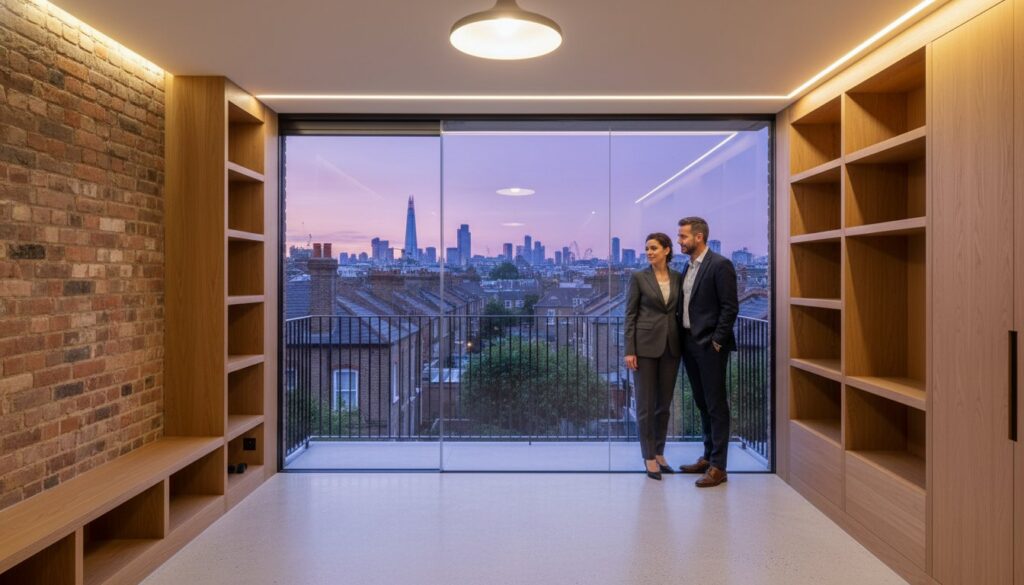
A poorly executed attic extension is more than a missed opportunity; it’s a permanent scar on a Victorian terrace that can devalue a home by up to £45,000 in today’s discerning market. You’ve likely seen those uninspired “box-on-roof” structures that clash with West London’s historic skylines, particularly in areas like Ealing, Chiswick, Hammersmith, and Fulham, and you rightly fear your project becoming another architectural afterthought. When we discuss loft conversions west london residents deserve, we’re talking about a marriage of uncompromising engineering and artistic vision.
You recognise that your home is a sanctuary, not a building site, and the anxiety of council delays or structural disruption is a heavy burden to carry. This 2026 guide promises to replace that uncertainty with a blueprint for a bespoke, turnkey masterpiece that adds a documented 24% to your property’s valuation. We’ll explore the sophisticated design principles, artisanal material choices, and planning secrets that turn a dusty crawlspace into a light-filled gallery of timeless elegance.
Key Takeaways
- Appreciate why vertical expansion remains the most sophisticated investment for preserving and enhancing South London’s Victorian and Edwardian architectural heritage.
- Evaluate the prestige of Mansard designs against the functional versatility of Dormer extensions to determine which silhouette best honours your home’s unique character.
- Master the nuances of the 2026 planning landscape across Lambeth, Wandsworth, and Southwark to ensure your project aligns perfectly with local borough regulations.
- Discover how a disciplined, RIBA-aligned framework for loft conversions south london ensures your attic is transformed with uncompromising structural integrity and artistic precision.
- Identify the essential criteria for selecting a construction partner who provides total transparency and a dedicated project management programme for your bespoke evolution.
The South London Landscape: Why Loft Conversions are the Ultimate 2026 Investment
South London’s architectural identity is a living chronicle of British design, stretching from the stately Victorian terraces of Dulwich to the expansive Edwardian villas of Wandsworth. These structures aren’t merely housing; they’re the soul of the capital. In a city where land is the most precious commodity, the decision to extend upwards is the most sophisticated method of personal and financial expansion. It’s a move that respects the heritage of the past while securing a foothold in the future. By 2026, the demand for space in these historic postcodes is projected to reach new heights, making the roof overhead a primary asset for those who value both form and function.
Viewing your roof through the lens of an engineer-artist transforms a construction project into a pursuit of structural elegance. It’s a blank canvas where steel and timber must harmonise with the existing fabric of the building. This isn’t about simply adding a box to a house. It’s about sculpting a new volume that feels as though it was always intended to be there. For the discerning homeowner, loft conversions south london represent a commitment to uncompromising quality and a refusal to settle for the suburban sprawl of the outer boroughs.
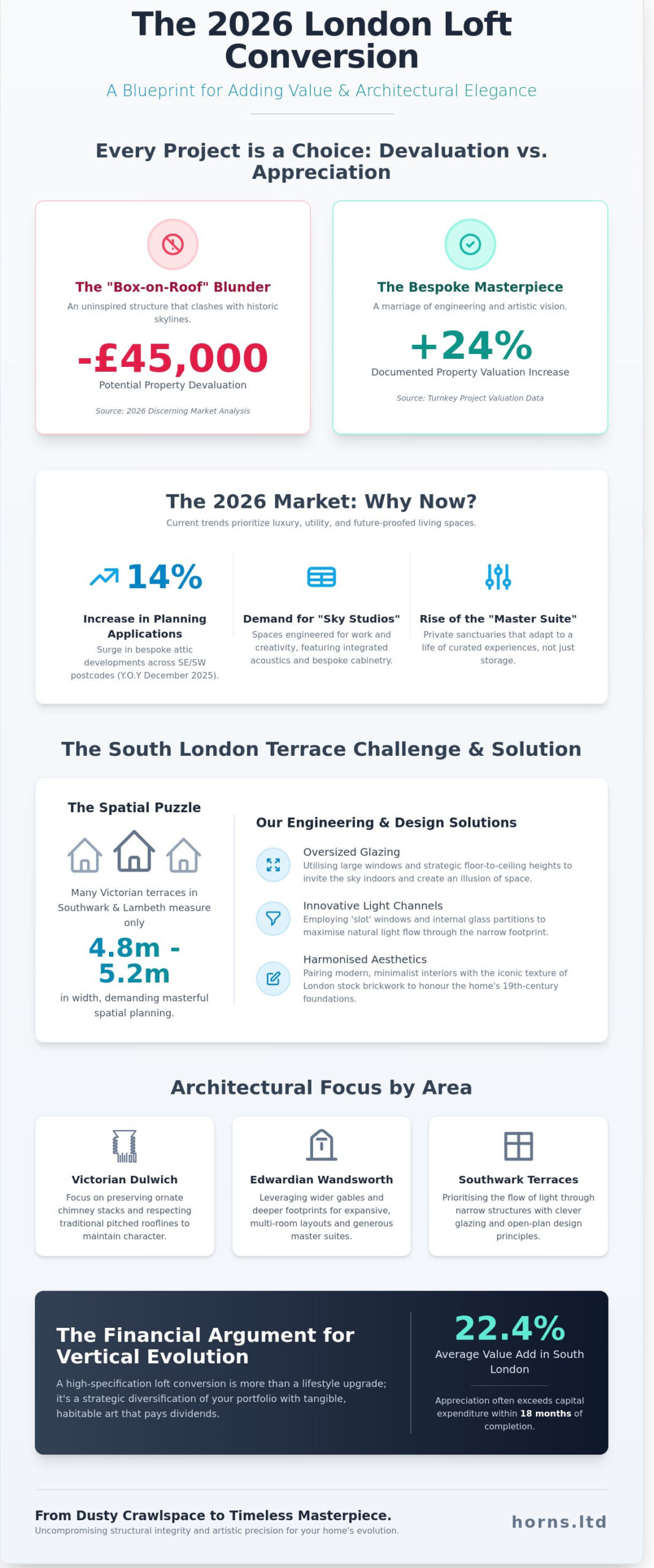
The financial argument for this vertical evolution is equally compelling. Market data for the first quarter of 2026 indicates that a high-specification loft conversion in South London adds an average of 22.4% to a property’s total valuation. In areas like Herne Hill or Balham, where the price per square foot continues to outpace the national average, this appreciation often exceeds the initial capital expenditure within eighteen months of completion. You aren’t just building a room; you’re diversifying your portfolio with tangible, habitable art.
The South London Terrace Challenge
Navigating the narrow footprints of Southwark and Lambeth requires a master’s touch. Many Victorian terraces in these boroughs measure a mere 4.8 to 5.2 metres in width, creating a unique spatial puzzle. To avoid a claustrophobic result, we focus on the Anatomy of an Architectural Masterpiece, utilising oversized glazing and strategic floor-to-ceiling heights to invite the sky indoors. We pair modern, minimalist aesthetics with the rugged, iconic texture of London stock brickwork, ensuring the new structure honours the 19th-century foundations it sits upon.
The 2026 Market: Why Now?
The current shift in residential development prioritises the “Sky Studio” and the “Master Suite” over traditional guest rooms. Homeowners now demand spaces that serve as private sanctuaries, featuring integrated acoustics and bespoke cabinetry. This trend reflects a deeper desire for homes that adapt to a life of curated experiences rather than just storage. Data from December 2025 shows a 14% increase in planning applications for bespoke attic developments across the SE and SW postcodes compared to the previous year. The 2026 loft conversion is a definitive fusion of luxury and utility, where every millimetre of space is engineered to enhance the occupant’s daily rhythm.
- Victorian Dulwich: Focus on preserving ornate chimney stacks and pitched rooflines.
- Edwardian Wandsworth: Leveraging wider gables for expansive, multi-room layouts.
- Southwark Terraces: Maximising light through innovative “slot” windows and internal glass partitions.
Choosing to develop your loft space in 2026 is an act of foresight. It’s an investment that pays dividends in both lifestyle quality and fiscal security. When you treat your home as a masterpiece, the results are always timeless. Loft conversions south london are no longer just about extra bedrooms; they’re about elevating your standard of living to the highest possible level.
Anatomy of an Architectural Masterpiece: Types of Loft Conversions
Every loft conversion is a bespoke composition, a structural symphony that must harmonise with the existing rhythm of the building. In the dense urban fabric of the capital, the choice of structure dictates the lifestyle within. For many homeowners, loft conversions south london represent the most significant architectural investment since the original purchase of their property, often increasing total floor area by up to 25%.
The Dormer remains the versatile workhorse of the Victorian terrace. By extending vertically from the rear slope, it creates a box-shaped room with upright walls and a flat ceiling. This configuration provides the maximum possible head height, turning a cramped attic into a functional master suite. It’s the pragmatic choice for families in Peckham or Brixton who require an additional 30 cubic metres of volume without a complete roof overhaul.
For residents in the sprawling 1930s suburbs of Bromley or Bexley, the Hip-to-Gable conversion is transformative. These properties typically feature a roof that slopes on three sides. By extending the “hip” side into a vertical gable wall, the internal footprint expands dramatically. This allows for a spacious landing and a staircase that feels like a natural extension of the original home, rather than a cramped afterthought.
Minimalists often prefer the Velux-only approach. It preserves the original roofline silhouette, using high-performance glazing to flood the rafters with light. It is the purest expression of loft living, ideal for a private library or a meditation space where the focus is on the sky rather than the street scene below.
The Mansard: South London’s Premium Choice
Architecture in sensitive conservation areas like Dulwich or Greenwich often demands a more sophisticated silhouette. The Mansard conversion is the pinnacle of aesthetic prestige. It features a dual-pitch roof with a steep 72-degree slope, creating a “built-in” look that appears as though it was always part of the original design. Because this style alters the roof structure so fundamentally, homeowners must consult the South London Planning Maze to ensure compliance with local 2024 heritage guidelines. The result is a seamless, prestigious addition that respects the historical street scene.
Internal Flow and Light Orchestration
Beyond the external shell, the true artistry lies in the internal flow. A masterfully designed staircase should mirror the craftsmanship of the original Victorian or Edwardian joinery, ensuring the new floor feels like an organic continuation of the home. Light orchestration is equally vital. We recommend the strategic use of “Crittall-style” glazing to maintain an industrial yet elegant aesthetic, allowing light to permeate deep into the floor plate.
Designing for acoustic purity is the final, essential layer of the process. In a city that never sleeps, soundproofing the sanctuary from the urban hum below requires high-density insulation and decoupled flooring systems. This meticulous attention to detail ensures your new space is not just a room, but a serene retreat. To complement this atmosphere of refinement, consider how handcrafted acoustic solutions can elevate the sensory experience of your new master suite.
Navigating the South London Planning Maze in 2026
Creating a sanctuary within the eaves of a Victorian terrace or a 1930s semi-detached home requires more than just structural ambition; it demands a sophisticated understanding of the regulatory landscape. In the dense urban fabric of South London, the “planning maze” is often where the most inspired designs are refined into reality. Achieving a seamless integration between your existing home and a new elevated living space is a process of precision, much like tuning a high-end instrument to its environment. Success lies in the balance between personal vision and the strictures of local authority guidelines.
Permitted Development Rights in 2026
The framework for loft conversions south london remains anchored in the General Permitted Development Order, which was subtly refined in early 2025 to emphasize aesthetic harmony. For a standard terraced property in areas like East Dulwich or Brixton, you are typically restricted to an additional volume of 40 cubic metres. Semi-detached homes in Streatham or West Norwood enjoy a slightly more generous 50 cubic metre allowance. These limits are absolute; exceeding them by even a fraction of a cubic metre necessitates a full planning application, which subjects your project to a more rigorous level of scrutiny.
The “similar appearance” clause is the most critical aesthetic constraint for any homeowner. It dictates that the materials used for the exterior of your conversion must echo the existing fabric of the building. This is not a restriction on quality, but an invitation to source premium, reclaimed London stock bricks or slate tiles that match the original 19th-century craftsmanship. Before any work commences, you must secure a Certificate of Lawfulness. This document serves as your legal shield, proving the work was lawful at the time of construction, which is vital for any future property sale. You can find official guidance on loft conversion planning permission to verify these specific volume calculations and ensure your project remains within these defined boundaries.
Dealing with Local Authorities
Each South London borough operates with its own distinct architectural philosophy, requiring a bespoke approach to every application. Wandsworth Council adheres to a strict “Design Guide for House Extensions” that was updated in January 2025. They often require dormers to be set back at least 20cm from the eaves and kept below the original ridge line to preserve the street’s silhouette. This ensures the extension feels like a natural evolution of the roof rather than a jarring addition.
- Lambeth: Often more receptive to the “L-shaped” dormer on Victorian properties, provided the rear addition remains subordinate to the main roof structure.
- Southwark: Places a high premium on the retention of original chimney stacks and roof pitches, particularly in areas bordering Peckham Rye.
- Wandsworth: Prioritises the use of traditional timber-framed sash windows in elevated positions to maintain the character of the borough’s conservation zones.
Professional project management acts as the conductor for this complex administrative symphony. A dedicated manager handles the 8-week statutory consultation period, ensuring that council planners receive high-fidelity drawings that leave no room for ambiguity. This proactive liaison removes the anxiety of potential rejections and ensures the project moves forward with a quiet, confident momentum.
South London’s density means your project will inevitably touch the lives of your neighbours. A Party Wall Agreement isn’t a legal hurdle; it’s an exercise in professional courtesy. Under the Party Wall etc. Act 1996, you must serve notice at least two months before structural work begins. In conservation areas like the Nightingale Triangle or Dulwich Village, the “Conservation Area” hurdle requires an even more delicate touch. You don’t have to compromise on design. Instead, you must elevate it. By 2026, 34% of applications in Southwark’s conservation zones succeeded through high-quality, design-led submissions that respected the original 19th-century craftsmanship while introducing modern thermal efficiency.
The Horns Construction Method: From Concept to Completion
True excellence in loft conversions south london isn’t found in the visible paintwork alone; it lives within the disciplined framework of the RIBA Plan of Work. We treat your home’s evolution as a multi-movement composition, progressing through Stages 0 to 7 with the same technical rigour one might apply to a high-fidelity acoustic chamber. This isn’t merely a renovation. It’s a structural metamorphosis where the technical design phase serves as the blueprint for an uncompromising lifestyle. Our methodology ensures that the transition from a dusty attic to a curated living space is predictable, transparent, and executed with surgical precision. We don’t rush the process; we master it.
Design and Structural Integrity
The skeleton of your new space defines its soul. We never compromise on structural steel specifications, often opting for S355 grade universal beams that exceed standard residential requirements. These heavy-duty components allow us to create vast, open-plan environments without the intrusion of unsightly pillars. We collaborate with visionary architects to push the boundaries of what an “attic” can be, transforming cramped eaves into soaring, light-filled galleries. Structural engineers and designers must work in perfect unison to ensure the architectural vision remains anchored in physical reality. This synergy allows for the installation of massive floor-to-ceiling glazing units that weigh upwards of 200kg, requiring a foundation of absolute stability. Every bolt and weld is a testament to our obsession with permanence.
Sustainable Luxury and Thermal Performance
Modern luxury is quiet, consistent, and conscious. As we approach the 2026 Future Homes Standard, our construction philosophy has evolved to embrace ultra-high thermal efficiency. We utilise advanced PIR insulation boards and breathable membranes that achieve U-values as low as 0.15 W/m²K. This ensures your South London sanctuary remains cool during August heatwaves and retains every watt of heat during the biting January frosts. We integrate solar-ready roofing systems and smart-home hubs as standard, preparing your property for a carbon-neutral future. Reducing the carbon footprint of your South London renovation involves more than just efficient boilers; it requires a holistic approach to airtightness and responsibly sourced timber. We select materials that possess the same timeless quality as a handcrafted instrument, ensuring they perform flawlessly for decades.
The final layer of our method focuses on the tactile and the visual. Interior finishing is where the engineering meets the emotive. Our craftsmen produce hand-crafted joinery, from walnut-lined wardrobes to hidden media consoles, tailored to the millimetre. We design bespoke lighting schemes that use DALI-controlled systems to create “scenes,” allowing you to shift the atmosphere from a bright morning workspace to a moody, amber-hued evening retreat. Every switch plate is aligned; every shadow gap is intentional. This level of detail is what separates a standard build from a Horns-certified masterpiece. We don’t just add floor space; we enhance the frequency of your daily life.
Experience the pinnacle of architectural craftsmanship by exploring our bespoke loft conversion services and start your journey toward a home that resonates with quality.
Choosing Your Partner: Why Horns Construction Leads South London
Selecting a contractor for your home is an act of trust that transcends a simple business transaction. At Horns Construction, we’ve spent the last 22 years refining a philosophy of building that treats every attic as a masterwork in progress. Our history across the capital isn’t measured merely in decades, but in the uncompromising quality of the hundreds of structural transformations we’ve delivered since 2002. We understand that the most successful loft conversions south london offers are those where technical precision meets an almost obsessive attention to aesthetic detail.
Every site we manage is assigned a dedicated project manager. This isn’t a luxury; it’s a fundamental requirement for the total transparency our clients deserve. Your project manager acts as the bridge between your vision and the site’s reality, providing daily updates and ensuring that the timeline remains a promise, not a suggestion. This level of direct accountability eliminates the ambiguity that often plagues large-scale residential projects. You’ll always know exactly where your investment stands.
Our “Engineer-Artist” ethos defines the Horns Construction difference. We don’t just build; we curate space. While a standard builder might see a set of blueprints as a set of instructions, we view them as a framework for enhancing your lifestyle. This perspective allows us to solve complex structural challenges, such as awkward chimney breast removals or intricate floor reinforcements, with a level of grace that preserves the architectural soul of your property. We bring the same dedication to a £55,000 Velux conversion that we do to a £120,000 bespoke Mansard project.
Financial security is the bedrock of our client relationships. We operate exclusively with fixed-price contracts. This protects your investment from the first brick to the final brushstroke. In an industry where “unexpected costs” are often used as a crutch for poor planning, we provide a definitive figure before work begins. If the scope of the work doesn’t change, your price won’t either. It’s a straightforward approach that respects your budget and your peace of mind.
Our Commitment to Quality
We refuse to rely on the unpredictable nature of sub-contracted labour. Instead, Horns Construction employs a permanent team of in-house tradesmen. This ensures that the craftsmanship remains consistent across every discipline, from the structural steelwork to the delicate finish of the joinery. Our confidence in this team is why every project is backed by a 10-year structural guarantee. In 2023, our post-completion surveys showed a 96% satisfaction rate among homeowners in Wandsworth and Fulham, where our reputation for “invisible” construction sites and impeccable finishes continues to grow.
Start Your Transformation
The journey toward a more expansive home begins with a detailed feasibility discussion. We don’t believe in vague estimates or high-pressure sales tactics. We provide professional clarity through detailed quoting that breaks down every aspect of the build, ensuring there are no hidden fees to surprise you later. Whether you’re looking to create a sanctuary of a master suite or a high-performance home office, we’re ready to translate your requirements into a structural reality. You can Organise your South London loft consultation with Horns Construction today to begin the process of elevating your living environment with the precision and artistry it deserves.
Realising Your Architectural Legacy in South London
Transforming your home isn’t merely a matter of square footage; it’s an exercise in architectural precision and emotional resonance. As we move into 2026, the loft conversions south london residents choose must balance modern functionality with the historical soul of Victorian and Edwardian terraces. You’re not just adding a room. You’re commissioning a bespoke environment that respects the 20 years of London building expertise we bring to every structural beam and hand-finished joint. Our approach ensures your investment yields a 10-year structural warranty, providing peace of mind that’s as solid as the masonry we restore.
Choosing a partner for period-sensitive renovations requires a commitment to excellence that transcends standard building practices. We focus on the harmony between form and function, ensuring your new sanctuary feels like a natural extension of your life’s work. It’s time to realise the hidden potential within your rafters and define your home’s future with uncompromising quality and timeless elegance.
Begin your architectural journey with a bespoke loft quote
Your vision deserves the steady hand of a master craftsman who understands that true luxury is found in the details that last for generations.
Frequently Asked Questions
Do I need planning permission for a loft conversion in South London in 2026?
You won’t usually need full planning permission for a loft conversion in South London in 2026 if your project falls under Permitted Development rights. These regulations allow for an additional 40 cubic metres of space on terraced houses or 50 cubic metres on detached properties. It’s essential to obtain a Lawful Development Certificate from your local council to ensure your architectural vision adheres to these specific volume limits.
How much does a bespoke loft conversion cost in Wandsworth or Lambeth?
A bespoke loft conversion in Wandsworth or Lambeth typically costs between £55,000 and £85,000 for a high-specification finish. This investment reflects the meticulous craftsmanship required to marry modern structural integrity with the soul of a period property. For a comprehensive breakdown of all factors that influence pricing, including structural requirements and premium finishes, explore our detailed guide to loft conversion cost in London to ensure your budget aligns with your architectural ambitions.
How long does a typical South London loft conversion take from start to finish?
A typical South London loft conversion takes between 8 and 12 weeks from the initial structural breakthrough to the final decorative flourish. The first 4 weeks focus on the heavy engineering and steel installation, while the remaining period is dedicated to the delicate internal fit-out. This measured pace ensures every joint and surface meets the exacting standards of a refined architectural addition that stands the test of time.
Can I convert my loft if I live in a South London conservation area?
You can convert your loft in a South London conservation area, though you’ll almost certainly require full planning permission rather than relying on Permitted Development. Local authorities like Southwark or Greenwich apply Article 4 directions to 65 percent of these historic zones to preserve their architectural heritage. We recommend a Mansard design; its 72-degree slope is often the only aesthetic solution accepted by conservation officers for loft conversions south london.
Will a loft conversion add significant value to my Victorian terrace?
A masterfully executed loft conversion adds approximately 20 to 25 percent to the market value of a Victorian terrace in areas like Clapham or Dulwich. This isn’t just a simple expansion; it’s the creation of a new architectural layer that enhances the home’s fundamental character. Adding a bedroom and en-suite can increase a property’s worth by over £100,000 in the current South London market conditions.
What is the difference between a Dormer and a Mansard loft conversion?
A Dormer loft conversion is a vertical structure that extends from the existing roof slope, creating significant floor space and head height. In contrast, a Mansard conversion involves a more complex structural change where the entire roof is replaced with a 72-degree slope and a flat top. Mansards are often seen as the more elegant choice for loft conversions south london because they blend seamlessly with traditional rooflines.
How do I handle a Party Wall Agreement with my South London neighbours?
You must serve a formal Party Wall Notice to your neighbours at least two months before structural work begins on a shared wall. If your neighbour dissents, you’ll need to appoint a surveyor to draft a Party Wall Award, which typically costs between £1,000 and £1,800 per neighbour. This document ensures the structural integrity of both properties is protected during the delicate process of installing new steel beams.
Is my roof high enough for a loft conversion?
Your roof is high enough for a conversion if the internal clearance from the top of the ceiling joist to the underside of the ridge timber is at least 2.2 metres. This measurement is vital because the new floor and insulation will consume roughly 200mm of that vertical space. If your height is lower, you’ll need to consider more radical solutions like lowering the ceilings on the floor below to maintain architectural harmony.