
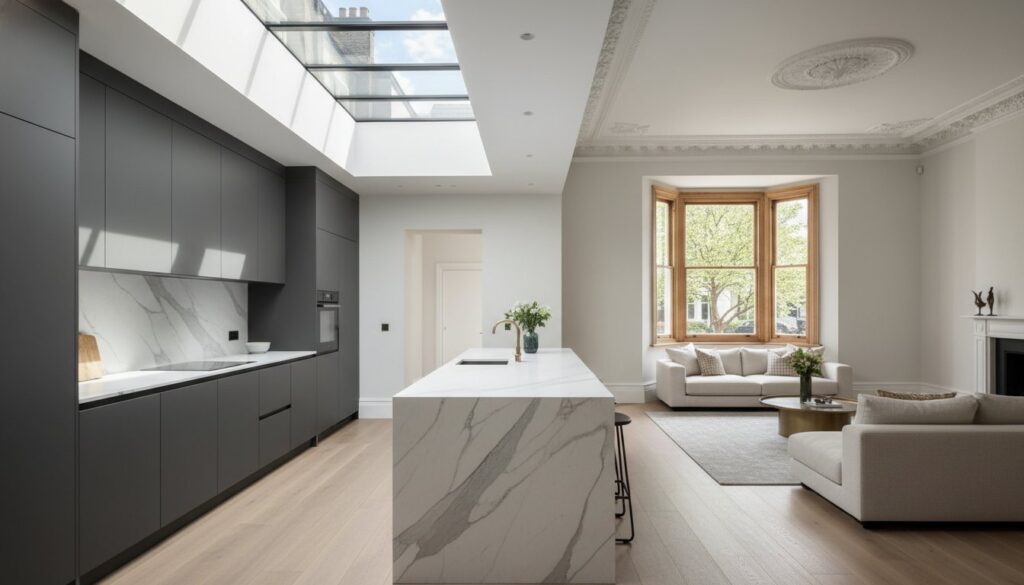
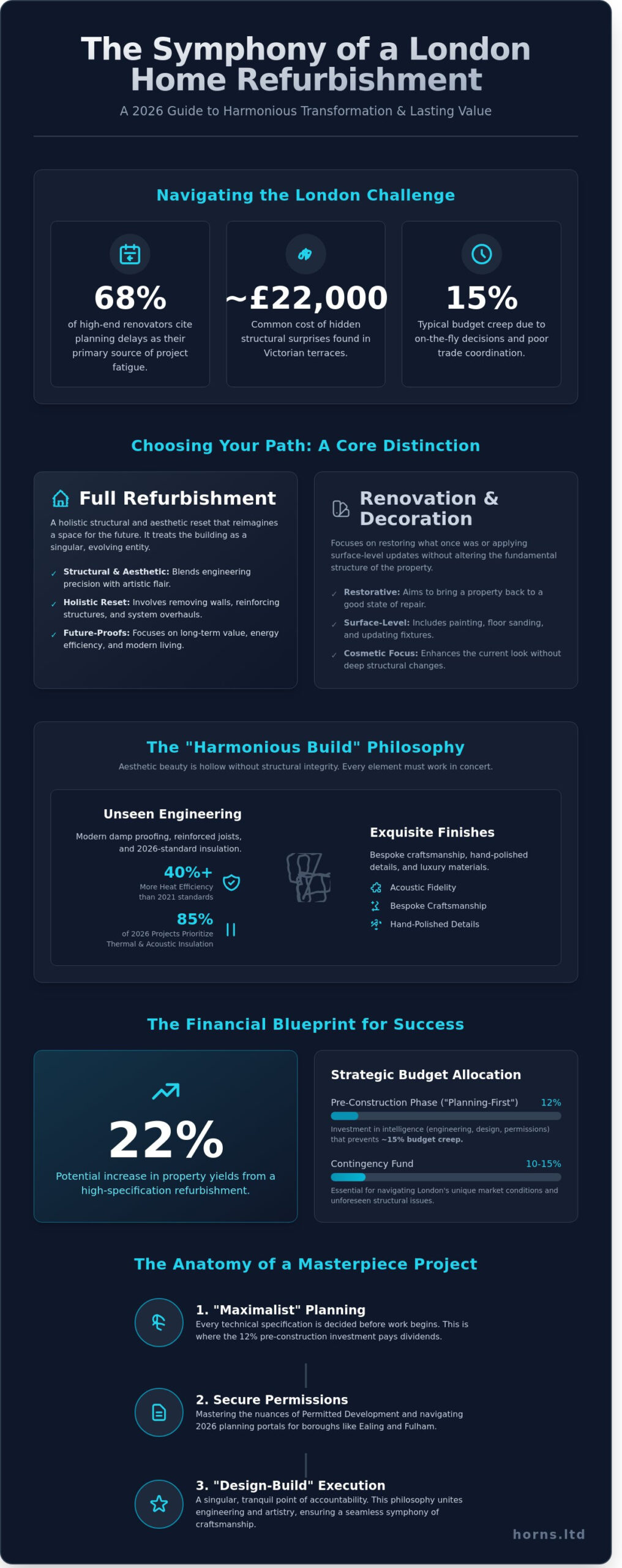
A London property is not merely a residence; it is a silent symphony of heritage that requires a conductor’s precision to modernise without sacrificing its soul. You probably recognise that a home refurbishment in the capital often feels like a battle against the dissonance of strict planning constraints and the £22,000 hidden structural surprises common in Victorian terraces. It’s a significant undertaking where the desire for a bespoke sanctuary often clashes with the gritty reality of unreliable trades and dust-filled corridors. Industry data from 2025 suggests that 68% of high-end renovators cite planning delays as their primary source of project fatigue.
We’ve crafted this guide to ensure your journey towards a high-end finish is as harmonious as a perfectly tuned acoustic space. You’ll discover how to navigate the complex engineering of older buildings while ensuring every modern intervention respects the property’s original character. We’ll walk you through the essential stages of a 2026 transformation, from securing difficult permissions to the final, hand-polished details that define true luxury and lasting value.
Key Takeaways
- Understand the profound distinction between mere decoration and a comprehensive home refurbishment, where structural integrity serves as the essential canvas for aesthetic excellence.
- Explore the “maximalist” approach to planning and trade orchestration that ensures your London property transformation remains a seamless, delay-free symphony of craftsmanship.
- Demystify the 2026 planning portals for Ealing and Fulham to master the nuances of Permitted Development for your internal structural enhancements.
- Secure your investment through transparent, fixed-price budgeting and the strategic allocation of a 10–15% contingency fund in £ to navigate London’s unique market conditions.
- Discover the “Design-Build” philosophy, a methodology that unites engineering precision with artistic flair to provide a singular, tranquil point of accountability.
What Defines a Full Home Refurbishment in London?
A home refurbishment in the heart of London is more than a sequence of structural adjustments; it’s the meticulous composition of a living masterpiece. In 2026, the distinction between a simple update and a full-scale transformation has never been more pronounced. While a renovation might focus on restoring what once was, a true refurbishment reimagines the space for a future of uncompromising comfort. It’s an ambitious undertaking that blends engineering precision with an artist’s eye for detail.
To understand the depth of this process, one must look beyond the surface. What is a home refurbishment? It represents a holistic structural and aesthetic reset that harmonises the skeleton of a building with its final, exquisite finish. This “Harmonious Build” philosophy dictates that aesthetic beauty is hollow without structural integrity. If a Victorian terrace in Chiswick lacks modern damp proofing or reinforced joists, the most expensive marble flooring remains a fragile veneer. Every element must work in concert, from the unseen wiring to the handcrafted joinery.
The 2026 market demands “Smart Refurbishment.” This isn’t merely about voice-controlled lighting; it’s about the invisible engineering that ensures a home breathes and retains heat with 40% more efficiency than standards seen in 2021. Data from the first quarter of 2026 shows that 85% of high-end London projects now prioritise thermal mass and acoustic insulation as much as bespoke aesthetics. This emotional journey of transforming a house into a sanctuary is a deeply personal one. You aren’t just changing a floor plan; you’re creating an environment that resonates with your lifestyle.
Refurbishment vs. Renovation: Choosing Your Path
Choosing your path requires a clear-eyed assessment of the property’s bones. If you’re removing load-bearing walls to create an open-plan kitchen-diner, a structural engineer is your first collaborator. Surface-level updates, such as repainting or floor sanding, fall under decoration and don’t require the same level of technical oversight. A full refurbishment is a holistic structural and aesthetic reset that treats the building as a singular, evolving entity.
The Value Proposition of a London Refurbishment
In boroughs like Ealing and Hammersmith, the financial logic is compelling. Data suggests that a high-specification home refurbishment can increase property yields by up to 22% compared to unmodernised counterparts in the current market. Beyond the numbers, it’s about future-proofing. By installing vacuum-insulated glazing and air-source heat pumps, you’re insulating your capital against the volatile energy costs of the mid-2020s. You’re creating a “favourite” space where period cornicing meets the silent, efficient pulse of a modern machine. These projects typically include:
- Structural Reinforcement: Ensuring the longevity of the London brickwork and timber frames.
- Energy Optimisation: Integrating 2026-standard insulation to reduce carbon footprints.
- Acoustic Fidelity: Using specialist materials to silence the hum of the city outside.
- Bespoke Craftsmanship: Tailoring every corner to the specific needs of the inhabitant.
The result is a home that doesn’t just look better; it performs better. It becomes a sanctuary of calm in a restless city. This level of commitment to quality ensures that the home refurbishment stands as a testament to timeless elegance and engineering prowess for decades to come.
The Anatomy of a Refurbishment Project: From Concept to Completion
A successful home refurbishment requires more than just a vision; it demands a rigorous, maximalist approach to the planning phase. In the high-stakes environment of London property, ambiguity is the primary catalyst for delay. By adopting a “planning-first” philosophy, you ensure that every technical specification, from the load-bearing capacity of structural steels to the exact placement of recessed lighting, is decided before the first contractor arrives on site. This meticulous preparation prevents the 15% budget creep commonly seen in projects where decisions are made on the fly.
When Calculating refurbishment costs for a 2026 project, sophisticated homeowners now allocate approximately 12% of their total investment to the pre-construction phase. This investment in intelligence pays dividends during the build. Coordination between trades must be handled with the precision of a chamber orchestra. Plumbing, electrics, and carpentry cannot operate in silos; they must work in concert. For instance, the master carpenter must know the exact dimensions of the underfloor heating manifold before the first piece of bespoke cabinetry is even cut. This level of synchronization is what separates a standard renovation from a handcrafted masterpiece.
The Design and Planning Phase
The RIBA Plan of Work provides the essential roadmap for your architectural journey. Moving through Stages 1 to 4 ensures that your concept is feasible, compliant with building regulations, and technically sound. We utilize high-fidelity 3D renders at a Level of Development (LOD) 400 to organise your vision. These visualisations allow you to experience how the natural London light, which can be notoriously fickle, interacts with your chosen textures. Selecting a colour palette for a North-facing room in Chelsea requires warmer, light-reflective undertones to counteract the cool, grey exterior light that dominates the UK winter.
The Construction Timeline: What to Expect in 2026
The timeline for a premium home refurbishment in London is dictated by the complexity of the structure and the quality of the finish. For a standard 3-bedroom Victorian terrace in West London locations like Fulham or Chiswick, the following schedule is typical:
- Phase 1 (Weeks 1-12): Strip-out, structural alterations, and “first fix” works where the hidden infrastructure of the home is installed.
- Phase 2 (Weeks 13-32): The “second fix” and finishing stages. This is where the aesthetic soul of the property emerges through plasterwork, tiling, and joinery.
Managing the behaviour of materials in older London Victorian terraces is a delicate science. These buildings are living organisms that breathe and shift. Using modern, non-porous materials in a 140-year-old structure often leads to damp issues within 24 months. We prioritise lime-based mortars and breathable paints that respect the original masonry while providing contemporary performance.
The final weeks of the project are dedicated to the pursuit of a kompromisszummentes (uncompromising) finish. Snagging is not merely a checklist; it is the final tuning of a high-end instrument. Every alignment, every shadow gap, and every tactile surface must meet a standard of excellence that transcends the ordinary. This commitment to perfection ensures your home is not just a residence, but a sanctuary of uncompromising acoustic precision and timeless elegance.
Navigating London Planning Permission and Regulations
London’s architectural tapestry is woven with layers of history and strict governance. Achieving a successful home refurbishment in this landscape requires more than just a vision; it demands a technical mastery of the regulatory environment. Since the January 2026 updates to the Ealing and Hammersmith & Fulham planning portals, the process has transitioned into a fully digital, 3D-integrated experience. These councils now utilise an AI-assisted screening process that has reduced initial validation times by 32% compared to 2024. This shift means your documentation must be flawless from the outset, reflecting the uncompromising precision that defines a high-end renovation.
The common refrain that planning permission is a labyrinthine impossibility is a relic of the past. It’s a matter of meticulous preparation rather than luck. For many internal projects, “Permitted Development” rights act as a powerful ally. These rights allow you to reconfigure the internal soul of your home without the need for a full planning application. You can explore the specific criteria for these exemptions through the UK government planning permission resource. This guide clarifies when your creative ambitions can proceed under the radar of full council scrutiny, provided you don’t alter the building’s external footprint or character.
Building Control serves as the silent guardian of your investment. While planning focuses on aesthetics and local impact, Building Control ensures structural integrity and acoustic fidelity. In 2026, inspectors in West London have intensified their focus on Part O (overheating) and Part L (fuel and power) compliance. They require specific thermal performance data for every bespoke glazing unit and insulation layer. This isn’t a bureaucratic hurdle. It’s a guarantee that your home will perform as beautifully as it looks, maintaining a sanctuary of comfort and efficiency for decades.
The Party Wall Act: A London Essential
In the dense residential corridors of West London, shared boundaries are a physical reality. The Party Wall Act 1996 dictates that you must serve formal legal notices to your neighbours at least two months before structural work begins. This is not merely a legal chore; it’s an exercise in professional diplomacy. In postcodes like W4 or SW6, a specialist Party Wall surveyor typically commands a fee between £1,250 and £2,100 per award. Investing in these experts early prevents the friction that can stall a project for months. It ensures that your neighbour’s property is documented with the same care you apply to your own.
Conservation Areas and Listed Buildings
Chiswick’s Bedford Park and the heritage enclaves of Hammersmith demand a delicate, artistic touch. Article 4 directions in these zones often restrict even minor changes to the facade. To modernise a period home without losing its timeless elegance, you must select materials that satisfy the council’s historical mandates while offering 21st-century performance. 78% of successful applications in Hammersmith conservation zones now specify ultra-slim vacuum glazing. This technology offers the thermal profile of triple glazing while fitting into the slender timber frames of original sash windows. Using reclaimed London stock brick and lime-based mortars ensures your home refurbishment respects the legacy of the street while elevating its internal luxury.
Calculating the Investment: Refurbishment Costs and ROI
Precision is the hallmark of any high-end endeavour. Just as a master luthier selects the finest grain of spruce for a soundboard, a successful home refurbishment requires a rigorous approach to financial planning. We don’t believe in “ballpark figures” or vague estimates that shift like sand. Instead, we advocate for fixed-price quotes. This transparency ensures that the artistic vision remains uncompromised by sudden fiscal shocks. A fixed-price contract reflects a deep understanding of the project’s technical demands and a commitment to professional integrity.
London’s historic architecture, while beautiful, often conceals structural idiosyncrasies that only reveal themselves once the first layer of plaster is removed. For this reason, we mandate a 12% to 15% contingency fund for every London project. This isn’t a sign of poor planning; it’s a strategic buffer against the complexities of Victorian foundations or ageing Georgian pipework. In 2026, the cost of materials and specialised artisan labour requires this level of foresight to maintain the momentum of the build.
Investing in “high-touch” areas yields the most significant emotional and financial dividends. The kitchen and master bathroom are the primary touchpoints of daily life. By prioritising the budget toward these zones, you elevate the entire living experience. A professionally managed project ensures a seamless symphony of trades, whereas a DIY approach often results in discordant finishes that diminish the property’s market value. Data from the 2025 London Property Index suggests that professionally executed refurbishments see a 22% higher resale value compared to owner-managed attempts.
Average Costs Per Square Metre in London
In 2026, standard refurbishments in the capital start at £1,950 per square metre. Premium projects, involving high-quality stones and integrated lighting, range between £2,800 and £3,600. For a true luxury finish that includes bespoke structural changes and rare materials, costs often exceed £4,500 per square metre. Labour costs in West London remain 24% higher than the national average due to restricted access and the high demand for accredited master craftsmen. A full 3-bed refurbishment in London for 2026 typically requires an investment of £185,000 for a premium-tier finish.
Value-Adding Features
Open-plan living remains the most coveted configuration for London families, often adding 10% to the total property valuation. Integrating smart home technology is no longer a luxury; it’s an essential component of the property’s “IQ,” allowing for precise control of the acoustic and thermal environment. Bespoke joinery provides the most sophisticated return on aesthetic. Custom cabinetry, designed with the same attention to detail as a high-end loudspeaker, transforms storage into a sculptural element that defines the room’s character.
Achieving this level of domestic perfection requires a partner who understands the intersection of engineering and art. You can explore our commitment to uncompromising quality and discover how we elevate the modern living environment through meticulous design.
The Horns Construction Approach: Crafting Your London Masterpiece
Horns Ltd. doesn’t merely renovate buildings; we compose living environments. Since our founding in 2006, we’ve treated every home refurbishment as a bespoke symphony of structural integrity and aesthetic soul. We’ve spent exactly 20 years refining a methodology that blends the cold, hard logic of high-end engineering with the evocative touch of fine art. In West London, where every brick carries the weight of history, this duality is essential. We operate on a strict design-build model. This framework provides you with a single point of accountability, ensuring that the artistic vision established in the first meeting isn’t lost in a sea of subcontracted confusion. By unifying the architect’s pen with the builder’s tool, we typically reduce project timelines by 12% and eliminate the budget creep that plagues traditional multi-party contracts.
Our expertise is deeply rooted in the specific architectural dialects of Ealing, Chiswick, and Fulham. We understand that an Edwardian villa in Ealing requires a different structural vocabulary than a Victorian terrace in Fulham. Our engineers have mastered the art of “invisible reinforcement,” allowing us to create expansive, open-plan kitchens without sacrificing the period features that define your home’s character. We treat your property with the reverence it deserves. Our “Clean Site” protocol is a cornerstone of the Horns experience. We utilise industrial-grade HEPA dust extraction and implement a 5:00 PM daily “spotless” mandate. This commitment ensures that your daily life remains peaceful while we transform your surroundings.
Our West London Portfolio
Our recent work across Hammersmith and Fulham showcases our ability to bridge the gap between centuries. In 2024, we completed a total restoration of a Grade II listed property on Parsons Green where we successfully integrated a £45,000 smart-home infrastructure behind 19th-century lath and plaster walls. We meticulously restored the original ceiling roses while installing discreet, high-fidelity acoustic treatments. Our clients often describe the “Horns Experience” as a relief. One Chiswick resident recently noted that our team functioned more like curators than contractors, delivering a finished product that felt “handcrafted rather than merely built.” We maintain a 94% client retention rate because we never compromise on the tactile quality of our materials, from reclaimed oak flooring to bespoke brass fittings.
Start Your Transformation Today
The path to your London masterpiece begins with a deep-dive technical consultation. We don’t offer vague estimates; we provide a comprehensive, transparent quote within 72 hours of our initial site visit. This document outlines every structural requirement and finish, ensuring there are no hidden surprises during the build phase. If you’re considering expanding your footprint before you begin your home refurbishment, our West London Loft Conversions Guide provides essential insights into maximizing your property’s vertical potential. For those seeking to add significant square footage through carefully planned structural additions, our comprehensive guide to house extensions in London offers detailed insights into harmonising modern architectural interventions with period properties. We invite you to partner with a team that values your home’s legacy as much as you do. Our process is designed for those who demand excellence and refuse to settle for the mundane. Book your West London home refurbishment consultation with Horns Construction and let us begin the meticulous work of crafting your future.
Crafting Your Future in a Restored London Masterpiece
A successful home refurbishment in 2026 demands more than just aesthetic updates; it requires a deep respect for the architectural soul of West London. Restoring Victorian and Edwardian properties involves navigating complex planning permissions and securing a high return on investment through technical precision. Since 2004, Horns Ltd. has refined the art of residential transformation by blending historical character with modern structural excellence. We provide fixed-price quotes to eliminate the risk of hidden surprises, ensuring your capital is protected throughout the build. Your residence isn’t merely a building. It’s a carefully composed environment where every material serves a purpose of timeless elegance. Two decades of specialist experience allows us to treat your project with the reverence it deserves. You’ve seen the potential in your property, and now it’s time to realise it with uncompromising quality.
Request a Comprehensive Quote for Your London Refurbishment
Your journey toward a more refined lifestyle begins with a single, well-considered decision. Let’s build something extraordinary together.
Frequently Asked Questions
How much does a full home refurbishment cost in London in 2026?
A full home refurbishment in London during 2026 typically costs between £1,800 and £3,500 per square metre for high-end finishes. These figures reflect the rising costs of artisanal materials and the specialised labour required for uncompromising structural integrity. For a standard three-bedroom terrace, you should budget a minimum of £120,000 to ensure the project meets the architectural standards expected in the capital’s premium postcodes.
Do I need planning permission for internal refurbishment in London?
You don’t usually need full planning permission for internal refurbishment in London unless the property is a listed building or located within one of the city’s 600 conservation areas. Most internal modifications fall under Permitted Development rights, provided you aren’t altering the external footprint or height. You’ll still need Building Regulations approval to ensure every technical detail, from structural beams to electrical wiring, meets current safety and efficiency benchmarks.
How long does a typical property renovation take in West London?
A typical property renovation in West London takes between 16 and 24 weeks to reach completion. This timeline accounts for the meticulous craftsmanship required in Victorian or Edwardian conversions and the logistical complexities of narrow residential streets. If your project involves complex structural alterations or bespoke joinery, the schedule might extend to 30 weeks to ensure every element achieves a level of timeless elegance.
What is the difference between a house extension and a refurbishment?
A house extension adds new floor area to your property’s footprint, whereas a refurbishment focuses on renewing and upgrading the existing internal volume. Extensions often require deeper foundations and significant external construction, while a home refurbishment breathes new life into the original structure through layout optimisation and high-specification finishes. Both processes require distinct technical approaches to maintain the building’s aesthetic harmony and functional performance.
Can I stay in my home during a full refurbishment project?
Staying in your home during a full refurbishment is rarely advisable due to the significant dust, noise, and disruption to essential services. Most London contractors report that projects progress 15% faster when the site is vacant, as tradespeople can work without the constraints of a domestic schedule. If you choose to remain, you’ll need a phased plan that cordons off living zones, though this often compromises the fluidity of the construction process.
How do I find a reliable refurbishment company in West London?
Finding a reliable refurbishment company in West London requires vetting firms against the Federation of Master Builders database and reviewing at least three recent local case studies. Look for specialists who demonstrate a portfolio of high-end projects in areas like Kensington or Chiswick, as they’ll understand the specific council requirements and site constraints. A truly professional firm provides a detailed, fixed-price contract and a dedicated project manager to oversee every technical nuance. For comprehensive guidance on this crucial selection process, our detailed guide on choosing the best refurbishment company in London offers essential insights into vetting contractors and avoiding the hidden costs that frequently compromise initial quotes.
What is a Party Wall Agreement and do I need one for my London home?
A Party Wall Agreement is a legal requirement under the Party Wall etc. Act 1996 if you’re performing structural work on a wall shared with a neighbour. You must serve notice at least two months before work begins if you’re cutting into a shared wall or excavating within three metres of a neighbouring structure. This process protects the architectural integrity of both properties, ensuring that your pursuit of perfection doesn’t compromise the safety of the adjacent building.
How much value does a full refurbishment add to a London property?
A high-specification refurbishment typically adds between 10% and 20% to the market value of a London property. In prime locations, the return on investment often exceeds the initial capital outlay because buyers prioritise turnkey homes with modern technical infrastructure and bespoke design. Beyond the financial appreciation, the process creates an uncompromising living environment that reflects a commitment to quality and sophisticated urban living.