
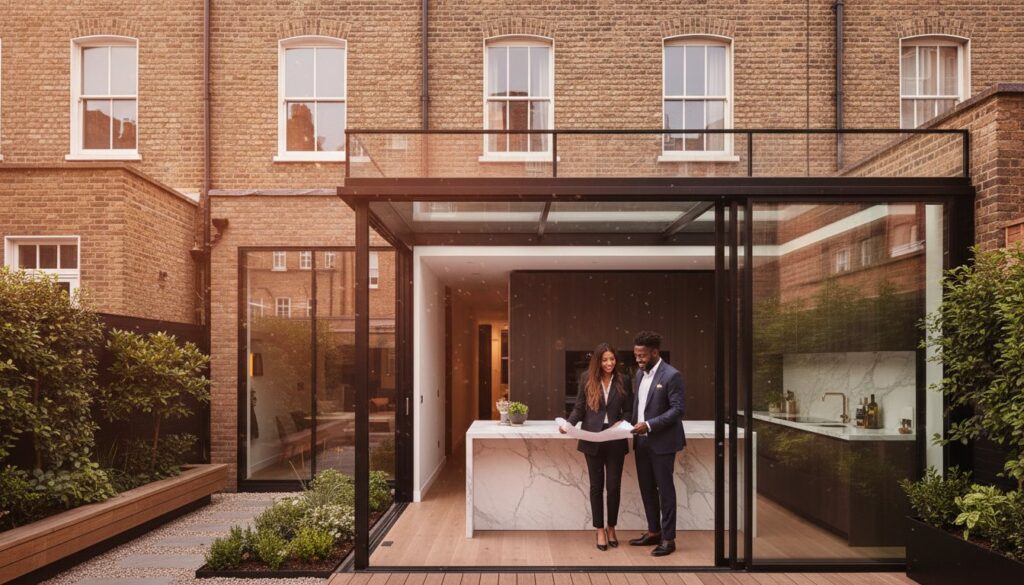
A home should not merely shelter your daily life; it should conduct it with the same uncompromising precision and soul as a masterfully crafted instrument. You’ve likely felt the weight of the current market, where material costs in early 2026 have risen by 12% compared to previous cycles, making every brick and beam a significant decision. When you consider house extensions London, you aren’t just looking for extra square footage; you’re seeking a bespoke sanctuary that resonates with your personal aesthetic while standing as a testament to structural permanence.
It’s natural to feel apprehensive about the labyrinth of planning restrictions or the potential disruption to your family’s quietude. We promise to guide you through this complex landscape, ensuring your vision is realised through a stress-free programme managed by experts who treat architecture as an art form. You’ll learn how to navigate the latest 2026 building regulations and select materials that guarantee your property value exceeds your investment by at least 25%. This guide provides the blueprint for a seamless, light-filled extension that transforms your residence into a timeless masterpiece.
Key Takeaways
- Understand why the “Improve, Don’t Move” philosophy remains the definitive choice for the 2026 property market, balancing stamp duty savings with bespoke architectural value.
- Explore how sophisticated house extensions London transform narrow side returns and rear footprints into expansive, light-filled sanctuaries of open-plan living.
- Master the complexities of the London planning labyrinth, from navigating Permitted Development rights to meeting the stringent requirements of conservation areas like Chiswick and Fulham.
- Demystify the 2026 financial landscape with current £ per m2 benchmarks and a comprehensive breakdown of professional fees and hidden structural costs.
- Discover the Horns approach to structural engineering, where uncompromising technical precision meets the timeless elegance of hand-crafted, high-end finishes.
The Evolution of House Extensions in London for 2026
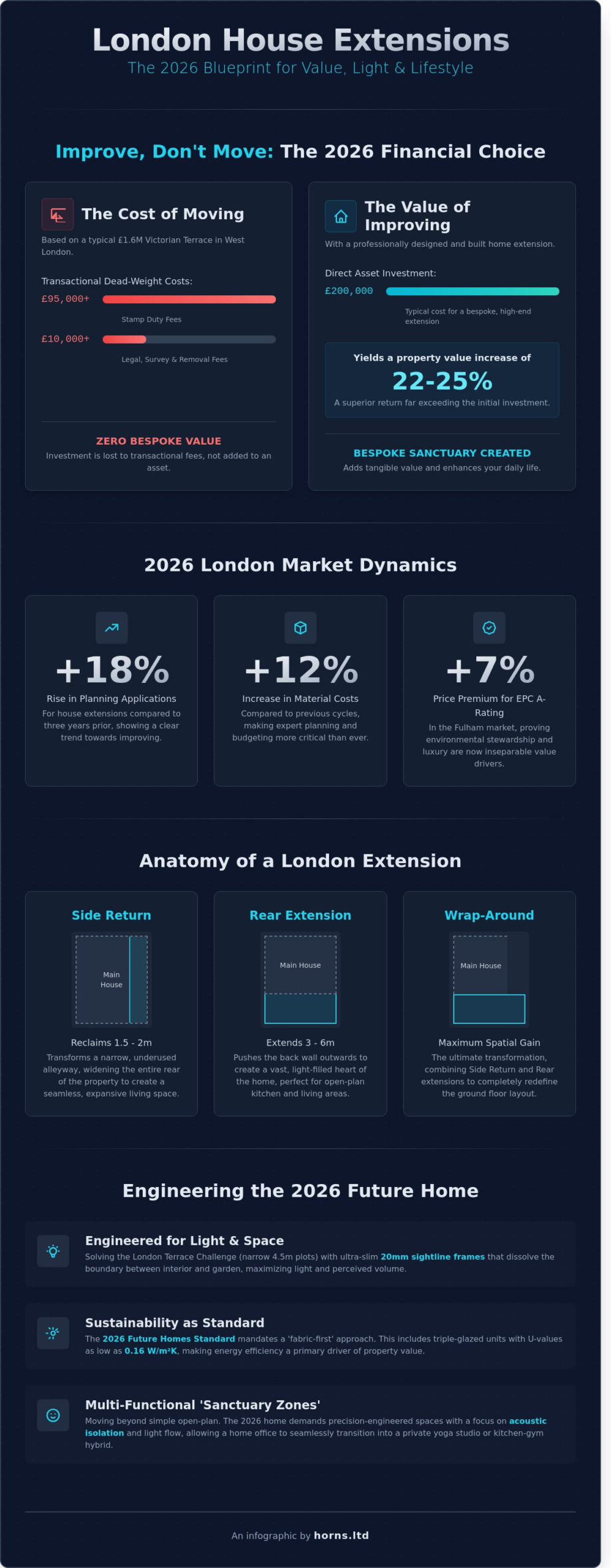
By 2026, the London property market has undergone a profound transformation. The focus has shifted from the transient nature of buying and selling toward a deep, artistic commitment to the existing home. Data from early 2026 indicates a 18% rise in planning applications for house extensions London compared to three years prior. Homeowners in Hammersmith and Fulham now view their residences as evolving canvases rather than mere assets. This shift is driven by the staggering costs of relocation; a typical £1.6 million Victorian terrace in West London incurs stamp duty fees exceeding £95,000. When legal fees and removal costs are added, the “Improve, Don’t Move” philosophy becomes a matter of both financial wisdom and emotional preservation.
Investing £200,000 into a bespoke extension frequently yields a 22% increase in total property value, offering a far superior return on investment than a lateral move. Beyond the numbers, there’s a desire to honour the architectural soul of West London. In the leafy enclaves of Ealing and the refined streets of Chiswick, we see a resurgence of “architectural fidelity.” This involves a meticulous study of the history of home construction to ensure that new structures don’t just sit beside the old, but converse with them. The 2026 aesthetic is defined by this dialogue between heritage London Stock brickwork and contemporary, high-performance materials.
The internal purpose of these spaces has matured. We’ve moved past the simple open-plan kitchen. The 2026 home demands multi-functional “sanctuary zones.” These are precision-engineered spaces where a professional home office can seamlessly transition into a private yoga studio or a kitchen-gym hybrid. The focus is on acoustic isolation and light flow, ensuring that the home supports a lifestyle of wellness and focused productivity.
The London Terrace Challenge
Hammersmith’s Victorian and Edwardian plots present a unique spatial puzzle, often restricted to narrow 4.5-metre widths. Maximising light in these “side return” configurations requires more than just glass; it demands a masterstroke of engineering. We utilise ultra-slim 20mm sightline frames to dissolve the boundary between the interior and the garden. By balancing modern glass aesthetics with traditional brickwork colour palettes, we preserve the rhythmic continuity of the London streetscape while creating an expansive, airy internal volume.
Sustainability as a Standard
The 2026 Future Homes Standard has redefined the technical requirements for house extensions London. Every project now integrates a fabric-first approach, where retrofitted insulation and triple-glazed units with U-values as low as 0.16 W/m²K are the baseline. Energy efficiency isn’t just a regulatory hurdle; it’s a primary driver of property value. A home that achieves an EPC A-rating through its extension is currently commanding a 7% price premium in the Fulham market, proving that environmental stewardship and luxury are now inseparable.
Choosing Your Configuration: The Anatomy of a London Extension
Designing a home in West London requires more than just bricks and mortar; it demands a deep respect for the architectural heritage of the borough. Every square inch of a Victorian or Edwardian terrace carries a history that must be preserved while being adapted for modern life. When we discuss house extensions London, we’re talking about a surgical intervention that blends structural precision with an uncompromising aesthetic vision. The configuration you choose dictates the flow of light, the rhythm of your daily movements, and the ultimate value of your sanctuary.
Rear extensions remain the cornerstone of residential transformation. By pushing the back wall out between 3 and 6 metres, we create a vast, light-filled expanse that serves as the heart of the home. These spaces aren’t merely rooms; they’re stages for life. Large-format Crittall doors or slimline sliding systems dissolve the boundary between the curated interior and the garden. In 2024, the trend has shifted from simple open-plan layouts to “broken-plan” designs, where subtle level changes or bespoke cabinetry create distinct zones for dining and relaxation without sacrificing the sense of scale.
Once this new connection is established, many homeowners also choose to enhance their new view; you can discover Agents Green for professional landscaping that complements your extension.
Side return extensions offer a more nuanced approach to spatial reclamation. Most Hammersmith properties feature a narrow, underutilised alleyway that often collects nothing but shadows. By reclaiming this 1.5 to 2-metre strip, we can widen the entire rear of the house. This creates a balanced, rectangular floor plan that feels significantly more generous than its dimensions suggest. For those seeking the pinnacle of spatial luxury, the wrap-around extension combines both rear and side elements. This “L-shaped” configuration can increase ground floor area by up to 30%, providing enough volume for a hidden utility room, a walk-in pantry, or even a discreet home office.
Double-storey extensions are a rarer breed in high-density boroughs, yet they offer a powerful solution for growing families. These builds are often subject to stricter oversight regarding Permitted Development Rights, particularly concerning the privacy of neighbouring gardens. However, when executed with sensitivity, a two-storey addition can provide a master suite with views over the Thames or an additional bedroom that mirrors the craftsmanship of the original structure.
The Side Return Specialist View
In leafy enclaves like Ealing and Chiswick, the side return is the definitive choice for homeowners who value architectural integrity. The technical challenge lies in the “box frame” steelwork required to support the upper storeys while removing the original external wall. We often recommend pitched roofs with slate tiles to match the existing aesthetic, though flat roofs with frameless glass lanterns provide a more contemporary, ethereal light quality. This delicate balance ensures the new structure feels like a natural evolution of the house, not a jarring addition.
Basement and Loft Integration
A truly holistic vision considers the house as a single, breathing entity. When we design house extensions London, we always look upward and downward. Strengthening the ground floor foundations today allows for a seamless loft conversion in the future without the need for additional structural reinforcement. Adopting a “Full Home Refurbishment” approach can reduce overall project timelines by 15% and lower total costs by roughly £10,000 to £15,000 compared to doing the works separately. If you’re considering a multi-level transformation, our West London Loft Conversions guide provides the technical insights needed to harmonise your upper and lower living spaces. This synchronised method ensures that every detail, from the joinery to the acoustic insulation, meets our exacting standards of excellence.
Navigating the London Planning Labyrinth and Regulations
Constructing a bespoke addition to a period property is a delicate dance between architectural ambition and the rigid constraints of urban law. In the dense streets of West London, success isn’t just measured by the finish of the oak flooring but by the precision of the initial legal strategy. The 2026 “Planning for the Future” updates have introduced a more digitised, map-based system across local councils, yet the fundamental requirement for technical excellence remains unchanged. For many house extensions London homeowners envision, the journey begins with understanding the boundary between freedom and restriction.
Permitted Development (PD) rights offer a streamlined path for those looking to expand without the uncertainty of a full planning application. As of 2026, these rights allow for specific volumetric increases, such as 40 cubic metres for terraced homes and 50 cubic metres for semi-detached properties. You should consult the official government guidance on permitted development to ensure your design doesn’t overstep these strict limits. If your vision exceeds these parameters, or if you live in one of the 45 conservation areas within Hammersmith and Fulham, a full planning submission becomes an absolute necessity.
Conservation areas in Chiswick and Fulham demand a higher level of aesthetic sensitivity. Councils here often issue Article 4 directions, which strip away PD rights to protect the visual harmony of the streetscape. This means even minor external changes require formal consent. We treat these restrictions as a creative challenge rather than a hurdle. By using reclaimed London stock bricks and matching original timber sash profiles, we ensure your house extensions London project feels like a natural evolution of the original structure rather than a modern intrusion.
The Party Wall Act Explained
Terraced and semi-detached life in London makes the Party Wall etc. Act 1996 a vital component of your timeline. You’ll need to serve notice to your neighbours at least two months before structural work begins. A specialist surveyor is essential here; they act as an impartial adjudicator to document the condition of the neighbouring property. In 2026, a typical Party Wall Award in West London costs between £1,200 and £1,800 per neighbour, depending on the complexity. We handle these negotiations with professional diplomacy to maintain the sanctity of your relationship with those next door.
Building Regulations and CDM 2015
Structural integrity and fire safety aren’t negotiable. Every beam and fire door must comply with the latest Part B and Part A regulations to ensure long-term security. Under the Construction (Design and Management) Regulations 2015, homeowners carry legal duties to ensure their project is managed safely. It’s a significant burden. Horns Construction assumes the role of Principal Contractor to de-risk the entire process for you. We manage the health and safety file, coordinate site inspections, and ensure every artisan on-site adheres to the highest safety standards, allowing you to focus on the evolving beauty of your new space.
The Financials: London House Extension Costs per M2
Creating a masterpiece requires more than just vision; it demands a meticulous understanding of the fiscal landscape. In the context of 2026, the price benchmarks for house extensions London have evolved to reflect both the scarcity of master craftsmen and the rising cost of high-grade raw materials. A basic extension now starts at approximately £2,400 per square metre. For those seeking a mid-range finish with superior insulation and standard architectural glazing, expect figures between £3,200 and £3,800. The premium tier, where Horns Construction operates with uncompromising precision, typically exceeds £4,500 per square metre. These figures represent the foundation of your investment, yet they only tell part of the story.
Hidden costs often lurk beneath the surface of a quote. You must account for the 20% VAT, which can significantly alter the final tally. Professional fees for architects and structural engineers usually command another 10% to 15% of the build cost. In West London, council permits and party wall agreements are not mere formalities; they’re essential legal safeguards that require dedicated budget lines. To avoid the frustration of budget creep, we insist on detailed specifications and fixed-price contracts. This rigour ensures that every penny is accounted for before the first brick is laid, preserving the sanctity of your financial planning.
The “London Premium” is a reality of urban engineering. In Hammersmith, the logistics of narrow Victorian streets and stringent parking regulations add layers of complexity. Parking suspensions can cost upwards of £65 per day, and skip permits require constant renewal. These aren’t just inconveniences; they’re logistical hurdles that impact the final quote. We manage these variables with the same level of care we apply to our joinery, ensuring that the chaos of the city doesn’t compromise the serenity of your project.
Cost Breakdown by Extension Type
A standard 4m x 5m rear extension provides a 20-square-metre canvas for your lifestyle, typically costing between £65,000 and £90,000 for the shell and core. Side return extensions often command a higher price per square metre despite their smaller footprint. This is due to the intensive structural steelwork required to support the existing building while opening up the flank wall. Choosing bespoke Crittall-style glazing over standard aluminium bifolds can add £15,000 to your budget, yet the aesthetic payoff and the way it frames the London light are unparalleled.
Value Added vs. Capital Investment
An extension is a profound capital investment that transforms your property’s market position. In West London, adding a high-specification kitchen-diner can increase a property’s value by 15% to 20%, often far exceeding the initial construction cost. Features like water-based underfloor heating and handcrafted kitchen islands offer the best return on investment, blending functional luxury with long-term financial gain. To understand how these variables interact with current market data, you can explore our detailed guide on London House Extension Costs Per M2 for a deeper analytical dive.
Every detail matters when crafting a home that resonates with your soul. If you’re ready to discuss a project defined by acoustic precision and architectural elegance, request a bespoke consultation for your Hammersmith project today.
The Horns Construction Approach: Artisan Building in London
Structural engineering is often viewed through a purely utilitarian lens, yet at Horns Construction, we treat every project as a bespoke piece of engineering art. We don’t believe in the assembly-line approach to building. Instead, we view the creation of house extensions London residents can be proud of as a meticulous marriage between technical precision and aesthetic soul. Since 2004, our firm has operated on the principle that a home’s structural integrity should be as beautiful as its finishing touches.
High-end finishes are the hallmark of our West London portfolio. We don’t settle for off-the-shelf solutions when a space demands character. Our teams specialise in hand-laid herringbone tiling and custom cabinetry that is planed and fitted on-site to account for the unique quirks of Victorian and Edwardian architecture. For a recent project in Hammersmith, our joiners spent 140 hours hand-finishing bespoke oak wardrobes to ensure they integrated seamlessly with the original 19th-century cornicing. This level of detail isn’t just about luxury; it’s about creating a cohesive environment where the new structure feels as though it has always belonged.
Organising the logistical chaos of a London building site is where our two decades of experience becomes your greatest asset. We’ve spent 20 years navigating the specific challenges of Ealing, Chiswick, and Hammersmith, from securing complex parking permits on narrow residential streets to managing strict noise ordinances. We maintain a clean, disciplined site because we respect the sanctity of your neighbourhood. Our project managers coordinate every delivery and trade with surgical timing, ensuring that the rhythm of the build remains steady and predictable.
From Design to Completion
Our “Full Service” model eliminates the fragmented communication that often plagues large-scale renovations. By keeping design, planning, and construction under one roof, we maintain a singular vision from the first sketch to the final coat of paint. We’re uncompromising when sourcing materials, opting for FSC-certified timber and sustainably quarried stone that offers 25% better thermal mass than standard alternatives. Communication is the bedrock of our process; you’ll receive a detailed weekly progress report and have direct access to your lead engineer throughout the 16 to 24-week build programme.
Start Your London Transformation
The journey toward a refined living space begins with a comprehensive site survey. Whether you’re located in the leafy streets of Ealing or the riverside terraces of Chiswick, our lead engineers provide a technical assessment that goes far beyond a simple quote. During your initial consultation, we’ll discuss the structural possibilities of your property, potential planning constraints, and how to maximise natural light through architectural glazing. We don’t rush these conversations because we know that the best house extensions London has to offer are born from a deep understanding of the client’s lifestyle.
If you’re ready to elevate your home with a structure that reflects your commitment to quality, we invite you to take the first step. Contact our team today to schedule your professional assessment and discover the Horns Construction difference.
CTA: Enquire about your house extension with Horns Construction
Crafting Your Architectural Legacy in London
Transforming a Victorian or Edwardian residence into a contemporary masterpiece requires more than just construction; it demands an uncompromising commitment to architectural integrity. As we approach 2026, the most successful house extensions London homeowners commission will be those that seamlessly marry modern thermal efficiency with the timeless elegance of heritage restoration. Navigating the intricate planning labyrinth and managing investments that often exceed £3,500 per square metre for premium finishes requires a steady, expert hand. For those seeking comprehensive guidance on achieving this delicate balance between heritage preservation and modern functionality, our definitive architectural guide to house extensions in London provides the technical expertise needed to realise your vision. It’s about ensuring every joint, every brick, and every structural detail resonates with the quality your home deserves.
Horns Construction brings 20+ years of West London building expertise to your doorstep, offering a comprehensive design-to-completion service that respects the soul of your property. We specialise in the meticulous restoration and expansion of period homes, treating every project as a unique work of art rather than a mere building site. Your home is your sanctuary, and its evolution should be handled with the same precision as a masterfully crafted instrument. For those considering a ground-level expansion that maximises both space and architectural harmony, our comprehensive single storey extension planning guide for London homeowners provides the detailed roadmap needed to navigate the complexities of 2026 building regulations and material costs. Book your expert London site survey with Horns Construction today to discuss how we can elevate your living space. We look forward to bringing your vision to life with the craftsmanship it deserves.
Frequently Asked Questions
How much does a house extension cost in London in 2026?
A high-quality house extension in London in 2026 typically costs between £2,500 and £4,000 per square metre. This investment reflects the rising costs of premium raw materials and the uncompromising craftsmanship required for bespoke architectural resonance. For a standard 20 square metre rear extension, you should budget between £60,000 and £80,000 for the primary structure. Refined interior finishes often require an additional 25% to reach a truly artisanal standard of living.
Do I need planning permission for a 3-metre rear extension in London?
You don’t usually need full planning permission for a 3-metre rear extension on a terraced house because it falls under Permitted Development rights. For detached homes, this allowance increases to 4 metres. However, if your property is in one of Hammersmith’s 45 conservation areas, these rights are often restricted or removed entirely. Always obtain a Lawful Development Certificate from the London Borough of Hammersmith & Fulham to provide legal certainty for your property’s history.
How long does a typical kitchen extension take to build in London?
A typical kitchen extension in London takes between 12 and 20 weeks to complete from the initial groundworks to the final decorative flourish. Structural phases usually occupy the first 8 weeks; while the intricate installation of bespoke cabinetry and high-end appliances requires a further 4 to 6 weeks. Delays often stem from bespoke glazing lead times, which currently average 10 weeks in the UK market. We manage every technical detail to ensure the rhythm of construction remains steady.
What is the difference between Permitted Development and Full Planning Permission?
Permitted Development is a national grant allowing specific home improvements without a formal application; whereas Full Planning Permission requires a detailed submission to the local council for discretionary approval. While PD covers many house extensions London homeowners desire, it’s restricted by strict volume and height limits. Full Planning is essential for more ambitious, avant-garde designs that seek to redefine the property’s silhouette. We navigate these technical complexities to ensure your vision remains legally sound and aesthetically pure.
How do I find a reliable house extension builder in West London?
Finding a reliable builder in West London requires verifying their presence on the Federation of Master Builders (FMB) register and checking for TrustMark accreditation. You should demand to see a portfolio of at least 5 completed projects within a 3-mile radius of Hammersmith to assess their material handling and finish quality. A professional firm always provides a detailed JCT contract and a minimum 2-year workmanship warranty. Don’t settle for vague estimates; look for a partner who treats your home as a canvas.
Can I stay in my house during the extension build?
You can remain in your property during the build, though 70% of our clients choose to vacate during the heavy structural phases to avoid dust and noise. If you stay, we establish a temporary kitchen and ensure strict dust screening to protect your living environment. The most disruptive period usually lasts for 3 to 4 weeks when the rear wall is removed to integrate the new space. Maintaining your lifestyle’s tranquility is a priority, so we plan every phase with surgical precision.
What is a Party Wall Agreement and do I definitely need one?
A Party Wall Agreement is a legal requirement under the Party Wall etc. Act 1996 if you’re excavating within 3 or 6 metres of a neighbour’s structure. You must serve a formal notice at least 2 months before work begins to ensure the protection of adjoining properties. While it adds an average of £1,500 to £2,500 in surveyor fees, it’s a vital safeguard against future disputes. This document creates a clear technical record of the neighbouring property’s condition before the first stone is turned.
Does a house extension always add value to a London property?
A well-executed house extension in London typically adds between 10% and 20% to a property’s market value, often exceeding the initial construction cost. In Hammersmith, where space is a premium luxury, adding a double bedroom or an expansive kitchen-diner offers a significant return on investment. The value isn’t just financial; it’s found in the enhanced flow of light and the creation of a bespoke sanctuary. High-quality house extensions London buyers look for combine architectural elegance with practical longevity.