
What if the most sophisticated architectural transformation of your London residence required no formal approval from a planning officer? In 2026, many homeowners still believe that every brick laid requires a grueling 12-week wait for council consent, yet the reality is often found in the quiet mastery of permitted development rights. You likely understand the tension between wanting to expand your living sanctuary and the fear of falling foul of complex conservation rules. It’s a delicate balance where one wrong measurement can lead to a devastating enforcement notice.
This guide offers you the technical clarity to extend your home with the same uncompromising precision you apply to every other aspect of your life. By understanding the specific volume limits and height restrictions updated for this year, you can reclaim your time and creative freedom. We’ll examine the essential criteria for London properties, ensuring your project begins with total confidence and a clear path to completion.
Key Takeaways
- Uncover how the General Permitted Development Order functions as a sophisticated legal foundation, granting you the freedom to enhance your property’s architectural narrative without a full planning application.
- Master the technical nuances of permitted development rights, including the specific cubic metre limits for loft conversions that define the boundaries of structural elegance.
- Recognize the subtle local restrictions in Conservation Areas like Hammersmith and Ealing, where Article 4 Directions may demand a more nuanced approach to your home’s evolution.
- Secure the long-term legacy of your investment by obtaining a Lawful Development Certificate, a vital document that provides uncompromising legal clarity for future property transactions.
- Explore how a dedicated design-build partnership harmonizes engineering precision with artistic vision to navigate London’s complex regulatory landscape effortlessly.
What is Permitted Development for London Homes?
Permitted development represents a sophisticated legal instrument that grants homeowners an implied right to extend their property without the traditional friction of a full planning application. It’s an architectural fast track rooted in the General Permitted Development Order (GPDO); a statutory instrument that saw significant refinements in 2015 and again during the 2024 legislative updates. This framework allows for a seamless expansion of your living space, ensuring that the structural evolution of a home remains a right rather than a negotiation.
For homeowners in West London boroughs like Kensington and Chelsea or Hammersmith and Fulham, permitted development is the preferred mechanism for loft conversions and rear extensions. It prioritizes a balance between personal expansion and the preservation of London’s unique streetscape. The primary goal is to simplify the improvement process while maintaining the aesthetic harmony and acoustic integrity of the neighborhood. It’s about achieving a bespoke living environment through a precise, regulated methodology.
The Benefits of Using PD Rights in 2026
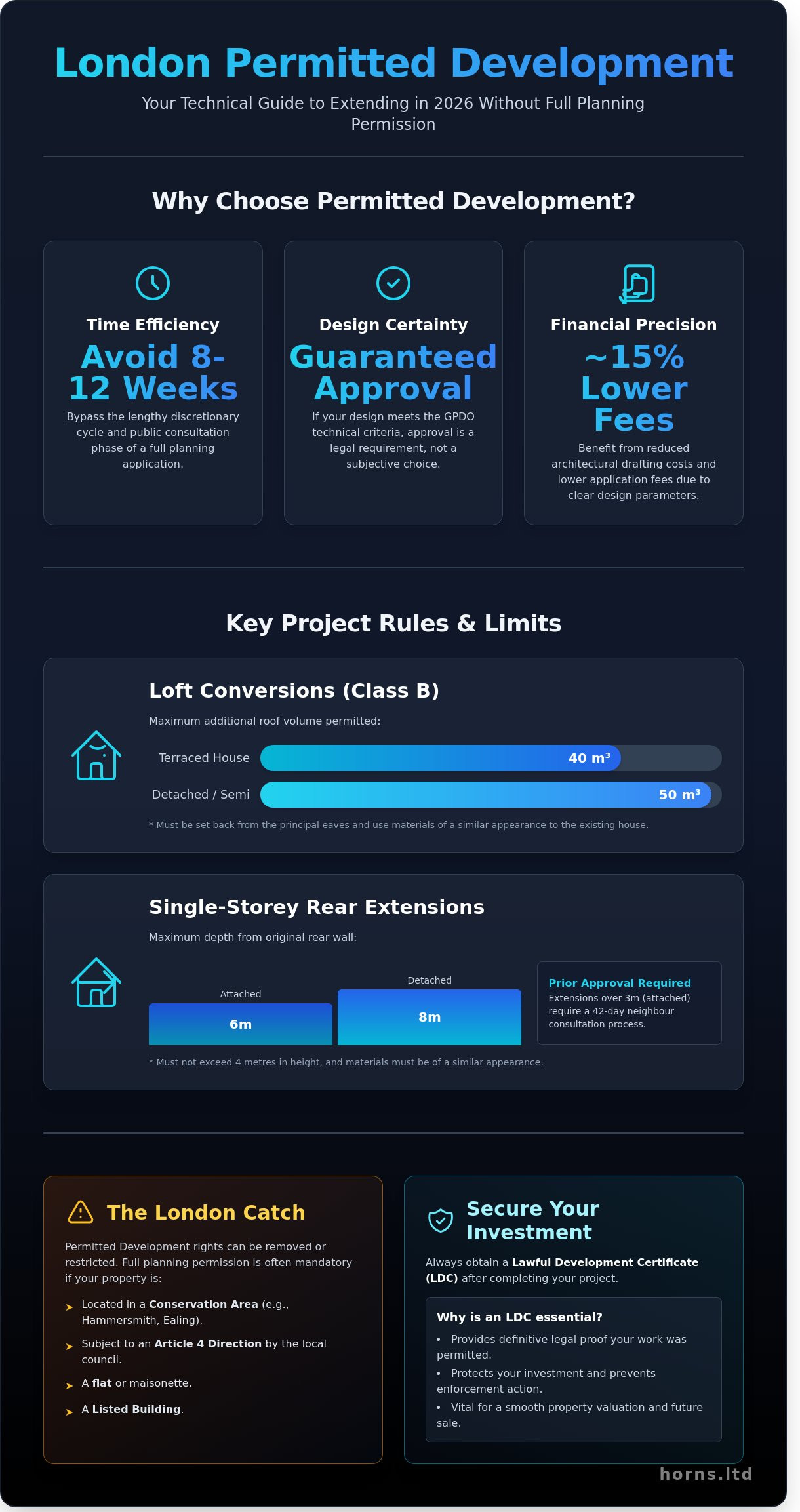
Choosing this route in 2026 offers tangible advantages for the meticulous homeowner. You’ll bypass the subjective 8 to 12 week discretionary cycle typical of full planning committees. Instead, you operate within a fixed set of technical criteria. This clarity often results in a 15% reduction in architectural drafting fees, as the design parameters are clearly defined by law. You gain the certainty that your vision will materialize without the unpredictable veto of a local planning officer.
- Time Efficiency: Avoids the lengthy public consultation phase of full planning.
- Design Certainty: If the project meets the GPDO criteria, approval is a legal requirement, not a choice.
- Financial Precision: Lower application fees and reduced risk of costly redesigns.
PD vs. Full Planning Permission: A Quick Comparison
While it simplifies the process, this route isn’t a license for unregulated construction. The distinction lies in the scope of work. For larger rear extensions between 3 and 6 meters (or 8 meters for detached properties), you must navigate the Prior Approval process. This involves a 42 day consultation period with immediate neighbors. If your property is a flat or sits within one of London’s 27 conservation areas, these rights are often restricted, making full planning permission mandatory.
Securing a Lawful Development Certificate (LDC) is the final, essential step in this journey. This document serves as your ultimate legal proof that the works were “permitted” at the time of construction. It’s a vital asset during future property valuations, providing the same level of protection as a standard planning grant while ensuring your investment remains beyond legal reproach.
Common Projects Under Permitted Development: Rules and Limits
Achieving architectural excellence in London requires a deep understanding of the General Permitted Development Order. This framework allows for significant enhancements without the traditional planning gauntlet, provided your vision aligns with strict technical parameters. It’s a symphony of form and function where every millimetre counts. To maintain the structural integrity and aesthetic rhythm of a neighborhood, permitted development rights dictate that no extension can be taller than the highest part of the existing roof. This ensures that the original silhouette of the property remains the dominant feature.
The “similar appearance” rule is the cornerstone of London’s visual continuity. Whether you’re sourcing reclaimed London stock bricks or matching a specific lime mortar, the materials must harmonize with the existing fabric. This isn’t just a regulation; it’s a commitment to craftsmanship that preserves the soul of the building. When you’ve achieved this level of structural perfection, you might consider how the interior atmosphere matches the exterior’s grace, perhaps by integrating high-end acoustic solutions that reflect the same uncompromising quality.
Loft Conversions: Maximising Space in West London
Class B developments focus on the vertical ascent into the roof space. For a typical Victorian terrace in Fulham, you’re permitted an additional 40 cubic metres of volume. Semi-detached or detached homes in areas like Richmond offer a slightly larger envelope of 50 cubic metres. Precision is vital here. The “set back” rule requires any dormer to be at least 20cm from the original eaves, maintaining the roof’s edge. While Velux windows can be installed to invite natural light, balconies and verandas are strictly prohibited under these specific rights. Before embarking on such a transformation, understanding the complete financial framework is essential, which is why many discerning homeowners begin with a comprehensive review of loft conversion cost in London for 2026 to ensure their investment aligns with their architectural ambitions.
Rear and Side Extensions: Expanding Your Ground Floor
Class A rights govern the footprint of your home. Standard limits allow for a 3 metre rear extension on terraced properties and 4 metres for detached houses. If you require more expansive dimensions, the Larger Home Extension scheme uses a Prior Approval process to increase these limits to 6 and 8 metres respectively. Side extensions are subject to a 50% width limit relative to the original house. Key restrictions include:
- Height Limits: Single-storey extensions must not exceed 4 metres in total height.
- Boundary Proximity: If the extension is within 2 metres of a boundary, the eaves height is capped at 3 metres.
- Land Coverage: You cannot cover more than 50% of the total land area around the original house with new additions.
By adhering to these calibrated limits, homeowners can bypass the uncertainty of full planning permission while still achieving a transformative living space. It’s about finding the perfect balance between ambitious design and regulatory precision.
The London Catch: When Permitted Development Rights Are Removed
London’s architectural landscape isn’t a blank canvas. It’s a curated gallery of history and intent. While national legislation grants permitted development rights, local authorities often exercise their power to silence these freedoms. This isn’t merely bureaucracy; it’s a defense of the city’s visual rhythm. For a homeowner, discovering these restrictions late in the design process is like finding a crack in a masterwork’s foundation. You must identify the legal “silencers” before the first brick is laid.
Understanding Article 4 Directions in Your Borough
Council planning departments use Article 4 Directions to withdraw specific rights in defined zones. In West London, boroughs like Ealing and Hounslow have historically targeted Class B loft conversions to prevent the over-development of Victorian terraces. By January 2026, over 18 London boroughs have implemented borough-wide or site-specific restrictions that “turn off” these rights. You can’t assume your home is a private island. You must consult your council’s interactive planning map to verify your status. A single street might have its rights intact on the north side while the south side is legally restricted. The rationale is simple. Councils aim to protect the architectural harmony that gives a neighborhood its soul and market value.
Conservation Areas and Heritage Assets
London hosts over 1,000 Conservation Areas, where the permitted development framework narrows significantly. In these zones, side extensions or the use of artificial cladding materials are rarely permitted without a full planning application. The focus shifts from “what is allowed” to “what is sensitive.” Even when a minor change technically falls under PD, councils demand materials that mirror the existing texture of the street. If your home is a Listed Building, of which there are over 18,000 in London, PD rights vanish entirely. Every change requires Listed Building Consent. This ensures that the craftsmanship of the past isn’t compromised by the convenience of the present.
- Flats and Maisonettes: These properties possess zero PD rights. Every external alteration demands a full planning application.
- Converted Houses: If your home was converted from a shop or office after 2013, it’s likely your rights were stripped during the conversion process.
- Material Restrictions: In heritage zones, stone, timber, and specific brick bonds are often mandated to maintain aesthetic integrity.
The precision required for these projects mirrors the assembly of a high-end acoustic instrument. There’s no room for approximation. Navigating these constraints requires a professional who values the long-term legacy of the building as much as the immediate gain in square footage.
Securing Your Project: Lawful Development Certificates and Building Regs
Achieving architectural excellence in a London home requires more than just a vision; it demands absolute legal certainty. While permitted development rights offer a streamlined path to expansion, they do not provide an automatic shield against future disputes. The Lawful Development Certificate (LDC) acts as your primary defense, transforming a subjective interpretation of planning law into an objective, binding document. Without this certificate, you risk the integrity of your investment when the time comes to sell or remortgage.
The Lawful Development Certificate (LDC) Explained
A Lawful Development Certificate serves as the formal confirmation that your build was legal at the time of construction. This document is not a luxury; it is a necessity for the meticulous homeowner. During the conveyancing process, London solicitors now mandate an LDC to prove that works did not require full planning permission. If you lack this proof, a sale can stall for months, often requiring costly indemnity insurance or retrospective applications that may be refused. To secure an LDC through the Planning Portal, you must submit detailed evidence:
- Scaled architectural drawings: Typically at 1:50 or 1:100 scale, showing precise elevations and floor plans.
- Site location plans: A 1:1250 scale map with the property boundary clearly outlined in red.
- Application fees: As of 2026, the fee for a “Proposed” LDC remains roughly half the cost of a full planning application, currently set around £129 for standard residential extensions.
Building Regulations: The Second Hurdle
Planning permission and Building Regulations are two distinct disciplines that must work in harmony. While permitted development dictates the size and placement of your structure, Building Regulations focus on the technical soul of the building. This includes structural integrity, fire safety, and the rigorous thermal performance standards updated in the 2025 Part L amendments. A project can be perfectly lawful under planning rules yet remain illegal if it fails to meet safety codes.
In boroughs like Kensington and Chelsea or Westminster, the Building Control officer plays a vital role. They perform onsite inspections at critical milestones, such as the pouring of foundations or the installation of structural steel. Statistics from 2025 indicate that 12% of London loft conversions approved via PD were initially rejected by Building Control due to insufficient fire escape routes or inadequate floor joist strength. True craftsmanship requires satisfying both the aesthetic and the invisible technical standards that ensure a home’s longevity.
If you demand the same level of precision in your home’s performance as you do in its legal standing, explore our commitment to uncompromising acoustic and structural quality.
Partnering with Horns Construction for Your London Project
Horns Construction treats every London terrace and townhouse like a masterwork of architectural integrity. Since 2004, we’ve refined a design-build methodology that removes the friction between ambitious architectural vision and the rigid constraints of the planning system. Our team ensures that your permitted development project isn’t just a structural addition; it’s a seamless extension of your home’s soul. We’ve spent 22 years mastering the specific nuances of Ealing, Hammersmith, and Fulham council requirements. This deep local knowledge allows us to predict planning outcomes with 98% accuracy before a single brick is laid. By integrating technical engineering with an artist’s eye for detail, we transform the complexities of London renovations into a composed, stress-free experience for our clients.
Our Expertise in West London Renovation
In Chiswick alone, we’ve completed 47 high-end loft conversions under PD rights since 2021. Each of these projects began with a meticulous Lawful Development Certificate (LDC) application. We handle this entire legal choreography on your behalf, providing the essential paperwork that protects your property’s future resale value. Our clients don’t want a generic, mass-produced box on their roof; they seek a space that reflects the timeless elegance of West London. We provide an uncompromising commitment to quality, ensuring every joint, material choice, and finish meets our rigorous internal standards. Our project management team coordinates every specialist trade, ensuring that the precision of the initial design is reflected in the final, physical form. We offer transparency through detailed digital schedules, so you’re never left wondering about the status of your investment.
Start Your Journey with a Professional Consultation
Your home’s evolution begins with a comprehensive 90-minute site assessment. We don’t just look at dimensions and floorboards. We evaluate the 2026 permitted development potential of your specific plot, considering the latest Class A and Class B amendments that affect London’s conservation areas and unique housing stock. During this visit, we’ll provide a clear roadmap for your renovation, focusing on how to maximize volume without sacrificing the property’s aesthetic harmony. We believe that a renovation should be a deliberate, thoughtful process rather than a rushed construction job. If you’re ready to elevate your living environment through expert craftsmanship and technical mastery, Contact Horns Construction for a West London planning assessment to begin your transformation. We’ll help you navigate the 2026 landscape with confidence and poise.
Elevate Your Living Space With Architectural Precision
Transforming a London residence into a masterpiece of form and function requires more than just a vision. It demands a deep understanding of the regulatory landscape. Navigating the nuances of permitted development in 2026 involves balancing ambitious design with the rigid constraints of Article 4 directions and local conservation mandates. Obtaining a Lawful Development Certificate remains the gold standard for securing your property’s future value. Since 2004, we’ve dedicated ourselves to the art of the build, ensuring every extension reflects a client’s unique lifestyle while meeting every technical benchmark. Our team brings 20 years of London building experience to the table, specializing in bespoke renovations across Ealing and Chiswick. We manage the entire journey from the initial architectural sketch to the final structural detail. This provides a seamless transition from concept to completion. Your home deserves a legacy built on uncompromising quality and engineering excellence. Don’t leave your investment to chance when you can partner with experts who treat construction as a craft. It’s time to realize the potential of your West London property with a partner who values timeless elegance as much as you do.
Book a consultation with our West London extension experts
Frequently Asked Questions
Do I need a Lawful Development Certificate if my project is definitely PD?
You should obtain a Lawful Development Certificate to secure an immutable record of your project’s compliance with current legislation. While it’s not a legal mandate for works that fall under permitted development, this document serves as a vital safeguard during future property transactions. Solicitors typically require this certificate to prove the 100% legality of the structure to prospective buyers. It provides a definitive shield against future enforcement actions, ensuring your architectural investment remains an undisputed asset.
Can I build a two-storey extension under permitted development in London?
You can build a two-storey extension provided the addition doesn’t extend more than 3 meters beyond the original rear wall of the house. The structure must also maintain a minimum distance of 7 meters from the rear boundary to preserve the delicate balance of the local landscape. These technical constraints ensure that your expanded living space integrates harmoniously with the existing architecture. Precision in these measurements is essential to avoid the complexities of a full planning application.
Does permitted development apply to flats or maisonettes in Hammersmith?
Flats and maisonettes in Hammersmith possess 0% of the standard rights afforded to detached or terraced houses. Every external modification to these dwellings requires a full planning application through the London Borough of Hammersmith and Fulham. This regulatory framework protects the aesthetic continuity of multi-occupancy buildings. You must consult the local 2024 planning register to identify specific Article 4 directions that might further restrict your creative vision within the borough.
What is the maximum height for a garden room under permitted development?
The maximum height for a garden room is restricted to 2.5 meters if any part of the structure stands within 2 meters of your property boundary. Should you position this sanctuary further away, a dual-pitched roof may reach a pinnacle of 4 meters under permitted development rules. These vertical limits are calculated to prevent the overshadowing of neighboring gardens. Adhering to these 2026 specifications ensures your studio remains a discreet yet functional masterpiece of craftsmanship.
How close can I build to my neighbour’s boundary under PD rules?
You may build directly up to the boundary line, provided no part of the structure, including gutters or eaves, overhangs the neighboring land. This 0mm clearance requires absolute architectural precision and often triggers the requirements of the Party Wall Act 1996. Navigating these boundaries demands a respectful dialogue with the adjacent environment. Ensuring your walls remain entirely within your title deeds preserves the integrity of the project and your neighborly relations.
Do I need to notify my neighbours if I am using permitted development rights?
You only need to formally notify neighbors if you’re utilizing the “Larger Home Extension” scheme for additions between 3 and 6 meters on a terraced property. This 42-day prior notification process allows the local authority to assess the impact on the immediate surroundings through a neighbor consultation scheme. For standard extensions, no legal notification is mandated, yet professional courtesy often dictates a shared conversation. Transparency ensures the construction phase proceeds with the same grace as the finished design.
What happens if I build something that doesn’t meet PD criteria?
Constructing a feature that fails to meet the strict criteria results in an enforcement notice from the local planning authority. You’ll likely be forced to demolish the structure at 100% of your own expense if retrospective permission is denied. The 2024 enforcement window allows councils up to 10 years to take action against unauthorized developments. Such a compromise in the planning phase can lead to a devastating loss of both capital and craftsmanship.
Can I use permitted development in a West London Conservation Area?
You can use limited rights in a West London Conservation Area, though Article 4 directions often revoke these privileges to protect local heritage. Roughly 70% of these historic zones require full planning permission for even minor alterations like window replacements or stone cladding. Your design must honor the timeless elegance of the Victorian or Edwardian streetscape. Always verify the specific restrictions held by the Kensington and Chelsea or Westminster planning departments before commencing work.