
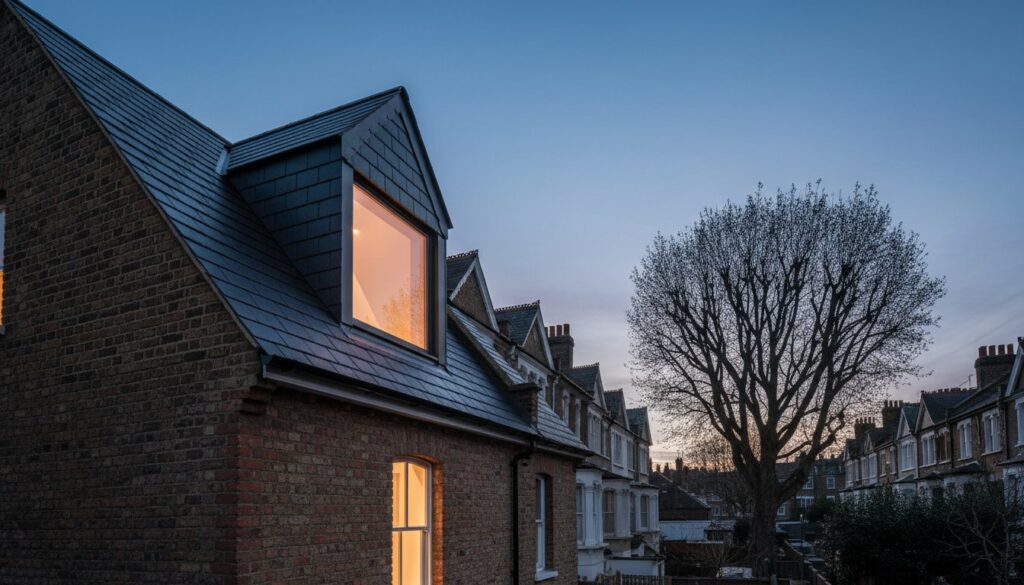
A poorly executed roof extension doesn’t just invite the damp; it disrupts the silent, architectural symphony of a West London streetscape. When you’re investing upwards of £85,000 into a bespoke loft conversion, the structural silhouette you choose becomes a permanent signature on your home’s character. You’ve likely felt the tension between the immediate cost savings of modern membranes and the enduring, stately presence of a traditional pitched roof that mirrors the original craftsmanship of your Victorian terrace. It’s a choice that defines whether your renovation feels like a seamless evolution or a jarring addition that devalues your most precious asset.
We believe that true architectural value lies in the meticulous details that others might overlook, from the precise angle of a gable to the way a hand-cut slate tile weathers the British rain. This guide explores why the pitched roof remains the gold standard for London homeowners who refuse to compromise on internal head height or long term durability. You’ll discover how to navigate the 2024 planning regulations while ensuring your extension adds a projected 22% to your property’s valuation. We’ll compare the structural integrity of these two distinct approaches to help you craft a space that’s as technically sound as it is visually captivating.
Key Takeaways
- Understand how a pitched roof preserves the historical character of London’s Victorian and Edwardian terraces while significantly enhancing long-term property value and architectural integrity.
- Learn to distinguish between Gable, Hipped, and Mansard designs to select the specific silhouette that most harmoniously complements your home’s unique period features.
- Evaluate the long-term investment benefits of traditional sloped structures over flat roofs, balancing initial costs against superior durability and visual cohesion.
- Navigate the nuances of London’s planning regulations, from Permitted Development rights to the essential 45-degree rule that governs extensions on terraced streets.
- Discover the Horns Ltd approach to uncompromising quality, where traditional craftsmanship and modern engineering converge to create an enduring architectural legacy.
The Architectural Significance of the Pitched Roof in London
A pitched roof is far more than a technical requirement for shedding rainwater; it is a structural symphony of form and function. Defined by two or more sloping surfaces that meet at a central ridge, this design represents a commitment to architectural permanence. In the context of London’s residential landscape, the pitch typically ranges between 35 and 45 degrees. This specific geometry creates a silhouette that has defined the British skyline for centuries, offering a sense of verticality and grace that flat alternatives often lack. It is a choice for the homeowner who views their property not just as a shelter, but as a meticulously crafted legacy.
London’s residential identity is inextricably linked to the Victorian and Edwardian eras. Between 1837 and 1910, builders almost exclusively utilised the pitched roof for terrace housing in boroughs like Hammersmith and Fulham. This wasn’t merely a trend. It was a response to the need for structural stability and the desire to create a “homely” aesthetic. For the modern buyer, these slopes trigger a psychological sense of security. Data from property valuations in 2023 suggests that homes retaining traditional rooflines in West London can command a premium of up to 12% compared to those with modern, box-like interventions. A sloped roof feels final, protective, and enduring.
Heritage and Aesthetics in West London
In the conservation areas of Ealing and Chiswick, maintaining the visual rhythm of the street is a matter of prestige. When planning an extension, matching the existing roofline is essential to ensure the new structure feels like a natural evolution of the original home. Craftsmen often select traditional materials such as hand-cut natural Welsh slate or reclaimed clay tiles. These materials don’t just age; they develop a patina that tells a story of time and quality, ensuring the extension remains indistinguishable from the heritage fabric of the neighbourhood.
Durability and Weather Resistance
London experiences an average of 106 rainy days every year, making efficient drainage a priority rather than an afterthought. The steep angle of a pitch allows gravity to act as a natural maintenance tool, clearing debris and water with minimal effort. While a standard flat roof might require a complete overhaul after 20 years, a professionally installed sloped design boasts a lifespan exceeding 60 years. This longevity represents a superior return on investment. It reduces the frequency of costly repairs and provides the homeowner with the quiet confidence that comes from uncompromising engineering.
Comparing Pitched Roof Types: Gable, Hipped, and Mansard
Selecting the right pitched roof is an exercise in balancing structural poetry with the rigid mandates of London planning departments. This choice dictates more than just the external silhouette; it defines the internal volume and the very soul of the home. The Gable roof remains the quintessential choice for Victorian side-return extensions. Its dual slopes meet at a sharp ridge, creating a clean, geometric “A-frame” that mirrors the historic terrace lines of East and North London. It’s a design that prioritises simplicity and traditional aesthetics without compromising on character.
The Hipped roof offers a more nuanced architectural profile. By sloping on all four sides, it provides superior stability against the elements and presents a softer, less imposing face to adjacent properties. This is often a strategic choice for detached or semi-detached homes where reducing the visual mass of an extension is necessary to secure planning approval. The symmetry of a hipped design brings a sense of grounded permanence to a building, reflecting a commitment to balanced proportions.
For those seeking the pinnacle of spatial efficiency, the Mansard roof is the undisputed London favourite. Originally popularised to bypass 18th-century height restrictions, it features two distinct slopes on each side. The lower slope is almost vertical, typically set at 72 degrees, which effectively creates an entire additional floor. It’s a sophisticated solution that turns a dusty attic into a grand master suite, blending seamlessly into the prestigious streetscapes of Kensington and Chelsea.
Maximising Volume for Loft Conversions
In the pursuit of usable space, every degree of a pitched roof matters. A standard 35-degree pitch might feel airy, but it often leaves significant “dead space” at the eaves. In West London refurbishments, where property values exceed £12,000 per square metre, maximising head height is essential. Achieving the required 2.2 metres of clearance often necessitates a Mansard or a large rear dormer. While Velux windows preserve the sleek, sloping lines of the original architecture, dormers provide the vertical wall space needed for showers and full-sized wardrobes. For those who appreciate architectural precision, the integration of these elements must be handled with surgical care. Understanding the full scope of your investment is crucial, which is why many homeowners begin by researching comprehensive loft conversion cost breakdowns for London properties before committing to their preferred roof design.
Structural Considerations for London Homes
The transition from a flat roof to a pitched structure introduces significant weight. You must account for the specific gravity of your chosen materials:
- Natural Slate: Weighs approximately 30kg to 35kg per square metre, offering a timeless, slim profile.
- Concrete Tiles: Can exceed 50kg per square metre, requiring reinforced timber supports.
- Traditional Cut-and-Pitch: Hand-cut on-site, this method allows for bespoke adjustments in cramped London plots.
- Timber Trusses: Pre-fabricated for speed, though they offer less flexibility for future internal modifications.
Older Victorian timber frames weren’t engineered for modern heavy-set tiles. Engaging a structural engineer is a mandatory step to ensure the foundations can support the new load. This technical rigour ensures that your home remains a sanctuary of safety and elegance for decades to come.
Pitched Roof vs Flat Roof: The Ultimate Comparison for Extensions
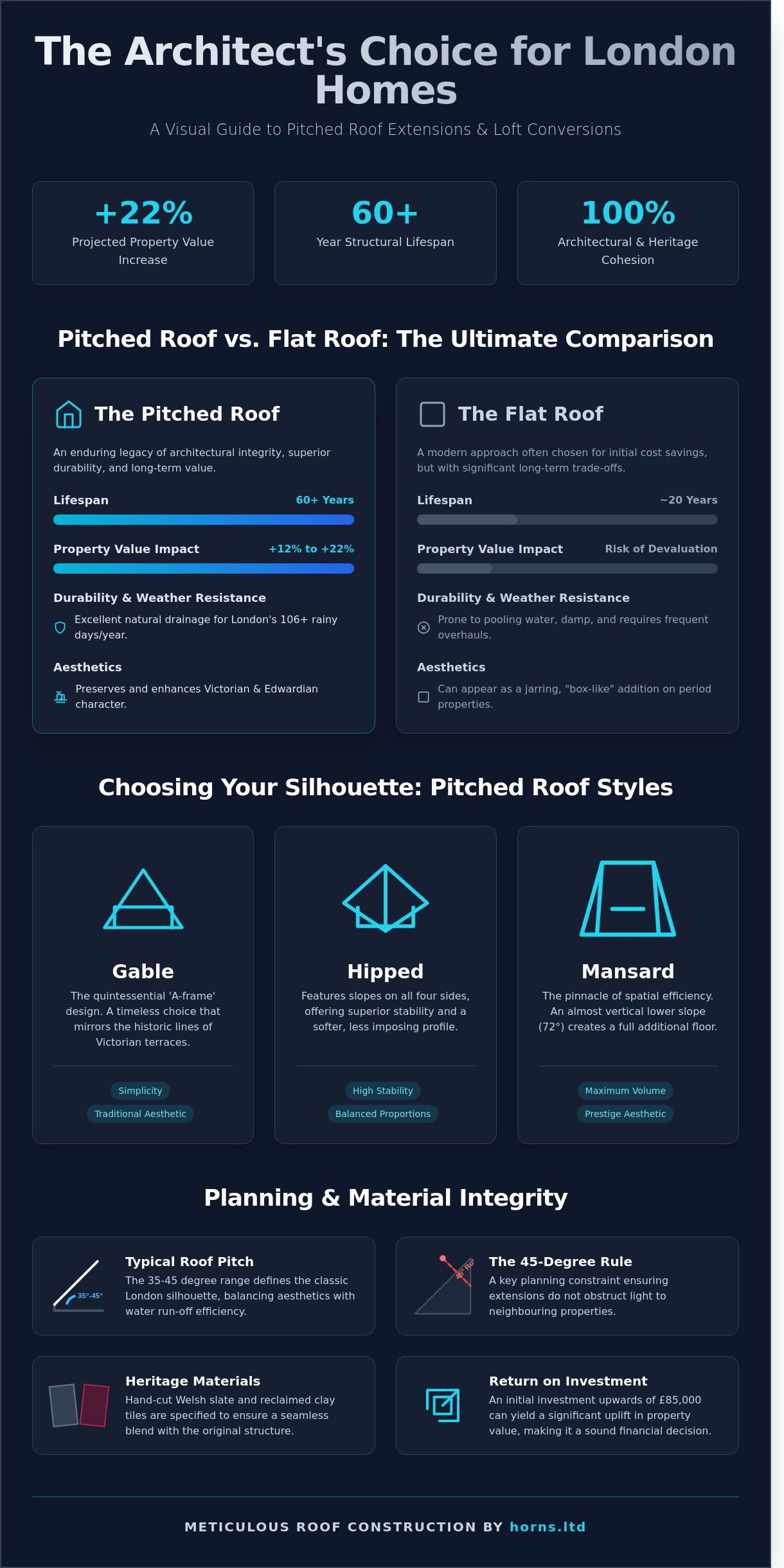
Choosing between these two forms is an exercise in balancing immediate capital expenditure against long-term architectural legacy. A pitched roof usually demands an initial investment 15% to 25% higher than a flat alternative; this often translates to an additional £4,500 to £8,000 for a standard 30-square-metre rear extension in London. This premium reflects the structural complexity of the timber framework and the artisanal skill required to lay traditional slate or clay tiles that match your home’s existing character.
Flat roofs often suffer from a jarring visual disconnect. They can appear like a modern appendage “tacked on” to the grand proportions of a Victorian or Edwardian terrace. In contrast, a pitched structure respects the original silhouette of the property. London planning departments, particularly within conservation areas like the Royal Borough of Kensington and Chelsea, frequently mandate pitched designs for street-facing elevations. This ensures the historic skyline remains a cohesive piece of art rather than a patchwork of mismatched heights.
The internal atmosphere undergoes a radical transformation when you opt for verticality. While flat roofs typically result in a standard 2.4-metre ceiling, a pitched roof allows for vaulted ceilings and the possibility of exposed structural beams. It’s a choice that trades a cramped box for a cathedral-like sense of volume. This extra height provides a canvas for natural light to cascade through roof lights, elevating the room from a mere utility space into a sanctuary of light and air.
The ROI Factor: Property Value in West London
In the competitive markets of Notting Hill and Fulham, buyers look for architectural permanence rather than temporary fixes. A well-executed extension acts as a seamless continuation of the home, suggesting a level of craftsmanship that resonates during a valuation. Data from prime London estate agents indicates that pitched roofs increase resale appeal by 10-15% in prime London markets compared to flat-roofed counterparts. It’s a strategic move that secures the building’s financial future by appealing to the aesthetic sensibilities of high-end purchasers.
Insulation and Thermal Performance
Thermal efficiency is where the engineering precision of a pitched structure truly excels. You’ll choose between a “cold roof,” where insulation sits between the rafters, or a “warm roof” configuration that places insulation above the structure to eliminate thermal bridging. Modern pitched designs easily achieve the stringent Part L Building Regulations, reaching U-values as low as 0.15 W/m²K. The natural void within the pitch also facilitates superior ventilation, preventing the moisture build-up that often plagues flat-roofed felt systems over time.
Navigating London Planning and Building Regulations
Achieving architectural excellence in London requires a deep respect for the city’s complex regulatory framework. It’s a delicate balance between personal vision and civic duty. Most homeowners find that a pitched roof extension falls under Permitted Development rights, provided the volume increase stays below 40 cubic metres for terraced houses or 50 cubic metres for detached properties. This path bypasses the lengthy full application process, allowing for a more efficient transformation of your living space.
Professional design must account for the 45-degree rule, a standard used by local authorities to protect the natural light of your neighbours. This technical calculation ensures that your new structure doesn’t overshadow adjacent windows. Compliance with Building Regulations Part L is equally vital. By 2026, new roofing must meet stringent energy standards, often requiring U-values as low as 0.11 W/m²K. This thermal precision mirrors the exacting standards we apply to acoustic engineering. Before work begins, the Party Wall etc. Act 1996 necessitates a formal agreement with neighbours if you’re altering a shared roofline. This legal step preserves the structural harmony of the entire terrace.
Conservation Area Constraints
In boroughs like Hammersmith and Fulham, where over 60% of the land sits within protected zones, the aesthetic demands are uncompromising. Planning officers often mandate the use of reclaimed Welsh slate or handmade clay tiles to preserve the 19th-century character of the streetscape. A specialist design-and-build firm acts as a vital intermediary here. They manage the complex Article 4 Directions that often strip away standard development rights, ensuring your pitched roof project satisfies the local authority’s artistic and historical requirements.
Fire Safety and Structural Integrity
Safety is the foundation of luxury. Building Regulations Part B requires specific fire-rated materials that provide at least 30 minutes of resistance in dense London housing. If you’re considering a sustainable future, your roof structure must be engineered to support the additional 25kg per square metre load of high-efficiency solar panels. Every detail must be documented and verified. A final Building Control sign-off isn’t just a formality; it’s a prerequisite for your property insurance and a testament to the build’s integrity. To ensure your project meets these high-performance standards, you should consult with our master consultants who understand the intersection of form, function, and regulation.
The Horns Ltd Approach to Meticulous Roof Construction
At Horns Ltd, we treat every London home as a unique architectural masterpiece. Our commitment to uncompromising quality means we reject the “one-size-fits-all” mentality pervasive in modern building. We blend 15 years of technical expertise with a passion for structural aesthetics. Every pitched roof we install is a symphony of structural integrity and visual harmony. We use advanced project management software to track every nail and tile, ensuring deadlines are met without sacrificing the artisan finish our clients demand. Whether you’re opting for a traditional pitched roof or a contemporary hybrid design, we apply the same level of engineering rigour to every timber.
West London homeowners trust us with their £500,000+ refurbishments because they value our obsession with detail. We don’t just build extensions; we create legacies. Our process begins with a deep analysis of your property’s existing geometry. We ensure the new structure integrates seamlessly with the original Victorian or Edwardian fabric. We’ve refined our workflow to minimise disruption, maintaining a clean, professional site that respects your neighbours and your time.
Bespoke Design for Discerning Clients
Your home’s character dictates our choice of materials. We source reclaimed Welsh slates or handmade clay tiles to ensure an authentic finish. Our master carpenters hand-cut every rafter on-site, achieving a level of precision that factory-made trusses cannot match. This dedication to craft is why we are leaders in Full Home Refurbishment services. We coordinate a network of specialist trades, from expert lead-workers to heritage tilers, ensuring every junction is watertight and every line is true.
Start Your London Renovation Journey
Embarking on a loft conversion or extension requires a partner who values transparency. We provide a comprehensive, fixed-price quote within 7 days of our initial site visit. You’ll receive a detailed breakdown of material costs and labour hours, leaving no room for unexpected extras. Our team handles the complexities of planning permissions and building control, so you can focus on the vision for your new space. Contact Horns Construction for an expert roof assessment today and discover how we elevate London living through superior craftsmanship.
Secure the Architectural Integrity of Your London Residence
Selecting the ideal silhouette for your extension is a defining moment that shapes your home’s character for generations. Whether you choose the timeless, soaring lines of a pitched roof to mirror West London’s historic charm or a minimalist flat design for modern utility, the execution requires an artist’s eye and an engineer’s precision. We’ve spent over 20 years mastering the complexities of period property refurbishments across West London; our team ensures every structural element exceeds standard building expectations. Our comprehensive design-to-completion service handles every intricacy of planning and construction, allowing you to focus on the aesthetic evolution of your space.
We don’t view a renovation as a mere building project, but as the creation of a bespoke architectural masterpiece. Our approach integrates 20 years of technical expertise with a passion for high-end craftsmanship that respects the original soul of your property. It’s an investment in quality that resonates through every detail of the finished work. Your vision for a more beautiful, functional home is within reach.
Book a Professional Consultation for Your London Roofing Project
Frequently Asked Questions
How much does a pitched roof extension cost in London?
A pitched roof extension in London typically costs between £2,100 and £3,200 per square metre. For a standard 30 square metre project, your total investment will likely range from £63,000 to £96,000 depending on the bespoke nature of the timber work and tile selection. These figures reflect the premium craftsmanship and logistical complexities inherent in high-end London residential projects.
Do I need planning permission to change a flat roof to a pitched roof?
You’ll almost certainly need planning permission to replace a flat roof with a pitched design. This structural evolution alters your property’s height and silhouette, usually exceeding the 15 centimetre height increase limit allowed under standard Permitted Development rules. Councils in boroughs like Camden or Islington scrutinise these changes to maintain the architectural rhythm and visual harmony of the streetscape.
What is the minimum pitch for a tiled roof in the UK?
The minimum pitch for a tiled roof in the UK is generally 15 degrees, though many traditional clay tiles require a steeper 22.5 degree angle. Achieving this precise geometry is vital for effective water runoff and the long-term health of your home’s structure. We recommend consulting a structural engineer to ensure your chosen material matches the specific gradient of your new pitched roof.
How long does it take to build a pitched roof for a house extension?
Constructing a high-quality pitched roof for a London extension typically takes between 4 and 6 weeks from the first timber cut. This period accounts for the meticulous installation of the rafters, breathable membranes, and the final hand-laid tiling process. Weather conditions in the South East can influence this schedule, so we always factor in a 10 percent time buffer for seasonal disruptions.
Can I have a pitched roof on a single-storey extension in London?
You can absolutely install a pitched roof on a single-storey extension to create a sense of grand, airy volume within your home. This design choice often adds 1.5 to 2 metres of internal ceiling height compared to flat alternatives, allowing for dramatic vaulted ceilings. It’s a masterful way to invite natural light through integrated glazing while respecting the timeless character of a Victorian terrace.
Which is better for a loft conversion: a dormer or a pitched roof change?
A dormer conversion is generally superior for internal space, providing up to 30 percent more usable floor area than a simple roof pitch adjustment. While a roof change focuses on the external silhouette, a dormer creates a functional room with full-height vertical walls. Most London homeowners choose the dormer for its 2.2 metre head height, which is essential for a truly comfortable living environment.
What are the best materials for a pitched roof in a conservation area?
Natural Welsh slate and handmade clay tiles are the essential materials for roofs within London’s 27 conservation areas. These materials offer an uncompromising level of quality and texture that modern synthetic alternatives simply can’t replicate. Using authentic 500mm by 250mm slates ensures your extension harmonises with the historic fabric of the neighbourhood, satisfying the stringent requirements of local planning officers.
How does a pitched roof affect my Party Wall Agreement?
A pitched roof affects your Party Wall Agreement if the new structure rests on or cuts into a shared boundary wall. Under the Party Wall etc. Act 1996, you must serve notice to your neighbours at least 60 days before any construction work begins. If they don’t consent within 14 days, you’ll need to appoint a surveyor to ensure the structural changes don’t compromise the shared masonry.