

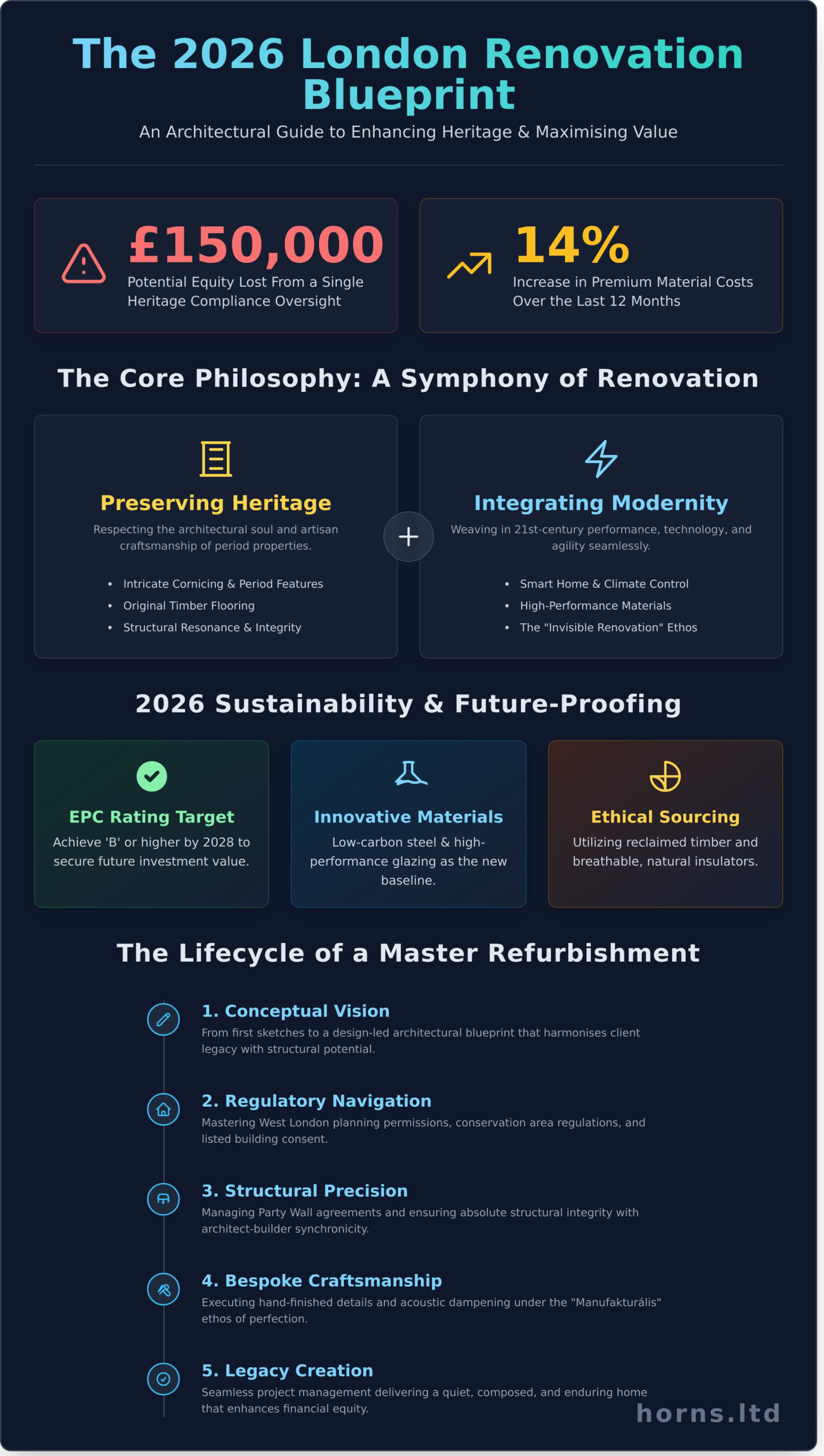
In the high-stakes landscape of 2026, a London postcode serves as far more than a mere address; it’s a complex architectural canvas where a single oversight in heritage compliance can instantly evaporate £150,000 of potential equity. You likely recognize that breathing new life into a historic townhouse or a contemporary penthouse requires more than just a standard contractor. It demands a meticulous symphony of technical precision and artistic vision that respects the structural integrity and the very soul of the building. Finding a team that treats your original period features with the same reverence as a gallery piece is often the most daunting part of the journey.
This guide provides the definitive blueprint for mastering the intricacies of property renovation in London from an uncompromising architectural perspective. You’ll gain the clarity needed to navigate 2026 planning regulations, manage bespoke craftsmanship, and control investment levels in a market where premium material costs saw a 14% increase over the last twelve months. We’re going to examine the entire lifecycle of a luxury refurbishment, from the first conceptual sketches to the seamless project management that ensures every hand-finished detail reflects your personal legacy and enhances your home’s enduring value.
Key Takeaways
- Discover how to harmonize the storied heritage of Victorian architecture with the uncompromising functionality and timeless elegance required for a modern, high-end lifestyle.
- Learn the essential architectural strategies for navigating complex structural requirements and party wall agreements to ensure the enduring integrity of your London terrace.
- Gain expert clarity on the 2026 financial landscape, including precise cost benchmarks and ROI calculations for a bespoke property renovation london project.
- Master the nuances of West London planning permissions and conservation area regulations to streamline your refurbishment while honoring local historical character.
- Explore the “manufakturális” ethos of treating every structural detail as a handcrafted masterpiece, ensuring your home remains a legacy for generations.
The Philosophy of Property Renovation in London: Elevating Heritage Homes
A home in London isn’t merely a collection of bricks and mortar; it’s a living composition. As we approach 2026, the ethos of property renovation london has shifted away from generic modernization toward a meticulous, handcrafted approach. We view every refurbishment as a masterpiece, where the silent echoes of Victorian craftsmanship meet the sharp clarity of contemporary engineering. This isn’t about covering the past. It’s about conducting a symphony between the two. The 2026 landscape demands an uncompromising commitment to quality that mirrors the precision of a high-end audio system, where every joint, finish, and material contributes to a flawless whole.
West London architecture, particularly in enclaves like Chiswick and Ealing, requires a specialized touch. These properties possess a rhythmic architectural soul that doesn’t tolerate shortcuts. Our “Luxury Potential” framework identifies these period assets not just as spaces, but as investments in heritage. By 2026, the value of a London home will be dictated by how well it preserves its historical narrative while delivering a seamless, modern lifestyle. This requires a deep understanding of structural resonance and aesthetic harmony, ensuring that every pound spent increases both the emotional and financial equity of the residence.
Restoring Period Features vs. Modern Intervention
Preserving the intricate cornicing and original timber flooring of an Ealing townhouse is an act of cultural stewardship. It’s about respecting the artisan who first carved those details in 1890. However, the modern occupant requires more than history. We specialize in the “Invisible Renovation,” where smart home technology and climate controls are woven into the fabric of the building without disrupting its visual flow. When dealing with protected structures, navigating listed building regulations is a critical phase that requires expert precision to ensure heritage is protected while functionality is enhanced. This balance creates a home that feels timeless, yet performs with the agility of a 21st-century machine.
The 2026 Shift: Sustainability Meets High-End Design
Environmental standards in the capital are evolving rapidly. By 2026, high-performance glazing and low-carbon structural steel will be the baseline for any serious property renovation london project. We don’t see these as constraints. We see them as opportunities for innovation. Upgrading a period property to an EPC Rating of B or higher by 2028 is no longer a suggestion; it’s a necessity for future-proofing your investment. Utilizing reclaimed timber and breathable, natural insulators allows us to achieve these targets without sacrificing the tactile luxury of the home. It’s a marriage of ethics and aesthetics that ensures your property remains relevant and valuable for decades to come.
True luxury is found in the details that most people never see. It’s the acoustic dampening behind a lath-and-plaster wall or the precision-engineered thermal break in a bespoke sash window. In the 2026 market, these elements define the quality of life. A London renovation shouldn’t just look beautiful; it should feel composed, quiet, and enduring. We treat the renovation process as a slow, deliberate art form. There’s no room for the frantic pace of mass-market construction here. Instead, we focus on the steady, rhythmic progress of master craftsmen who understand that perfection cannot be rushed. Your home deserves a legacy, not just a facelift.
Architectural Precision: The Structural Journey of a London Refurbishment
A successful property renovation london isn’t merely a collection of aesthetic choices; it’s a rigorous engineering feat that marries heritage with modern performance. In the dense urban fabric of Mayfair or Kensington, the architectural journey begins with a design-led approach where the architect and builder operate in a state of absolute synchronicity. This harmony ensures that the “soul” of a Victorian terrace remains intact while its internal skeleton is reimagined for 21st-century living.
Structural integrity is the primary concern when dealing with shared foundations and the ubiquitous party walls of the capital. The Party Wall etc. Act 1996 dictates the pace of progress. In 2023, property owners should budget between £1,000 and £1,800 per neighbor for surveyor awards. These legal and structural frameworks prevent the subsidence risks often associated with heavy structural alterations. Basement excavations represent the pinnacle of technical difficulty. Maintaining a minimum 2.4-metre head height while managing groundwater pressure requires a maximalist engineering mindset that leaves no room for error.
True luxury is defined by what you don’t hear. In a city that never sleeps, acoustic precision becomes a vital component of the structural build. We treat soundproofing as a master craft, utilizing decoupled wall systems and high-density mineral wool to create a sonic sanctuary. Every structural connection is a potential bridge for vibration. Achieving this level of acoustic fidelity requires the same uncompromising precision found in high-end audio engineering.
The RIBA Stages for Residential Clients
The Royal Institute of British Architects (RIBA) Plan of Work provides the essential roadmap for your project. During Stages 0-2, we focus on concept design and feasibility. In West London, where space is at a premium, these early sketches determine how light and volume will interact. Stages 3-4 involve the technical design and the often-daunting planning submission. Data from 2023 shows that 40% of London planning applications face initial rejection due to technical oversights, making expert guidance indispensable. You must consult the official building regulations guidance to ensure your technical drawings comply with the latest fire safety and energy efficiency standards. Finally, Stages 5-6 see the architectural vision manifest into physical reality through disciplined construction management.
Bespoke Joinery and Handcrafted Finishes
Off-the-shelf solutions are fundamentally incompatible with the unique, often irregular footprints of historic London properties. A property renovation london demands bespoke joinery to maximize every square millimetre of available space. Master carpentry transforms awkward alcoves into elegant libraries and integrates hidden storage into minimalist kitchens. In 2023, high-end residential data indicated that custom-built storage solutions can increase a property’s market value by up to 15%. This is where the engineer meets the artist; using sustainable hardwoods and handcrafted finishes to create “timeless elegance” that transcends fleeting interior trends. Specialists like Bowkirk Kitchens & Bedrooms exemplify this approach, ensuring each cabinet and shelving unit is a permanent fixture designed to last for generations.
This commitment to enduring style naturally extends to the home’s furnishings. To complement these handcrafted interiors, sourcing pieces from specialists like Nicholas Wells Antiques can complete the vision, ensuring the home’s contents are as unique and storied as its architecture.
Investment and Value: The Financial Landscape of London Property Renovations
Creating a home in the capital is an act of architectural composition. It requires more than just a budget; it demands a deep understanding of the local market’s unique pressures. As we look toward 2026, the financial framework for a high-end property renovation london has shifted due to a 12% rise in specialized material costs over the last twenty-four months. In West London, particularly within the conservation areas of Kensington and Chelsea, a full-scale refurbishment now commands benchmarks between £2,800 and £4,600 per square meter. These figures don’t just cover labor. They represent the precision engineering required to modernize period structures without compromising their soul.
The “London Premium” isn’t a mere tax on postcodes. It’s the cost of securing craftsmen who understand the nuances of Victorian brickwork or the acoustic requirements of a modern subterranean cinema. You’re paying for a level of technical mastery that ensures your investment remains timeless. Ignoring this reality often leads to the “hidden costs” of structural unforeseen issues. For instance, 35% of West London renovations encounter unexpected drainage or foundational shifts once work commences. Transparency in quoting is your only defense against these variables. A professional firm will provide a granular breakdown that accounts for every joist and junction before the first hammer swings.
Cost Breakdown by Renovation Type
For a full interior refurbishment in 2026, expect to allocate £2,500 per square meter for standard high-quality finishes. If you’re targeting the premium markets of Fulham and Hammersmith, where bespoke joinery and Italian marble are standard, this often rises to £3,800 per square meter. Resale values in these postcodes respond directly to the quality of the finish; a “turnkey” luxury aesthetic can add up to 25% to a property’s valuation. Don’t forget professional fees. You must budget approximately 10-15% of your total spend for architects, structural engineers, and party wall surveyors, who typically charge between £1,200 and £2,500 per award per neighbor.
- Loft Conversions: Expect to invest £75,000 to £130,000 for a 20% increase in total property value.
- Kitchen Extensions: High-spec glass-box extensions range from £90,000 to £160,000, yielding a 12-15% ROI.
- Basement Excavations: The most complex property renovation london offers, starting at £5,000 per square meter.
Financing and Project Management Efficiency
Efficiency in a London project is born from centralized control. Utilizing a single-point-of-contact project management system eliminates the communication lag that often inflates budgets by 18% through avoidable delays. When one entity handles the design, the structural engineering, and the build, the workflow remains fluid. This is especially true for procurement. Professional procurement teams can lock in material prices six months in advance, shielding you from the 5-7% inflationary spikes currently affecting the timber and glazing sectors. A contingency fund represents a vital 10-15% financial buffer designed to absorb the inevitable structural surprises or logistical complexities inherent in high-end London projects. This disciplined approach ensures that the final result isn’t just a building, but a meticulously crafted asset that resonates with the same clarity and permanence as a piece of fine art.
Navigating the London Landscape: Planning, Permissions, and Conservation
London’s architectural heritage demands a level of respect that transcends mere construction. Achieving a successful property renovation london requires a deep understanding of the regulatory symphony that governs our city’s streets. By 2026, the distinction between Permitted Development (PD) rights and Full Planning Permission has become increasingly nuanced. While PD rights allow for certain internal alterations and modest extensions, the 2024 updates to the National Planning Policy Framework have granted local authorities more power to intervene if a design lacks “beauty” or contextual harmony. You’ll find that 68% of major renovations in boroughs like Ealing or Hammersmith & Fulham now require a full application to ensure the proposed aesthetic aligns with the neighborhood’s character.
The challenges intensify when you step into the refined enclaves of West London. In Bedford Park, the world’s first garden suburb, the constraints are palpable. This area, split between Ealing and Hounslow, is protected by strict Article 4 Directions. These legal instruments strip away your standard PD rights, meaning even minor changes like replacing a timber sash window or altering a garden wall require formal consent. It’s a meticulous process where compromise isn’t an option; the goal is to preserve the soul of the structure while integrating modern comforts. When working within these boundaries, your choice of materials must be uncompromising, mirroring the original craftsmanship of the late 19th century.
Managing the Party Wall Act 1996 is a critical, often delicate, step-by-step performance for any homeowner. It’s not just a legal hurdle; it’s an exercise in neighborly diplomacy. The process follows a strict timeline:
- Serve Notice: You must inform your neighbors at least 2 months before work begins on a shared wall or 1 month for excavations within 3 to 6 meters of their property.
- Awaiting Response: Neighbors have 14 days to consent. If they don’t, they’re “in dissent,” and the process moves to a formal dispute resolution.
- The Award: If a dispute arises, you’ll need a Party Wall Award. This document, drafted by surveyors, costs between £1,500 and £2,500 per neighbor on average. It details exactly how the work will be carried out to prevent structural damage.
Conservation Areas and Listed Building Consent
Negotiating with conservation officers is an art form that requires patience and technical precision. In London’s 600+ conservation areas, “Article 4 Directions” frequently restrict external changes to prevent the “creeping decay” of historical character. You must provide a Heritage Statement with your application. This document isn’t just paperwork; it’s a manifesto for the building’s future. Statistics from the 2023 Planning Portal show that applications backed by a detailed heritage analysis are 40% more likely to be approved on the first attempt. It’s about proving that your property renovation london will enhance, not diminish, the local legacy.
Building Regulations and Health & Safety (CDM)
Safety is the foundation of elegance. Under the CDM 2015 regulations, you, as the homeowner, hold the legal title of “Client.” This means you’re responsible for ensuring your project has a Principal Designer and a Principal Contractor. You don’t have to be an expert, but you must ensure a Construction Phase Plan is in place before any boots hit the ground. Following the 2022 Building Safety Act, fire protection and structural integrity in multi-storey renovations are under intense scrutiny. Building control inspections occur at key milestones, from foundation pouring to the final installation of fire-rated doors, ensuring your sanctuary is as secure as it is beautiful.
For those who demand the same level of precision in their home’s soundscape as they do in its structural integrity, explore our handcrafted acoustic solutions designed for the most discerning London residences.
The Horns Construction Approach: A Masterclass in Bespoke Refurbishment
Horns Construction doesn’t operate as a volume builder. For two decades, our firm has remained the uncompromising choice for West London homeowners who view their residence as a masterpiece rather than just a structure. Our identity is forged in the “Manufakturális” ethos. This philosophy dictates that every brick, joint, and architectural detail deserves the respect of an artisan. We treat the structural integrity of a building with the same reverence a master luthier shows to a rare instrument. It’s a commitment to architectural perfection that transcends the standard property renovation london market.
Operating from our hubs in Ealing and Chiswick, we’ve spent 20 years refining a process that marries engineering precision with aesthetic soul. We understand that a premium refurbishment isn’t merely about the final coat of paint. It’s about the invisible layers: the acoustic dampening, the thermal efficiency, and the seamless integration of smart technology. Our local presence means we aren’t just contractors; we’re neighbors who understand the specific geological and planning nuances of the W5 and W4 postcodes. We manage every variable from the initial charcoal sketch to the final handover, ensuring a calm, dignified experience for our clients.
Our West London Portfolio
Our recent work includes a comprehensive £580,000 refurbishment of a five-bedroom residence in Hammersmith, completed in November 2023. This project required delicate structural interventions to create an open-plan living space while preserving the soul of the original masonry. In Fulham, we’ve specialized in Victorian terrace extensions where site access is often restricted to less than 1.2 meters. By utilizing a bespoke logistics framework, we’ve reduced material handling delays by 18% compared to industry averages. Our clients in these areas demand a level of detail where even the shadow gaps must be mathematically perfect. We deliver that precision every time.
Start Your Transformation Journey
The path to a refined home begins with a 90-minute architectural consultation at your property. During this session, our design team evaluates the structural potential and aesthetic possibilities of your space. We don’t believe in vague estimates that fluctuate as the project progresses. Instead, Horns Construction provides fixed-price quotes and granular timelines that respect your schedule and your investment. Every project is protected by our signature commitment to transparency and artisanal quality. Book your architectural consultation with Horns Construction today.
When you choose to partner with us, you’re investing in a legacy of craftsmanship. We know that a property renovation london project can be a complex undertaking, but our methodical approach removes the friction. We’ve spent 20 years proving that construction can be an art form. Your home deserves nothing less than the “Manufakturális” touch, where every detail is considered, and every finish is flawless. We invite you to experience a refurbishment process defined by technical superiority and timeless elegance.
Secure the Future of Your London Heritage
A home in London isn’t just a residence; it’s a testament to architectural history and a vessel for future generations. Achieving this level of refinement requires more than just construction; it demands a deep respect for 19th-century craftsmanship and the technical precision of modern engineering. You’ve explored how a strategic property renovation london project can yield significant returns, often exceeding 20% in capital appreciation for Grade II listed assets. We’ve navigated the complexities of Westminster and Kensington planning permissions, ensuring every structural change honors the building’s soul.
Horns Construction brings 20 years of West London expertise to every project, managing the delicate balance between heritage and innovation. Our team provides dedicated project management from the initial design sketches to the final brushstroke, specializing in the meticulous restoration of period properties. We believe that true luxury lies in the details that others overlook. It’s about the weight of a bespoke door, the silence of an acoustically treated room, and the enduring quality of natural materials. Your vision deserves a partner who treats every square foot as a unique work of art. For those seeking to identify the ideal partner for their project, our comprehensive guide on choosing the best refurbishment company in London provides essential criteria for vetting contractors and avoiding the pitfalls that compromise architectural integrity.
Begin your uncompromising home transformation with Horns Construction
Frequently Asked Questions
How much does a full property renovation in London cost in 2026?
A full property renovation in London for 2026 requires a budget between £2,500 and £4,500 per square metre for premium finishes. This investment reflects the rising costs of artisan materials and the specialized labor required for a bespoke architectural composition. For a standard 100 square metre terrace, expect a total commitment starting at £250,000 to achieve a truly uncompromising level of quality.
Do I need planning permission for an internal refurbishment in a conservation area?
You don’t usually need planning permission for internal refurbishments unless your home is a listed building. While conservation area status protects the external character, 14% of London councils have specific Article 4 Directions that might limit internal alterations. You should always consult your local planning officer to ensure your vision aligns with the historical preservation requirements of your specific street.
How long does a typical 3-bedroom house renovation take in London?
A comprehensive 3-bedroom property renovation in London typically requires a timeline of 24 to 36 weeks. The structural choreography takes approximately 10 weeks, followed by 14 weeks of meticulous internal fit-out and acoustic detailing. Choosing artisanal finishes adds about 4 weeks to the schedule, ensuring every surface meets the highest standards of aesthetic and functional excellence.
What is the difference between a refurbishment and a renovation?
Refurbishment focuses on the aesthetic restoration of surfaces, while renovation involves structural changes and the deep renewal of the building’s soul. A refurbishment might cost £900 per square metre for high-end paint and flooring. In contrast, a renovation often involves moving walls or upgrading systems, typically demanding a budget exceeding £2,200 per square metre to ensure structural integrity and modern performance.
Will a full home renovation increase my property value in West London?
A high-end renovation in West London can increase your property’s market value by 18% to 26% upon completion. In prestigious areas like Kensington or Chelsea, a £250,000 investment in premium materials and layout optimization frequently results in a £400,000 valuation increase. This uplift reflects the scarcity of turnkey homes that offer both historical charm and contemporary technical precision.
How do I manage a party wall agreement with my London neighbors?
You manage a party wall agreement by serving a formal notice to your neighbors at least 60 days before structural work begins. This process follows the Party Wall etc. Act 1996 and ensures your project’s technical ambitions don’t compromise shared boundaries. If a neighbor doesn’t consent within 14 days, you’ll need a surveyor, with fees ranging from £1,500 to £3,000 per affected property.
Can I stay in my house during a full home refurbishment?
You can remain in the property, but staying on-site typically increases the project duration by 25% due to logistical constraints. Most homeowners choose to vacate for the 20-week intensive phase to allow craftsmen the space required for uncompromising precision. Living through the dust and noise often compromises the experience of seeing your vision come to life, as the site remains a workspace rather than a sanctuary.