
A truly exceptional West London home renovation is never the result of chance; it is a meticulously composed masterpiece where every structural note must be played in perfect sequence. You likely understand the quiet anxiety of navigating the Royal Borough’s strict conservation area regulations or the fear that a £200,000 budget might spiral because of fragmented preparation. It’s exhausting to feel like you’re losing control of your vision before the scaffolding even arrives. By mastering the professional riba stages, you transform from a worried spectator into a confident patron of architectural excellence.
This 2026 guide provides the rigorous framework necessary to ensure your project remains legally compliant, fiscally disciplined, and aesthetically uncompromising. We’ll explore the eight critical phases of the RIBA Plan of Work, providing a clear roadmap from the first sketch to the final, high-quality handover. You’ll gain the precise knowledge needed to manage your architect and builder with the authority of a seasoned professional, ensuring your home transformation is delivered with the timeless elegance it deserves.
Key Takeaways
- Discover how the structured riba stages act as a master blueprint, ensuring your West London renovation achieves a harmonious balance between visionary design and engineering precision.
- Learn to navigate the intricate complexities of London planning and conservation area constraints through meticulous feasibility studies and strategic briefing.
- Understand the vital transition from aesthetic concept to technical reality, where a detailed “construction pack” ensures every bespoke detail is executed with uncompromising quality.
- Explore how a unified design-build approach provides a single point of contact, safeguarding the artistic integrity of your home from initial concept to the final handover.
- Gain insights into preserving the timeless elegance of Victorian terraces while integrating modern architectural excellence through the latest RIBA framework.
Understanding the RIBA Stages for London Homeowners
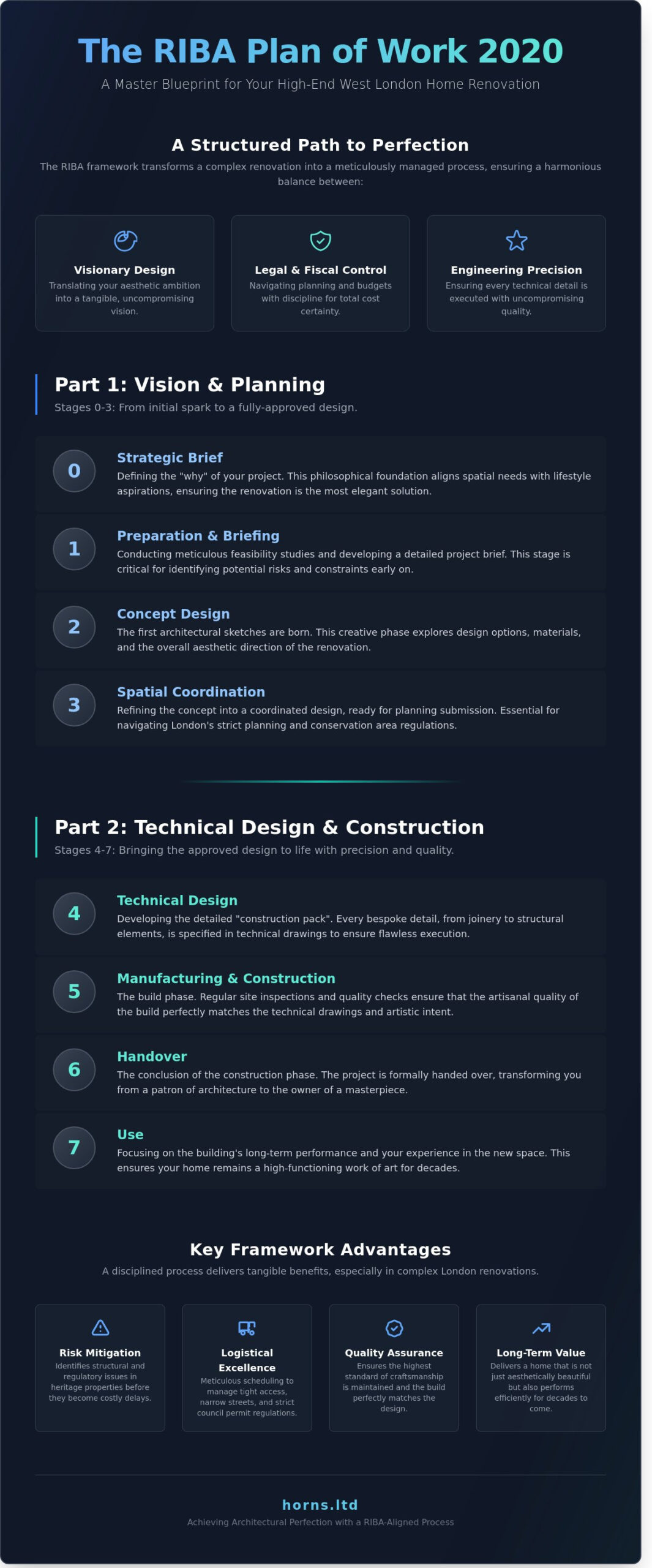
A London home is a canvas of historical significance and personal expression. To achieve a result that resonates with the soul, one must follow a disciplined, artistic framework. The RIBA Plan of Work 2020 represents the definitive model for the UK building process, acting as a symphony of coordination for complex residential projects. For homeowners in areas like Kensington or Marylebone, where architectural integrity is paramount, these riba stages offer a structured path from the first spark of inspiration to the final handover of a masterpiece. It is a roadmap that ensures every technical detail aligns with your aesthetic vision.
The framework organises the design, planning, and construction phases into eight distinct stages, numbered 0 through 7. This is not a mere checklist; it is a sophisticated system designed to manage the delicate balance between creative ambition and structural reality. By adopting the riba stages, professional builders and architects in London provide a level of quality control that mirrors the precision of a high-end audio instrument. Every stage serves a purpose, ensuring that the transition from a Victorian terrace to a modern sanctuary is seamless and uncompromising in its execution.
What is the RIBA Plan of Work?
The Royal Institute of British Architects (RIBA) established this framework to bring clarity to the building process. While older models felt linear, the 2020 update reflects the collaborative design required in the 2026 landscape. It prioritises sustainability and digital integration, allowing specialists to work in harmony. In London’s high-end market, where 85% of projects involve bespoke elements, this standard ensures that the “handmade” quality of your renovation is not lost in technical translation.
The Value of Following RIBA Stages in Residential Projects
Structural alterations in Victorian and Edwardian homes carry inherent risks that require more than just a builder’s intuition. Following a structured framework provides the necessary rigour to mitigate these hazards. When you are investing £500,000 or more in a West London refurbishment, cost certainty becomes as vital as the finish of the joinery. The RIBA stages facilitate this through structured information exchanges, ensuring that every penny spent is documented and every design choice is vetted for feasibility before a single brick is moved.
- Risk Mitigation: Precise planning at Stage 2 and 3 identifies structural constraints in heritage properties before they become costly site delays.
- Logistical Excellence: Managing the narrow streets and strict skip permit regulations of Central London requires the meticulous scheduling found in Stage 4.
- Quality Assurance: Regular check-ins during Stage 5 (Construction) ensure that the artisanal quality of the build matches the technical drawings.
- Long-term Value: Stage 7 (Use) focuses on the building’s performance, ensuring your home remains a high-functioning work of art for decades.
The complexity of a London renovation demands a calm, methodical approach. Whether it is navigating the 1974 Health and Safety at Work Act or ensuring the acoustic fidelity of a new basement cinema, the framework provides a sense of security. It allows the homeowner to remain the conductor of the project while the professionals handle the intricate technical performance. This process ensures that the final result is not just a house, but a carefully curated environment that reflects a commitment to perfection and timeless elegance.
Stages 0 to 3: Crafting the Vision and Navigating London Planning
Every architectural masterpiece begins with a profound question of purpose. Stage 0, the Strategic Brief, isn’t a mere checklist; it’s the philosophical foundation of your luxury renovation. Here, we define the “why” behind the project, ensuring the spatial requirements align with your lifestyle aspirations. Whether you’re seeking to integrate a bespoke listening room with uncompromising acoustic precision or simply yearning for a more fluid connection between living areas, this phase distils your intent into a clear, actionable mandate. It’s the moment where we determine if a renovation is the most elegant solution to your needs.
The progression through the early riba stages requires a transition from abstract desire to technical reality. This framework, detailed in the RIBA Plan of Work 2020, provides a structured path through the complexities of London’s residential landscape. By Stage 3, the design must be sufficiently robust to withstand the scrutiny of local authorities, ensuring that the artistic vision remains intact through the rigours of the planning process.
Stage 1: Preparing Your London Site
Precision is the hallmark of a successful London project. In dense urban environments like Kensington or Chelsea, where every millimetre carries significant value, a standard tape measure is insufficient. Stage 1 demands meticulous topographical and structural surveys to identify the hidden constraints of historic Victorian or Georgian footprints. Approximately 88% of successful renovations in these boroughs now utilise 3D laser scanning to create highly accurate “as-built” models. Stage 1 serves as the technical bedrock where site data dictates the boundaries of architectural possibility. Identifying whether your ambitions fall under “Permitted Development” rights or require a full planning application is vital at this juncture to avoid costly delays in the 2024 planning cycle.
Stage 2 & 3: From Sketches to Planning Approval
Stage 2 is where architectural creativity finds its form. We move beyond simple layouts to develop a rich material palette and aesthetic “colour” that resonates with the existing fabric of your home. This isn’t just about choosing finishes; it’s about the tactile experience of the space. As we transition into Stage 3, known as Spatial Coordination, the focus shifts toward the technical requirements of a planning submission. For homeowners in the London Borough of Hammersmith & Fulham or Ealing, this means preparing detailed drawings that respect local conservation guidelines and daylighting standards.
- Planning Committees: Navigating the specific nuances of the Ealing or Hammersmith & Fulham planning committees requires a balance of bold design and sensitivity to the local streetscape.
- The Party Wall Act 1996: In London’s terraced environments, addressing party wall matters early in Stage 3 is essential. Neglecting this can lead to legal injunctions that pause work for 4 to 6 months.
- Material Integrity: Finalising the external appearance during these riba stages ensures that the proposed brickwork, glazing, or zinc cladding meets both your aesthetic standards and the council’s expectations.
By the conclusion of Stage 3, the project reaches a significant milestone: the planning application submission. Statutory decision periods typically last 8 weeks for minor residential developments. This period of waiting is not idle time; it’s an opportunity to refine the internal technical specifications that will define the next phase of the journey. The goal is a seamless transition from the approved vision to the surgical precision of the construction drawings.
Stages 4 to 7: Meticulous Technical Design and Construction Excellence
The transition from a conceptual dream to a tangible structure requires a level of uncompromising precision that mirrors the calibration of a high-end audio system. This phase of the riba stages represents the bridge between artistic intent and physical reality. It’s the moment where the “construction pack” becomes the definitive technical DNA of your home. Every structural calculation and material specification must align perfectly to ensure the final result is as durable as it’s beautiful. For a detailed breakdown of these phases, the official RIBA Plan of Work provides the industry-standard framework for managing this complexity.
Stage 4: The Technical Blueprint
Stage 4 transforms the aesthetic vision into a rigorous technical manual. This isn’t merely about drafting; it’s about the sophisticated integration of structural engineering with bespoke interior architectural details. At this level, we address the following critical elements:
- Regulatory Compliance: We ensure every detail meets the 2026 Building Regulations, specifically focusing on Part L (fuel and power) and Part O (overheating) to future-proof your investment.
- Fire Safety: Implementing advanced fire safety standards that exceed minimum requirements, providing peace of mind in high-density London environments.
- Procurement Strategy: Finalising the selection of premium materials, from Italian Calacatta marble to specialist acoustic glazing, and securing contracts with master tradespeople.
Stage 5: High-End Construction in Practice
In West London, where property values frequently exceed £18,000 per square metre in districts like Kensington or Mayfair, the construction site must be managed with absolute decorum. Stage 5 is the physical realisation of the design. Managing a live site in a residential conservation area requires more than just building; it requires a symphony of logistics. We coordinate deliveries within strict local council hours and manage noise levels to respect the neighbourhood’s tranquility.
The role of project management here’s to maintain the integrity of the riba stages by ensuring that “craftsmanship” isn’t just a marketing term. It’s a measurable standard. Quality control involves daily inspections where we verify that the joinery, stonework, and MEP (Mechanical, Electrical, and Plumbing) systems match the original concept design with millimetre accuracy. We don’t accept “near enough” when the goal’s perfection.
Stage 6 focuses on the handover, a period of meticulous final inspections. This is where the “snagging” process occurs. It’s a deep dive into the finishes, ensuring every hinge operates silently and every surface is flawless. We treat this stage as the final tuning of an instrument before a performance. It’s about delivering a home that’s ready for immediate, effortless living.
Finally, Stage 7 (Use) acknowledges that a high-end home’s a living entity. We provide a post-occupancy evaluation roughly 12 months after completion to see how the building’s performing. Long-term maintenance plans are established here, ensuring that your investment retains its value and aesthetic brilliance for decades. We don’t just build for the present; we create a legacy that’ll endure through generations.
The London Context: Applying RIBA to Victorian Terraces and Conservation Areas
London’s architectural landscape is a complex tapestry of history and strict regulation. Renovating a Victorian terrace isn’t just a construction task; it’s an act of preserving a piece of the city’s soul. Utilizing the riba stages allows homeowners to balance modern luxury with the rigid constraints of a 19th-century structure. It ensures the structural integrity of a terrace, often shared with multiple neighbours, remains uncompromised while introducing contemporary flow and light. This framework acts as a bridge between the artistic vision of the homeowner and the technical realities of London’s high-density urban environment.
Renovating in London Conservation Areas
In conservation areas such as Kensington or Richmond, Stage 2 Concept Design becomes a delicate dialogue between your personal vision and the council’s heritage officers. You aren’t just choosing a layout; you’re selecting materials that resonate with the street’s history. Statistics from Historic England show that approximately 27% of London’s residential areas fall under conservation status. This means your technical design must specify materials like hand-cut Welsh slate or London stock brick to satisfy the Planning (Listed Buildings and Conservation Areas) Act 1990. Every aesthetic choice must be grounded in historical context to secure approval.
Loft Conversions and Extensions: Local Nuances
Stage 3 is where the project’s spatial coordination truly takes shape. For a West London Loft Conversion, the decision between a Dormer or a Mansard is often dictated by the local borough’s supplementary planning documents. Mansards are frequently the only viable option in strictly protected zones like the Hans Town Conservation Area. This stage must also account for the structural load of new floors on century-old brickwork. If you’re considering a basement refurbishment, the technical precision required for deep excavations involves complex waterproofing and piling strategies that must be finalised before any ground is broken. This level of detail prevents the common pitfalls of London’s high-density living.
Neighbourly relations are the silent engine of a successful London build. The RIBA framework helps incorporate the Party Wall etc. Act 1996 into your timeline early. By Stage 4, all awards should be in place to avoid delays that can cost upwards of £2,000 per week in site overheads. This structured approach prevents the emotional friction that often arises when heavy machinery starts vibrating through a shared wall. It transforms a potentially litigious process into a professional, managed transition that respects the proximity of London living.
Adapting the riba stages to fit the timeless elegance of London architecture requires a craftsman’s eye. It’s about ensuring the transition from a heritage facade to a modern, high-end interior feels seamless. Every detail, from the acoustic properties of the flooring to the bespoke joinery, follows a rigorous path from concept to reality. This meticulous process ensures that the final result isn’t just a house, but a curated work of art that respects its origins while embracing the future. We believe that true luxury lies in this uncompromising attention to detail, where engineering meets artistry.
Achieving Architectural Perfection with Horns Construction’s RIBA-Aligned Process
At Horns Construction, we view a London property not merely as a structure, but as a masterpiece of functional art. Our methodology treats the riba stages as a fundamental score, ensuring every note of the renovation is played with absolute precision. By integrating architectural design and master craftsmanship under one roof, we’ve refined a design-build service that honours the soul of your home while adhering to the most rigorous technical standards. It’s a philosophy born from a maximalist desire for perfection, where the engineering of the space is as vital as its aesthetic allure.
The traditional friction between separate architects and contractors often results in a loss of vision. We eliminate this vulnerability by providing a single point of accountability from the initial Stage 0 Strategic Definition through to Stage 7 Use. This continuity ensures that the “uncompromising acoustic precision” we’re known for is baked into the fabric of the building, not added as an afterthought. Whether we’re installing bespoke sound-dampening layers in a Mayfair townhouse or hand-finishing oak joinery in a Kensington loft, our master-craftsmen maintain the integrity of the original design throughout the entire lifecycle of the project.
Why a Design-Build Approach Enhances the RIBA Framework
The design-build model transforms the riba stages from a linear checklist into a dynamic, collaborative engine. In traditional procurement, the gap between Stage 3 (Spatial Coordination) and Stage 5 (Construction) is often where budgets escalate and timelines fracture. Our integrated approach allows us to begin technical detailing and procurement earlier. This typically accelerates the transition from planning approval to boots-on-the-ground by 15 to 20 per cent, as our construction team is already intimately familiar with the architectural nuances before the first brick is laid.
Cost-effective luxury isn’t a contradiction; it’s the result of meticulous budget management. By controlling the supply chain and employing our own specialist artisans, we manage costs across every stage with surgical accuracy. We’ve found that this transparency reduces the likelihood of unforeseen variations by 25 per cent compared to fragmented project teams. Every decision is weighed against the dual scales of architectural merit and financial viability, ensuring that the finished result is both a sanctuary and a sound investment.
- Seamless Transitions: We bridge the gap between Stage 4 (Technical Design) and Stage 5 (Manufacturing and Construction) to prevent design dilution.
- Artisan Quality: Our “hand-finished” approach means that every surface is inspected with the same rigour as a high-end audio component.
- Acoustic Mastery: We apply engineering principles to residential spaces to achieve a level of quietude and resonance rarely found in standard London builds.
Start Your London Renovation Journey
Transforming a high-value London property requires more than just a builder; it requires a partner who understands the weight of your ambition. We invite you to book a Stage 0 strategic consultation with our West London experts. During this session, we’ll explore the latent potential of your site and establish the technical parameters required to achieve your vision. Our team has a 35-year heritage in delivering complex refurbishments that stand the test of time, blending modern engineering with timeless elegance.
You can begin your inspiration by reviewing our portfolio of Full Home Refurbishments in London, where you’ll see the physical manifestation of our commitment to quality. Every project we undertake is a testament to the belief that your home should be a perfectly tuned instrument for living. When you’re ready to move beyond the ordinary and embrace a level of craftsmanship that refuses to compromise, we’re here to lead the way.
Enquire about your London project today and take the first step toward architectural excellence.
Master Your London Legacy with Architectural Precision
Transforming a West London terrace into a modern masterpiece requires more than just vision; it demands a disciplined adherence to the riba stages. By 2026, navigating the complexities of conservation area consents and structural integrity in Victorian properties will require a symphony of technical skill and artistic intuition. We’ve seen how the early phases define the soul of a project, while the later stages ensure that every join and finish meets an uncompromising standard of excellence. It’s about finding the perfect harmony between heritage and innovation.
Horns Construction brings over 20 years of London construction expertise to your doorstep, specialising in high-end West London refurbishments where every millimetre matters. Our approach blends meticulous project management with a deep respect for architectural heritage, ensuring your investment transcends the ordinary. We don’t just build rooms; we curate spaces that resonate with timeless elegance and structural perfection. It’s time to align your ambitions with a team that views construction as a high-end craft rather than a mere commodity. Your home deserves a legacy built on precision and passion.
Begin your professional London renovation journey with Horns Construction
Frequently Asked Questions
Do I really need to follow all 8 RIBA stages for a small house extension?
You should follow the core principles of the 2020 RIBA Plan of Work to ensure your project maintains its structural integrity and aesthetic harmony. While stages 0 and 7 are often condensed for residential extensions under 30 square metres; ignoring the framework often leads to the 15% budget creep common in unmanaged builds. A disciplined approach ensures your home remains a bespoke masterpiece rather than a compromised structure.
At which RIBA stage do I need to apply for planning permission in London?
You’ll typically submit your planning application at the conclusion of Stage 3, known as Spatial Coordination. In London boroughs such as Westminster or Hammersmith and Fulham, this follows the “design freeze” where architectural intent is finalised against local constraints. Statistics show that 90% of successful applications depend on the precise technical drawings and heritage statements produced during this crucial phase of the riba stages.
How much do architectural fees typically cost across the RIBA stages?
Total architectural fees for a premium London renovation usually range between 8% and 12% of the total construction cost. For a high-end £300,000 project, you can expect to allocate approximately £30,000 for comprehensive services. Stage 3 and Stage 4 are the most resource-intensive, often accounting for 45% of the total fee due to the technical precision required for modern building regulations.
What is the difference between Stage 3 and Stage 4 in a home renovation?
Stage 3 focuses on the architectural soul and spatial coordination of the project, while Stage 4 delivers the technical manufacturing and construction data. During Stage 4, we define every minute detail, from the specific acoustic properties of glazing to the exact grain of 22mm solid oak joinery. It’s the transition from a visual concept into a meticulous manual that your contractor must follow without deviation.
Can I skip the Strategic Brief (Stage 0) if I already know what I want?
Skipping Stage 0 is a risk that often results in foundational errors, as this phase validates the project’s core logic and site constraints. Approximately 40% of avoidable delays in London builds stem from poorly defined briefs that don’t account for the £4,000 per square metre reality of luxury construction. This stage ensures your desires align with the physical and financial boundaries of your specific property. When selecting a refurbishment company London professionals trust, ensure they prioritise this crucial foundation phase to prevent costly oversights.
How does the Party Wall Act fit into the RIBA Plan of Work?
You should initiate Party Wall proceedings during Stage 2 or the beginning of Stage 3 to prevent legal delays from stalling your construction schedule. The Party Wall etc. Act 1996 requires a minimum of 60 days’ notice for structural works affecting shared boundaries. Integrating these legal requirements into the riba stages ensures that the arrival of your master craftsmen isn’t delayed by preventable neighbour disputes.
What happens during the Handover stage (Stage 6) of a London build?
Stage 6 involves the physical transfer of the building back to your care, coupled with the rectification of any minor aesthetic defects. We perform a final inspection to ensure every finish meets our 100% quality threshold before issuing the final certificate. You’ll receive the “As-Constructed” information and a building manual, signifying the moment your vision officially becomes a functional piece of art.
How long does a typical London renovation take to move from Stage 0 to Stage 5?
Moving from the initial concept in Stage 0 to the start of construction in Stage 5 typically requires a period of 9 to 12 months. This timeline accounts for the 8 weeks required for a standard planning decision and the 4 weeks necessary for detailed technical tendering. A composed, 300-day lead-in ensures that the manufacturing process is never rushed, preserving the timeless value of your investment.