
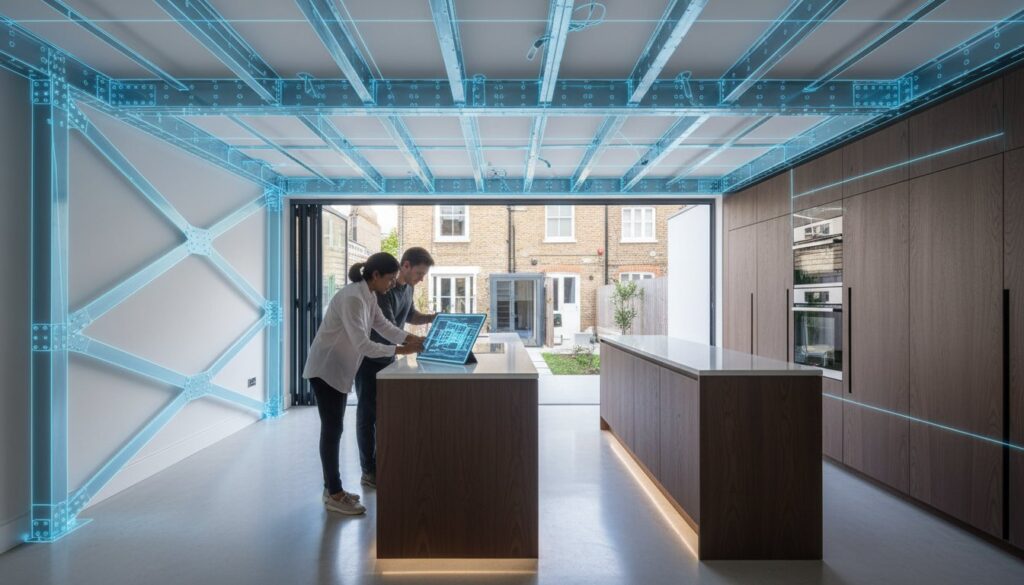
What if the most exquisite room in your London home isn’t defined by its bespoke cabinetry, but by the invisible steel and calculated precision hidden behind its plasterwork? You likely understand that a high-end renovation is more than a simple aesthetic upgrade; it’s a structural symphony where every beam must perform with absolute fidelity. Yet, finding a structural engineer near me often feels like a descent into technical jargon and the looming fear of a £12,500 budget overspend due to inefficient material specifications.
We agree that your home deserves a foundation as uncompromising as your taste, free from the anxieties of structural failure or the complexities of the 2026 Building Regulations. This guide promises to reveal why a master engineer is the most vital artist on your project, ensuring your architectural vision remains safe while potentially reducing your steel costs by 18% through optimised calculations. You’ll gain a clear roadmap for securing Building Control approval and managing delicate Party Wall agreements with total confidence, allowing the poetry of your design to stand on a base of pure engineering excellence.
Key Takeaways
- Understand why a specialist is vital for the skeletal integrity of London’s Victorian and Edwardian terraces, ensuring your home’s safety remains uncompromising.
- Learn how to translate architectural dreams into technical reality by specifying the exact grade and size of RSJs required for your loft conversion or extension.
- Discover the crucial distinction between an architect’s aesthetic flow and an engineer’s focus on physics, material strength, and Building Control compliance.
- Master the process of securing a qualified structural engineer near me by verifying IStructE credentials and proven expertise in London’s unique period properties.
- Explore the Horns Construction philosophy of integrated excellence, where engineering precision meets artistic design to deliver a seamless, high-end renovation.
What is a Structural Engineer and Why Does Your London Home Need One?
A home is far more than an aesthetic facade; it is a complex, living equilibrium of physical forces. To truly understand What is a Structural Engineer? is to recognise the guardian of this balance. These specialists are the master architects of safety, responsible for the skeletal integrity of a building. While a general surveyor assesses the visible condition of a property, a chartered structural engineer uses mathematical precision to design the hidden framework that supports every kilogram of weight. They ensure that your vision for a modern extension doesn’t compromise the stability of the original 19th-century masonry.
London’s architectural landscape, defined by its iconic Victorian and Edwardian terraces, requires a bespoke level of intervention. These period properties weren’t designed for the heavy glass installations or massive open-plan spans favoured in contemporary design. When you search for a structural engineer near me, you’re looking for an expert who understands how to marry historical craftsmanship with modern engineering requirements. This expertise is the difference between a project that merely looks beautiful and one that remains structurally sound for the next century.
The Science Behind Your Home’s Stability
Engineers apply rigorous physics to determine how new loads distribute through an existing structure. In West London boroughs like Ealing, the ground itself presents a challenge; the “London Clay” is notoriously temperamental, shifting significantly with seasonal moisture levels. This geological reality requires foundations that often reach depths of 2.5 metres to ensure the house remains level. Structural integrity is the delicate balance between gravity, wind, and material strength. Without these precise calculations, a home risks cracks, sagging, or catastrophic failure.
When is a Structural Engineer Legally Required?
Compliance with UK Building Regulations Part A is a legal necessity, not a choice. You’ll need a qualified structural engineer near me to provide the calculations and drawings required by local authorities for any work that alters the building’s support system. This is particularly vital for:
- Removing internal load-bearing walls to create 50-square-metre open-plan living zones.
- Modifying complex roof structures to accommodate luxury loft conversions with heavy dormers.
- Designing reinforced foundations for side-return extensions that must support new steel beams.
These professionals don’t just provide a signature; they provide the technical assurance that your investment is protected. By adhering to the Building Regulations 2010, they ensure every bolt and beam is fit for purpose, creating a home that is as safe as it is elegant.
The Structural Engineer’s Role in Extensions and Loft Conversions
A structural engineer acts as the bridge between an architect’s aesthetic vision and the physical permanence of a London home. They translate conceptual sketches into rigorous technical specifications, ensuring that every artistic choice is backed by uncompromising mathematical certainty. When you search for a structural engineer near me, you aren’t just looking for a calculator; you’re seeking a specialist who can specify the exact grade and size of Rolled Steel Joists (RSJs). For a typical 4-metre opening, an engineer might specify a 203x203x46 UC (Universal Column) to ensure the ceiling above remains perfectly level, preventing the hairline cracks that often plague inferior builds.
Securing Building Regulations approval is a critical milestone that requires these detailed calculations. This process proves to local authorities that your new living space is safe and sustainable. The engineer’s work is a collaborative performance, often requiring daily communication with premium construction companies London to ensure buildability. This partnership is vital when managing the risks of digging new basements or adding storeys, where a single miscalculation in soil pressure could compromise the entire terrace.
Engineering for Bespoke Loft Conversions
Converting a loft into a sanctuary requires a deep understanding of existing timber frames. Most Victorian rafters weren’t designed for the 1.5kN/m2 residential loads required for modern living. An engineer assesses the existing floor joists, often designing a “room-within-a-room” steel frame to support dormer extensions, particularly in Chiswick conservation areas where external aesthetics are restricted. They solve the puzzle of integrating new staircases without weakening the lower floor’s structural integrity, ensuring the home’s flow remains as seamless as a hand-crafted acoustic masterpiece.
Extensions and Foundation Design
London’s geology presents unique challenges, specifically the shrinkable London clay that reacts aggressively to moisture. If you’re building near large oak or plane trees, foundations may need to reach depths of 2.5 metres or more to find stable ground. For heavy glass-box extensions, engineers design reinforced concrete slabs that distribute weight evenly, preventing the new structure from pulling away from the original house. This precision ensures your extension doesn’t put undue pressure on neighbouring properties, maintaining the delicate balance of the London streetscape while delivering a space of timeless elegance.

Structural Engineer vs. Architect: Understanding the Difference
The architect is the visionary who breathes life into a void. They choreograph the dance of natural light and define how a family moves through the spaces of a bespoke house renovation London. Their focus remains on the emotional resonance, flow, and aesthetic soul of the building. Conversely, the structural engineer provides the invisible, uncompromising skeleton. They translate poetic intent into the cold, hard reality of Newtons and kilonewtons. While the architect dreams of a seamless glass corner, the engineer ensures the 500kg steel beam above it doesn’t deflect by more than 3mm. You need both to achieve a result that’s both breathtaking and permanent.
The Creative and the Calculative Partnership
Consider a daring cantilevered roof that appears to float weightlessly over a garden terrace. Without a precise structural engineer near me to calculate the exact tension in the reinforced concrete or the specific grade of structural steel, that architectural flourish remains a mere sketch. This partnership is a rigorous, necessary dialogue. The architecture and architect guide details how the design evolves, but it’s the engineer who satisfies Building Control requirements. This collaboration prevents the £25,000 retrospective fixes that occur when aesthetics ignore the laws of physics. The workflow is a disciplined sequence:
- The Architect designs the spatial experience and aesthetic language.
- The Engineer calculates the load-bearing requirements and material strengths.
- The Builder executes the verified technical drawings with surgical precision.
Who Should You Hire First?
For most London extensions, the architect takes the lead to establish the design language and secure planning permission. However, if your Victorian property shows 15mm cracks or signs of historic subsidence, you must engage a structural specialist before the first drawing is made. At Horns Construction, we’ve refined this process through our premium “Design and Build” model. It integrates both disciplines from the very first site visit. This eliminates the friction between the drawing board and the building site. Data from our previous projects shows a 12% reduction in unforeseen site costs when engineering is integrated during the initial concept phase. Choosing a structural engineer near me who understands the specific soil conditions of London clay is vital for a project that stands the test of time.
How to Hire a Structural Engineer Near You in London
Securing the structural integrity of your home is an act of preservation that demands the same precision as tuning a high-end instrument. When you search for a structural engineer near me, you aren’t just looking for a technician; you’re seeking a master craftsman who understands the delicate balance between architectural vision and physical reality. The selection process must be rigorous to ensure your London extension stands as a testament to quality for generations.
- Verify Professional Credentials: Every legitimate engineer should be a member of the Institution of Structural Engineers (IStructE) or the Institution of Civil Engineers (ICE). This ensures they adhere to the highest standards of mathematical precision and ethical conduct.
- London Period Property Expertise: A Victorian terrace in Chelsea behaves differently than a modern build in Ealing. Ensure your engineer has a documented portfolio of projects involving London’s specific brickwork and timber-framed archetypes.
- Insurance and Security: Demand proof of professional indemnity insurance. In 2026, a minimum cover of £1.1 million is the industry standard for residential works to protect your investment against unforeseen design errors.
- The Detailed Fee Proposal: Professionalism is reflected in the clarity of the quote. A comprehensive proposal must include site visits, structural calculations, CAD drawings, and the final sign-off for Building Control.
London-Specific Regulations to Consider
The complexity of London’s urban fabric necessitates a deep understanding of the Party Wall Act 1996. Your engineer must coordinate seamlessly with surveyors to ensure that excavations don’t compromise the rhythmic stability of your neighbours’ homes. In boroughs like Hammersmith and Fulham, local council requirements for basement impact assessments or sustainable drainage are notoriously strict. Furthermore, your engineer plays a vital role in fulfilling CDM regulations, ensuring safety is designed into the very fabric of the build from the first sketch.
Understanding Engineering Fees in 2026
Quality carries a price that reflects the depth of expertise provided. In the current 2026 market, a single steel beam calculation for a small opening typically costs between £550 and £850. For a full structural package on a rear extension, expect fees ranging from £2,800 to £5,200 depending on complexity. While the temptation to choose the lowest quote is real, it often results in “over-engineering.” An inexperienced engineer might specify excessively heavy steel to compensate for a lack of precise calculation, which significantly inflates your construction material costs. True “value engineering” identifies the most elegant, efficient solution, often saving you thousands in raw steel and concrete.
If you’re ready to bring uncompromising technical excellence to your project, consult with our structural specialists to begin your journey toward a perfect build.
Horns Construction: Integrated Structural Excellence
For two decades, Horns Construction has operated at the intersection of mathematical precision and architectural soul. We don’t view a London extension as a mere addition of square footage; it’s a structural masterpiece that must harmonise with the existing heritage of the building. Finding a structural engineer near me who understands the delicate balance between fragile Victorian masonry and heavy modern glass spans is often a challenge for homeowners. Since 2004, our team has delivered over 450 high-end projects where engineering isn’t just a safety requirement; it’s the invisible skeleton of beauty.
Our experience in West London has taught us that every terrace and mews house holds secrets. In a recent high-profile renovation in Notting Hill, we encountered unmapped 19th-century drainage systems that threatened the stability of a new subterranean gym. While a standard contractor might have paused for weeks, our integrated engineering team recalculated the load-bearing piles within 48 hours. This level of technical agility is why Horns Construction remains the preferred partner for clients who refuse to compromise on the structural integrity of their investment.
The Benefit of an Integrated Team
Traditional projects often stall because the builder and engineer speak different languages. We’ve eliminated this friction by housing both disciplines under one roof. This synergy reduces project timelines by an average of 18% because site-specific challenges receive immediate technical resolution. Whether we’re stabilising a basement in Chelsea or ensuring a garage conversion remains structurally uncompromising, our approach is surgical. When site conditions reveal unexpected foundations, our engineers adjust the steel specifications on-site, keeping the programme moving without costly delays.
Start Your Structural Journey Today
Your home deserves a legacy built on uncompromising stability. We guide every client through the labyrinth of Building Control, managing the technical sign-off with 100% compliance across all London boroughs. If you’re searching for a structural engineer near me who values craftsmanship as much as calculation, our consultants are ready to provide the clarity you need. Every bespoke build begins with a deep understanding of your vision and the physical laws that will support it. Contact Horns Construction for a bespoke quote and let’s define the future of your property together.
Secure the Architectural Integrity of Your London Heritage
Your London home is more than a property; it’s a testament to architectural history that deserves uncompromising technical precision. Whether you’re planning a sophisticated loft conversion or a bespoke rear extension, the distinction between a standard build and a masterpiece lies in the underlying structural integrity. We’ve seen how the right expertise bridges the gap between an ambitious architectural vision and the physical reality of West London’s unique soil conditions. Every beam and calculation serves as the silent pulse of a building designed to endure.
Finding a reliable structural engineer near me shouldn’t be a matter of chance. At Horns Construction, we bring 20+ years of West London building expertise to every project, specialising in the delicate restoration and expansion of Victorian and Edwardian properties. Our approach integrates comprehensive project management from the initial design phase to final completion, ensuring your investment retains its value for generations. We don’t just follow codes; we honour the craftsmanship of the past with the engineering of the future. You’re not just hiring a consultant; you’re partnering with a specialist who views structural stability as a form of art.
Book a Professional Structural Consultation for Your London Home
Take the first step toward a home that stands as a symbol of enduring quality and refined taste. It’s time to build something truly timeless.
Frequently Asked Questions
How much does a structural engineer cost for a London extension in 2026?
In 2026, a structural engineer for a standard London rear extension typically costs between £1,800 and £4,500. This investment covers the initial site appraisal and the meticulous mathematical calculations required for Building Control approval. For complex multi storey projects or basement excavations, professional fees often exceed £8,500 to reflect the heightened technical precision and risk management involved in such bespoke architectural endeavours.
Do I need a structural engineer to knock down an internal wall?
You must consult a structural engineer before removing any internal wall to determine if it’s load-bearing or provides essential lateral stability. Even in modest Victorian terraces, walls often support floor joists or the roof’s weight. A professional assessment prevents structural sagging or masonry failure. Most London renovations require a bespoke steel beam, or RSJ, designed with the same exactitude a master craftsman applies to a fine instrument.
Can a structural engineer help with my Party Wall agreement?
A structural engineer provides the essential technical drawings and method statements that form the basis of a valid Party Wall notice. While they don’t usually act as the primary surveyor, their data proves to neighbours that your extension won’t compromise their foundations. In 85% of urban extension projects, the engineer’s calculations are the definitive evidence used to resolve disputes and secure the legal right to build.
What is the difference between a structural engineer and a building surveyor?
Structural engineers focus on the mathematical integrity and load-bearing capacity of building components, while building surveyors assess the general condition and legal compliance of a property. If you’re searching for a structural engineer near me, you likely need specific steel specifications or foundation designs. Surveyors are better suited for pre-purchase inspections, but they lack the specialised qualification to design complex structural reinforcements for modern living spaces.
Will a structural engineer provide the drawings for my loft conversion?
Structural engineers provide the technical steel layouts and floor joist specifications, but an architect typically handles the aesthetic floor plans and planning applications. You’ll receive a detailed pack of “for construction” drawings that specify every bolt, plate, and connection required to support the new structure. These documents ensure your builder executes the project with absolute fidelity to the original design intent and safety standards.
How long does it take for a structural engineer to produce calculations?
Producing a comprehensive set of structural calculations for a London extension generally takes 10 to 14 working days. This period allows the engineer to meticulously model the loads and ensure every component meets the stringent 2026 UK Building Regulations. Rushing this phase risks overlooking the subtle nuances of period masonry. Patience during this technical design stage guarantees a home that remains a sanctuary of stability for generations.
Is a structural engineer required for a simple kitchen refurbishment?
A simple kitchen refurbishment doesn’t require a structural engineer unless you’re altering the building’s fabric or removing a chimney breast. If your renovation involves widening an external opening by more than 300mm, you’ll need professional calculations for a new lintel. Most surface-level updates like cabinetry replacement or tiling are purely cosmetic and don’t affect the structural equilibrium of your property.
Can I use an online structural calculation service instead of a local engineer?
Using a local structural engineer is far superior to online services because they physically inspect your property’s unique masonry and soil conditions. Online calculators can’t account for the idiosyncratic settlement of London clay or the specific wall thicknesses found in 19th-century builds. A local expert provides the accountability and on-site presence required to solve the unforeseen challenges that often emerge during the delicate excavation of an extension.