

What if the very transformation intended to elevate your London terrace into an architectural masterpiece became the catalyst for its structural undoing? While your vision focuses on the precision of a bespoke loft conversion or the seamless flow of a house extension, the reality is that 92% of projects exceed their budgets, often due to unforeseen complications. Securing comprehensive home renovation insurance uk isn’t just a regulatory checkbox; it’s the silent guardian of your 2026 investment. Most standard policies fail the moment a structural wall is touched, leaving your most valuable asset vulnerable to the complexities of modern building regulations and the 12% Insurance Premium Tax environment.
You understand that the pursuit of perfection requires more than just artistic vision; it demands meticulous stewardship of the construction process. This article promises to clarify the nuances of ‘Joint Names’ coverage and mortgage compliance, ensuring your journey remains as refined as the finished result. We will explore the essential shifts in the Future Homes Standard and how to shield your property from the risks of neighbouring structural damage before the September 30, 2026, Building Safety Act deadline arrives. We’ll examine how specialist cover bridges the gap between your builder’s liability and your own peace of mind.
Key Takeaways
- Standard home policies often become void the moment structural alterations begin. You’ll learn how to identify the specific triggers that necessitate specialist intervention to maintain your coverage.
- True protection requires a dual focus on the original architectural fabric and the emerging value of new contract works. We’ll show you how to secure both through every phase of your home’s transformation.
- Relying solely on a contractor’s public liability is a common oversight that leaves your property vulnerable to non-negligent accidents. This guide explains how to bridge the gap between their responsibility and your total security.
- Professional project management often dictates the use of JCT contracts, which carry specific mandates for your home renovation insurance uk. Understanding these obligations is vital for a compliant and secure investment.
- Discover the strategic importance of ‘Joint Names’ coverage in fostering a collaborative and secure environment between the homeowner and the construction team.
Why Standard Home Insurance Fails During Major Renovations
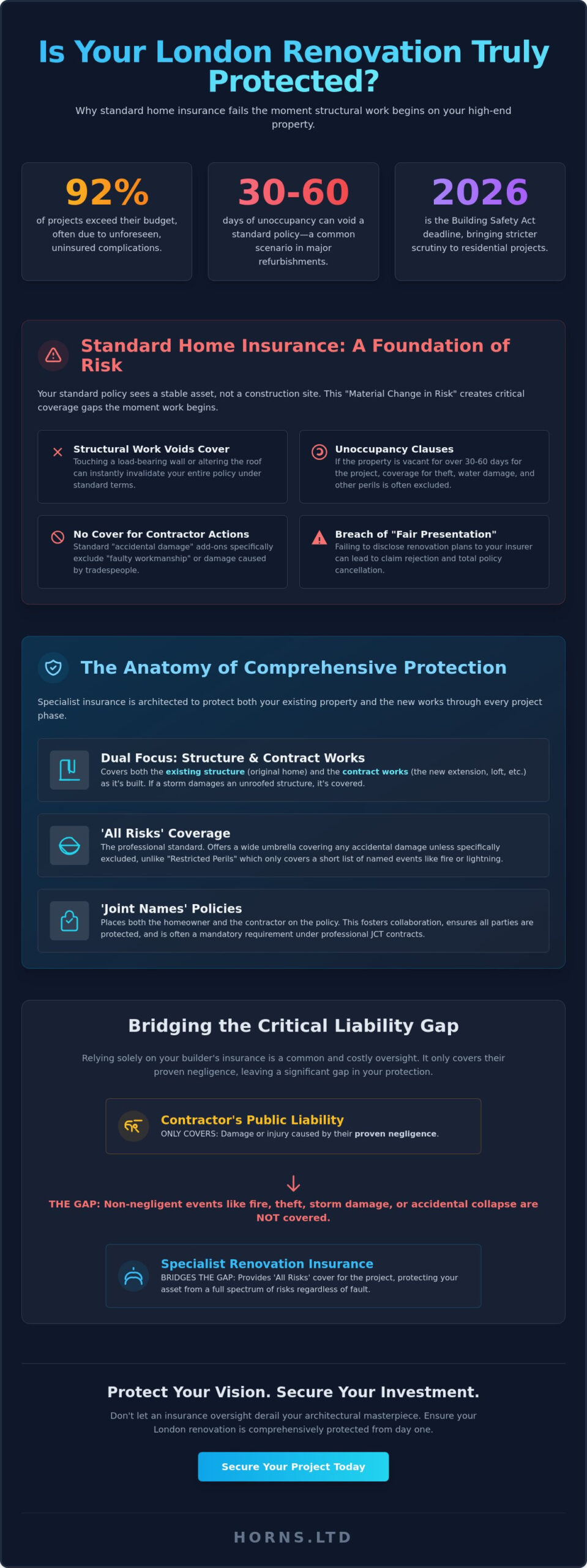
A standard policy assumes your home is a finished, stable asset. The moment you introduce a contractor to begin a house extension or a full home refurbishment, the risk profile shifts entirely. In the eyes of a 2026 UK underwriter, this constitutes a “Material Change in Risk.” This isn’t a mere technicality; it’s a fundamental alteration of the contract you signed. Most Standard home insurance policies are built on the premise of maintenance, not transformation. When you remove a roof for a loft conversion or breach a load-bearing wall, you’re creating a “work in progress” that standard underwriters simply haven’t priced for.
Under the Insurance Act, you have a “Duty of Fair Presentation.” This means you must disclose every detail that could influence a prudent insurer’s judgment. Failing to mention your planned structural works before they commence doesn’t just risk a rejected claim; it can lead to the total cancellation of your policy. With the Building Safety Act 2026 bringing increased scrutiny to residential projects, the margin for error has vanished. Securing specialist home renovation insurance uk is the only way to ensure your architectural investment remains protected under these stricter standards.
The Limits of Occupancy Clauses
Many high-end London refurbishments require the property to be vacated to allow for the precision required in carpentry and joinery or complex electrical services. However, most standard policies contain a clause that limits coverage if the home is unoccupied for more than 30 to 60 days. Moving out during a major project can trigger an automatic exclusion of “perils” like escape of water or theft. Specialist renovation insurance incorporates “unoccupied” cover, recognizing that a temporary vacancy is often a necessary part of a premium transformation.
Exclusions for Accidental Damage by Tradespeople
It’s a common misconception that “accidental damage” add-ons cover the actions of professionals. In reality, standard homeowner policies almost universally exclude “faulty workmanship” or damage caused by a contractor’s process. If a wall collapses during a house extension because of a structural mishap, your basic policy will likely fail you. While your contractor may have public liability, it often only covers their negligence, not the inherent risks of the build itself. Protecting the existing fabric of your period home requires a policy that specifically embraces the “works in progress” phase, ensuring that even when walls are breached, your security remains intact.
The Essential Components of a Renovation Insurance Policy
The architecture of a high-end London home is a delicate balance between historical integrity and modern innovation. A robust policy for home renovation insurance uk must address two distinct entities: the existing fabric and the emerging creation. Existing Structure Coverage protects the period features, the original masonry, and the soul of the building you already own. In contrast, Contract Works insurance covers the house extension or loft conversion as it takes shape. It ensures that if a storm damages an unroofed structure or a fire breaks out in a newly framed basement, the cost of rebuilding the work already completed is fully covered.
Choosing between ‘All Risks’ and ‘Restricted Perils’ is a decision that defines your level of security. Restricted Perils only cover specific, named events like fire, lightning, or explosions. For a premium project, ‘All Risks’ is the professional standard. It offers a much wider umbrella, covering any accidental damage unless it’s specifically excluded in the policy wording. This level of detail is vital when we execute a full home refurbishment, as the complexity of the work demands a safety net that accounts for the unexpected.
Public Liability remains a cornerstone of any renovation strategy. While it’s recommended that any contractor working on your home has a minimum of £2 million in public liability cover, your own policy should provide a secondary layer of protection. This covers injuries to visitors or passers-by and damage to third-party property, which is a significant risk in the tightly packed streets of the capital.
Protecting Materials and Equipment on Site
High-value materials like bespoke marble, designer kitchen fittings, or handcrafted joinery are often delivered weeks before installation. Standard policies rarely cover these items if they’re stolen or damaged while in storage on a construction site. Specialist insurance protects these assets from the moment they arrive. It also extends to hired-in plant and machinery, ensuring you aren’t personally liable for the replacement of expensive equipment used during the build phase.
Non-Negligent Liability (6.5.1 Insurance)
For those renovating London terraces, Non-Negligent Liability, often referred to as 6.5.1 insurance, is essential. It covers damage to neighbouring properties where the contractor isn’t legally ‘negligent’. If a shared party wall cracks due to the inherent nature of the works rather than a specific mistake, standard liability policies won’t pay out. This component provides the specific protection needed against subsidence, heave, or collapse of adjacent buildings, preserving your relationship with your neighbours and your financial security.
Contractor Liability vs. Homeowner Insurance: Bridging the Gap
The assumption that a contractor’s insurance portfolio offers a comprehensive shield for your home is a dangerous simplification that often crumbles under the weight of a complex London project. While a reputable firm will carry Public Liability, this specific cover only activates when legal negligence is proven. If a structural mishap occurs without a clear breach of professional duty, or if a sudden storm compromises the exposed site, the builder’s policy may remain silent. For a homeowner, this gap represents an unacceptable vulnerability. Securing your own home renovation insurance uk ensures that the protection of your asset isn’t contingent on proving another party’s fault. It places the security of the building back into your hands.
Beyond Public Liability, the depth of a contractor’s Professional Indemnity insurance must be meticulously scrutinized. This cover is the silent guardian of the design and technical advice phase. If a structural calculation for a complex house extension or loft conversion is flawed, this is the policy that responds. However, relying solely on a third party’s insurance means you’re trusting their administrative diligence. If premiums aren’t paid or if their policy has lapsed without your knowledge, the safety net disappears. A dedicated homeowner policy acts as the primary layer of defense, regardless of the builder’s status.
Understanding Joint Names Coverage
A “Joint Names” policy is often a non-negotiable requirement of mortgage lenders for significant structural works. By naming both the homeowner and the contractor on a single policy, you create a unified legal front. This specific arrangement prevents the insurer from exercising “subrogation,” which is the legal right to sue the builder to recover a claim paid to the homeowner. It fosters a collaborative spirit on site, ensuring that the focus remains on the seamless transformation of the property rather than adversarial legal proceedings. It’s a sophisticated method of aligning all parties toward a singular goal of excellence.
When Your Builder’s Policy is Insufficient
Even when a contractor holds the recommended minimum of £2 million in public liability cover, this figure can be quickly dwarfed by the reinstatement costs of a high-end period home in West London. In the tightly woven terraces of the capital, a single structural incident can affect multiple neighbouring properties simultaneously. If the builder’s liability limit is reached, the homeowner is often left to cover the financial excess. Specialist home renovation insurance uk provides the necessary buffer, ensuring that your architectural investment isn’t derailed by the administrative limitations of your construction partner. It allows you to maintain total control over the narrative of your home’s evolution.
Aligning Insurance with Professional Project Management
Professional project management serves as the structural framework for any successful high-end renovation. It requires a deep understanding of how legal frameworks and protective policies intertwine to create a secure environment for transformation. In the UK, the Joint Contracts Tribunal (JCT) provides the industry standard for these relationships. When you embark on a significant architectural change, you aren’t merely a homeowner; you assume the legal role of the ‘Employer’. This position carries the essential responsibility of ensuring the site remains protected through adequate home renovation insurance uk, bridging the gap between the design phase and the final reveal.
Calculating the ‘Reinstatement Cost’ is an exercise in meticulous precision that goes beyond simple market valuations. For a premium 2026 renovation, this figure must represent the total financial requirement to rebuild your home from its foundations using the same high-caliber materials and artisanal craftsmanship. It must account for the specific costs of bespoke carpentry and joinery, specialized electrical services, and the complex logistics of London’s urban landscape. Underestimating this value creates a vulnerability that can compromise the entire project if a major loss occurs, making technical fidelity in your calculations vital.
Insurance and the JCT Contract
Within JCT Minor Works contracts, the mandate for insurance is typically governed by specific clauses that dictate who holds the risk. Clause C is the most frequent requirement for major refurbishments, placing the obligation on the homeowner to arrange a policy in joint names. This arrangement ensures that the existing structure and the new works are covered under a single, cohesive umbrella. The policy must remain active and robust until the ‘Practical Completion’ certificate is issued, at which point the risk profile transitions back to a standard homeowner arrangement.
Party Walls and Structural Engineers
The risk profile of a London project is heavily influenced by the Party Wall Award and the technical reports provided by your structural engineer. Insurers often require a ‘Schedule of Condition’ for neighbouring properties to establish a baseline of integrity before any ground is broken. If your vision includes deep excavations for a house extension or the complex structural shifts of a loft conversion, these engineering reports provide the technical assurance insurers need to approve coverage. They act as a testament to the precision and safety of the planned work. To ensure your project is handled with this level of professional stewardship, explore our approach to full home refurbishments where we align technical excellence with total project security.
The Horns Construction Approach to Risk and Excellence
Horns Construction views risk management not as a bureaucratic burden but as a fundamental element of the creative process. With over 20 years of experience navigating the architectural complexities of West London, we understand that protecting your investment is as vital as the precision of our carpentry and joinery. Architectural excellence and robust home renovation insurance uk go hand-in-hand; one provides the vision, while the other ensures its endurance. We act as your professional partner, helping you decode the intricacies of JCT insurance obligations so that every structural shift is backed by technical and financial certainty.
Our philosophy is rooted in the belief that a premium lifestyle deserves a premium safety net. We don’t just execute a design; we curate an entire environment where your peace of mind is prioritized. This involves meticulous coordination with specialist insurers to ensure that the unique requirements of your property are met with the same level of detail we apply to our tiling and painting services. By bridging the gap between homeowner responsibility and contractor liability, we create a seamless path toward your home’s transformation.
A Seamless Partnership from Design to Completion
Our stewardship begins long before the first brick is laid. By integrating insurance considerations into the initial design and planning phase, we identify potential risk triggers early in the timeline. We maintain a rigorous network of professional trades, from master plumbers to expert electricians, all of whom adhere to the highest insurance standards. This collaborative approach ensures that your full home refurbishment is built upon a foundation of absolute security, allowing the artistic evolution of your space to unfold without the shadow of liability concerns.
Securing Your 2026 Renovation
The peace of mind inherent in a Horns Construction managed project stems from our meticulous site safety documentation. We don’t just build; we provide the evidence required to maintain your insurance validity throughout the construction lifecycle. Whether we are executing a sophisticated house extension or a complete interior overhaul, our team ensures that every safety protocol is followed with the same dedication as our aesthetic finishes. Contact us today to discuss how we can bring your 2026 architectural vision to life within a framework of professional protection and uncompromising quality.
Elevating Your Architectural Vision with Absolute Security
Navigating the complexities of a London transformation requires a balance of artistic ambition and technical stewardship. The decision to secure specialist home renovation insurance uk is a vital step in preserving the integrity of your period property. True peace of mind isn’t found in a contractor’s basic liability. Instead, it arises from the deliberate alignment of JCT contract compliance and comprehensive ‘Joint Names’ coverage. This ensures that every structural refinement remains a secure evolution of your lifestyle.
Horns Construction brings over 20 years of West London building expertise to every project, specializing in high-value period property refurbishments that demand the highest standards of care. We understand that your home is a masterpiece in progress. By ensuring full JCT contract compliance and assisting with the nuances of specialist site insurance, we remove the anxiety of construction. This leaves you free to focus on the beauty of the final reveal. Your architectural investment deserves a foundation of uncompromising security.
Begin your secure home transformation with Horns Construction and step into a future where perfection is protected.
Frequently Asked Questions
Do I really need specialist insurance for a simple loft conversion?
Yes, because a loft conversion is rarely simple in the eyes of an underwriter. Most standard insurers view structural alterations as a material change in risk that can immediately invalidate your existing policy. Specialist home renovation insurance uk is essential to protect the integrity of your period home while the roof is breached and new load bearing elements are introduced. It bridges the gap that standard homeowner policies simply aren’t designed to cover.
What is ‘Joint Names’ insurance and why do mortgage lenders require it?
‘Joint Names’ insurance creates a unified protective envelope by listing both the homeowner and the contractor on a single policy. Mortgage lenders insist on this arrangement to ensure the building is protected without the complication of insurers suing each other through subrogation. It provides the financial institution with the technical assurance that their underlying security remains robust throughout the construction phase, regardless of who is working on site.
Will my home insurance premium increase significantly after a renovation?
Your premium will likely reflect the enhanced value and increased reinstatement cost of your transformed property. As of early 2026, the average buildings insurance quote for homes with specified work in progress rose to approximately £296, compared to a standard quote of £174. This adjustment accounts for the superior materials and artisanal finishes that now define your elevated living space and the increased risk associated with a higher rebuild value.
Does renovation insurance cover me if I am doing the work myself (DIY)?
Most specialist policies are designed to complement the precision of professional trades and don’t automatically extend to DIY efforts. If you intend to undertake the work yourself, you must secure a specific self build or DIY renovation policy. This ensures that the technical fidelity of the project is covered even without the presence of a professional main contractor, though many premium insurers prefer the accountability of a managed project.
How much public liability cover should my builder have for a London extension?
A minimum of £2 million in public liability cover is the professional recommendation for any contractor working on a residential project. However, the density of London’s architectural landscape often necessitates higher limits to account for potential damage to neighbouring terraces. You should always verify that your builder’s policy is active and sufficient for the specific reinstatement costs of your West London postcode before any ground is broken.
What happens to my insurance if my renovation project is delayed?
You must inform your insurer immediately if your project timeline shifts beyond the original policy period. Since 87% of building works experience schedule overruns, specialist insurers typically offer policy extensions to maintain continuous protection. Failing to formalize this delay can leave your property without coverage during the most vulnerable final stages of the build, potentially jeopardizing your compliance with mortgage lender requirements.
Is my existing furniture and content covered while work is being carried out?
Standard contents insurance often becomes restricted or entirely void once a major renovation commences. While the structure is being transformed, your bespoke furniture and designer fittings may require additional protection or professional storage. It’s vital to confirm whether your home renovation insurance uk includes a ‘contents in trust’ clause to safeguard your possessions from site related accidents, dust, or theft during the construction phase.
Can I get renovation insurance if my property is already unoccupied?
Specialist providers offer dedicated unoccupied renovation insurance for properties that are vacant prior to the commencement of work. This coverage is essential for high end refurbishments where the home is uninhabitable during the initial structural or demolition phases. It provides the necessary security for the empty shell while we prepare to execute your vision, ensuring the property remains protected against fire, theft, and environmental damage.