
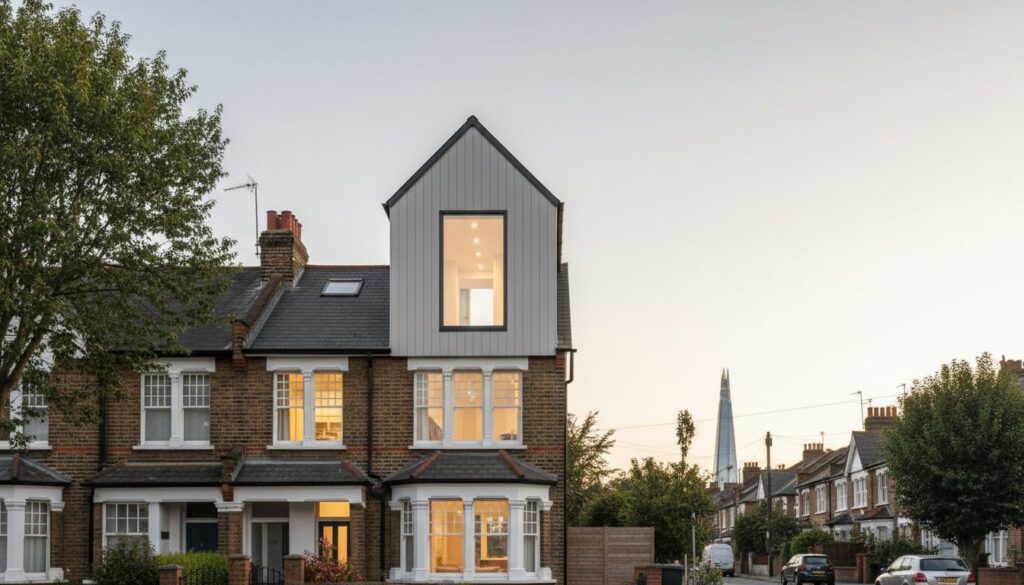
What if the sloping roof that currently defines your home is actually a silent constraint on your lifestyle’s true potential? Many London homeowners in 2026 still view their semi-detached properties through a lens of limitation, fearing that a hip to gable loft conversion planning permission application will inevitably end in a cold rejection or a compromised design. It’s natural to feel a sense of hesitation when faced with the 50 cubic metre volume threshold or the haunting possibility of an enforcement notice. You likely seek a space that reflects a commitment to architectural excellence rather than a hasty, box-like addition that lacks soul.
This guide provides the technical precision and creative clarity needed to master the complexities of London’s evolving planning landscape. We’ll demonstrate how to transform your attic into a sanctuary of light and volume while ensuring every square inch remains legally compliant. You’ll learn the exact steps to secure a Lawful Development Certificate, protecting your property value with the same rigor a master craftsman applies to a fine work of art. From understanding the 2026 Permitted Development nuances to avoiding aesthetic pitfalls, we’re here to ensure your vision reaches its most elevated, uncompromising expression.
Key Takeaways
- Discover how to transform a restricted sloping roof into a grand vertical gable, unlocking the hidden spatial and aesthetic potential of your semi-detached London home.
- Master the 2026 Permitted Development regulations to determine if your project qualifies for the 50-cubic-metre volume allowance, bypassing the need for a full planning application.
- Identify the specific London boroughs and Conservation Areas where local Article 4 Directions may necessitate formal hip to gable loft conversion planning permission.
- Learn to balance structural engineering with high-end architectural elegance, ensuring your new gable creates a seamless extension of your property’s original character.
- Understand the critical importance of a Lawful Development Certificate as the definitive legal proof that your conversion meets all current building standards and rights.
Understanding Hip to Gable Loft Conversions for London Properties
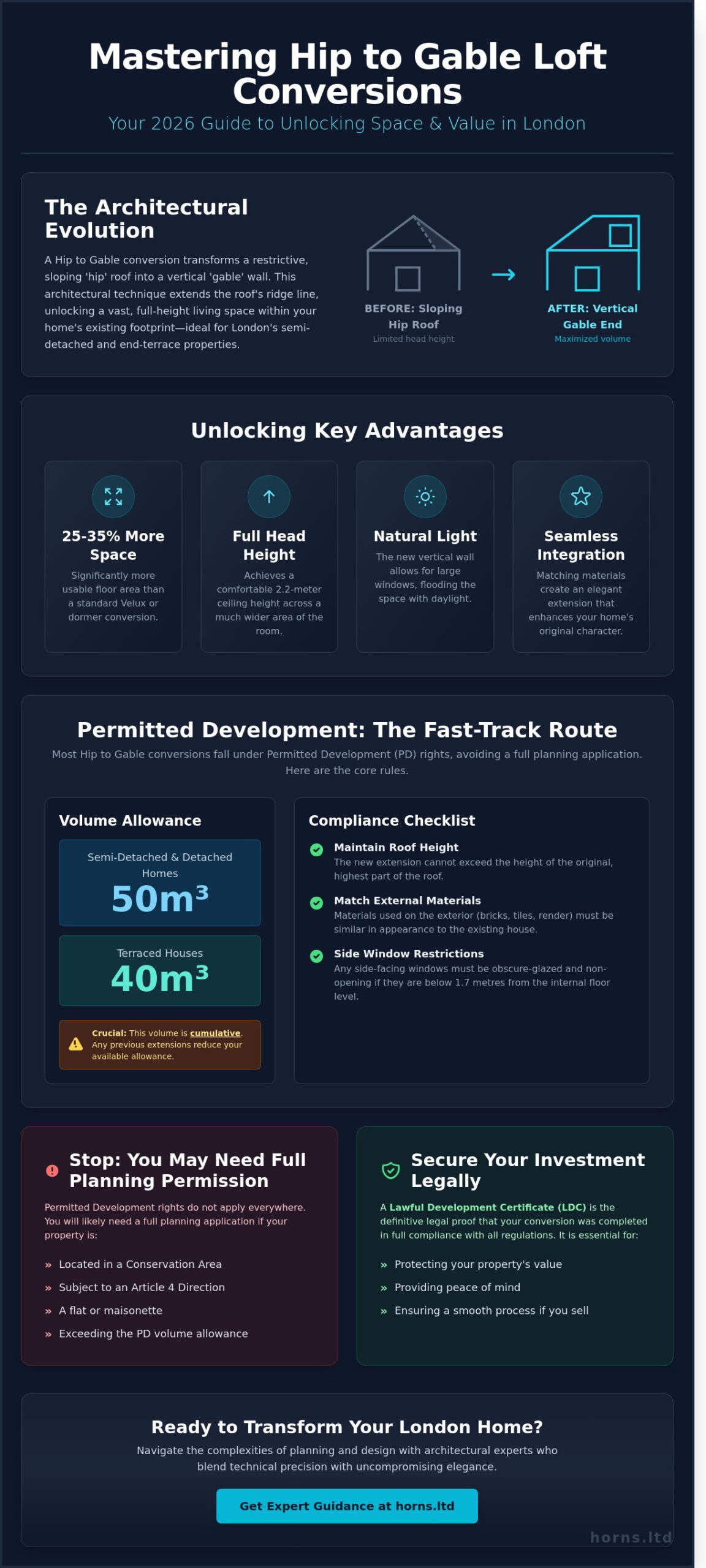
A home is more than a structure; it’s a sanctuary where form and function must exist in perfect equilibrium. For owners of London’s semi-detached and end-terrace properties, the hip to gable conversion represents an uncompromising approach to spatial design. This architectural evolution involves extending the sloping “hip” side of a roof outwards, transforming it into a vertical “gable” wall. By doing so, the ridge line is extended to its maximum potential, creating a voluminous interior that mirrors the footprint of the floor below.
While standard Velux conversions merely inhabit existing constraints, a hip to gable design fundamentally reengineers the property’s silhouette. This technique is particularly vital in 2026, as London’s density demands more sophisticated living solutions. Understanding Hip to Gable Loft Conversions reveals why this method is the preferred choice for those seeking a full-height master suite. It offers approximately 25% to 35% more usable floor area than a simple skylight conversion. This extra volume isn’t just a luxury; it’s the technical requirement needed to accommodate a permanent, building-regulation-compliant staircase without sacrificing the proportions of the existing first-floor rooms.
Hip Roof vs. Gable Roof: The Core Difference
Visualising the change is essential for appreciating the engineering precision involved. A traditional hip roof slopes on three or four sides, often feeling restrictive and claustrophobic. In contrast, the gable end rises vertically to meet the ridge, mimicking the classic “A-frame” look found on detached homes. This structural shift allows for a 2.2-meter head height across a much wider span. When considering hip to gable loft conversion planning permission, homeowners should note that this modification often falls under Permitted Development, provided the total volume increase stays within the 50-cubic-meter limit for semi-detached houses.
The Aesthetic Advantage of Hip to Gable Designs
The beauty of this conversion lies in its ability to achieve a seamless blend with the existing character of the street. It’s an exercise in architectural harmony. By using matching brickwork and roof tiles, the new gable wall appears as though it was part of the original 1930s or Victorian blueprint. Natural light becomes a primary design element, as the new vertical wall permits the installation of large, bespoke windows. This creates the “Horns” look, where technical engineering meets artistic home refurbishment, resulting in an elevated living experience that’s both timeless and functional. Securing hip to gable loft conversion planning permission ensures that these aesthetic upgrades meet the rigorous standards of London’s 2026 urban planning policies.
Navigating Permitted Development Rights in 2026
The architectural evolution of a London property requires a delicate balance between ambitious design and strict regulatory compliance. Most homeowners seek a hip to gable loft conversion planning permission through Permitted Development (PD) rights; these allow for significant structural changes without the traditional full planning application. This process relies on technical precision. For detached and semi-detached residences, the law permits an additional 50 cubic metres of volume. Terraced properties are restricted to 40 cubic metres. You must ensure the new ridge line stays below the original roof height to maintain the street’s silhouette. Aesthetic harmony is mandatory. The new gable end must reflect the existing brickwork or render exactly. For privacy, side-facing windows must be fitted with obscure glazing and remain non-opening unless they’re at least 1.7 metres above the internal floor level.
The 40m³ vs 50m³ Rule Explained
Volume calculations are the foundation of a successful PD project. A terraced house is capped at 40 cubic metres because of the higher density of the urban fabric, while semi-detached and detached homes enjoy a 50 cubic metre allowance. It’s vital to remember that these figures are cumulative. If you added a 15 cubic metre rear extension in 2022, that volume is deducted from your current allowance. Many homeowners face planning breaches because they fail to account for previous additions. Accurate measurements prevent the costly requirement of dismantling a nearly finished structure. Before finalizing your blueprints, you can verify general guidelines on the official UK Planning Permission portal to ensure your project aligns with national standards.
Standard Conditions for Loft PD Rights
The transition from a sloped roof to a vertical gable must adhere to specific spatial constraints to remain within PD rights. The law dictates that any enlargement must be set back at least 20cm from the original eaves, measured along the roof slope. This preserves the visual break between the old and new structures. Certain features are strictly prohibited under these rights:
- Verandas, balconies, or raised platforms are not permitted without full planning consent.
- Juliet balconies are usually allowed, provided they don’t have a platform.
- Chimney removals or structural alterations to the chimney stack often require separate consideration and may fall outside simple PD rights.
Achieving this level of structural precision is akin to the way we approach handcrafted acoustic engineering, where every millimetre of a tölcsér (horn) design dictates the final performance. A hip to gable loft conversion planning permission is not just a legal hurdle; it’s a blueprint for expanding your lifestyle without compromising the architectural integrity of your home. If your design exceeds these volume limits or alters the front roof slope facing a highway, you’ll need to transition from PD rights to a full planning application by the end of 2026.
When Planning Permission is Essential: London-Specific Constraints
In the pursuit of architectural excellence, one must recognize that the standard Permitted Development framework serves as a baseline, not a universal guarantee. For many Londoners, securing hip to gable loft conversion planning permission becomes a necessity when the property resides within a protected enclave. The capital’s unique history demands a level of sensitivity that transcends basic construction; it requires an understanding of the visual rhythm of a street. When the structural integrity of a neighborhood is at stake, local councils step in to ensure that every modification respects the existing aesthetic harmony.
Conservation Areas and Heritage Impact
West London boroughs like Ealing and Richmond maintain rigorous standards to protect their historic roofscapes. In these zones, councils often view the skyline as a collective work of art. If you live in a conservation area, the luxury of Permitted Development is typically withdrawn. You’ll likely need a Full Planning Application, which requires a detailed Heritage Statement. This document justifies how your new gable end respects the original 19th-century or Edwardian craftsmanship. It’s about achieving a balance where the new structural volume harmonizes with the period vernacular, ensuring the extension feels like a natural evolution rather than a modern intrusion.
Article 4 Directions in London
Beyond conservation areas, Article 4 Directions represent a specific legal tool used by local authorities to withdraw PD rights entirely. This is common in densely packed Victorian terraces where the council wishes to prevent inconsistent development. You should verify your specific postcode via the official government planning portal to see if these restrictions apply to your specific street. If your home is a Listed Building, the rules change completely. Standard PD rights never apply to heritage assets. Every change, from the timber used in the rafters to the specific shade of the roof tiles, must be negotiated through Listed Building Consent to maintain the property’s timeless value.
When Permitted Development is not an option, the Full Planning Application process begins. This isn’t a barrier but an opportunity for bespoke design. You’ll need to provide technical drawings that show architectural precision and material samples that prove your commitment to quality. Strategic design adjustments, such as stepping the gable back slightly or using reclaimed slate, can often win over a skeptical planning officer. Achieving hip to gable loft conversion planning permission in restrictive zones is a test of patience and technical mastery, ensuring the final result is a seamless addition to the London landscape.
Architectural Design Standards: Balancing Volume with Elegance
Creating a bespoke gable involves a sophisticated departure from the standard “box” dormer. It represents a transition from mere utility to architectural mastery. While many homeowners pursue a hip to gable loft conversion planning permission to unlock substantial volume, the true value lies in the seamless integration of the new structure with the existing facade. A well executed gable doesn’t just sit on the roof; it grows from it. This process requires a deep understanding of London’s diverse architectural heritage, ensuring that the 2026 aesthetic standards are met with uncompromising precision.
The Horns approach to internal layouts treats the new space as a master suite where flow and “acoustic” harmony take precedence. We design these environments to act as private sanctuaries. By placing ensuites and walk-in wardrobes within the new gable end, we maximize the central floor area for the sleeping or living quarters. This layout ensures that natural light, often harvested from high-performance Velux or conservation rooflights, reaches every corner of the room. Sustainable design is no longer an afterthought. In 2026, upgrading thermal performance is a core requirement. We target U-values as low as 0.15 W/m²K for roof elements, utilizing multi-layer foil insulation and high-density mineral wool to ensure the space remains temperate regardless of the London climate.
Structural Precision and Safety
The structural transformation of a hipped roof into a vertical gable is a feat of engineering that demands surgical accuracy. Heavy-duty steel beams, often Grade S275 or higher, are essential to support the extended ridge and the new masonry or timber-framed gable wall. This isn’t just about stability; it’s about the longevity of the home’s skeleton. Ensuring fire safety compliance under Part B of the Building Regulations is mandatory. This includes the installation of fire-rated doors and the protection of the escape route. Seeking professional [structural engineer near me] services is vital for London projects to navigate the complexities of party wall agreements and the specific load-bearing challenges of Victorian and Edwardian terraces.
Premium Interior Refurbishment
The interior of a gable conversion should mirror the sophistication of a high-end gallery. We focus on bespoke joinery that utilizes the often-neglected space under the eaves. Custom-built wardrobes and integrated shelving units follow the pitch of the roof, providing elegant storage solutions that feel like part of the architecture. Natural light is curated through the strategic placement of glazing, ensuring that the transition from the original staircase to the new level feels intuitive. Every finish, from the texture of the plastered walls to the grain of the hardwood flooring, is selected to resonate with your broader home refurbishment goals, creating a space that is as functional as it is beautiful.
Ready to elevate your home with a design that balances technical mastery with timeless elegance? Consult with our architectural specialists today to begin your transformation.
Securing Your Lawful Development Certificate with Horns Construction
A Lawful Development Certificate (LDC) represents the ultimate peace of mind for any London homeowner. While many projects fall under Permitted Development, relying on a verbal “it should be fine” is a risk that compromises the long-term integrity of your investment. An LDC serves as a formal, legal document issued by your local authority. It confirms that your hip to gable loft conversion planning permission was never required because the project adheres strictly to national mandates. This certificate transforms a structural change into a verified asset. When you eventually list your property on the competitive London market, solicitors will demand this proof. Without it, sales often collapse or require expensive indemnity insurance. Horns Construction approaches every project with the precision of a master craftsman; we ensure that legal compliance is as flawless as the final architectural finish.
The LDC Application Process
Securing this document requires a meticulous assembly of evidence. Our team prepares comprehensive architectural drawings, detailed site plans, and precise volume calculations to prove the 50-cubic-meter limit for detached or semi-detached homes hasn’t been exceeded. Most London local planning authorities, such as Ealing or Richmond, operate on an 8-week statutory timeline for these decisions. DIY applications frequently fail due to minor technical errors in the drawings or a misunderstanding of “original roof space” definitions as they stood on July 1, 1948. We manage every council liaison. We shield you from the bureaucratic friction that often stalls ambitious renovations. This methodical approach ensures that your hip to gable loft conversion planning permission status is legally bulletproof from the day the first tile is moved.
Start Your London Loft Transformation
Choosing a design-build partner allows for a seamless transition from conceptual sketches to the final structural beam. We don’t just build; we curate spaces that resonate with the homeowner’s lifestyle and the unique character of London’s diverse architecture. Our integrated approach to complex house extensions and lofts ensures that the aesthetic vision remains uncompromised by technical constraints. Professional project management reduces the typical stress of construction. It allows you to focus on the creative evolution of your home rather than the minutiae of building control. You deserve a space that reflects your standards of excellence and an uncompromising eye for detail. Book your West London loft conversion consultation with Horns Construction to begin your journey toward a perfectly realized home.
Elevate Your London Architectural Legacy
Navigating the intricacies of hip to gable loft conversion planning permission requires more than technical knowledge; it demands a deep appreciation for the structural soul of your home. By 2026, London’s building landscape has shifted, making the distinction between Permitted Development and full planning consent more vital for homeowners. Success hinges on balancing the volume constraints defined in the General Permitted Development Order with the aesthetic elegance required for high-end West London properties. A Lawful Development Certificate isn’t just a legal formality. It’s the definitive proof of your project’s integrity and future value.
Horns Construction brings over 20 years of London-specific construction expertise to your doorstep. We’re specialists in high-end West London property refurbishments, offering a comprehensive design-to-completion service that treats every renovation as a work of art. Our team ensures that every joint and finish meets the uncompromising standards of a bespoke masterpiece. We don’t build simple extensions; we curate elevated living environments where engineering precision meets timeless design. Your vision deserves the touch of a master craftsman.
Begin your premium London loft conversion journey with Horns Construction
Your home is ready for its next chapter of sophistication and light.
Frequently Asked Questions
Do I need planning permission for a hip to gable loft conversion in London?
You usually don’t need planning permission because most hip to gable conversions fall under Permitted Development rights. These rights allow you to extend your home without a formal application if you follow specific design constraints. You must confirm your property isn’t a flat or located on designated land where these rights are often restricted or removed entirely.
How much volume can I add to my roof under Permitted Development?
You can add up to 50 cubic meters of additional space to a semi-detached or detached house in London. If you own an end-of-terrace property, the limit is strictly 40 cubic meters. These calculations must include any previous roof additions made since 1948. Accuracy in these volumes is vital to ensure your hip to gable loft conversion planning permission remains valid and legally compliant.
Can I do a hip to gable conversion on a mid-terrace house?
You can’t perform this specific conversion on a mid-terrace home because it requires a sloping “hipped” roof side to extend. Mid-terrace properties only have two shared party walls and no side roof slope to convert into a gable. Homeowners in these properties typically choose a rear dormer conversion to achieve the extra space and architectural elevation they desire.
Is a Lawful Development Certificate the same as planning permission?
An Lawful Development Certificate isn’t the same as planning permission; it’s a legal document that proves your project was lawful without needing a full application. While planning permission is a request for consent, this certificate is a formal confirmation of your existing rights. It provides essential peace of mind and serves as a vital document when you eventually sell your London property.
What happens if my London home is in a Conservation Area?
You’ll almost certainly need full planning permission if your home is located within one of London’s 1,000 plus Conservation Areas. Local councils frequently issue Article 4 Directions in these zones to protect the historical character of the neighborhood. This means your design must show an uncompromising commitment to the original aesthetic, using materials that harmonize perfectly with the existing streetscape.
How long does it take to get a Lawful Development Certificate?
The statutory period for a local planning authority to issue a Lawful Development Certificate is 8 weeks. During this time, officers review your architectural drawings to ensure every detail aligns with national legislation. It’s a methodical process that requires technical precision, but it’s significantly faster than the complex negotiations often involved in a full planning application.
Will a hip to gable conversion add significant value to my London property?
A professionally designed conversion can increase your home’s value by approximately 20 percent according to data from the Nationwide Building Society. It transforms a dusty attic into a refined living suite, adding both functional square footage and aesthetic appeal. This investment represents a fusion of practical expansion and long-term financial appreciation in the competitive London property market.
Do I need a structural engineer for a hip to gable conversion?
You’ll definitely need a structural engineer to calculate the loads for the new steel beams and floor joists. They provide the technical precision required to ensure the new gable wall is stable and safe. These engineering specifications are mandatory for Building Regulations approval, ensuring your home’s structural integrity is never compromised during or after the construction process.