
In the pursuit of architectural excellence, the “average” price tag is often a veil that hides the true cost of uncompromising quality. Defining the house extension cost per square metre london 2026 requires more than a simple calculation; it demands an appreciation for the 6.6% rise in construction costs reported by RICS this May. You likely feel the weight of unpredictable material inflation and the complexity of London’s planning restrictions, where 60% of properties now face conservation hurdles. It’s frustrating to receive vague quotes when you seek the technical precision of a master craftsman.
This guide provides the clarity you deserve, revealing the precise 2026 benchmarks from £3,000 base builds to £6,000+ high-specification masterpieces. You’ll gain a reliable budget framework that accounts for the 20% VAT and the 15% professional fee margin. We’ll examine the distinction between shell and fit-out costs while exploring how the Future Homes Standard mandates a shift toward triple-glazing and superior thermal performance. By the end, you’ll have the confidence to choose a premium builder who treats your home as a timeless work of art, ensuring every square metre reflects both structural integrity and aesthetic grace.
Key Takeaways
- Master the Gross Internal Area (GIA) metric to accurately benchmark the house extension cost per square metre london 2026 for your specific project.
- Distinguish between ‘Shell Only’ and ‘Full Fit-out’ pricing models to ensure your budget accounts for every architectural detail and high-end finish.
- Identify hidden variables unique to London, such as the logistical constraints of Victorian terraces and the technical requirements of Thames Water build-over agreements.
- Allocate appropriate resources for professional expertise, understanding why architectural and structural engineering fees are the foundation of a kompromisszummentes build.
- Discover how a project management approach rooted in engineering precision and artistic integrity can transform a standard extension into a timeless work of art.
Understanding House Extension Costs in London for 2026
In the world of high-end architecture, precision begins with how we measure space. The industry standard for estimating the house extension cost per square metre london 2026 is the Gross Internal Area (GIA). This metric calculates the total floor area within the internal face of the perimeter walls, including partitions and chimney breasts. While material prices have finally found a level of stability in early 2026, the overall investment remains high. This isn’t merely a reflection of supply chains; it’s a testament to the increasing complexity of modern engineering. A deeper understanding of renovation reveals that structural integrity is the silent heartbeat of any beautiful home. We don’t just build walls; we compose the framework for your future life.
London isn’t just a city; it’s a unique construction ecosystem. Data from April 2026 shows that London extensions command a 25% to 40% premium over the UK national average. This gap exists because a London home is a complex puzzle of heritage, proximity, and meticulous craftsmanship. At Horns Ltd., we believe that engineering meets art when the invisible structures of a house are as carefully calibrated as a fine musical instrument. The house extension cost per square metre london 2026 reflects this commitment to kompromisszummentes quality, where the technical mastery of a structural frame is as vital as the final aesthetic finish.
Why London Extensions Command a Premium
The M25 corridor faces a persistent shortage of master tradespeople in 2026, driving labour costs upward by approximately 3% to 4% over the last twelve months. Logistics in boroughs like Hammersmith or Chiswick add layers of expense that national averages simply ignore. Parking permits, skip hire, and the sheer challenge of narrow access in West London require surgical project management. Additionally, London authorities enforce the most stringent sustainability requirements in the country. Meeting the 2026 Future Homes Standard requires high-performance materials and specialized installation techniques that exceed standard building practices.
The 2026 Market Context
Post-Brexit labour dynamics have permanently elevated the price floor for skilled carpentry and joinery in the capital. While interest rates in 2026 have influenced borrowing, the trend has shifted toward long-term ROI through “improving, not moving.” A well-executed extension adds up to 20% to a property’s value, making the initial investment a wise preservation of wealth. Beware of “cheap” quotes this year. In a market where RICS reports a 6.6% rise in construction costs, an unusually low bid is often a precursor to contractor insolvency or a compromise in material quality that no homeowner should ever accept.
Benchmarking the 2026 Cost Per Square Metre by Extension Type
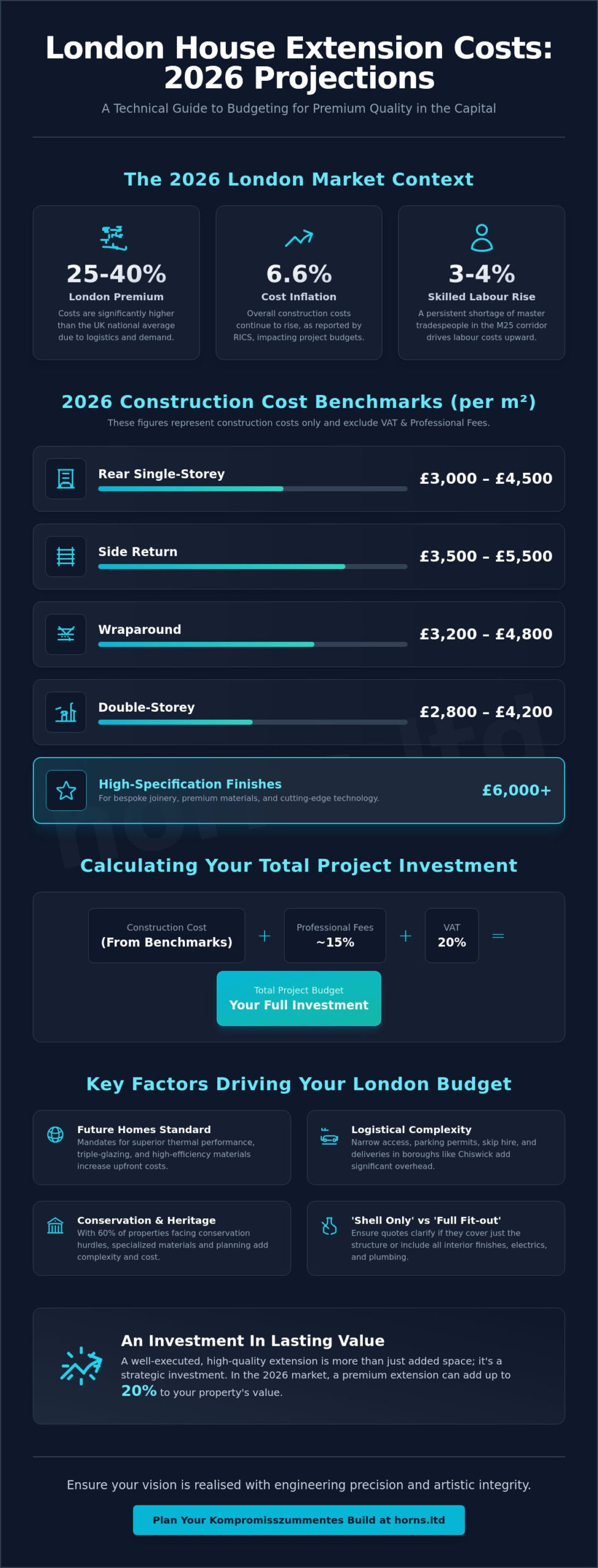
Every architectural journey begins with a number, but for the discerning homeowner, that number must reflect the reality of master craftsmanship. The house extension cost per square metre london 2026 varies significantly based on the structural ambition and the level of finish required. While a basic shell provides the canvas, it’s the fit-out that brings the artistic vision to life. It’s essential to understand that the following benchmarks focus strictly on construction and material components, excluding the 20% VAT and professional fees which we’ll detail later in this guide.
- Rear Single-Storey: £3,000 – £4,500
- Side Return: £3,500 – £5,500
- Wraparound: £3,200 – £4,800
- Double-Storey: £2,800 – £4,200
- High-Specification Finishes: £6,000+
Differentiating between ‘Shell Only’ and ‘Full Fit-out’ pricing is where many budgets falter. A ‘Shell Only’ quote typically covers the structural foundations, external walls, and weatherproofing. In contrast, a ‘Full Fit-out’ includes the soul of the home: bespoke joinery, premium tiling, and high-performance glazing. For those seeking a kompromisszummentes result, the fit-out phase is where technical precision meets aesthetic grace. If you’re ready to explore how these figures apply to your unique vision, consider how our expertise in high-end house extensions can elevate your property.
Single-Storey Extensions: Rear and Side Returns
Standard specifications for rear extensions in 2026 hover between £3,100 and £3,500 per m², but architectural glazed designs quickly reach £5,500+. Side returns often command a premium because they involve intricate structural alterations to the existing building’s spine. Understanding permitted development rights is vital here; these smaller additions must adhere to strict technical guidance to avoid the delays of a full planning application while maximizing every millimetre of available space.
Double-Storey and Wraparound Extensions
Double-storey extensions offer a compelling economy of scale because the costly foundations and roof structures are shared across two levels of living space. This efficiency often brings the house extension cost per square metre london 2026 down to a range of £2,800 to £4,200. A wraparound extension, which merges a side return and a rear extension into a unified L-shaped space, typically requires a 2026 investment of £3,200 to £4,800 per square metre to account for the significant structural steel needed for an open-plan layout.
Variables: What Drives Your London Extension Budget Up?
A budget is a living document, shaped by the physical reality of the London landscape. Calculating the house extension cost per square metre london 2026 is only the first step; the true mastery lies in anticipating the variables that lie beneath the surface. For the discerning homeowner, these “hidden” factors aren’t merely obstacles but essential components of a project’s structural and artistic integrity. Whether it’s the geological surprises of the Thames basin or the logistical dance of a West London street, every detail influences the final investment.
Ground conditions often present the first significant variable. In London, many extensions require Thames Water build-over agreements if they’re situated near public sewers, a process that involves technical surveys and specific foundation designs. Beyond the earth, the internal reconfiguration of your existing home can often exceed the cost of the new extension itself. Seamlessly blending a 19th-century structure with a 21st-century addition requires surgical precision in carpentry and joinery to ensure the transition feels like a natural evolution rather than a jarring graft. Navigating the requirements for planning permission for extensions is just one layer of this statutory puzzle that must be solved before the first brick is laid.
West London Site Logistics
The “Victorian Terrace” challenge in Hammersmith and Chiswick is a prime example of how geography dictates price. Narrow side access often makes machinery impossible to use, necessitating manual excavation for foundations. This labour-intensive process can significantly increase the house extension cost per square metre london 2026. If your property sits within a Conservation Area in Richmond or Fulham, expect further premiums for heritage-matched materials and bespoke glazing. Furthermore, Party Wall agreements with multiple neighbours are a standard reality here; you should budget between £5,000 and £10,000 for surveyor fees alone to ensure legal harmony and structural protection.
Specification and Finishes
In 2026, the standard for luxury is defined by invisible efficiency. Underfloor heating has replaced traditional radiators as the baseline for high-end extensions, offering superior thermal dynamics and aesthetic freedom. This technical choice often goes hand-in-hand with a premium kitchen renovation, where bespoke cabinetry and smart home integration create a unified living experience. Future-proofing your electrical infrastructure for home automation and high-speed connectivity isn’t just a convenience; it’s a commitment to the long-term value and timeless elegance of your London residence.
The Total Project Budget: Professional Fees and Statutory Costs
The structural elegance of a London extension is a symphony composed long before the first shovel hits the ground. When benchmarking the house extension cost per square metre london 2026, it’s vital to look beyond the bricks and mortar. The intellectual and legal framework of your project requires a specific allocation of resources to ensure the result is both safe and legally sound. Architectural and design fees for a bespoke project typically range from 7% to 12% of the total construction cost. This investment isn’t just for drawings; it’s for the vision that harmonises your lifestyle with architectural grace. You must also account for the 20% VAT, which applies to both construction labour and professional services. This tax is a non-negotiable addition that sits atop your base budget.
Statutory costs are the often-overlooked gatekeepers of your project. Planning applications, Building Control inspections, and the Community Infrastructure Levy (CIL) can add several thousand pounds to your total. These fees vary by borough, but they’re essential for securing the long-term value of your home. Factoring these into your house extension cost per square metre london 2026 ensures there are no jarring financial surprises halfway through the build. A project managed with mérnöki pontosság accounts for every penny, from the initial site survey to the final certificate of completion.
Essential Professional Services
Structural engineering is the backbone of any London project, especially when creating the wide, open-plan spaces that define modern luxury. Specialist calculations for complex steels are required to support the weight of existing Victorian or Georgian masonry. If your property shares boundaries, you’ll need Party Wall Surveyors to handle the legal requirements of the 1996 Act. For a high-end home refurbishment, a Quantity Surveyor provides an extra layer of security by managing costs with surgical precision, ensuring your artistic vision stays within its financial boundaries.
Contingency and Hidden Costs
A 10-15% contingency fund is non-negotiable in 2026’s economic landscape. This buffer protects the kompromisszummentes quality of your build against unforeseen structural discoveries or shifts in material pricing. You should also consider the logistical cost of temporary accommodation; moving out during a major build often preserves your peace of mind and accelerates the construction timeline. It’s a common misconception that ‘Permitted Development’ eliminates all bureaucratic expenses. Even without a full planning application, you’ll still face costs for Lawful Development Certificates and mandatory Building Control oversight. If you’re ready to invest in a build that matches your standard of living, contact Horns Ltd today for a consultation.
Maximising ROI: Why Horns Construction is the Choice for 2026
Selecting a partner for your home’s evolution is an act of trust that transcends simple mathematics. While understanding the house extension cost per square metre london 2026 is a vital fiscal foundation, the true return on investment lies in the harmony between structural mastery and artistic vision. A well-conceived project doesn’t just add floor space; it elevates the property’s market value by up to 20%, as verified by industry data from March 2026. At Horns Construction, we approach every project with the same dedication a master luthier brings to a fine instrument, ensuring that the final “resonance” of your living space is nothing short of perfection.
Our philosophy is rooted in the belief that engineering meets art at every junction of a build. With over 20 years of experience navigating the specific architectural fabric of the capital, we’ve refined a process that delivers house extensions that are both technically superior and aesthetically timeless. We manage the entire journey from the first design sketch to the final coat of paint, providing a comprehensive service that shields you from the volatility of the 2026 construction market. This end-to-end oversight ensures that the house extension cost per square metre london 2026 remains transparent and controlled, reflecting our commitment to project management excellence.
Engineering Artistry in Every Detail
Precision is the hallmark of our work. We select premium materials that don’t just meet the 2026 Future Homes Standard but are chosen for their ability to age with grace and dignity. Whether we’re managing the complex logistics of a West London site or executing manual excavations in a narrow terrace garden, our team works with a surgical focus to minimise neighbour disruption. This meticulous attention to structural integrity ensures that the invisible components of your home are as carefully crafted as the visible finishes, resulting in a kompromisszummentes build that stands as a work of art for generations.
Your Next Steps in 2026
The path to a successful extension begins with early expertise. Engaging with a premier construction company in London during the conceptual phase allows for better cost certainty and architectural alignment. We provide detailed, transparent quotes that account for every variable discussed in this guide, from structural steels to bespoke joinery. If you’re ready to transform your residence into a masterpiece of modern design and engineering, contact Horns Construction for a bespoke extension consultation. Let’s create a space that reflects your standard of living and your passion for excellence.
Transforming Your Architectural Vision into Reality
Navigating the complexities of a London build requires more than just a spreadsheet; it demands a partner who views your home as both a sanctuary and a masterpiece. You’ve now seen how the house extension cost per square metre london 2026 is shaped by rigorous technical standards and the 6.6% rise in construction costs recorded this May. From the logistical puzzles of West London terraces to the invisible precision of the 2026 Future Homes Standard, every detail must be orchestrated with profound care. True value isn’t found in the lowest bid but in the enduring quality of a project managed with absolute structural integrity.
Horns Construction brings over 20 years of West London experience to your doorstep, specializing in the delicate restoration and expansion of Victorian and Edwardian properties. Our team provides full RIBA stage project management, ensuring your artistic vision is supported by engineering excellence at every turn. We don’t just build extensions; we create timeless spaces that resonate with the elegance of your life. It’s about more than adding floor area; it’s about preserving heritage while embracing modern luxury.
Begin your premium London extension journey with Horns Construction and invest in a legacy of uncompromising quality. Your home deserves nothing less than architectural perfection.
Frequently Asked Questions
Is it cheaper to build a double-storey extension in London?
Building a double-storey extension is more cost-effective on a per-square-metre basis than a single-storey project. This efficiency exists because the most expensive structural elements, such as the foundations and the roof, are shared across two levels of living space. By spreading these fixed costs over a larger Gross Internal Area, you achieve a lower average rate while doubling the functional footprint of your home.
How much value does an extension add to a house in West London in 2026?
A professionally executed extension typically adds between 10% and 20% to the total property value in West London, according to March 2026 market data. In premium boroughs like Richmond or Hammersmith, the return on investment is particularly high when the design respects the property’s heritage. Beyond the financial gain, a bespoke addition elevates your daily life through superior acoustic fidelity and architectural grace.
Do I really need a Party Wall agreement for a simple rear extension?
You almost certainly need a Party Wall agreement if your excavation is within three or six metres of a neighbour’s structure. The Party Wall Act 1996 mandates this legal process to protect both your property and the adjoining buildings. Even a simple rear extension often requires deep foundations that can affect boundary walls, making early legal consultation essential to avoid construction delays and neighbour disputes.
Can I live in my house while the extension is being built?
Living on-site is possible, but we don’t recommend it for projects requiring significant structural reconfiguration or utility disruptions. High-end builds involve fine dust, noise, and periods without heating or water that can compromise your comfort. Most homeowners find that moving out for the duration of the heavy structural phase accelerates the build timeline and preserves their peace of mind during the renovation process.
What is the average duration of a 30m2 extension project in London?
A 30m2 extension usually requires a timeline of 12 to 16 weeks from the initial groundworks to the final decorative handover. This period accounts for the technical complexity of London sites and the curing time for structural foundations. If your project involves intricate bespoke joinery or high-performance glazing, the schedule may extend toward 20 weeks to ensure every detail reaches our standard of perfection.
How has inflation affected London building costs between 2024 and 2026?
Construction costs in the capital have seen a steady climb, with the RICS CIL Index reaching 400 in early 2026. While material prices have found stability since 2024, labour inflation remains a primary driver, increasing overall project budgets by 3% to 4% over the last twelve months. This shift means the house extension cost per square metre london 2026 reflects a market defined by the scarcity of master craftsmen.
What are the current VAT rules for residential extensions in the UK?
Standard residential extensions and professional services in the UK attract a 20% VAT rate as of May 2026. This tax applies to all construction labour, materials, and fees for architects or engineers. It’s vital to ensure your initial budget framework includes this 20% figure on top of all quoted construction costs to avoid significant financial shortfalls during the final stages of your project.
Should I choose a Design and Build company or an independent architect?
A Design and Build approach offers superior cost control and accountability by merging engineering precision with the construction phase. While independent architects create beautiful concepts, a unified service ensures the house extension cost per square metre london 2026 is balanced against the design from day one. This integration eliminates the risk of vague quotes and ensures your artistic vision is structurally and financially viable.