

A loft conversion is not merely an addition of square footage; it is the architectural realization of a vision that requires a financial foundation as robust as the steel beams supporting your new roof. You likely understand the delicate balance between investing in premium craftsmanship and the fear of a project stalling after a significant upfront payment. With construction material prices rising 2.6% in the 12 months to March 2026, the anxiety surrounding hidden costs or disappearing contractors is a rational response to a complex market. You deserve a process that reflects the same precision and transparency as the bespoke joinery in your new master suite.
This guide will empower you to master your loft conversion payment schedule by aligning every pound spent with a tangible, verified milestone. We’ll show you how to structure a fair agreement that protects your capital while ensuring architectural excellence remains the priority. You’ll gain a clear template for payments, the confidence to negotiate contract terms, and a deep understanding of legal protections like JCT contracts. We’ll explore the current 2026 landscape, from the £50,000 average for a Dormer conversion to the meticulous U-value requirements of 0.18W/m2K, ensuring your investment is both secure and timeless.
Key Takeaways
- Understand how a transparent loft conversion payment schedule acts as a roadmap for mutual trust, ensuring your investment is mirrored by physical progress on-site.
- Learn to identify the five critical project milestones, from the initial 10-15% booking deposit to the final structural sign-off, that protect your capital from risk.
- Discover how to spot the dangers of front-loaded payments and why progress-based releases are the hallmark of a professional, high-end builder.
- Gain the confidence to utilize JCT contracts and professional certifications to provide a layer of legal security for your bespoke home transformation.
- Explore how a commitment to architectural excellence and meticulous financial management creates a stress-free environment for your renovation.
Why a Structured Payment Schedule is Essential for Your Loft Project
A loft conversion represents one of the most popular forms of home improvement in the UK; yet its success hinges on more than just structural engineering. It requires a financial blueprint that mirrors the physical ascent of the build. A well-crafted loft conversion payment schedule acts as a transparent roadmap, transforming a complex construction process into a series of manageable, trust-building steps. It mitigates risk by ensuring the contractor has the liquidity to secure high-quality materials while protecting the homeowner from over-exposure before work is verified. This balance of capital and craftsmanship is the foundation of a stress-free renovation.
In 2026, where energy efficiency standards require new loft walls to hit a U-value of 0.18W/m2K, the alignment of payments with Building Control sign-offs is non-negotiable. Releasing funds only after an inspector verifies the insulation or the structural integrity of the steelwork ensures that the artistic vision is backed by technical compliance. This synchronisation prevents the anxiety of hidden costs appearing mid-project. Every pound spent is anchored to a certified achievement, ensuring that the structural integrity of your home remains as uncompromising as the aesthetic finish.
The Psychology of Staged Payments
Momentum is the lifeblood of any high-end West London renovation. When milestones are clearly defined, they serve as a rhythmic heartbeat for the project, keeping the team motivated and the homeowner reassured. Seeing a Dormer structure take shape or bespoke glazing installed provides a visual confirmation of value that eliminates buyer’s remorse. It’s a professional dialogue where capital meets craft; this transparency fosters a partnership rather than a mere transaction. Regular, earned payments maintain a steady pace, ensuring the project never loses the creative energy required for a premium result.
Financial Planning and Cash Flow Management
Precision in finance is as vital as precision in joinery. Homeowners navigating the 2026 market, where representative loan APRs hover around 6.2% to 6.4%, need a clear forecast to satisfy lenders and manage personal cash flow. This includes accounting for the standard 20% VAT or the reduced 5% rate applicable to specific energy-saving installations. A payment schedule is a contractual synchronisation of value and capital. It allows for the careful management of contingency funds, ensuring that the 2.6% rise in material costs seen over the last twelve months doesn’t disrupt the pursuit of perfection. By planning for these stages, you ensure the financial health of the project is as robust as the architecture itself.
The 5 Key Milestones of a Fair Loft Conversion Payment Plan
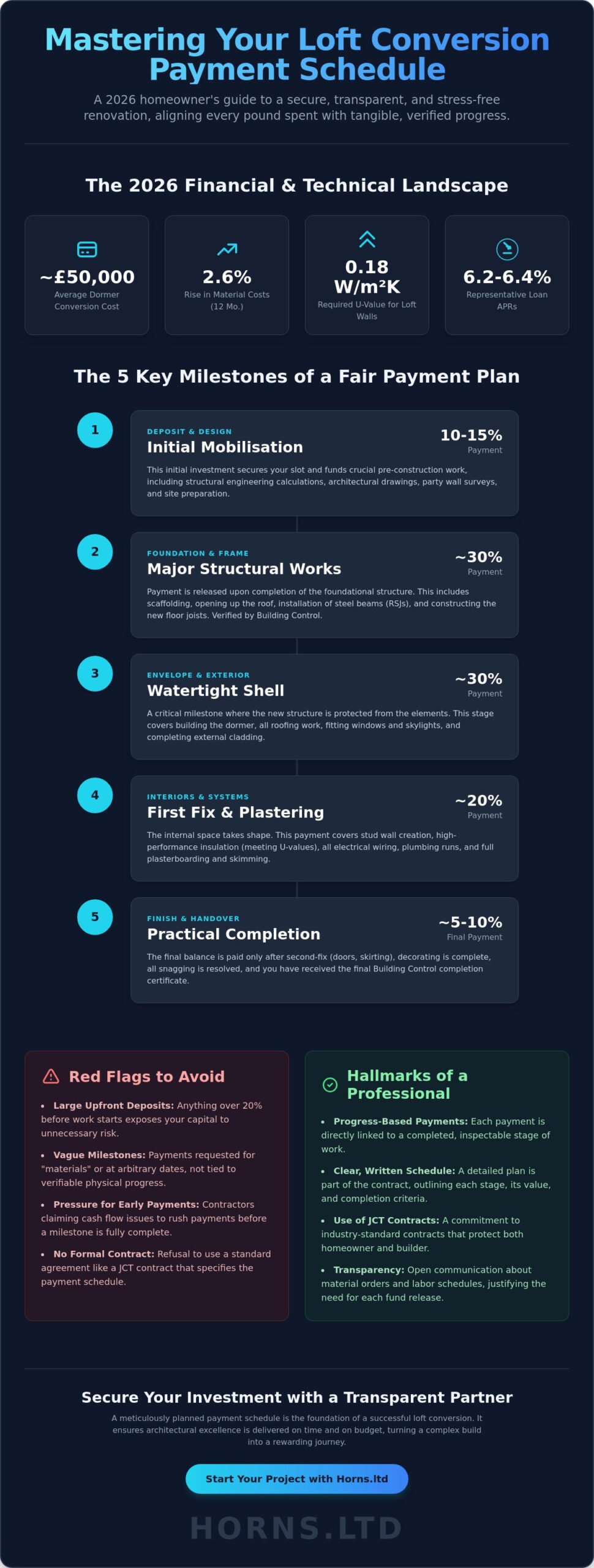
A meticulously balanced loft conversion payment schedule serves as the heartbeat of a successful project, ensuring that every financial release is met with a corresponding leap in structural reality. Unlike the front-loaded demands often seen in less professional agreements, a fair plan adheres to the Legal Protections for Homeowners established in UK construction law, which mandates clear mechanisms for determining when payments are due. In the premium London market, this typically manifests as five distinct, verifiable stages that keep the project moving while safeguarding your capital. This structure ensures that your investment remains as secure as the new architecture being created above your head.
Initial Mobilisation and Architectural Design
The journey begins with a booking deposit, usually 10% to 15% of the total contract value. This initial investment isn’t just a fee; it’s the engine for mobilisation. It covers the intricate structural engineering calculations, the commencement of party wall surveys, and the detailed site preparation required for a high-end build. For those considering broader transformations, our House Extensions in London: The Definitive 2026 Architectural Guide offers deeper insight into how these early design stages integrate with your overall property vision. A 10% deposit is the industry benchmark for premium builders, providing the necessary liquidity to secure design talent without exposing you to excessive risk.
The Structural and Weather-Tight Phases
Once the scaffolding rises, the second milestone occurs upon the completion of the primary structural work. This stage, involving the installation of heavy steelwork and floor joists, often commands the largest single payment because it represents the build’s most material-intensive phase. With sawn wood prices increasing 7.6% in the year to February 2026, this payment allows your contractor to lock in materials and maintain the project’s momentum. It’s a moment of significant transition where the skeletal form of your new space becomes tangible.
Following the structural frame, the “weather-tight” milestone is perhaps the most critical for your peace of mind. This phase encompasses the roofing and Dormer construction, ensuring your existing home is protected from the elements. Before releasing this instalment, it’s standard practice to have the work verified by Building Control. This ensures the 2026 fire safety standards, such as the requirement for mains-powered interlinked smoke alarms, are being met from the outset. Releasing funds at this stage confirms that the shell of your conversion is both safe and secure.
First Fix and Final Artistry
The final stages focus on the internal transformation. The “First Fix” payment covers the hidden intricacies: plumbing, electrical wiring, and internal partitioning. The final 5% to 10% of the total cost should always be reserved for the completion and snagging phase. This last release only occurs once the Building Control Certificate is issued and every detail, from the tiling to the carpentry, meets our uncompromising standards of excellence. Ensuring your loft conversion payment schedule concludes with this final sign-off guarantees that the artistic vision is matched by technical perfection. If you’re ready to discuss your own project milestones, feel free to consult our specialist team for a bespoke assessment.
Identifying Red Flags: Front-loading vs. Progress-based Payments
A masterfully orchestrated construction project relies on a rhythmic exchange of value. Front-loading occurs when a contractor demands capital that significantly outpaces the physical reality on-site. This imbalance places the homeowner at a distinct disadvantage, as the incentive to maintain momentum often diminishes once the builder’s profit is secured ahead of schedule. A transparent loft conversion payment schedule must remain anchored to progress. While international state guidelines on payment schedules emphasize that payments should never exceed the value of work performed, this logic is the cornerstone of any professional agreement in the UK. It ensures that your investment is always represented by the bricks, mortar, and craftsmanship already present in your home.
To safeguard the final finish, a “Retention Fund” is an essential component of a high-end contract. By withholding 2.5% to 5% of the total project value until the final sign-off, you create a dedicated reserve for the “snagging” phase. This isn’t a sign of distrust; it’s a professional mechanism that ensures every detail, from the alignment of a door handle to the precision of a plaster finish, is perfected before the final account is settled. This ensures the project concludes with the same technical rigour with which it began.
When High Upfront Costs are Justified
There are instances where a deviation from the standard progress-based model is necessary for artistic excellence. Bespoke architectural elements, such as tölcséres (horn-style) aesthetic features or premium, high-performance glazing, often require significant lead times and upfront manufacturing costs. These items are crafted specifically for your property and cannot be repurposed. In these cases, a specific material deposit is justified. You should always verify that these funds are being used exclusively for your project by requesting proof of order or manufacturer invoices. This ensures that even your most unique design choices are managed with financial integrity and transparency.
Signs of a Financially Unstable Contractor
A contractor’s financial health is often visible in their communication style. Demands for cash payments or “urgent” funds to cover material deliveries outside the agreed loft conversion payment schedule are significant red flags. Such requests often indicate a reliance on new deposits to finish previous jobs. Professionalism is found in documentation. A lack of a formal written contract, such as a JCT Minor Works agreement, suggests a lack of accountability. At Horns Construction, we advocate for a meticulous, pre-agreed financial programme that respects both the artisan’s needs and the client’s security. True luxury is found in the peace of mind that comes from a project managed with absolute transparency.
Legal Protections and Financial Security for London Homeowners
The realization of an architectural dream requires a safety net woven from legal precision and financial foresight. In the high-stakes environment of 2026 property development, a loft conversion payment schedule must be anchored in a robust legal framework to protect the homeowner’s capital. While the creative process is fueled by passion, the execution remains governed by the cold, clear logic of contract law. This duality ensures that your investment in a premium home transformation remains secure from the first structural calculation to the final decorative flourish. By formalizing every transaction, you transform a potentially volatile construction process into a dignified professional partnership.
The Importance of the JCT Contract
For high-value renovations in areas like Fulham or Chiswick, the Joint Contracts Tribunal (JCT) Homeowner Contract is the industry’s gold standard. This document does far more than list costs; it formalizes the payment schedule and establishes clear protocols for dispute resolution. It provides a level of certainty that is essential when managing the 20-40% price premium often found in the London market. If you are considering a wider scope of work, our guide on Mastering Home Refurbishment in London: The 2026 Definitive Guide explores how these legal protections scale across complex, multi-stage projects. A JCT contract ensures that the “rules of engagement” are understood by all parties, preventing the ambiguity that leads to project delays.
Security is further enhanced through the involvement of an architect or independent project manager. Their role is to act as a technical arbiter, certifying that work has reached the required standard before any capital is released. For large-scale West London renovations, many homeowners now utilize Escrow services. This system holds funds in a neutral account, releasing them only when both the homeowner and the certifying professional are satisfied. This method, combined with an Insurance Backed Guarantee (IBG), provides a multi-layered shield against contractor insolvency or technical failure.
Building Control and Final Sign-off
The transition from “Practical Completion” to “Final Completion” is a critical distinction in your financial strategy. Practical completion means the space is functional and ready for use, but it does not signal the end of the builder’s responsibility. The final payment in your loft conversion payment schedule must always be contingent on the receipt of the Building Regulations Completion Certificate. This document is the only legal proof that your conversion meets the 2026 standards for fire safety and energy efficiency, including the mandatory U-value of 1.4 W/m2K for new windows. The final 5% of the contract value is the homeowner’s ultimate leverage for quality assurance. To ensure your project meets these uncompromising standards, book a technical consultation with our specialist team today.
The Horns Construction Commitment to Transparent Financial Management
Horns Construction approaches the transformation of your home with the same reverence a master luthier brings to a bespoke instrument. We believe that the structural integrity of a build and its financial transparency are inseparable; both must be executed with absolute precision to achieve a harmonious result. Our loft conversion payment schedule is not merely a list of transactions. It is a rhythmic progression that synchronizes your investment with the tangible evolution of your living space. By aligning every financial milestone with a physical achievement, we ensure that the creative vision remains unburdened by the weight of fiscal uncertainty. This commitment to clarity allows you to witness the metamorphosis of your property with the same tranquility one feels when listening to a perfectly calibrated soundstage.
Trust is built through professional rigor. We utilize industry-standard JCT contracts to formalize our agreements, providing a level of security that is essential for high-end West London developments. Our “No Hidden Surprises” policy is our vow to you. While the market saw construction material prices rise by 2.6% in the 12 months to March 2026, our clients remained protected through meticulously defined fixed-price agreements. Any variations or additional works are handled with the same technical documentation as the primary build, ensuring you are never met with an unexpected invoice. We invite you to explore our portfolio of transformations across Hammersmith, Fulham, and Chelsea, where engineering excellence meets artistic soul.
Bespoke Service, Transparent Costs
Our approach to high-end refurbishments in Hammersmith and beyond is defined by a refusal to accept mediocrity. We combine the engineering precision of a master builder with the financial clarity required for modern property management. The snagging process is where our dedication to a kompromisszummentes (uncompromising) finish truly shines. We don’t consider a project complete until every joint is seamless and every surface reflects our standard of architectural hűség (fidelity). This final phase is supported by the retention fund, ensuring our team remains dedicated to the smallest details of your new master suite or creative studio.
Start Your Transformation with Confidence
Beginning your journey with Horns Construction starts with a dialogue about vision and value. During your initial consultation, we set both the financial and creative parameters of the project, ensuring your expectations are met with a realistic, milestone-based roadmap. We provide a detailed breakdown that accounts for everything from the £50,000 average cost of a 2026 Dormer conversion to the specific requirements of the latest fire safety regulations. This ensures you can step into your renovation with the confidence that your capital is being managed as carefully as your home’s structure. To begin your journey toward a more elevated lifestyle, contact Horns Construction for a professional loft conversion consultation and discover the difference that true craftsmanship makes.
Elevate Your Home with Architectural and Financial Precision
A loft conversion is more than an expansion of space; it’s a legacy of craftsmanship that deserves a secure financial foundation. By mastering your loft conversion payment schedule, you transform a complex renovation into a series of calm, verified milestones. You’ve learned that aligning capital with structural progress isn’t just a safety measure. It’s a professional necessity that ensures every detail, from the first steel beam to the final decorative touch, meets the highest standards of excellence. This structured approach provides the transparency needed to maintain project momentum and creative energy.
Protecting your vision requires the technical rigour of JCT-compliant contracts and the oversight of experts who respect both your home and your investment. With over 20 years of expertise in West London’s most prestigious neighbourhoods, we specialize in high-end architectural refurbishments that stand the test of time. You don’t have to navigate these complexities alone. True luxury is found in the peace of mind that comes from a project managed with absolute transparency and meticulous care.
Request a Transparent, Milestone-Based Quote from Horns Construction and take the first step toward a transformation defined by clarity and uncompromising quality. Your dream space is within reach; let’s build it with the precision it deserves.
Frequently Asked Questions
How much deposit should I pay for a loft conversion?
A professional deposit typically ranges between 10% and 15% of the total project value. This initial investment secures your place in the builder’s schedule and covers the mobilization of design teams and structural engineers for the early planning stages. Paying more than 20% upfront is often seen as a red flag in the 2026 London market, where progress-based payments are the standard for high-end builds.
Is it normal to pay for materials before they arrive on site?
It’s standard practice to pay for bespoke materials, such as high-performance glazing or handcrafted joinery, before they arrive on site. These items often have lead times exceeding 8 weeks and are manufactured specifically for your home’s unique dimensions. Always ask for a manufacturer’s invoice or a vesting certificate to verify that your capital is being used to secure your specific components rather than general company overheads.
What happens if I disagree with a builders milestone payment request?
If a milestone request feels premature, you must refer to the specific definitions in your JCT contract to verify the work’s completion. A milestone is only reached when the work is physically complete and, where necessary, verified by a third party like an architect or building inspector. Transparent communication is vital; don’t release funds until you are satisfied that the structural reality on-site matches the billing request.
What is a retention fee in a construction contract?
A retention fee is a dedicated reserve, usually 2.5% to 5% of the total cost, held back to ensure the final finish is perfect. This sum is only released once all “snags” or minor defects are rectified to an uncompromising standard after the project’s completion. It provides the homeowner with essential leverage during the delicate final stages of the renovation, ensuring the artisan remains committed to technical perfection.
Should I pay the final instalment before receiving my Building Control certificate?
You should never release the final payment in your loft conversion payment schedule until you hold the Building Regulations Completion Certificate in your hand. This document is your legal guarantee that the conversion meets the 2026 fire safety and energy efficiency requirements. Without it, your investment isn’t fully protected, and you may face significant legal or financial difficulties when selling the property in the future.
Can I negotiate the payment schedule proposed by my builder?
Negotiating the loft conversion payment schedule is a standard part of the pre-contractual dialogue between a homeowner and a professional builder. You should aim for a plan that mirrors the value of work performed on-site rather than one that is heavily front-loaded. A fair, negotiated schedule protects the contractor’s cash flow for materials while ensuring your capital is never at unnecessary risk before work is verified.
What are the risks of paying a builder in cash for a loft conversion?
Paying in cash removes your legal safety net and makes it impossible to prove that payments were made as part of a formal contract. You lose the protections offered by the Consumer Credit Act and Insurance Backed Guarantees, which are vital if the builder ceases trading. Professional builders who value technical precision and artistic integrity will always prefer transparent, traceable bank transfers that align with a documented financial roadmap.
How do I handle “extra” costs that weren’t in the original payment schedule?
Handle any additional works by creating a formal “Variation Order” that details the specific cost and impact on the project timeline. This document should be signed by both parties before the extra work commences to ensure complete financial transparency. This disciplined approach prevents the anxiety of hidden costs appearing at the end of the project and keeps your overall financial plan robust and predictable.