
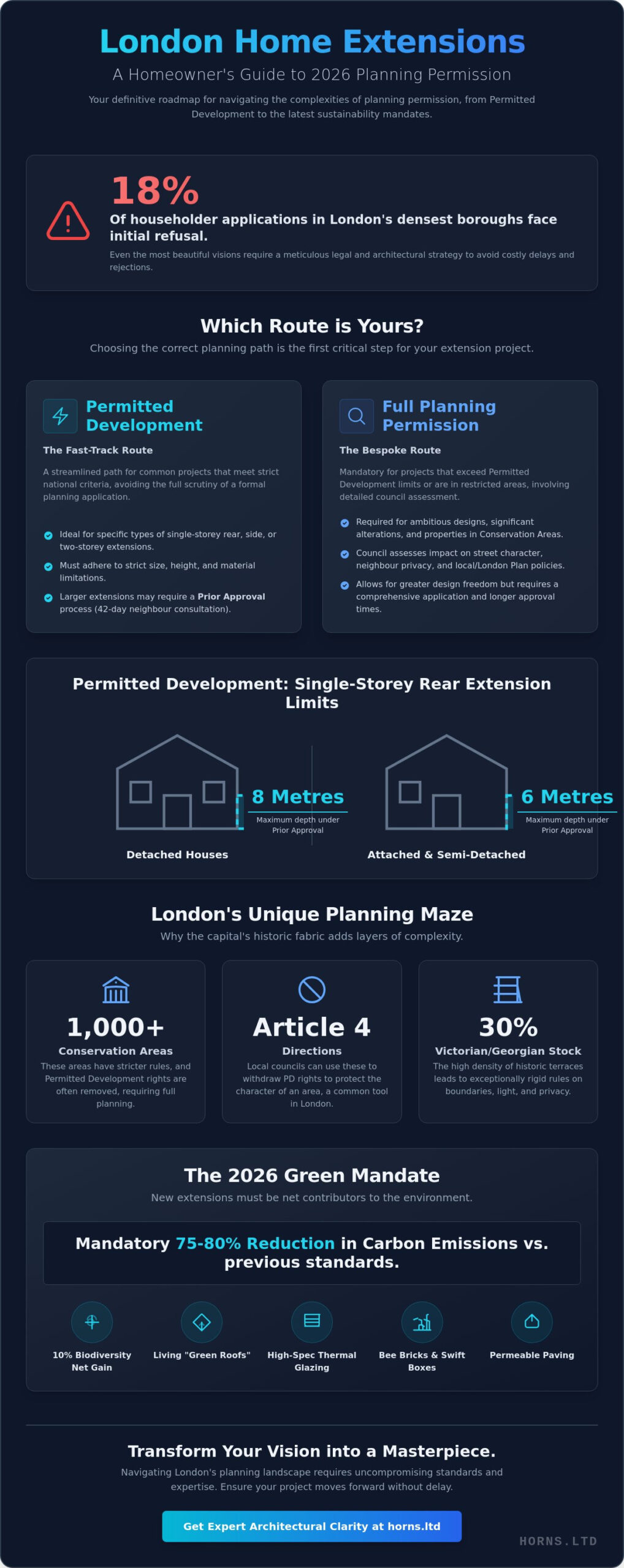
What if the most significant obstacle to your home’s evolution isn’t the structural engineering, but the intricate web of local council regulations? You’ve likely spent months dreaming of a sanctuary defined by architectural precision and a seamless flow of light, yet the prospect of a rejection letter or a neighbor’s formal objection feels like an insurmountable shadow. In 2024, approximately 18% of householder applications in London’s densest boroughs faced initial refusal, proving that even the most beautiful visions require a meticulous legal strategy. It’s natural to feel overwhelmed by the subtle, often frustrating distinctions between Permitted Development and the formal requirement for planning permission for extension london in 2026.
This guide offers the expert architectural clarity you require to navigate these complexities with the same uncompromising standards you apply to your home’s aesthetics. We’ll provide a definitive roadmap through the application process, detailing specific size limits and strategic insights to ensure your project moves forward without delay. You’ll gain the confidence to transform your current residence into a bespoke masterpiece that respects both the heritage of your street and your personal desire for excellence.
Key Takeaways
- Navigate the 2026 planning landscape by aligning your vision with the latest “Good Growth” and sustainability standards mandated by London’s borough councils.
- Determine whether your project qualifies for the Permitted Development fast-track or requires full planning permission for extension london, particularly when navigating the Prior Approval process.
- Uncover the hidden constraints of London’s 1,000+ conservation areas and how Article 4 Directions can transform a routine extension into a delicate architectural challenge.
- Learn how to bridge the gap between technical structural surveys and high-end aesthetic value through a meticulous, step-by-step application strategy.
- Gain the confidence to approach local planning officers by leveraging twenty years of London-specific expertise to ensure your home remains a timeless masterpiece.
The 2026 Landscape of Planning Permission for Extensions in London
Planning permission for extension london represents the formal bridge between an architectural vision and civic responsibility. It’s the mandatory consent required from your local borough council before any significant structural metamorphosis occurs on your property. This regulatory framework finds its legal foundation in the Town and Country Planning Act 1990, a piece of legislation that ensures every addition to the city’s skyline respects the collective aesthetic and functional harmony. By 2026, this process has evolved into a sophisticated evaluation of “Good Growth.” The London Plan now dictates that every square meter of new residential space must justify its existence through superior craftsmanship and environmental stewardship.
Obtaining
planning permission for extension london
in 2026 is no longer a mere box-ticking exercise. It’s a commitment to the city’s longevity. Councils now scrutinize applications through the lens of the latest London Plan revisions, which prioritize sustainable densification. If your design doesn’t harmonize with the existing character of the street while offering a clear benefit to the local ecosystem, approval remains elusive. This shift reflects a move away from generic “box” extensions toward bespoke structures that embody both technical precision and artistic intent.
Why London is a Unique Planning Environment
London’s architectural fabric is a dense, historical tapestry. Victorian and Georgian terraces comprise approximately 30% of the city’s housing stock, creating a high-density environment where boundary rules are exceptionally rigid. Many of these modern constraints originated from the 1666 Great Fire of London, which necessitated strict rules regarding party walls and fire-resistant materials that still influence contemporary designs. Local councils interpret national guidelines with distinct nuances. For instance, the London Borough of Hammersmith & Fulham often enforces stricter “outlook” and “overshadowing” rules than other boroughs to protect the privacy of neighboring Victorian villas.
2026 Sustainability and Biodiversity Requirements
The 2026 planning landscape is defined by the rigorous Part L updates of the Building Regulations, which mandate a 75% to 80% reduction in carbon emissions compared to previous standards. Extensions must now function as high-performance envelopes. Furthermore, the “Urban Greening Factor” (UGF) has become a critical metric for residential applications. You’ll likely need to prove a 10% Biodiversity Net Gain (BNG) on your plot, even for modest rear extensions. This might involve:
- Integrating living “green roofs” to manage rainwater runoff.
- Installing high-specification thermal glazing that exceeds 2025 efficiency benchmarks.
- Providing “bee bricks” or swift boxes to support local wildlife corridors.
- Implementing permeable paving to mitigate the increasing risk of flash flooding in urban basins.
Your 2026 application must demonstrate that the extension is a net contributor to the environment, rather than a drain on local resources.
Permitted Development vs. Full Planning: Which Route is Yours?
Selecting the right regulatory path for your London home requires the same level of discernment as choosing a bespoke audio system. Understanding the nuances of planning permission for extension london is the first step toward a successful build. Permitted Development (PD) offers a streamlined trajectory for specific architectural enhancements, acting as a structured framework for those seeking efficiency without compromising on structural integrity. For many homeowners, this route avoids the exhaustive scrutiny of a full application by following the official government guidance on planning permission, provided the project adheres to strict national criteria.
Larger single-storey rear extensions, reaching up to 8 metres for detached houses or 6 metres for semi-detached properties, fall under the Prior Approval scheme. This isn’t a guarantee of success; it’s a 42-day consultation period where the local authority assesses the impact on neighbouring light and privacy. Once the project is complete, you must secure a Lawful Development Certificate (LDC). This document serves as definitive proof that your project was legal at the time of construction, an essential asset when the property eventually changes hands.
The Limits of Permitted Development in London
PD rights aren’t universal. They vanish for flats, maisonettes, and the 600+ conservation areas across the capital. The 50% rule is absolute; you can’t cover more than half the land around the original house with new structures. Height is equally restricted, as extensions cannot exceed the highest part of the existing roof. If you’re planning a side extension, it must not exceed half the width of the original dwelling. Materiality is a legal cornerstone. To qualify for PD, the external finish must match the existing house’s aesthetic, ensuring a seamless, albeit conservative, integration.
When a Full Planning Application is Unavoidable
If your vision involves a wraparound extension or a bold two-storey addition that challenges the existing roofline, you’ll need to seek full planning permission for extension london. This path is necessary when the design departs from the traditional. If you’re introducing charred timber or industrial glass that contrasts with 19th-century London brickwork, the local council must weigh the architectural merit against the street scene. These bespoke projects require a delicate balance of engineering and artistry. For those seeking a truly uncompromising living space, consulting with specialists ensures every detail aligns with both your aesthetic desires and local regulations.
London’s Conservation Areas and Article 4 Directions
London is a mosaic of history, containing over 1,000 designated conservation areas that protect the city’s architectural soul. If your home resides within these boundaries, the standard rules of permitted development often vanish. Local authorities use Article 4 Directions to strip away “automatic” rights, ensuring that even minor changes don’t erode the character of a neighborhood. Securing planning permission for extension london in these zones requires more than a technical drawing; it demands a deep respect for the original builder’s intent.
Planners focus their scrutiny on the tactile details. They examine the profile of a window frame, the specific bond of the masonry, and the silhouette of a roofline against the London sky. At Horns Construction, we view these heritage constraints through the lens of artisanal precision. We don’t see regulations as obstacles. Instead, we treat them as a framework for excellence, ensuring every new brick and glass pane harmonizes with the existing structure’s timeless elegance.
Navigating Borough-Specific Restrictions
The path to approval varies significantly between the Royal Borough of Kensington and Chelsea and the suburban reaches of Ealing. Each council maintains its own set of aesthetic commandments. For those in West London, documents like the “Ealing Suburban Design Guide” are essential reading. These guides dictate the massing and scale of your project to prevent “terracing” effects that crowd the streetscape. You must also navigate the “Right to Light” and privacy concerns. London’s density means your extension cannot unfairly overshadow a neighbour’s garden or peer into their private quarters. We manage these delicate balances by using 3D sunlight modeling to prove your design respects the surrounding community.
Working with Listed Buildings
There’s a fundamental distinction between standard planning permission and Listed Building Consent. If your home is Grade II or Grade I listed, the interior is as protected as the exterior. You cannot simply knock through a wall or replace a floor without explicit permission. This is why structural engineering must be part of your design conversation from day one. We believe in the value of pre-application advice from council heritage officers. Engaging these experts early in the process reduces the risk of rejection and ensures your vision aligns with the statutory duty to preserve the building’s fabric. It’s a meticulous process, but the result is a home that functions as a modern sanctuary while remaining a piece of living history.
Our approach mirrors the philosophy of high-end acoustic engineering. Just as a master-crafted speaker must balance technical frequency with emotional resonance, a London extension must balance modern living with historic integrity. We don’t build mass-market additions. We create bespoke architectural statements that stand as a testament to quality and enduring value. Every project is an opportunity to prove that planning permission for extension london is achievable when you lead with uncompromising craft and engineering rigour.
The Application Process: From Architectural Vision to Approval
Transforming a London residence into a bespoke sanctuary requires the same precision as tuning a high-fidelity instrument. The journey to securing planning permission for extension london is a calculated sequence of technical mastery and diplomatic finesse. It begins with the creation of the technical soul of your project: the architectural drawings. You must commission a structural survey and detailed 1:100 scale elevations that respect the existing fabric of the building while introducing modern functionality. These documents serve as the definitive record of your intent.
The second stage involves the pre-application phase. This is an optional but vital investment where you present initial concepts to local planning officers. In boroughs like Westminster or Kensington and Chelsea, this dialogue can identify potential heritage or massing issues before they become costly roadblocks. Once refined, your project moves to formal submission via the Planning Portal. This digital gateway requires a suite of London-specific reports, from fire safety statements to biodiversity impact assessments. Following submission, a statutory 8-week determination period begins. During this time, a 21-day public consultation allows the community to review your vision, while the planning officer evaluates the proposal against the London Plan 2021 and local supplementary guidance.
The Anatomy of a Successful Planning Pack
A successful application is a narrative of architectural integrity. Your pack must include precise location plans and block plans that sit alongside existing and proposed elevations. The Design and Access Statement (DAS) acts as the voice of the project; it explains the “why” behind your aesthetic choices. For 2026, London councils increasingly scrutinize sustainability statements and heritage impact assessments. If your home sits within one of London’s 600 conservation areas, your pack must demonstrate how the extension preserves the character of the neighborhood. Every detail, from the choice of brick bond to the thermal efficiency of the glazing, must reflect a commitment to quality.
Managing Neighbour Relations and Objections
The technical approval of the council is only one half of the equation. The Party Wall Act 1996 governs how your construction interacts with shared boundaries; it’s a legal requirement separate from planning permission. Smart homeowners conduct a “neighbourly consultation” before the official council letters arrive. This transparency often prevents formal objections that can trigger a Planning Committee hearing. If your local council refuses the application, you have a 6-month window to lodge an appeal with the Planning Inspectorate. Success in these cases often hinges on technical nuances and the ability to prove that your design enhances the local urban fabric. Navigating the complexities of planning permission for extension london requires a partner who understands architectural harmony and the value of a perfectly executed plan.
Horns Construction: Merging Architectural Vision with Planning Success
Two decades of dedicated service in the London property market have taught us that an extension is far more than an additional room. It’s a symphony of engineering precision and artistic expression. Our 20 years of experience serve as your most potent asset when navigating the complexities of the capital’s planning departments. We understand that securing planning permission for extension london requires a delicate balance between ambitious design and the rigid constraints of local authority guidelines. By treating every project as a masterpiece of functionality, we present councils with proposals that respect the urban fabric while delivering uncompromising luxury.
Our methodology begins at RIBA Stage 0. We believe the seeds of a successful build are sown long before the first brick is laid. This early involvement allows us to orchestrate a process where technical feasibility and aesthetic value coexist. We manage every detail, from initial site appraisals to the final handover, ensuring the transition from paper to property is flawless. This holistic oversight transforms the stress of construction into a curated experience for the homeowner. We don’t just build structures; we create enduring legacies that enhance the architectural heritage of London.
A Design-Build Synergy for London Homes
The traditional disconnect between architects and builders often leads to “unbuildable” approvals. Designs that look stunning on a screen can prove structurally impossible or prohibitively expensive once on-site. At Horns Construction, our design-build synergy eliminates this friction. By involving our construction experts during the design phase, we ensure that every curve and corner is grounded in structural reality. This approach is particularly vital when integrating bespoke house extensions with full home refurbishments. We specialize in crafting spaces that respect the historic soul of Victorian or Edwardian terraces while introducing the sharp, clean lines of modern high-end living. Our team ensures that your planning permission for extension london application reflects a project that is both visionary and viable.
Your Next Steps with Horns Construction
Your journey toward a transformed home begins with a detailed feasibility study. For homeowners in West London, we offer an exhaustive analysis of your property’s potential, identifying opportunities that others might overlook. We provide comprehensive quotes that encompass everything from planning consultancy to the procurement of premium structural materials. There are no hidden costs, only a transparent path to excellence. Our commitment to artisanal quality means we only take on projects where we can guarantee a result that meets our exacting standards. Start your journey toward a bespoke London extension today by contacting our team for a consultation. Let’s build a space that resonates with your lifestyle and stands as a testament to timeless elegance.
Mastering the Art of Your 2026 London Extension
Navigating the intricate landscape of planning permission for extension london requires a delicate balance between ambitious architectural vision and the rigorous demands of municipal regulations. In 2026, the distinction between Permitted Development and Full Planning remains a critical pivot point for any homeowner. Success in London’s strictly protected Conservation Areas depends on an uncompromising attention to detail and a deep respect for heritage. It’s not merely about obtaining a permit; it’s about ensuring your home’s evolution is both technically flawless and aesthetically profound.
Horns Construction brings 20+ years of West London building expertise to every project we undertake. As specialists in high-end residential refurbishments, we provide comprehensive project management that bridges the gap between design and completion. We understand that a home is a sanctuary, requiring a level of craftsmanship that transcends the ordinary. Our team ensures that your architectural aspirations are met with engineering precision at every stage of the application process. Consult with Horns Construction for your bespoke London extension to begin crafting a living space that reflects your unique lifestyle and commitment to quality. Your journey toward a transformed residence starts with a partner who values perfection as much as you do.
Frequently Asked Questions
Do I need planning permission for a 3-metre rear extension in London?
You typically don’t need planning permission for a 3-metre rear extension in London if your property is a house and falls under Permitted Development rights. For terraced or semi-detached homes, this 3-metre limit is a standard threshold, while detached houses can often extend to 4 metres without a formal application. It’s vital to remember that flats and maisonettes don’t enjoy these rights, meaning any addition requires a full submission to your local council.
How much does planning permission cost for an extension in London in 2026?
A standard householder application for planning permission for extension London projects currently carries a statutory fee of £258. By 2026, these government-mandated costs may reflect inflationary adjustments, though the primary expense remains the professional fees for architectural drawings and technical surveys. You should budget between £2,500 and £6,000 for a comprehensive design package that meets the meticulous standards required by London planning officers.
How long does it take to get planning permission in London?
Most London boroughs aim to issue a decision within 8 weeks of your application being validated by the planning department. Complex projects or those within high-density boroughs like Camden or Islington might face administrative backlogs, occasionally stretching the timeline to 12 weeks. Approximately 82% of householder applications are decided within these statutory windows, provided the initial documentation is flawless and requires no major revisions.
Can my neighbours stop me from building an extension in London?
Neighbours cannot unilaterally stop your project, but they can submit formal objections during the mandatory 21-day public consultation period. The local authority only considers material considerations, such as loss of privacy, overshadowing, or significant impact on local character. While objections from neighbours are common, they rarely lead to a total refusal if your design adheres to the Supplementary Planning Documents (SPD) of your specific borough.
What is the “Prior Approval” process for London extensions?
The Prior Approval process allows homeowners to build larger single-storey rear extensions up to 6 metres for terraced houses or 8 metres for detached properties. You must notify the council of your intent, and they’ll contact your immediate neighbours to ensure no valid concerns regarding the impact on their light or privacy exist. If no objections are raised within 21 days, the council usually grants approval for these larger footprints under the Larger Home Extension scheme.
Do I need a structural engineer before applying for planning permission?
You don’t strictly need a structural engineer for the initial planning permission phase, as the council focuses on the aesthetic and volumetric impact of your design. However, engaging a specialist early ensures your vision is technically feasible before you commit to the full application process. Most London homeowners commission structural calculations immediately after planning is granted to satisfy Building Regulations, which is a separate legal requirement for all construction work.
What happens if I build an extension in London without planning permission?
Building without the necessary consent triggers an enforcement notice from the local authority, which can legally mandate the total demolition of the new structure. While you can attempt to secure retrospective planning permission, there’s absolutely no guarantee the council will approve an existing build that flouts local guidelines. Failure to comply with an enforcement notice is a criminal offence that can result in unlimited fines and a permanent mark on the property’s legal title.
Is it harder to get planning permission in a London conservation area?
Securing planning permission for extension London builds is considerably more complex within the city’s 1,000+ conservation areas where Article 4 directions often apply. These regulations strip away standard Permitted Development rights to protect the historical integrity and architectural rhythm of the streetscape. Your application must demonstrate that the materials, such as reclaimed London stock brick or bespoke timber joinery, harmonise perfectly with the existing heritage fabric of the neighbourhood.