
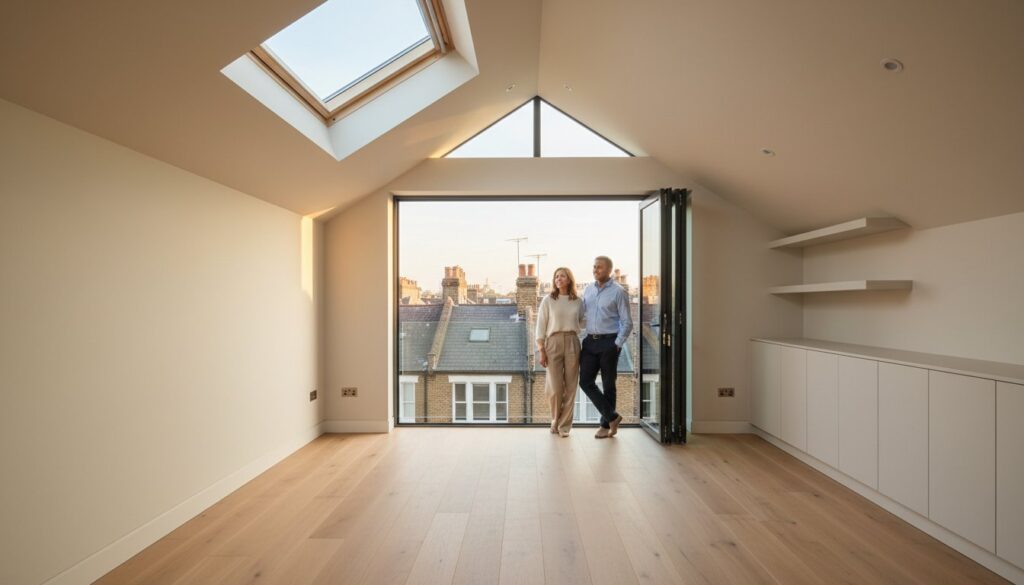
What if the most exquisite potential of your London residence lies not in the rooms you currently inhabit, but in the silent, unrefined sanctuary gathering dust beneath your rafters? You likely feel that expanding your home should be an act of creative liberation, yet the looming shadow of council enforcement and the complex arithmetic of volume limits often stifle that ambition. It’s a common frustration to feel trapped between the desire for more space and the administrative weight of the planning system.
Understanding the permitted development rights for loft conversions uk is the key to unlocking this hidden value with the precision of a master craftsman. This 2026 guide provides the absolute clarity you need to navigate the strict 40 cubic metre limit for terraced houses and the 50 cubic metre allowance for detached properties. You’ll gain the confidence to initiate your project while ensuring every detail aligns with local borough restrictions. We will explore how to secure a Lawful Development Certificate to protect your home’s future resale value and transform your vision into a lasting architectural legacy.
Key Takeaways
- Navigate the complexities of London’s planning landscape by leveraging Permitted Development as an implied grant of permission, elegantly bypassing the delays of traditional committee reviews.
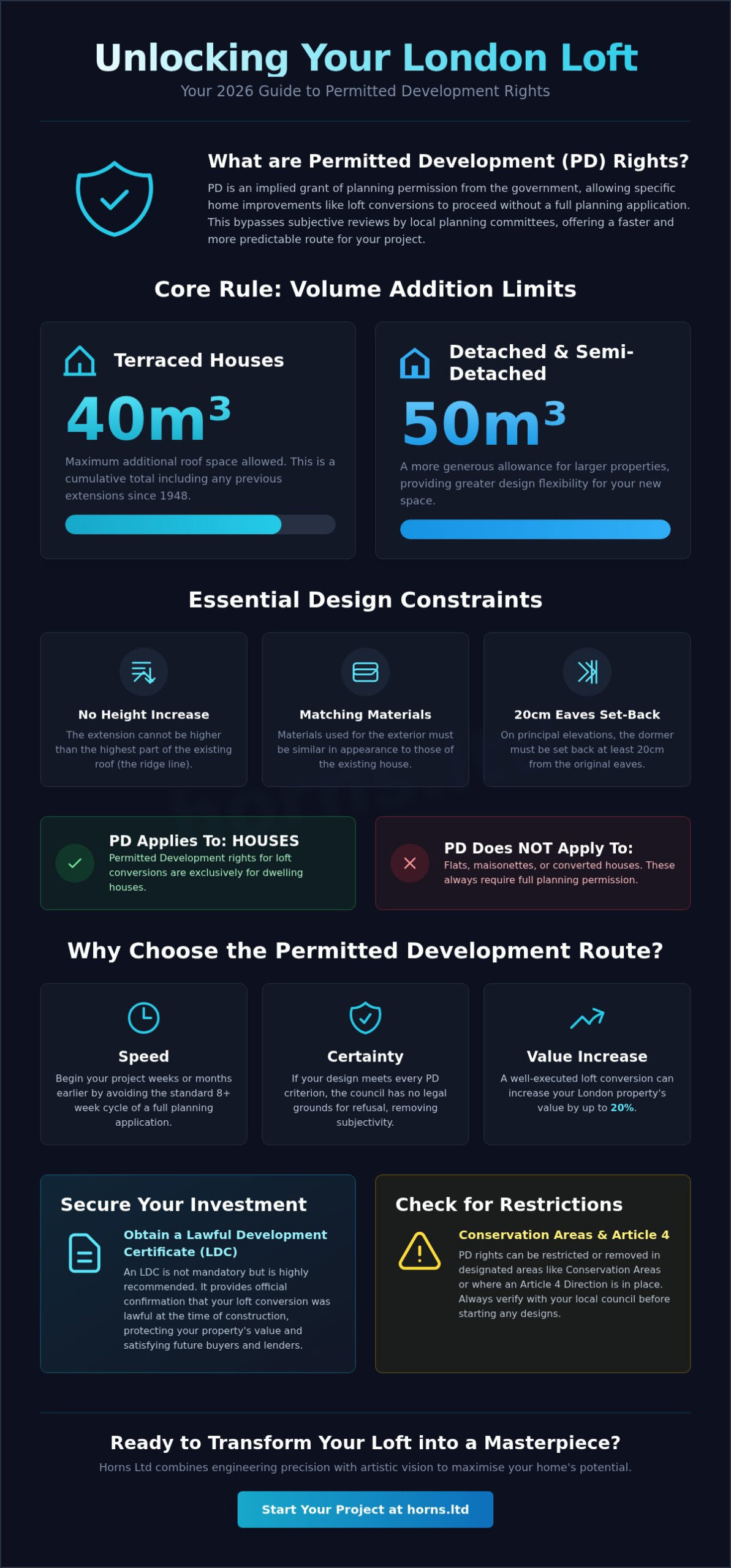
- Master the technical volume thresholds—40m³ for terraces and 50m³ for detached homes—to stay within the legal limits of permitted development rights for loft conversions uk.
- Identify the subtle constraints of Conservation Areas and Article 4 directions to ensure your home’s transformation respects local heritage while avoiding unforeseen legal restrictions.
- Secure your long-term investment by obtaining a Lawful Development Certificate, providing the essential certification required to validate your property’s value and craftsmanship to future buyers.
- Discover how Horns Ltd harmonises engineering precision with artistic vision, transforming a standard loft into a light-filled masterpiece of bespoke architectural design.
The Fundamentals of Permitted Development for London Lofts
Permitted Development (PD) represents a sophisticated legal instrument, an implied grant of planning permission bestowed by the General Permitted Development Order. It bypasses the arduous requirement for a full planning application for specific types of home improvements. For homeowners of period terraces in West London, this route offers a sanctuary from the often unpredictable whims of local planning committees. By adhering to a strict set of national criteria, you ensure your project remains outside the subjective debates of local councillors. The evolution of Loft conversions in the United Kingdom has seen PD become the primary vehicle for high-end residential expansion, particularly in conservation-conscious boroughs.
As we move through 2026, national policy remains steadfast in its commitment to densification. The government continues to encourage upward extensions as a method to maximise urban footprints without encroaching on the Green Belt. While permitted development rights for loft conversions uk provide the legal freedom to build, they don’t exempt you from technical scrutiny. You must distinguish between planning permission and Building Regulations. Planning permission concerns the external appearance and impact on neighbours, whereas Building Regulations are a non-negotiable set of safety and performance standards. These regulations ensure structural integrity, fire safety, and thermal efficiency, regardless of whether your project required a full planning application.
Why Permitted Development Matters in 2026
Speed is the most immediate advantage of the PD route. You can typically begin your project weeks earlier than those stuck in the full planning cycle, which often stretches beyond the statutory eight-week period due to backlogs. There’s an inherent certainty to this path. If your design meticulously meets every national criterion, the local council possesses no legal grounds for refusal. This predictability is vital for high-stakes investments in areas like Chiswick or Ealing. In these high-demand postcodes, adding a master suite via a loft conversion can increase property value by up to 20% according to recent market data. It’s an investment in both lifestyle and capital, executed with surgical precision.
The Legal Framework: Houses vs. Flats
It’s vital to recognize that permitted development rights for loft conversions uk apply exclusively to houses. Flats, maisonettes, and even some converted houses don’t enjoy these rights, meaning owners must always seek full planning permission. Within the PD framework, we focus on two specific categories. Class B covers additions to the roof that increase the volume, such as rear dormers or hip-to-gable extensions. Class C pertains to other alterations, such as the installation of flush rooflights that don’t protrude more than 150mm from the roof plane. A Lawful Development Certificate serves as the ultimate proof of compliance, providing a legal guarantee that your conversion was built within the law at the time of construction.
The Technical Limits: Navigating the 40m³ and 50m³ Rules
Transforming a London attic into a refined living space is an exercise in architectural poise. To maintain the structural harmony of the city’s diverse streetscapes, the permitted development rights for loft conversions uk dictate strict volume limitations that homeowners must respect. For terraced properties, the additional roof space must not exceed 40 cubic metres. Semi-detached and detached homes enjoy a slightly more generous allowance of 50 cubic metres. These figures represent the total cumulative increase, meaning any historical additions since 1948 are subtracted from your current potential.
The peak of your new creation cannot rise above the highest part of the existing roofline. This ensures the silhouette of the building remains respectful to its heritage. Materials must mirror the original house, creating a seamless visual transition rather than a jarring contrast. Precision is also paramount with the 20cm set-back rule. This requires the edge of the extension to sit at least 20cm back from the original eaves, measured along the roof slope. It’s a common point of failure in planning applications because even a minor deviation can render the entire project unlawful.
Calculating Your Volume Allowance
To calculate the volume of a standard dormer, you can use the formula: (Width x Height x Depth) / 2. This provides the cubic capacity of the triangular prism added to the roof. Always measure from the “original” house, defined as the property’s state on 1 July 1948 or when it was first built. If a previous owner added a small extension in 1995, that volume already counts against your 40m³ or 50m³ limit. For more nuanced details on specific roof shapes, consult the official government technical guidance to avoid costly miscalculations.
Aesthetic and Structural Constraints
True elegance excludes balconies and verandas; these are strictly prohibited under PD rules. Side-facing windows must feature obscure glazing to protect privacy, and any opening frames must be positioned at least 1.7 metres above the floor level. These regulations on House Extensions in London often intersect with loft designs, requiring a holistic architectural approach. Every detail, from the glass opacity to the frame finish, contributes to the final masterpiece. If you seek a space that transcends the ordinary, consider how a bespoke architectural vision can harmonise these strict rules with your lifestyle.
When PD Fails: Conservation Areas and Article 4 Directions
London’s architectural landscape is a masterpiece of historical layers, but this heritage often places a sophisticated barrier between a homeowner and their vision. While the national framework provides a generous baseline, thousands of properties across the capital operate under restricted permitted development rights for loft conversions uk due to local protective measures. In boroughs where Victorian and Edwardian terraces define the local character, the aesthetic integrity of the streetscape is guarded with uncompromising precision. This means your right to extend may be suspended to ensure that any modification respects the original craftsmanship of the building.
The most common hurdle is the Article 4 Direction. This is a legal mechanism where a local planning authority withdraws specific permitted development rights in a defined area. It doesn’t signify a prohibition of work; rather, it requires a full planning application for changes that would otherwise be automatic. According to Historic England, London contains over 600 conservation areas, and in high-value enclaves like Kensington or Chelsea, these directions are the standard, not the exception. Before committing to a design, obtaining a Certificate of Lawfulness is a non-negotiable step. This document serves as your legal shield, confirming that your proposed works are allowed and protecting the future resale value of your home.
London’s Conservation Area Map
In West London, particularly within Fulham, Hammersmith, and Richmond, the density of conservation areas creates a complex regulatory environment. These neighborhoods are often classified as “Designated Land” under Schedule 1, Part 2 of the General Permitted Development Order. On such land, the rules for dormers change significantly. You cannot rely on the standard volume allowances if the extension involves the “principal elevation,” which is the front-facing side of the property. Local councils almost always require that the street-facing roofline remains untouched to preserve the rhythmic elegance of the terrace. For the most accurate technical limits, homeowners should consult the official permitted development guidance provided by the government’s Planning Portal.
Navigating Article 4 Restrictions
If your street is subject to an Article 4 Direction, the strategy must shift from a volume-based approach to one of architectural merit. This transition requires a deeper focus on material quality and structural harmony. When permitted development rights for loft conversions uk are removed, the council evaluates your proposal based on how it contributes to the local aesthetic. This is where high-quality design becomes your greatest asset. Success in restricted areas often depends on using traditional materials, such as Welsh slate or handmade lead flashing, to match the existing fabric. Evidence suggests that even in the most restrictive boroughs, a design that demonstrates technical precision and respect for heritage often wins approval. You aren’t just adding a room; you’re refining a piece of London’s history.
Securing Your Investment: Lawful Development Certificates
A loft conversion is more than an expansion of square footage; it is a meticulous refinement of your home’s architectural legacy. While permitted development rights for loft conversions uk provide the legal framework for these transformations, the Lawful Development Certificate (LDC) serves as your definitive proof of compliance. In the sophisticated London property market of 2026, a “handshake agreement” with a builder is insufficient. Savvy buyers and institutional lenders now demand an LDC to confirm that the work was performed within the strict parameters of the law. Without this document, you risk complications during future surveys or even enforcement action if regulations were misinterpreted.
The LDC Application Process
The journey toward securing an LDC begins with architectural precision. You must gather existing and proposed drawings that reflect every millimeter of the intended change. These aren’t mere sketches; they are technical blueprints that demonstrate your project adheres to volume limits and height restrictions. Once these are ready, you’ll submit your application through the Planning Portal. In 2026, the typical turnaround for a decision remains approximately 8 weeks. During this period, London planning officers may issue “Requests for Information” (RFIs). Handling these requires a calm, professional response. Providing detailed data quickly prevents the clock from resetting and ensures your project remains on its precise schedule.
Building Regulations vs. Planning
It is a common misconception that a planning approval covers the safety of the build. It doesn’t. While planning concerns the “what” and “where,” Building Control focuses on the “how.” This is where the technical soul of the project comes alive. You must address fire safety, thermal insulation, and the structural integrity of the new floor. A structural engineer is indispensable here; they calculate the exact load-bearing requirements to ensure the design is buildable and safe. Premium Construction Companies in London must manage both the planning nuances and the rigorous building control inspections to maintain a seamless workflow.
The process culminates in the “completion certificate.” This document is the final seal of quality, proving that the physical structure meets every modern safety standard. When you combine this with the LDC, you create a comprehensive legal and technical package that protects your investment for generations. This level of detail reflects a commitment to excellence that goes beyond simple renovation; it is the hallmark of a truly well-considered home. If you are ready to elevate your living space with uncompromising quality, consult with the experts at Horns Ltd. to begin your transformation.
Architectural Excellence: How Horns Construction Maximises Your Loft
At Horns Ltd, we don’t view a loft conversion as a mere extension of square footage. We treat it as a structural masterpiece where engineering precision meets an uncompromising artistic vision. Our approach transforms the often-rigid framework of permitted development rights for loft conversions uk into a bespoke sanctuary. In West London neighbourhoods like Chiswick and Ealing, we’ve delivered projects that turn dark, cramped attics into expansive suites flooded with natural light. By managing the legal complexities and the physical build under one roof, we ensure that the initial design’s poetic intent remains intact through to the final structural joint.
The design-build advantage means you won’t face the friction between an architect’s dream and a builder’s reality. We handle the technical calculations and the craft simultaneously. This unified workflow is vital for projects in 2026, where homeowners demand both speed and artisanal quality. We’ve seen properties increase their usable volume by up to 50 cubic metres without ever needing a full planning application, provided the design respects the specific constraints of the local authority.
Bespoke Design Within Legal Boundaries
Adhering to the “similar appearance” rule doesn’t mean sacrificing modern aesthetics. We select premium materials, such as hand-finished zinc or reclaimed London stock brick, to ensure the exterior respects the streetscape while the interior feels avant-garde. Our engineers focus on clever structural steel placement to reclaim every millimetre of internal head height. This technical rigour is essential for Mastering Home Refurbishment in London, where vertical space is the ultimate luxury. We prioritise the flow of light through oversized Velux windows or bespoke Juliet balconies that stay within the permitted development rights for loft conversions uk.
The Horns Construction Commitment
Our 20-year history in London’s construction sector has taught us that quality is non-negotiable. We don’t cut corners on structural integrity or acoustic insulation. Every joint and finish is a testament to our craftsmanship. We understand that your home is an investment in your lifestyle, requiring a partner who values durability as much as design. Whether you’re in a Victorian terrace or a 1930s semi-detached, our team navigates the nuances of the planning landscape to unlock hidden potential.
Ready to redefine your living space? The journey begins with a technical site survey. Our experts will assess your roof pitch and ridge height to confirm exactly what’s possible under current 2026 regulations. Contact Horns Construction for a London Loft Consultation to start your property’s transformation with a team that views construction as an art form.
Elevating Your London Horizon with Architectural Precision
Transforming a London roofline requires more than just construction; it demands a deep respect for both technical boundaries and aesthetic potential. Navigating the permitted development rights for loft conversions uk involves mastering the strict 40m³ or 50m³ volume limits while ensuring every structural detail aligns with 2026 regulations. A Lawful Development Certificate remains the definitive shield for your investment, providing the legal certainty that your refined new space stands beyond reproach. It’s the difference between a simple extension and a permanent architectural legacy.
Horns Construction brings 20+ years of London building expertise to your doorstep, treating every project as a unique piece of functional art. We provide fixed-price quotes for large-scale conversions, ensuring your vision remains uncompromised by hidden costs. From the initial design sketches to the final completion, our team provides full project management to maintain the highest standards of craftsmanship. Your home deserves a transition that’s as seamless as it is spectacular. Book your expert West London loft survey with Horns Construction and begin the journey toward a space that resonates with timeless quality and engineering excellence.
Frequently Asked Questions
Do I need planning permission for a loft conversion in London in 2026?
In 2026, most London homeowners don’t require full planning permission if their project adheres to specific permitted development rights for loft conversions uk. These rights allow for transformative architectural changes without the bureaucratic weight of a full application. You must ensure the design respects the 40 cubic metre limit for terraced houses or 50 cubic metres for semi-detached properties. This streamlined path ensures your pursuit of a refined living space remains uninterrupted by local council delays.
How much volume can I add to my loft under permitted development?
You can expand your home’s volume by 40 cubic metres for terraced properties or 50 cubic metres for semi-detached and detached houses. These precise limits are calculated based on the original roof space, excluding any previous additions made since 1948. Adhering to these dimensions is essential for maintaining the structural and legal integrity of your residence. It’s a technical boundary that allows for significant lifestyle enhancement while preserving the architectural harmony of the London streetscape.
Can I build a dormer on the front of my house under PD?
No, you cannot build a dormer on the principal elevation or any roof slope that faces a highway under permitted development. Any structural extension protruding from the front of your home requires a full planning application to ensure it aligns with local aesthetic standards. This regulation protects the visual continuity of London’s historic facades. Rear dormers remain the standard choice for those seeking to blend internal spaciousness with external discretion.
What is a Lawful Development Certificate and do I really need one?
A Lawful Development Certificate is a formal document issued by your local authority that proves your conversion was legal at the time of construction. While it’s not a mandatory requirement for the build itself, it’s indispensable when selling your property. 95% of buyers’ solicitors will request this proof during the conveyancing process. It acts as a definitive guarantee of your home’s architectural legitimacy and protects your investment from future legal challenges.
Does permitted development apply to flats or maisonettes in London?
Permitted development rights do not apply to flats, maisonettes, or other converted buildings within the London area. Owners of these residences must always submit a full planning application for any loft conversion or external structural change. This distinction ensures that high-density living environments are managed with greater oversight regarding shared structural integrity and light rights. Every detail must be meticulously approved by the council to maintain the delicate balance of urban living.
How high can my loft conversion be under permitted development rules?
Your new loft conversion cannot exceed the height of the highest part of your existing roof. This rule ensures the silhouette of your home remains consistent with its original design and the surrounding neighbourhood. Maintaining this vertical limit is a non-negotiable aspect of permitted development rights for loft conversions uk. It forces a focus on internal spatial efficiency and handcrafted precision rather than simply adding raw height to the structure.
What happens if I build a loft conversion without planning permission or an LDC?
Building without the correct permissions can lead to an enforcement notice from your local council, which may require you to demolish the entire structure at your own expense. Beyond the physical loss, the lack of an LDC can decrease your property’s marketability by 10% or more. Financial penalties vary, but the stress of legal remediation often outweighs the cost of initial compliance. True craftsmanship deserves the security of a solid legal foundation to ensure its longevity.
Can I use permitted development in a London conservation area?
Permitted development rights are strictly limited or entirely removed in London’s 600+ conservation areas to protect their unique heritage. You’ll almost certainly need to apply for full planning permission for any visible changes to the roofline. This process demands a higher level of architectural sensitivity and a commitment to using premium, traditional materials. It ensures that every addition contributes to the timeless elegance and historical narrative of the local environment.