
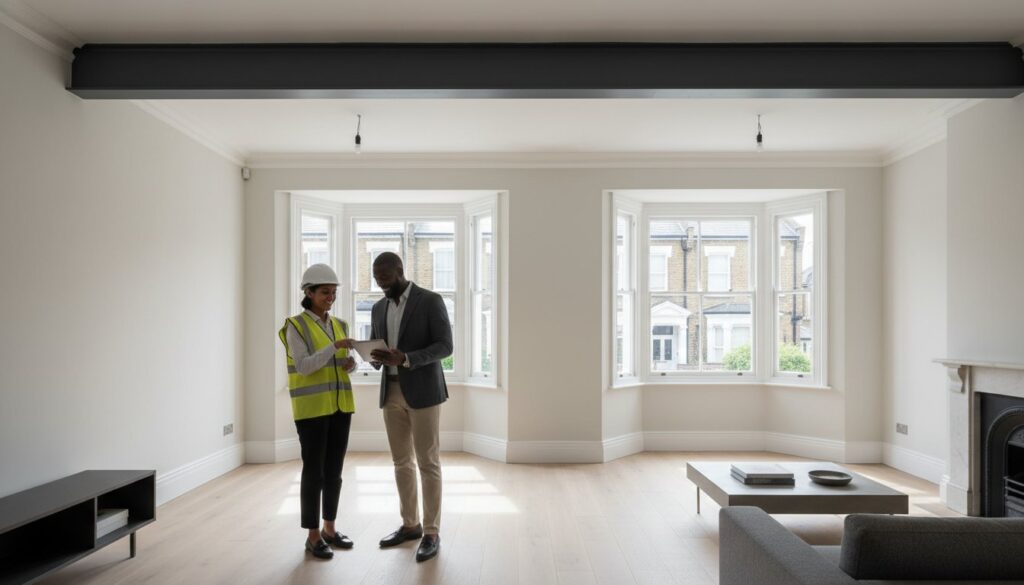
In March 2025, a homeowner in an Islington Victorian terrace discovered that removing what appeared to be a simple partition led to a structural shift of 12mm in the floor above, an oversight that cost £14,000 to remediate. You likely recognize that creating an open, fluid living space is an act of architectural artistry, yet the anxiety of structural instability or a missing completion certificate often halts the most inspired visions. Mastering the building regulations for internal wall removal uk is not merely a bureaucratic hurdle; it’s the essential foundation of a safe, uncompromising home transformation that preserves your property’s soul and its long term market value.
We’ll provide the technical precision and legal clarity required to transform your London residence with absolute confidence. This guide explores the 2026 structural requirements, the vital distinction between planning permission and building control, and the exact steps to secure your final certification. You’ll gain a comprehensive understanding of the engineering standards and safety protocols that ensure your renovation remains an enduring testament to quality and craftsmanship, allowing you to focus on the aesthetic harmony of your renewed space.
Key Takeaways
- Understand the essential legal distinction between Planning Permission and the mandatory building regulations for internal wall removal uk to ensure your London renovation remains fully compliant.
- Learn the engineering science used to identify load-bearing walls in London’s period properties, protecting your home’s structural integrity from the foundation to the rafters.
- Discover how to maintain critical 30-minute fire resistance and safe escape routes when transitioning to sophisticated open-plan configurations under Part B regulations.
- Navigate the London Building Control landscape by choosing the optimal application path—whether Local Authority or Private Inspector—tailored to your project’s unique requirements.
- Explore the Horns approach to structural precision, where meticulous engineering allows for flush ceiling finishes that preserve the architectural elegance of your home.
Understanding Building Regulations for Internal Wall Removal in 2026
Refining the interior of a London residence is an exercise in architectural precision. It requires a meticulous approach that balances aesthetic desire with structural reality. Obtaining approval under the building regulations for internal wall removal uk isn’t just a legal formality; it’s a commitment to the safety and longevity of your home. While planning permission concerns itself with how a building looks to the outside world, building control focuses on the invisible engineering that prevents a structure from collapsing. In 2026, these standards have become even more rigorous, reflecting a modern demand for uncompromising safety and technical excellence.
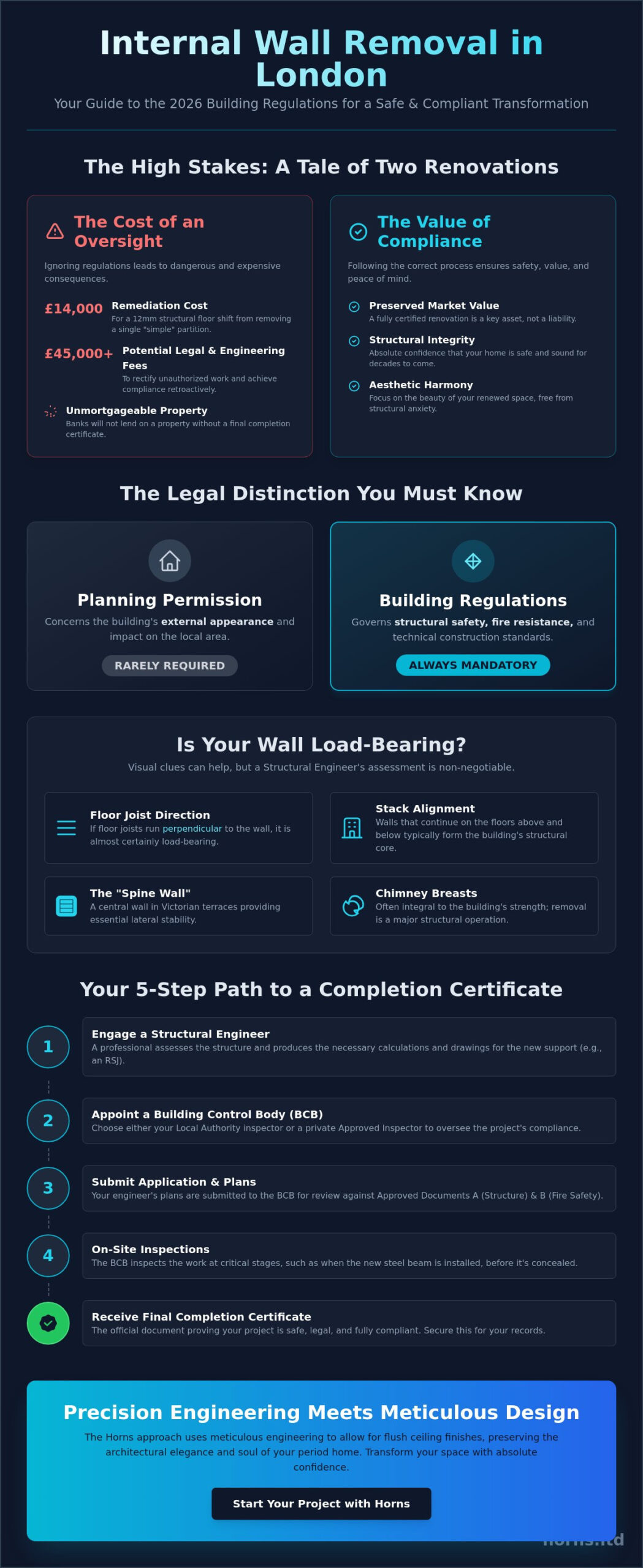
The 2026 regulatory landscape places a heavy emphasis on fire safety and structural redundancy. These updates ensure that if one element of a building fails, the entire structure doesn’t follow. Ignoring these mandates leads to catastrophic outcomes. Beyond the immediate physical danger, non-compliance renders a property unmortgageable. Banks simply won’t lend on homes lacking a final completion certificate. Rectifying unauthorized work often costs homeowners upwards of £45,000 in remedial engineering and legal fees. Understanding the Building Regulations in the United Kingdom is the first step toward an enduring, high-quality renovation.
Do I Need Approval for Every Wall?
Identifying the difference between a simple timber stud partition and a structural masonry wall requires a professional eye. You shouldn’t assume a wall is non-load-bearing just because it sounds hollow. The 2026 “Better Safe Than Sorry” rule suggests that even minor partitions need a check to ensure they aren’t providing vital lateral stability to the overall frame. Removing chimney breasts is particularly complex. These features are often part of the building’s core strength. Removing a supporting stack without a specific structural design is a dangerous gamble that no serious homeowner should take.
The Legal Framework: Approved Document A
Approved Document A serves as the technical blueprint for structural integrity in the UK. The 2026 revisions have introduced stricter specifications for structural steel (RSJ) sections, requiring higher load-bearing capacities to handle modern building materials and increased safety margins. Your project must be overseen by a Building Control Body (BCB). In London boroughs, these inspectors are the gatekeepers of quality. They verify that every calculation meets the building regulations for internal wall removal uk, ensuring that your home’s transformation is both beautiful and permanent.
Determining Structural Integrity: Is Your Wall Load-Bearing?
Engineering in a London period home is a delicate dance of forces, much like the balanced resonance of a high-end acoustic instrument. Understanding whether a wall is load-bearing requires more than a simple tap on the plaster. It demands an appreciation for how Victorian and Edwardian builders distributed weight across timber and masonry. To identify these critical elements, look first at the floor joists. If the timber beams run perpendicular to the wall, that partition is almost certainly supporting the floors above. You must also observe stack alignment; walls that repeat on every floor usually form the primary structural skeleton of the property.
A frequent danger in 19th-century builds is the “settled” partition. Over 140 years, a wall originally designed as a simple room divider can become structural as the house shifts. The weight of the roof or upper floor plates often transfers onto these timber-stud partitions, making their removal a high-risk operation without temporary propping. Consulting the Planning Portal guidance on internal walls provides a baseline for the legal requirements, but it doesn’t replace the sharp eye of a professional. For any high-end refurbishment where precision is the only acceptable standard, a Structural Engineer is a non-negotiable partner.
Specific Challenges in London Victorian Terraces
The “spine wall” is the silent hero of the London terrace, providing the lateral stability that keeps entire blocks standing. When homeowners seek to merge ground-floor double reception rooms, they often target this central artery. Opening this space requires more than just a beam; it requires an analysis of the 1880s brick footings. Installing a heavy steel without reinforcing the foundations can lead to point-load failure, where the concentrated weight crushes the original masonry beneath it.
The Structural Engineer’s Role
A Structural Engineer translates architectural vision into mathematical certainty. Their calculation report is a technical masterpiece that defines the exact load paths and deflection limits required to satisfy building regulations for internal wall removal uk. This document is what the local council or private inspector will scrutinize before signing off on your project. The engineer will specify the exact dimensions of the steel required, choosing between a standard Rolled Steel Joist (RSJ) or a Parallel Flange Channel (PFC) for areas where height is at a premium. An RSJ is the structural backbone of open-plan living. This meticulous planning ensures your home achieves a sense of uncompromising spatial harmony without risking the integrity of the building’s soul. Every calculation is a commitment to longevity and safety.
Beyond Structure: Fire Safety, Ventilation, and Part B
Creating an expansive, light-filled living space involves more than just calculating the load-bearing capacity of a new RSJ. When you alter the internal anatomy of a London property, you fundamentally change how heat, sound, and fire move through the building. Adhering to the building regulations for internal wall removal uk homeowners must follow ensures that your pursuit of aesthetic openness doesn’t compromise the safety of the inhabitants. Every modification to the layout triggers a chain reaction across different parts of the Building Regulations, from Part B (Fire Safety) to Part F (Ventilation).
A common oversight in open-plan designs is the disruption of the fire escape route. In a traditional multi-storey dwelling, the hallway and stairs act as a “protected corridor,” offering a 30-minute window of safety during an emergency. Removing the wall between a kitchen and a hallway can instantly dissolve this protection. To satisfy the official government guidance, you might need to install automated fire curtains or a high-pressure water mist system. These solutions provide an invisible yet potent layer of security without sacrificing the visual flow of your home.
Fire Safety and Protected Escape Routes
For three-storey London homes or those with loft conversions, the regulations are uncompromising. You can’t simply remove the door to the stairwell to create a “loft-style” vibe. If the stairs lead directly into an open-plan ground floor, you must implement compensatory measures. This often includes upgrading all doors on the upper floors to FD30 fire-rated specifications or installing a Grade D1 smoke alarm system. These technical requirements prevent the creation of “inner rooms,” where the only escape route is through another room that could be the source of a fire.
Thermal and Sound Insulation
Acoustic integrity is the soul of a refined home. When you remove a partition wall, you risk turning a peaceful sanctuary into an echo chamber. Part E of the Building Regulations mandates that internal modifications shouldn’t worsen sound transmission. This is particularly vital in London’s converted flats, where a minimum sound reduction of 40dB is often required between dwellings. Integrating high-density mineral wool or resilient bars during the refurbishment process ensures that your new layout preserves the acoustic silence essential for high-fidelity audio enjoyment. For a deeper dive into these technical nuances, explore our guide on Mastering Home Refurbishment in London, which places these regulations within the context of a total property transformation.
Ventilation is the final piece of the compliance puzzle. Removing a wall can leave a previously ventilated space without an external window or air brick. Under Part F, you must ensure that the new combined space retains adequate “purge ventilation.” This typically requires an opening area equal to 5% of the floor area. Neglecting this leads to stagnant air and condensation, undermining the premium environment you’ve worked so hard to create. Precise planning ensures that your home remains a breathable, safe, and acoustically perfect masterpiece.
The Application Process: Navigating London Building Control
Navigating the bureaucratic landscape of London building control is an exercise in precision, much like tuning a high-end acoustic instrument. You face a primary choice: Local Authority Building Control (LABC) or a Private Approved Inspector. While the local borough council offers a traditional path, many London homeowners in 2026 opt for private inspectors for their specialized focus and agile response times. For a structural change as significant as removing a load-bearing wall, the building regulations for internal wall removal uk mandate a clear, documented path to safety.
You must decide between a Full Plans application and a Building Notice. A Building Notice allows work to commence 48 hours after submission, yet it carries the risk of retrospective changes if the inspector finds faults. The Full Plans route is the connoisseur’s choice. It involves submitting detailed structural calculations weeks in advance, providing the peace of mind that your architectural vision is technically sound before the first hammer strikes. This method ensures that every steel beam and padstone meets the uncompromising standards required for both safety and future property value.
Step-by-Step Application Guide
The process begins with the appointment of a structural engineer and a specialist builder. Horns Construction handles this synergy with meticulous care, ensuring that engineering theory and physical craftsmanship align perfectly. Once your plans are prepared, you’ll submit them to your specific London borough, such as Hammersmith & Fulham. The council or inspector then conducts site visits at critical milestones. These typically include the initial “hole in the wall” to check temporary propping, the installation of the steel beam and padstones, and a final check on fireproofing and plastering. Only after these stages is the final completion certificate issued, a document as vital to your home as a certificate of authenticity is to a work of art.
The Party Wall Agreement
In the densely packed streets of London, structural work often touches a shared boundary. The Party Wall Act 1996 is a legal necessity when your wall removal involves cutting into a shared structure to insert a beam. You’re required to serve a Party Wall Notice to your neighbours at least two months before the scheduled start date. If a neighbour dissents, you’ll need to appoint a surveyor to create a Party Wall Award. This document records the condition of the neighbouring property and outlines how the work will proceed to prevent damage. For those considering more extensive modifications, our guide on House Extensions in London provides deeper insight into managing boundary regulations with elegance and legal certainty.
The Horns Approach: Engineering Precision Meets Meticulous Design
For two decades, Horns Construction has redefined the boundary between structural integrity and architectural beauty across London. Removing a load-bearing wall isn’t merely a demolition task; it’s a precision exercise that demands an uncompromising eye for detail. We understand that a London homeowner doesn’t want a bulky steel beam disrupting the visual flow of their living space. Our methodology prioritizes “flush” finishes, where we integrate structural steels directly into the ceiling void. This creates a seamless, uninterrupted plane that honors the original proportions of the property while embracing modern open-plan living.
Navigating the nuances of building regulations for internal wall removal uk requires a partner who views engineering through the lens of an artist. We don’t settle for the easiest path. We pursue the most elegant one. Our 20-year history in the capital has given us an intimate understanding of how Victorian, Edwardian, and Georgian structures behave. We treat every brick and joist with the respect that a heritage building deserves, ensuring your renovation is both legally compliant and aesthetically flawless.
Bespoke Structural Solutions
In our recent work across West London’s Victorian terraces, particularly in areas like Fulham and Chiswick, we’ve mastered the art of the “invisible” support. A 2025 project involved removing a 5-meter internal wall to create an expansive kitchen-diner. Instead of a visible downstand, our engineers calculated a recessed steel system that maintained the 2.8-meter ceiling height throughout. Horns’ commitment to “invisible engineering” ensures that the technical complexity of your premium renovation remains hidden behind a veil of meticulous craftsmanship. We ensure every calculation meets the rigorous building regulations for internal wall removal uk while elevating the home’s market value.
Your Peace of Mind
Choosing a full-service refurbishment partner is a strategic decision for the longevity of your home. Unlike hiring independent trades who might lack a unified vision, Horns manages every variable from the initial calculation to the final sign-off. We ensure that every structural modification complies with the latest 2026 standards, securing the necessary completion certificates that are vital for future property transactions. Our project managers handle every interaction with local council inspectors, removing the administrative burden from your shoulders.
- Comprehensive structural appraisals conducted before any work begins.
- Direct coordination with Building Control officers for seamless inspections.
- Detailed digital documentation of all concealed structural elements for your records.
- A single point of contact to manage timelines, logistics, and quality control.
If you’re planning to transform your living space, ensure the process is handled with the technical rigor it deserves. Contact Horns Construction for a consultation on your London refurbishment project and experience the intersection of engineering and art.
Crafting Your Vision with Architectural Precision
Navigating the complexities of building regulations for internal wall removal uk requires more than just technical compliance; it demands an artistic eye for structural harmony. Your home is a sanctuary, particularly within the historic fabric of West London’s period properties. Ensuring that fire safety protocols and ventilation standards meet 2026 requirements isn’t merely a legal hurdle. It’s a commitment to the enduring integrity of your residence. Every beam installed and every partition removed contributes to the silent rhythm of a well-engineered home.
At Horns Construction, we bring over 20 years of West London building expertise to the delicate task of period property restoration. We manage the entire symphony of your renovation, overseeing everything from complex structural calculations to the final, meticulous decor. It’s a process defined by engineering precision and a refusal to compromise on quality. Discuss your structural renovation with Horns Construction to ensure your project becomes a lasting legacy of craftsmanship. Your vision for a refined, open living space is within reach when guided by experts who value excellence as much as you do.
Frequently Asked Questions
Do I need planning permission to remove an internal wall in London?
You don’t usually need planning permission for internal wall removal in London unless your property is a Grade I or Grade II listed building. Most internal modifications fall under Permitted Development rights. If your home is listed, you must apply for Listed Building Consent to ensure the architectural heritage remains intact. In 2025, data from the London Planning Datahub showed that 94% of internal renovations avoided full planning applications by adhering to these guidelines.
How much does a structural engineer cost for wall removal in 2026?
You should budget between £650 and £1,400 for a structural engineer’s calculations and site visit in 2026. This investment provides the mathematical precision needed to ensure your home’s skeleton remains stable. These calculations are a mandatory requirement to satisfy the building regulations for internal wall removal uk. London rates typically sit 20% higher than the rest of the country due to the intricate nature of the city’s period housing stock.
What happens if I removed a wall without building regulations approval?
Removing a wall without approval can lead to an enforcement notice from your local council or a “Regularisation” fee that costs significantly more than a standard application. The council can legally force you to uncover the work or even rebuild the wall if they suspect structural instability. Statistics from 2024 indicate that local authorities in London issued over 1,200 notices for uncertified structural works, causing massive delays for homeowners.
Is a building regulations certificate required when selling my house?
Yes, a building regulations certificate is a vital document that your solicitor will require during the conveyancing process. Potential buyers need proof that any structural changes were executed with professional oversight and meet safety standards. Without this certificate, you’ll likely face requests for expensive indemnity insurance or be forced to lower your asking price. A 2025 industry report found that properties with missing compliance documents take 14 weeks longer to sell on average.
How long does it take to get building control approval in London?
You can start work just 48 hours after submitting a Building Notice, but the Full Plans approval process generally takes 5 to 8 weeks. While the notice is faster, the Full Plans route offers more security because your designs are vetted before construction begins. This meticulous approach ensures your project aligns perfectly with the building regulations for internal wall removal uk. It eliminates the risk of being told to change your steel beam after it’s already installed.
Can I remove a load-bearing wall myself?
You shouldn’t attempt to remove a load-bearing wall yourself because the technical complexity and physical danger require professional expertise. Supporting a ceiling with temporary “acrow props” while installing a heavy steel lintel demands precision that DIY enthusiasts rarely possess. Structural failure is a real risk that can compromise the entire building’s integrity. In 2024, insurance providers reported a 15% increase in claims related to botched domestic structural work.
What is the difference between a load-bearing wall and a partition wall?
A load-bearing wall carries the weight of the floors or roof above it, while a partition wall simply acts as a room divider. You can often identify a load-bearing wall by its thickness or the direction of the floor joists. Every structural element in your home serves a purpose, much like the components of a high-end audio system. Partition walls are usually made of timber studs and plasterboard, making them much easier and safer to relocate.
Does a Party Wall Agreement apply to internal wall removal?
A Party Wall Agreement is necessary if the wall you’re removing is shared with a neighbour or if your new support beam will rest on a shared boundary wall. You’re legally required to serve a Party Wall Notice at least 2 months before the work begins under the Party Wall etc. Act 1996. In London’s crowded terrace streets, roughly 70% of wall removals trigger this requirement. It’s a respectful process that protects the structural peace of both households.