
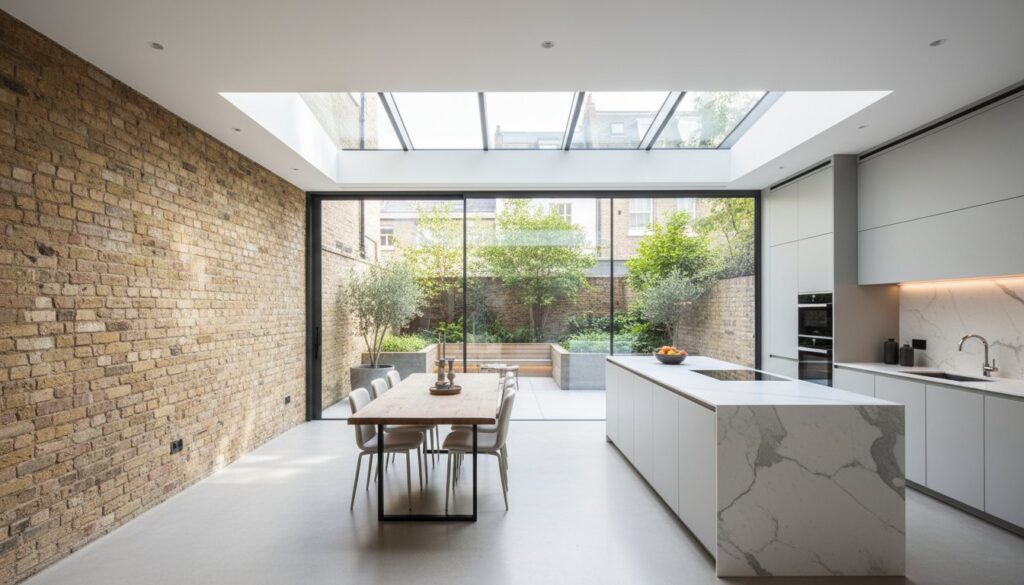
By 2026, the traditional Victorian terrace will no longer be viewed as a rigid historical relic, but as a sophisticated canvas for architectural precision where the side return extension cost london 2026 must be measured against the value of uncompromising design. You likely recognise that a London home is far more than a mere residence; it’s a curated sanctuary where light and form should harmonise. However, the persistent lack of transparency in the construction market often leaves homeowners feeling adrift in a sea of opaque estimates and the looming shadow of the “London Tax”.
This guide provides the clarity you require to build a defensible budget for a truly bespoke living space, ensuring your investment reflects your pursuit of excellence. You’ll gain a thorough understanding of the delicate planning requirements within West London conservation areas and the technical distinctions between basic structural work and premium, artisanal finishes. We’ll examine the logistical mastery needed to minimise disruption to your daily life, ensuring your path to a refined home is as seamless as the final design itself.
Key Takeaways
- Understand why transforming the narrow dog-leg passage into a bespoke living space remains the premier investment strategy for London homeowners in 2026.
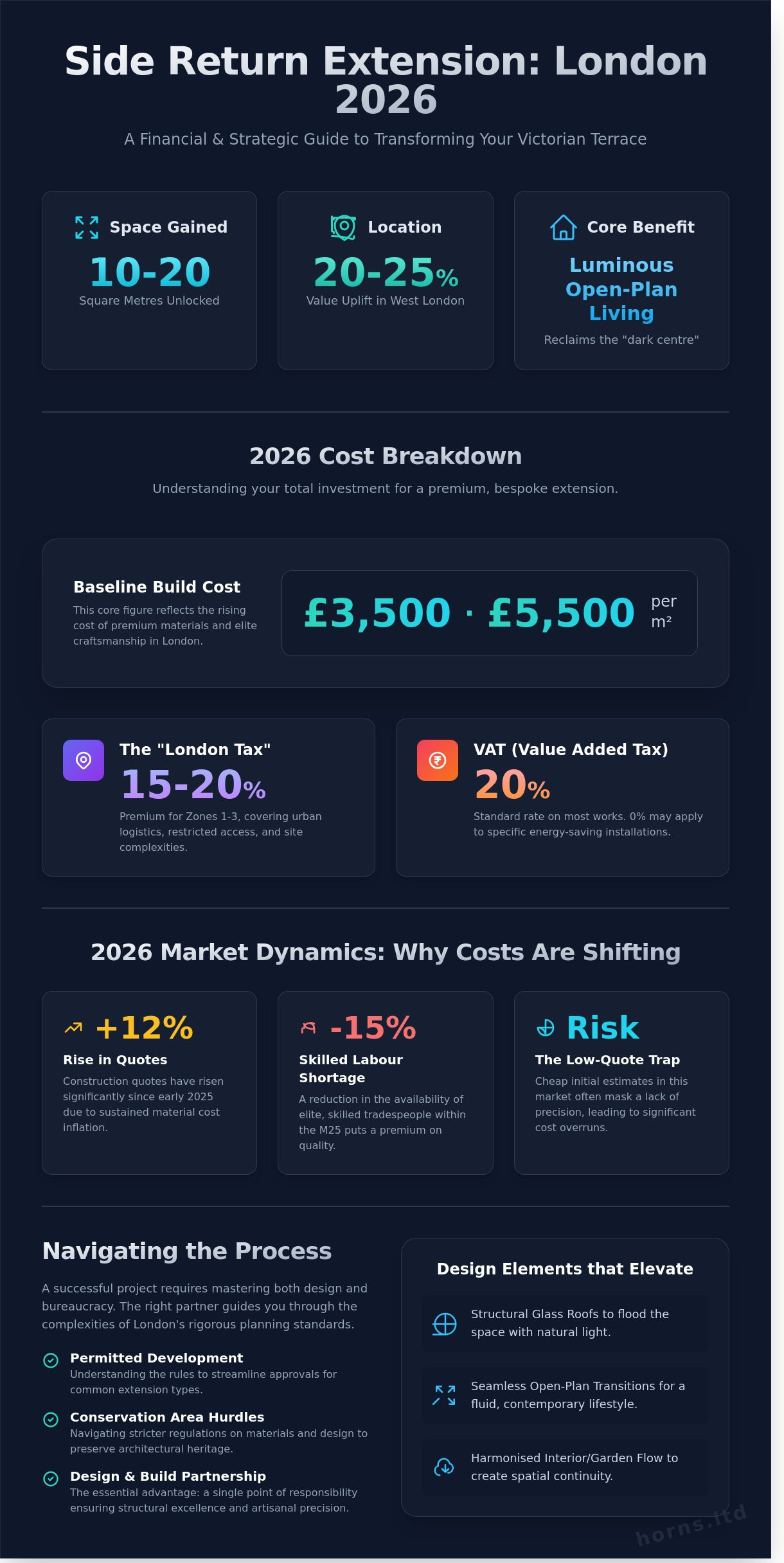
- Navigate the financial landscape with our detailed breakdown of the side return extension cost london 2026, where baseline rates now reflect a new standard of £3,500 – £5,500 per square metre.
- Explore how uncompromising design choices, from structural glass roofs to seamless open-plan transitions, elevate a functional extension into a timeless architectural masterpiece.
- Master the intricacies of Permitted Development and Conservation Area hurdles to ensure your project meets the rigorous standards of London’s planning authorities.
- Discover the essential advantages of a design-and-build partnership that prioritises structural excellence and artisanal precision over mass-market compromises.
The Strategic Value of a Side Return Extension in London (2026 Update)
In the 2026 property climate, London homeowners are increasingly choosing architectural refinement over the logistical burden of relocation. The side return extension has emerged as the definitive home improvement strategy for those seeking to unlock the latent potential of their existing footprint. By reclaiming the narrow, neglected “dog-leg” passage typically found alongside Victorian rear additions, owners can integrate between 10 and 20 square metres of high-performance living space. This intervention does more than just add floor area; it fundamentally reconfigures the light-starved “dark centre” of the traditional terrace. It replaces shadows with a luminous, open-plan kitchen-diner that serves as the home’s emotional and social heart. It’s a surgical strike on a building’s layout, removing the cramped corridors of the past to make way for a fluid, contemporary lifestyle.
The demand for these projects has accelerated throughout 2025 and into 2026 as buyers prioritise expansive, multifunctional ground floors. A well-designed side return doesn’t just expand a room; it harmonises the transition between the interior sanctuary and the garden. This creates a sense of spatial continuity that’s rare in the capital’s densest boroughs. For the sophisticated homeowner, this isn’t merely a construction project. It’s a pursuit of a higher standard of living where every millimetre is curated for aesthetic and functional perfection.
The Victorian and Edwardian Terrace Factor
These period properties possess a rhythmic architectural beauty that demands a respectful, yet bold, design approach. Integrating structural glass with original London stock brickwork creates a dialogue between eras, allowing the side return extension cost london 2026 to reflect a commitment to both heritage and modern utility. In West London postcodes like W11 or W4, a meticulously executed extension can command a 20% to 25% uplift in property value. This return on investment remains robust because the extension addresses the specific structural limitations of the Victorian era while introducing the airy, gallery-like proportions that 2026 buyers crave.
2026 Market Dynamics: Why Cost is Shifting
The economic landscape of 2026 presents unique challenges for the discerning homeowner. Construction quotes have experienced a 12% rise since early 2025, driven by the sustained inflation of premium raw materials and a 15% reduction in the availability of elite, skilled tradespeople within the M25. Selecting a partner based solely on a low initial estimate often invites the risk of mid-project escalations. A professional approach requires a transparent understanding of the side return extension cost london 2026, where the focus remains on uncompromising quality and long-term structural integrity. Cheap quotes in this market often mask a lack of precision that leads to significant overruns during the critical structural phases.
Calculating the Side Return Extension Cost in London: 2026 Price Breakdown
Investing in a side return extension in 2026 requires a nuanced understanding of the London property market’s evolving landscape. The baseline square metre rates now sit firmly between £3,500 and £5,500. This figure represents a shift driven by the rising costs of skilled craftsmanship and the logistical complexities inherent in the capital’s architectural fabric. When you calculate the side return extension cost london 2026, you aren’t just paying for bricks and mortar; you’re commissioning a bespoke structural transformation that demands precision and uncompromising quality.
A significant portion of your budget will be absorbed by the “London Tax,” a 15% to 20% premium applied to projects in Zones 1–3. This surcharge accounts for the intricate dance of urban logistics, including restricted access for plant machinery and the necessity of hand-carrying materials through narrow Victorian corridors. VAT remains a standard 20% for most building works, though savvy homeowners may find relief through 0% ratings on specific energy-saving measures, such as high-performance insulation or advanced heat pump installations. Creating a space where light and sound harmonise requires an uncompromising approach to materials, much like the philosophy found at Horns Ltd.
Standard vs. Premium Specification Costs
The gulf between a standard build and a premium masterpiece is defined by the quality of the finish and the complexity of the glass. A standard fit-out, typically ranging from £75,000 to £95,000, offers a functional expansion with high-quality off-the-shelf components. In contrast, a bespoke or premium specification often exceeds £150,000. This level of investment introduces structural glass roofs that invite the sky into your home, underfloor heating systems that provide silent warmth, and artisan joinery. The kitchen remains the largest variable; choosing a handcrafted, designer culinary suite can easily add £40,000 to your total project outlay.
Professional Fees and Hidden Preliminaries
Budgeting for a side return extension cost london 2026 must include a dedicated 10% to 15% for professional fees. This covers the essential work of architects and structural engineers who translate your vision into technical reality. Adherence to Permitted development rights ensures the structural integrity and legal standing of your vision, preventing costly delays during the planning phase. Beyond the design, you must account for the “preliminaries” that often surprise the unprepared:
- Project Management: Hiring a dedicated London project manager vs. self-managing (typically 5% of build cost).
- Parking and Access: Parking suspensions and pavement licences in boroughs like Hammersmith and Fulham can cost upwards of £100 per day.
- Waste Removal: Skip hire and wait-and-load services in congested streets.
- Party Wall Agreements: Necessary for almost all side return projects in terraced London streets.
The rhythm of a high-end build is slow and deliberate. Every detail, from the acoustic properties of the flooring to the thermal efficiency of the glazing, contributes to a home that functions as a sanctuary. By allocating your budget with foresight, you ensure that the final result is not merely an extension, but a timeless addition to your lifestyle.
Design Elements that Influence Your Total Investment
Creating a side return extension in London for 2026 requires a meticulous balance of architectural ambition and technical precision. The final side return extension cost london 2026 is rarely determined by the shell alone; it’s the invisible engineering and the tactile finishes that define the investment. Structural glass roofs, for instance, offer a celestial connection to the city sky, yet they require bespoke structural support that standard skylights do not. This architectural choice can add £15,000 to £25,000 to your budget depending on the span and the complexity of the glass coatings.
Achieving a fluid, open-plan layout necessitates the removal of the original rear wall. This structural surgery involves heavy-duty steel beams, often hidden within the ceiling void to maintain a flush look. When you’re assessing the UK’s official planning permission rules, you’ll find that structural integrity and thermal performance are non-negotiable. By 2026, homeowners must also account for the Future Homes Standard. This means integrating high-performance insulation and low-carbon heating, such as air-source heat pumps, which represent a higher initial outlay but ensure the property remains future-proofed against rising energy costs.
The “Glass Box” Aesthetic vs. Traditional Masonry
The choice between floor-to-ceiling Crittall-style doors and sleek aluminium bi-folds is as much about thermal physics as it is about style. Genuine steel frames offer an industrial elegance that’s hard to replicate, though they typically cost 40% more than aluminium alternatives. Beyond the aesthetic, you must consider the thermal trade-offs. High-spec frames with triple glazing are essential to meet 2026 Part L compliance, ensuring your expansive glass walls don’t become a source of heat loss during the London winter. Investing in high-spec frames pays off through durability and superior acoustic insulation from the city hum.
Internal Finishes and Bespoke Joinery
A side return shouldn’t feel like an add-on but a natural evolution of the home. Many clients opt for full home refurbishments to ensure the new extension flows perfectly into the existing ground floor. In the narrow footprint of a side return, every millimetre is precious. Custom cabinetry can turn a dead corner into a functional pantry or a hidden workstation, maximising the utility of the space. Lighting design also plays a vital role; layered circuits allow you to define zones within the long space, using warm, focused beams to create intimacy in the dining area while maintaining bright, functional light in the kitchen.
Navigating London Planning Permissions and Building Regulations
Creating an architectural masterpiece in the heart of London requires more than just aesthetic vision; it demands a rigorous adherence to the evolving legal framework of 2026. While the allure of a glass-roofed side return is undeniable, the side return extension cost london 2026 is heavily influenced by the regulatory path you choose. Permitted Development (PD) rights remain a powerful tool for homeowners, allowing for specific extensions without the need for full planning permission. However, these rights are often restricted in 2026 by height limits and materials that must match the existing dwelling. If your property sits in a Conservation Area, such as the refined streets of Fulham or the historic quarters of Kensington, Article 4 Directions likely remove these shortcuts entirely, necessitating a full planning application that respects the local heritage.
The 2026 Building Regulations have introduced even more stringent benchmarks for technical excellence. The focus has shifted decisively toward the Future Homes Standard, with uncompromising rules on carbon emissions and thermal efficiency. Your extension must now achieve ultra-low U-values, often requiring high-performance triple glazing or advanced insulation materials. Ventilation requirements (Part F) have also been tightened to prevent damp in these highly airtight structures, while fire safety regulations (Part B) for terraced properties now demand specific fire-rated boundaries and escape routes that can add £3,000 to £5,500 to your overall budget.
The Party Wall Process in London
In the dense architectural fabric of London, your side return will almost certainly involve the Party Wall Act 1996. Because you’re excavating near a neighbour’s foundations or building on a shared boundary, you must serve formal notice at least two months before work begins. If your neighbour dissents, you’ll need to appoint a surveyor; often two if they prefer their own representation. A professional “Schedule of Condition” report is essential to document the state of the adjoining property before ground is broken. Budgeting approximately £1,200 to £2,500 per surveyor is a realistic expectation for 2026. You should initiate this process at least 90 days before your build date to avoid costly delays that can derail your project timeline.
Planning for Success in West London
Borough-specific nuances are the hallmark of London’s planning landscape. In Ealing, planners may show a preference for contemporary designs that provide a clear architectural contrast, whereas Hammersmith and Fulham often insist on a “subservient” design that mirrors the original Victorian brickwork. When designing house extensions, the 2026 guidelines place heavy emphasis on the “Right to Light.” This is a common hurdle where neighbours can legally object if your new roofline significantly diminishes the natural light reaching their windows. Handling these objections requires precision engineering and often a bespoke, angled roof design to satisfy both your aesthetic desires and your neighbour’s legal rights. Understanding these complexities is the only way to ensure the side return extension cost london 2026 remains predictable and controlled.
Ready to transform your London residence with uncompromising quality? Contact Horns Ltd. for a bespoke architectural consultation and bring your vision to life with precision and elegance.
The Horns Construction Approach: Premium Building in London
London’s Victorian and Edwardian architecture demands more than just a builder; it requires a structural artist. At Horns Construction, we’ve spent 20 years refining a compromise-free approach to the side return. We understand that the side return extension cost london 2026 isn’t just a figure on a spreadsheet; it’s a significant investment in your property’s architectural heritage. Choosing a design and build specialist is vital because it eliminates the friction between the architect’s vision and the site’s reality. We take full responsibility for the structural integrity and the aesthetic finish, ensuring your home remains a cohesive masterpiece.
Managing a build in West London requires a delicate touch and clinical precision. We’ve mastered the logistics of tight access and neighbourly diplomacy in conservation areas. We treat your neighbours with the same respect we show your floorboards. Our project management is rigorous, keeping noise and dust within strict parameters. We don’t just build walls; we preserve your local reputation. Every project comes with the Horns guarantee. You’ll receive a fixed-price quote that protects you from the volatility of the 2026 market, backed by a team that views construction as a fine art. We view a home’s structure like a finely tuned instrument. Every joist and beam must resonate with the existing architecture. Our history is built on this uncompromising pursuit of excellence.
From Concept to Completion: Our Process
Our process begins with a deep dive into the soul of your home. We seamlessly integrate your kitchen renovation into the primary structural build. This holistic view ensures that plumbing, lighting, and bespoke cabinetry are considered before the first brick is laid. Our network of specialist tradespeople, from master bricklayers to fine joiners, understands that every millimetre matters. By 2026, we’ll provide every homeowner with real-time project tracking. You’ll see progress, schedules, and budget updates through a transparent digital interface. This transparency ensures the side return extension cost london 2026 remains predictable and controlled throughout the build duration.
Your Next Steps for a 2026 Project
Planning for a 2026 start requires early action. We recommend booking a site survey at least six months in advance. During our feasibility study, we’ll assess your property’s specific structural needs and local planning constraints. Prepare your brief by focusing on how you want to feel in the space, not just the square footage. Think about the interplay of light and the rhythm of your daily life. When you’re ready to transcend the ordinary, contact Horns Construction for a bespoke side return consultation. We’ll help you navigate the complexities of London building with confidence and grace.
Securing Your Architectural Legacy in London
A side return extension isn’t merely a construction project; it’s a meticulous orchestration of architectural heritage and modern engineering. As we navigate the specific landscape of the side return extension cost london 2026, homeowners must balance technical precision with aesthetic ambition. Success in this market requires a deep understanding of London’s strict building regulations and the nuanced structural demands of period properties. Horns Ltd. brings over 20 years of London building experience to every project, specialising in the delicate restoration and expansion of Victorian and Edwardian homes. Our comprehensive design-to-completion service ensures that every millimetre of your new space reflects an uncompromising commitment to quality. By integrating high-end materials with engineering excellence, we transform narrow alleyways into light-filled sanctuaries that enhance both your daily experience and your property’s long-term value. Your home deserves a legacy built on craftsmanship rather than compromise; it’s an investment in a lifestyle defined by timeless elegance.
Book a Professional Feasibility Survey for Your London Extension
Frequently Asked Questions
Is a side return extension worth it in London in 2026?
A side return extension represents a superlative investment in 2026, typically yielding a 15% to 20% increase in total property value across prime London postcodes. It’s not merely a structural addition; it’s a meticulous refinement of your home’s spatial flow. By reclaiming the underutilised “alleyway,” you create a kitchen and dining sanctuary that resonates with modern elegance and architectural purpose.
Do I need planning permission for a side return extension in a conservation area?
You’ll almost certainly require full planning permission if your property sits within one of London’s 600 conservation areas, as Permitted Development rights are often restricted by Article 4 directions. Local councils demand a level of architectural precision that respects the historical narrative of the streetscape. Expect a statutory 8 week period for a decision once your application’s submitted to the planning department.
How long does a side return extension take to build in London?
The physical construction of a side return typically requires 12 to 16 weeks of focused craftsmanship on site. However, the entire journey from the first architectural sketch to the final coat of paint often spans 7 to 9 months. This timeline accounts for the 120 days needed for design, structural engineering, and navigating the nuances of the London planning system.
What is the average cost per square metre for a London extension in 2026?
In the current market, the side return extension cost london 2026 averages between £3,500 and £5,200 per square metre for premium, high-specification builds. These figures reflect the uncompromising quality of artisanal labour and the rising costs of bespoke materials. Investing at this level ensures your home isn’t just larger, but is a masterpiece of technical and aesthetic excellence.
Can I stay in my house during a side return extension?
While staying is possible, 75% of homeowners choose to vacate because noise levels frequently exceed 85 decibels during the structural phase. The removal of the flank wall creates a significant disruption to the home’s thermal and acoustic serenity. If you value your daily peace, a temporary relocation ensures the construction process doesn’t compromise your lifestyle’s quality.
How much does a Party Wall agreement cost for a side return?
A standard Party Wall agreement in London costs between £1,200 and £2,500 per neighbouring property in 2026. If your neighbours appoint their own independent surveyors, these professional fees can quickly double. It’s a vital legal safeguard that protects the structural integrity of both your sanctuary and the adjoining terrace through meticulous documentation.
Will a side return extension add more value than it costs?
Data from the 2025 property market indicates that a well-executed side return adds roughly £1.50 in value for every £1.00 spent on construction. This profit margin is most pronounced in high-demand boroughs like Wandsworth or Islington where space carries a premium. The side return extension cost london 2026 is balanced by the creation of a timeless, light-filled heart of the home.
What are the 2026 building regulations for glazing and insulation?
The 2026 updates to Part L of the Building Regulations mandate a maximum U-value of 1.1 W/m²K for new glazing units to ensure thermal efficiency. You’ll also need to incorporate high-performance PIR insulation boards with a minimum thickness of 150mm in the floor and roof structures. These exacting standards guarantee that your new space remains a haven of warmth and acoustic precision throughout the year.