
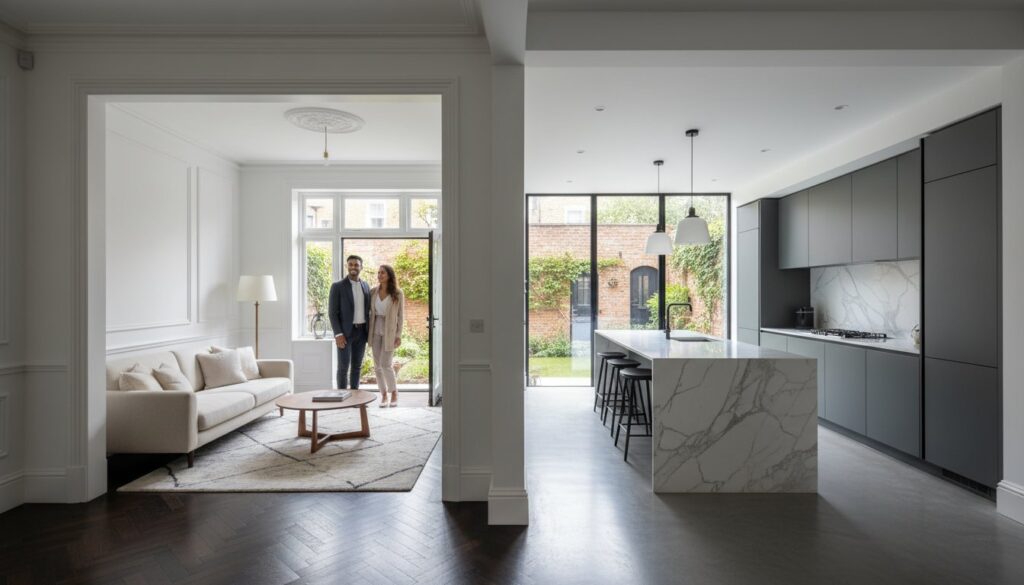
What if the true soul of a London terrace isn’t found in its ornate cornicing, but in the silent, structural dialogue between 1880s brickwork and 2026 engineering? You likely recognise that a victorian house renovation london is far more than a simple refurbishment; it’s a meticulous act of stewardship that requires navigating the specific Article 4 Directions found within London’s 1,000 plus conservation areas. It’s a complex journey where the shifting nature of London clay meets the uncompromising demand for modern, light-filled living spaces.
You deserve a home that functions with the technical precision of a fine instrument while retaining its original, hand-crafted character. This guide promises to show you how to harmonise period aesthetics with bespoke luxury, ensuring your structural extensions add lasting value to your property. We’ll examine the technical realities of heritage restoration, from managing ageing foundations to securing planning approval for contemporary glass interventions.
Key Takeaways
- Understand the distinct architectural nuances of the Early, Mid, and Late Victorian eras to ensure your restoration honours the original soul and proportions of your property.
- Navigate the complexities of West London conservation areas with a sophisticated approach to planning permission, ensuring your aesthetic vision aligns with rigorous regulatory standards.
- Discover how bespoke side-return and wraparound extensions can redefine traditional layouts, creating a seamless flow between period elegance and modern open-plan living.
- Learn to balance uncompromising comfort with historical integrity by integrating advanced thermal insulation and acoustic glazing without sacrificing the building’s character.
- Realise the benefits of a dedicated design-build philosophy for your victorian house renovation london, where artisanal precision and expert project management guarantee a timeless result.
Understanding the Anatomy of a Victorian House Renovation in London
Victorian architecture isn’t a single, stagnant style but a rich, evolving narrative of British craftsmanship. Between 1837 and 1901, London’s residential landscape moved through three distinct chapters. The Early Victorian phase (1837-1850) often mirrored Georgian simplicity with its neoclassical restraint. The Mid-Victorian era (1850-1875) embraced the dramatic shadows of Gothic Revival and Italianate flourishes. Finally, the Late Victorian period (1875-1901) introduced the ornate, red-brick aesthetics of the Queen Anne style. A successful victorian house renovation london demands an intimate knowledge of this Anatomy of a Victorian House to ensure every modern intervention respects the building’s soul.
- Sash Windows: These provide the rhythmic pulse of the facade, offering vertical elegance and essential ventilation.
- Decorative Brickwork: Intricate Flemish bond patterns and polychromatic details define the prestige of the streetscape.
- Proportions: High ceilings and generous floor-to-ceiling heights create an inherent sense of luxury that modern builds struggle to replicate.
The “London Terrace” presents a specific set of challenges for the contemporary developer. These narrow plots were designed for a different age of domestic life. They share party walls that require careful navigation under the Party Wall etc. Act 1996. In 2026, these properties remain the gold standard for investment. Their scarcity and undeniable character ensure they consistently outperform modern developments in the luxury sector.
The Structural Reality of London Clay and Ageing Foundations
London clay is a living challenge for 19th-century masonry. This soil shrinks and swells with the seasons, often leading to structural movement in shallow footings that have stood for over 140 years. You’ll often see stepped cracks in the brickwork or internal plaster failure in unmodernised homes. Subsidence is the downward movement of a building’s foundations caused by the loss of support from the underlying soil, often triggered by the moisture-extraction properties of London clay or historic drainage leaks. Rectifying these issues is the first step in any uncompromising refurbishment project.
The Aesthetic Value of Heritage Preservation
Preserving original features is a matter of artistic integrity and financial wisdom. Hand-crafted ceiling roses and deep cornicing aren’t merely decorations; they’re the building’s DNA. In the 2026 London market, these elements carry significant weight, providing the period charm that drives emotional connections for high-net-worth buyers. We don’t believe in stripping away history. Instead, the goal of a victorian house renovation london is balancing this heritage with the technical demands of a modern family. It’s about creating a home that feels both timeless and technologically advanced.
Navigating Planning Permission and Conservation in West London
Preserving a Victorian masterpiece in West London requires more than just an architect; it demands a curator’s eye. In conservation areas like the Bedford Park estate in Chiswick or the tree-lined avenues of Ealing, the local council’s gaze is unwavering. Understanding the delicate balance between modern luxury and historical preservation is the first step in any successful victorian house renovation london. Navigating Planning Permission becomes an art form when dealing with Article 4 Directions. These specific regulations often strip away Permitted Development rights, meaning even a minor change to a front facade or the replacement of original sash windows requires a formal application. Working with Heritage Officers isn’t an obstacle but a collaboration. They’ll often approve contemporary materials, such as ultra-slim vacuum glazing, if the profile respects the original 19th-century timber craftsmanship and aesthetic integrity.
For homeowners looking to enhance their property’s kerb appeal with high-performance materials that respect these heritage guidelines, check out Grabex Windows Ltd for bespoke entrance doors that marry traditional style with 21st-century security.
Borough-Specific Nuances: Ealing to Fulham
Ealing’s planning department maintains a specific rigour regarding the volume of rear dormers in loft conversions. They often cap additions to 40 cubic metres for terraced properties to maintain the roofline’s rhythm. Conversely, the London Borough of Hammersmith & Fulham enforces stringent rules on “matching materials.” This requires sourcing reclaimed London Stock bricks that mirror the specific weathered patina of the existing structure. Navigating the West London planning portal demands local intelligence to avoid the 8-week delay of a rejected application. Expert consultants ensure your vision aligns with the borough’s 2026 development plan from the first sketch.
The Party Wall Act: A London Renovation Essential
A victorian house renovation london almost always involves the Party Wall etc. Act 1996. For a typical terrace, you’ll need a Party Wall Agreement before any structural steel touches the shared boundary. Managing these relations is vital. It’s about respecting the shared history of the building while introducing the acoustic precision and bespoke design your lifestyle demands. Consider these factors for your timeline:
- Notice Periods: You must serve notice at least two months before structural work begins.
- Surveyor Costs: Budget between £1,200 and £2,500 per neighbour for professional awards.
- Schedule of Condition: Detailed photographic records prevent 95% of future damage disputes.
This phase adds approximately 10 to 12 weeks to your pre-construction timeline. Early engagement with your neighbours isn’t just a legal requirement; it’s a gesture of respect that ensures the structural symphony of your renovation proceeds without Discord.
Structural Transformations: Extensions and Conversions for Modern Living
A victorian house renovation in London is a delicate dance between historical reverence and engineering audacity. The rigid, cellular rooms of the 1800s rarely align with the fluid lifestyle of a modern connoisseur. To bridge this gap, structural transformations must be executed with the precision of a master craftsman, ensuring every new beam and glass pane enhances the building’s inherent character. These interventions don’t just add floor area; they redefine the home’s relationship with light and movement.
The side-return extension remains the most surgical way to reclaim the underused “dog-leg” alleyway found in traditional terraces. By infilling this narrow strip, you can expand a cramped kitchen into a spacious, light-filled sanctuary, often increasing the ground floor footprint by up to 25%. For those seeking a more dramatic shift, rear wraparound extensions combine side and rear additions to create a singular, expansive living zone. These projects require sophisticated structural steelwork to achieve wide, column-free spans that feel weightless. Ensuring the safety and aesthetic integrity of such a feat often involves working with a RIBA chartered architect who can navigate the complexities of load-bearing walls and the specific requirements of London planning departments.
In high-value postcodes like Kensington or Chelsea, basement excavations offer a subterranean retreat for cinema rooms, wine cellars, or private galleries. While technically demanding, these excavations represent the final frontier of urban expansion. 2024 market data suggests that a well-executed basement can increase a property’s value by as much as 30% in prime central locations, provided the damp-proofing and ventilation systems are designed without compromise.
The Kitchen Extension: The Heart of the Victorian Home
Modern victorian house renovation london projects focus heavily on the kitchen as a social hub. Integrating bi-fold doors or slim-profile Crittall-style glazing allows natural light to flood the space, erasing the boundary between the interior and the garden. This structural transparency requires uncompromising quality in material selection to maintain thermal efficiency. For a deeper look at bespoke cabinetry and technical layouts, explore our Kitchen Renovation London guide for inspiration on blending utility with artistic design.
Maximising Vertical Space with Loft Conversions
The attic should not be a dusty archive of the past; it’s the ultimate canvas for an elevated master suite. Mansard conversions represent the pinnacle of architectural harmony for London rooflines, providing a near-vertical wall that maximises headroom without disrupting the city’s historic silhouette. Dormer styles offer a more cost-effective alternative, though they require careful design to maintain the original roof pitch and chimney stacks. You’ll find detailed technical specifications in our West London Loft Conversions guide, which highlights how to blend acoustic insulation with elegant, light-filled interiors.
Modernisation vs. Restoration: Balancing Comfort and Character
The true soul of a Victorian house renovation in London lies in the delicate tension between preservation and progression. It’s a curation of history where the goal is to enhance the 19th-century narrative through 21st-century engineering. Achieving this balance requires a compromise-manuscript that respects the building’s original breathability while introducing the thermal efficiency expected in 2026.
Thermal performance in solid-wall properties is a primary challenge. Unlike modern cavity walls, Victorian brickwork relies on a moisture-exchange cycle. Using non-breathable synthetic insulation often leads to interstitial damp; instead, we utilise wood-fibre boards or lime-based insulating plasters. These natural materials can reduce heat loss through walls by up to 35% without compromising the structural integrity of the masonry. The sash window dilemma follows a similar logic. While repairing original timber frames is the purist’s choice, installing high-spec acoustic double glazing has become the standard for London residents. Modern vacuum-insulated glass units provide U-values as low as 0.4, offering triple-glazing performance within a profile thin enough to fit original 19th-century rebates.
Smart home integration must be felt, not seen. We conceal high-fidelity technology within the period architecture, hiding invisible speakers behind plasterwork or nesting Lutron lighting controls within deep-moulded architraves. This invisible luxury extends to the floor. Underfloor heating (UFH) is perfectly compatible with original pine floorboards, provided a low-profile water-based system is used and the timber is carefully seasoned to a moisture content of 8-10% to prevent warping.
Sympathetic Interior Architecture
The “Modern Victorian” aesthetic demands a deep respect for proportions. Sourcing reclaimed materials, such as 19th-century encaustic tiles or cast-iron fireplaces, ensures the home’s heritage remains authentic. We often specify a palette of saturated, heritage tones like Farrow & Ball’s ‘Railings’ or ‘Studio Green’ to ground the high-ceilinged rooms. Bespoke joinery, designed with traditional rail-and-stile techniques, allows for modern storage that feels like an original architectural feature of the victorian house renovation london project.
Mechanical and Electrical (M&E) Upgrades
Unmodernised homes require a complete systemic overhaul. A full rewire and replumbing are essential to handle the demands of contemporary luxury. In 2026, the transition toward air-source heat pumps (ASHP) is accelerating, though selecting the most efficient system remains vital; specialists such as Parallel Plumbing and Heating offer insights into the various modern boiler types suitable for large Victorian residences. These systems require precise calibration and larger radiator surface areas to function at lower flow temperatures. For homes with multiple new bathrooms, we install unvented hot water cylinders to ensure a constant 3-bar pressure, providing a spa-like experience even in the highest loft conversion.
For those who demand uncompromising acoustic precision and timeless elegance in their period home, discover our artisanal audio solutions at Horns Ltd.
The Horns Construction Approach to Full Home Refurbishment
We treat every Victorian house renovation in London as a masterwork in the making. Our design-build philosophy removes the traditional friction between architect and contractor, ensuring your original vision remains untarnished through to the final coat of paint. This holistic approach allows us to manage every detail, from the initial structural calculations to the bespoke joinery that defines a luxury home. By integrating the creative and technical phases, we eliminate the communication gaps that often plague large-scale London projects.
A dedicated Project Manager serves as the conductor of this complex operation. In the tight residential corridors of West London, areas like Kensington or Chelsea, logistics demand absolute precision. We handle the complexities of skip permits, narrow-access deliveries, and neighbourly relations with a level of care that respects the local community. Because Victorian structures frequently hide 150 years of architectural secrets, we insist on fixed-price contracts. This provides you with financial certainty. While other contractors might present a low initial bid only to add £15,000 for “unforeseen” joist repairs later, our thorough pre-construction surveys allow us to commit to a price that stays firm.
Quality Control and Meticulous Craftsmanship
Our standard of uncompromising quality extends to every layer of the build. We don’t just hire contractors; we curate a team of specialist trades who understand the soul of heritage properties. Our heritage plasterers restore original cornices using traditional techniques, while our structural steel teams implement modern reinforcements with millimetre precision. This blend of old-world artistry and modern engineering is what defines our reputation. You can explore our detailed methodology in our Mastering Home Refurbishment guide to see how we maintain these exacting standards throughout the project lifecycle.
Starting Your Renovation Journey
Transformation begins with a deep assessment of your property’s latent potential. During our initial consultation, we analyse the structural integrity and aesthetic possibilities of your home to ensure the victorian house renovation london homeowners expect meets the reality of modern living. For a full London refurbishment, we establish a realistic 2026 timeline that accounts for the 8-12 weeks typically required for planning permissions and the intricate nature of bespoke craftsmanship. We believe in a pace that allows for perfection. Contact Horns Ltd today to discuss how we can elevate your period residence into a contemporary masterpiece through a process that is as refined as the final result.
Orchestrating Your 2026 London Legacy
A successful victorian house renovation london project requires a delicate equilibrium between architectural preservation and the uncompromising demands of modern life. You’ve explored how structural transformations and sensitive modernisation breathe new life into these period gems. Navigating West London’s specific planning landscape requires a specialist’s eye for detail; it’s a process where technical precision meets artistic intent. Every decision made today defines the comfort and character of your home for the next century.
Horns Construction brings over 20 years of West London building experience to every project. We’re specialists in period property structural transformations, treating every brick and beam as a vital component in a larger masterpiece. Our comprehensive project management ensures a seamless journey from the first design sketch to the final completion. It’s about creating a space that’s as precise as it’s beautiful. We don’t believe in compromise when it comes to your home’s enduring value and aesthetic harmony.
Book a consultation for your London Victorian renovation with Horns Construction
Your home’s next chapter begins with a single, deliberate step toward excellence.
Frequently Asked Questions
How much does a Victorian house renovation in London cost in 2026?
A high-end victorian house renovation london typically costs between £2,500 and £4,500 per square metre in 2026, depending on the level of bespoke finishes. For a standard three-bedroom terrace, this often equates to a total investment of £250,000 to £500,000. These figures reflect the rise in material costs and the scarcity of specialist artisans capable of restoring period plasterwork or installing integrated smart home systems with surgical precision.
Do I need planning permission to extend my Victorian terrace in London?
You don’t always need full planning permission for a Victorian terrace extension if the project falls under Permitted Development rights. These rights allow for rear extensions up to 6 metres for terraced homes, provided they meet specific height and material requirements. However, if your property is within one of London’s 27 conservation areas or is a Grade II listed building, you’ll need to secure formal consent from your local council before any work commences.
How long does a full home refurbishment typically take in West London?
A comprehensive home refurbishment in West London usually takes between 8 and 12 months from the initial strip-out to the final polish. Structural alterations and basement excavations often add 12 weeks to the timeline. We focus on a rhythmic, deliberate pace that respects the drying times of traditional lime plasters and the intricate calibration of bespoke joinery. Rushing such a transformation risks compromising the timeless quality that defines a truly curated London residence.
Can I modernise a Victorian house and still keep its original features?
You can absolutely integrate modern technology into a victorian house renovation london while honouring the property’s historical soul. This delicate balance is achieved by concealing contemporary infrastructure, such as underfloor heating and high-fidelity acoustic systems, beneath restored floorboards or behind custom cornicing. It’s about creating a dialogue between 19th-century elegance and 21st-century comfort, ensuring the home functions perfectly without losing its architectural heritage.
What is the best type of extension for a Victorian side-return?
A glass-roofed wraparound extension is the most effective choice for a Victorian side-return, as it floods the traditionally dark middle room with natural light. By using slim-profile steel frames or frameless structural glass, you create a seamless transition between the original brickwork and the new kitchen-diner. This architectural intervention adds approximately 15 to 20 square metres of high-value living space, transforming a narrow corridor into a bright, social heart of the home.
Is it worth renovating a Victorian house in London for investment purposes?
Renovating a Victorian property remains a sound investment, with well-executed refurbishments in prime London postcodes often seeing a 15% to 20% uplift in capital value. Beyond the financial return, the rarity of these period homes ensures they remain highly sought after by discerning buyers who value character over mass-produced modern builds. A bespoke renovation isn’t just a property upgrade; it’s the preservation of a finite piece of London’s architectural history.
How do I find a reliable builder for a Victorian renovation in Chiswick or Ealing?
Finding a reliable builder in Chiswick or Ealing requires verifying credentials through the Federation of Master Builders and requesting a portfolio of local Victorian projects. You should visit at least two active sites to witness their craftsmanship and site management first-hand. A truly expert contractor will demonstrate a deep understanding of period-specific challenges, such as damp proofing and brick bonding, rather than offering vague promises of speed and low costs.
What are the common structural problems found in London Victorian houses?
Common structural issues in London’s Victorian stock include shallow foundations leading to subsidence and the natural decay of timber floor joists. You’ll often find that 150 years of ground movement has caused lintel failure above windows, requiring specialist masonry reinforcement. Rising damp is another frequent visitor, usually caused by the breach of original slate damp-proof courses or the misguided application of non-breathable modern cements on porous old bricks.