

A builder’s promise is only as enduring as the insurance that anchors it, yet many homeowners mistake a simple handshake for a structural shield. When you are commissioning a high-end transformation of your property, securing a robust builder’s warranty for renovation work uk is not merely a formality; it is the fundamental architecture of your long-term peace of mind. You have likely spent months envisioning a home that reflects your personal legacy. The anxiety that structural flaws or unreliable contractors could tarnish that vision is entirely justified, especially when the boundary between a craftsmanship guarantee and a structural warranty feels blurred.
We believe that true luxury requires an uncompromising commitment to technical precision. This guide will show you how to fortify your investment through a sophisticated dual-layer approach of contractual guarantees and latent defect insurance. You will gain a clear understanding of the 10-year protection model and the implications of the 2026 Building Safety Levy. We provide the exact framework of questions to pose to your contractor, ensuring that your renovation remains a masterpiece protected by the most stringent modern standards and insurance-backed security.
Key Takeaways
- Learn why the 2026 regulatory landscape demands a more sophisticated builder’s warranty for renovation work uk to safeguard structural integrity in high-end refurbishments.
- Master the critical distinction between a standard builder’s guarantee and an insurance-backed warranty to ensure your protection remains valid even if a contractor ceases trading.
- Discover how to navigate the “alterations clause” to prevent your ambitious loft conversion or extension from inadvertently voiding your existing new-build warranty.
- Identify the essential professional credentials and insurance documents you must verify before signing a contract for major structural works.
- Explore how RIBA-standard project management provides a foundation of security that transcends standard contractual obligations for complex residential projects.
Understanding Builder’s Warranties for UK Renovations
A builder’s warranty for renovation work uk is far more than a bureaucratic checkbox; it’s a sophisticated insurance instrument designed to protect the structural integrity of your home long after the dust has settled. The pursuit of architectural perfection requires more than just aesthetic vision. It demands a rigorous commitment to structural permanence. As we move through 2026, the UK’s regulatory environment has matured, demanding a level of documentation that matches the complexity of modern engineering. This warranty provides a vital safety net against latent defects, ensuring that the exquisite craftsmanship of your refurbishment is backed by financial security and technical accountability.
Building Control and the LABC play a pivotal role in this ecosystem, yet their role is frequently misunderstood by homeowners. While they verify that work meets minimum safety standards during the construction phase, they don’t provide the long-term financial protection of a structural warranty. For those owning premium London assets, this distinction is vital. Whether you’re planning a full home refurbishment or a complex house extension, a robust warranty is often the deciding factor for mortgage lenders and future buyers who seek absolute certainty in the property’s bones. Without it, remortgaging or selling a recently renovated property can become an arduous, if not impossible, endeavour.
Is a Warranty Legally Required for Renovations?
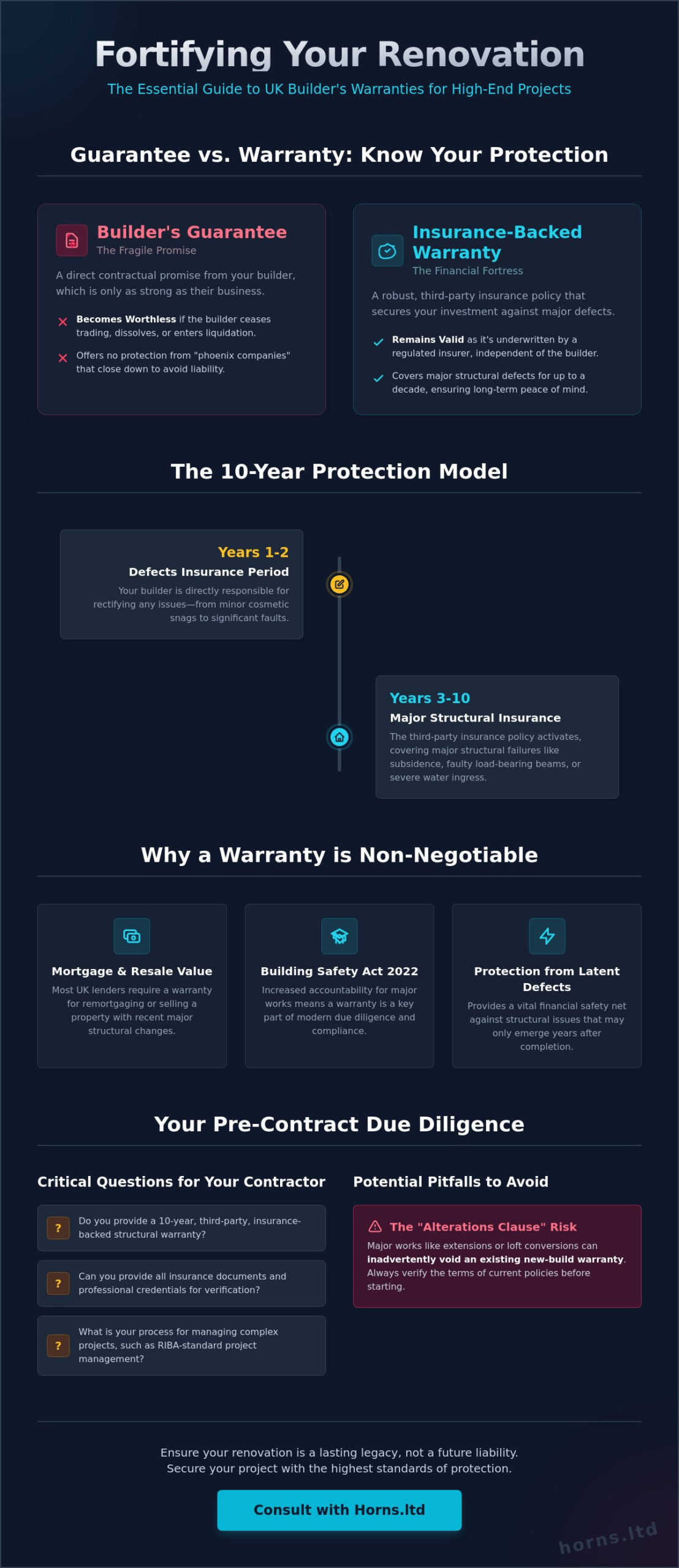
Strictly speaking, a structural warranty isn’t always a legal mandate for all renovation types, but it’s almost always a commercial necessity for high-value projects. The Building Safety Act 2022, which saw the Building Safety Regulator transition to an independent body in January 2026, has significantly heightened the accountability of those performing major works. A certificate of completion from your local authority merely confirms the project complied with building regulations at the time of inspection. It doesn’t offer a path to recourse if a structural issue appears five years later. Most mortgage lenders require a formal warranty for any significant structural changes before they’ll approve a remortgage or a future sale.
The Standard 10-Year Protection Model
The industry standard, often associated with the National House Building Council (NHBC), follows a clear decadal timeline that balances builder accountability with long-term insurance. The first two years are known as the defects insurance period. During this time, the builder is directly responsible for rectifying any issues, from minor snags to significant faults. The subsequent eight years focus exclusively on major structural insurance. In the context of a London terrace or a loft conversion, a major defect might involve the failure of load-bearing steelwork, subsidence caused by inadequate foundations, or significant water ingress. This tiered protection ensures that while the builder’s immediate presence may fade, the property’s structural health remains insured for a full decade.
The Critical Difference: Builder’s Guarantees vs. Insurance-Backed Warranties
In the pursuit of architectural excellence, the distinction between a builder’s promise and a financial fortress must be absolute. Many homeowners believe that a written guarantee from their contractor provides sufficient protection, yet this document is only as resilient as the company that issued it. When securing a builder’s warranty for renovation work uk, you are looking for more than just a signature on a contract. You are seeking a multi layered safety net that preserves your home’s value against the unforeseen. Understanding how these instruments differ is the first step in ensuring your renovation remains a lasting legacy rather than a liability.
Why a “Paper Guarantee” Isn’t Enough
A standard builder’s guarantee is a contractual obligation to rectify snags or defects within a set period. While valuable, it carries a significant inherent risk: if the building firm dissolves or enters liquidation, the guarantee vanishes with them. The London construction market has occasionally seen the rise of “phoenix companies,” which close only to reopen under a different name, leaving previous clients with no recourse for structural issues. An Insurance-Backed Guarantee (IBG) is a third-party policy that honours the original builder’s warranty even if they go out of business. This ensures that the technical integrity of your investment remains protected by an independent insurer, regardless of the builder’s future status.
Beyond the guarantee, you must distinguish between the various types of insurance a contractor carries. Public liability insurance protects against accidental damage or injury during the build, while professional indemnity insurance covers errors in design or technical advice. However, neither of these acts as a structural warranty. For major extensions, you require latent defects insurance. This specific cover addresses flaws in design, materials, or workmanship that only become apparent years after completion. It provides the deep, structural security that high-end properties demand.
Third-Party Warranties (NHBC, LABC, Premier Guarantee)
Securing a warranty from an established provider like the FMB Build Assure Warranty or the NHBC adds a rigorous layer of quality control to your project. These organisations do not simply provide insurance; they audit the build process at critical stages to ensure compliance with elite industry standards. Choosing a warranty approved contractor is a strategic investment in quality assurance. This level of oversight is a fundamental component of a successful home refurbishment, where the complexity of integrating new structures with existing heritage requires meticulous precision. If you are preparing to transform your property, ensure your peace of mind by consulting with experts who prioritise these technical safeguards from the very first sketch.
How Renovations Impact Your Existing Home Warranty
The pursuit of architectural evolution must never come at the expense of established security. For owners of relatively new properties, the desire to add a bespoke loft conversion or a sun-drenched garden room often runs into the “Alterations Clause” found in most new-build policies. This clause is a defensive mechanism for insurers; it states that any unauthorised structural changes can immediately void your existing 10-year protection. When you are considering a builder’s warranty for renovation work uk, you must first audit your current coverage to ensure that your new vision doesn’t dismantle the safety net already in place. This delicate balance between preserving the old and perfecting the new requires a strategic approach to documentation.
Notifying your warranty provider before the first stone is turned is a non-negotiable step in maintaining your property’s value. Many high-end homeowners find themselves in a precarious position where their original policy covers the foundation, but a new extension remains uninsured because the provider wasn’t consulted. In some cases, a mortgage lender might even require a new home warranty for a renovation to bridge the gap between the old structure and the new additions. If work has already commenced without these protections, you may be forced to seek a retrospective warranty. This process involves rigorous, often invasive, inspections to verify the quality of the hidden engineering, and it carries a significantly higher premium due to the increased risk for the insurer.
Common Renovation Mistakes That Void Coverage
Precision is the hallmark of a master craftsman, yet even the most ambitious DIY projects can lead to catastrophic insurance failures. Removing load-bearing walls without a structural engineer’s verified sign-off is the most common path to voiding a policy. Similarly, modifying the original drainage or roofing systems in a new-build property can lead to claims being rejected if water ingress occurs elsewhere. Insurers view these systems as integrated units. Once the original seal is broken by an uncertified hand, the collective protection for the entire structure often dissolves, leaving the homeowner vulnerable to the full cost of future repairs.
Protecting Your Existing Structure During Work
Standard home buildings insurance is rarely sufficient for the duration of a major refurbishment. Most policies specifically exclude damage caused by the renovation process itself, such as a roof being left exposed to a sudden London downpour or a wall collapsing due to vibration. This is where Renovation Insurance, also known as Contract Works Insurance, becomes indispensable. It provides a temporary but vital shield for both the existing house and the new elements. This level of foresight is particularly critical during complex house extensions, where the delicate join between the heritage of the past and the technology of the future must be handled with surgical care. By aligning your insurance-backed builder’s warranty for renovation work uk with a comprehensive contract works policy, you create a seamless barrier of protection for your investment.
Securing Protection for Major Works: Extensions & Conversions
The transition from architectural blueprint to physical reality requires a meticulous verification of safeguards. When you are commissioning a significant transformation of your property, securing a builder’s warranty for renovation work uk for these large-scale projects involves a disciplined five-step protocol. This ensures that the artistic vision of your extension is anchored by structural certainty and financial protection. It’s about creating a legacy that withstands the scrutiny of time and future valuations.
- Step 1: Verify your builder’s membership in elite professional bodies such as the Federation of Master Builders (FMB) or TrustMark. These credentials signify a commitment to audited standards of craftsmanship.
- Step 2: Explicitly request a specific Insurance-Backed Guarantee (IBG) for all structural elements. This document is your primary shield against future contractor insolvency.
- Step 3: Ensure that your loft conversion or extension is inspected by Building Control at every critical milestone, from foundation pouring to the final installation of structural steels.
- Step 4: Upon completion, demand a “Letter of Comfort” or a structural engineer’s certificate. This provides technical validation that the work meets the highest safety parameters.
- Step 5: Compile all warranties and certificates into a permanent “Home Pack.” This archive is an invaluable asset when the time comes to pass your home to its next custodian.
Specific Warranties for Loft Conversions
Loft projects demand unique technical oversight, particularly regarding fire safety and the structural integrity of new floor joists. A standard builder’s warranty for renovation work uk must account for the increased load on the existing structure. Dormer extensions, which involve significant alterations to the roofline, require a more comprehensive warranty scope than simple roof-light (Velux) installations. Furthermore, ensure your party wall agreement includes specific damage clauses. This protects you and your neighbours during the delicate process of inserting steel beams into shared masonry.
Kitchen and Bathroom Refurbishment Guarantees
In high-end refurbishments, you must distinguish between the manufacturer’s warranty on luxury appliances and the builder’s installation guarantee. For a bespoke kitchen renovation London, the integrity of the waterproofing, or tanking, is paramount. A failure in these hidden systems can cause devastating damage to the property’s subframe. Similarly, a premium bathroom installation should carry a workmanship guarantee of at least two to five years, covering everything from pipework seals to the precision of the tiling. These details represent the invisible quality that defines true luxury. If you are ready to elevate your living space through a project that balances artistic vision with structural certainty, contact Horns Construction today for a bespoke consultation.
Why Horns Construction Prioritises Long-Term Project Security
At Horns Construction, we perceive the structural integrity of a West London residence not merely as a technical requirement, but as a profound commitment to a family’s legacy. Our dedication to RIBA-standard project management ensures that every full home refurbishment or house extension we undertake is executed with a level of precision that transcends the ordinary. We believe that true luxury is found in the invisible details; the depth of a foundation, the exactitude of a steel placement, and the absolute transparency of a contract. By integrating these high-level management practices, we provide a framework where architectural ambition can flourish without the shadow of structural uncertainty.
Our twenty years of experience in the London market has taught us that a robust builder’s warranty for renovation work uk is the cornerstone of homeowner peace of mind. While the industry standard often focuses on the minimum requirements, the “Horns Guarantee” is built upon a philosophy of over-engineering and meticulous site supervision. We don’t just provide a document; we provide a documented history of excellence. Our clients aren’t just purchasing a renovation; they’re investing in a bespoke lifestyle that’s protected by comprehensive insurance-backed guarantees and a reputation for uncompromising quality.
Our Approach to Quality Assurance
Quality is never an accident; it’s the result of high intention and sincere effort. To maintain our status as a premier construction partner, we implement a rigorous quality assurance protocol that prioritises the longevity of your investment:
- Elite Inspections: We conduct internal site reviews that exceed the mandates of local building control at every critical milestone.
- Open-Book Communication: Our clients receive detailed technical updates, ensuring total transparency regarding the engineering behind the aesthetics.
- Engineering Collaboration: We work exclusively with top-tier structural engineers to validate every load-bearing alteration in your property.
- Regulatory Synergy: Our deep-rooted relationships with London local authorities facilitate a smoother, more reliable certification process.
This collaborative approach is why West London’s most discerning homeowners choose us for their property transformations, knowing that the risks associated with complex structural work are managed with surgical precision at every stage of the journey.
Start Your Secure Renovation Journey
The path to a perfected home should be as refined as the final result. We handle the labyrinth of technical paperwork, from planning permissions to the final certification of your builder’s warranty for renovation work uk, allowing you to focus on the creative evolution of your space. Our consultations are designed to provide clarity on design, structural feasibility, and the specific warranty requirements that will protect your property’s future value. If you’re ready to begin a transformation that balances artistic vision with long-term security, we invite you to take the first step towards your new home. Contact Horns Construction for a Professional Renovation Quote and discover the difference that two decades of mastery can make to your project.
Architecting a Legacy of Structural Excellence
Your home is more than a physical structure; it’s a meticulously crafted sanctuary that reflects your personal journey and aesthetic values. Securing a robust builder’s warranty for renovation work uk ensures that the technical precision of your refurbishment is never compromised by the passage of time. By mastering the distinction between a contractor’s promise and an insurance-backed guarantee, you protect the architectural permanence of your investment. You also ensure that your property’s existing protections remain intact throughout the evolution of your living space, allowing you to build with confidence.
With over 20 years of London renovation experience, Horns Construction remains a dedicated specialist in high-end West London refurbishments. We provide insurance-backed guarantees on all major structural work, treating every project as a unique masterpiece that demands the highest engineering standards. We invite you to begin your transformation with a partner who values your peace of mind as much as your artistic vision. Secure your London home renovation with Horns Construction and step into a future where your home’s beauty is matched only by its structural certainty. We look forward to bringing your vision to life with the uncompromising excellence it deserves.
Frequently Asked Questions
Do I need a structural warranty for a small home renovation?
A structural warranty isn’t strictly necessary for cosmetic updates, but it’s essential for any project involving load-bearing changes or significant footprint increases. For high-end refurbishments, a builder’s warranty for renovation work uk provides the technical assurance that the architectural integrity of your home remains a permanent asset. While minor aesthetic changes might only require a workmanship guarantee, any alteration to the property’s bones demands the security of a long-term policy.
How long does a builder have to be responsible for their work in the UK?
In the UK, builders are typically responsible for rectifying defects for the first two years of a structural warranty period. Beyond this, the Statute of Limitations allows for claims regarding breach of contract for up to six years. However, a 10-year structural warranty extends this protection significantly, covering major failures in the building’s core elements long after the contractor’s initial liability period has concluded. This ensures your investment is protected through a decade of seasonal transitions.
What is the difference between a building warranty and home insurance?
Home insurance is designed to protect you against accidental damage, theft, or fire, whereas a building warranty specifically covers latent defects in design, materials, or workmanship. If a structural beam fails due to poor installation, your standard home insurance will likely reject the claim. A builder’s warranty for renovation work uk bridges this gap, providing a dedicated financial shield against the technical failings of the construction itself rather than external events.
Can I get a warranty if I am doing a DIY renovation?
Securing a structural warranty for DIY work is exceptionally difficult as insurers require professional oversight and rigorous certification at every stage of the build. Most reputable warranty providers will only offer cover if the work is executed by a contractor with verified credentials and a history of technical precision. For those seeking to preserve the long-term value of a premium property, professional execution is the only viable path to obtaining insurance-backed security.
Does a builder’s warranty cover wear and tear over 10 years?
No, a structural warranty doesn’t cover standard wear and tear, weather damage, or issues arising from a lack of ongoing maintenance. Its purpose is strictly to protect against “latent defects,” which are hidden flaws in the structural engineering or craftsmanship that weren’t apparent at completion. Understanding this distinction is vital for homeowners who wish to maintain their property’s pristine condition through proactive care alongside their insured protections.
What happens to my warranty if my building company goes bust?
Your protection remains secure if you have an Insurance-Backed Guarantee (IBG) or a third-party structural warranty from a provider like the NHBC. These policies are designed to remain valid even if the original contractor ceases trading, as the insurance is held by a separate financial institution. This ensures that the technical legacy of your home refurbishment isn’t vulnerable to the commercial fluctuations of the construction industry, providing a permanent safety net for your family.
How much does an insurance-backed warranty typically cost for an extension?
The cost of a structural warranty is calculated based on the property’s total value and the complexity of the architectural changes. While these are third-party products, industry data for 2026 suggests that a 10-year policy typically ranges between £1,500 and £5,000 for standard residential works. For high-value London properties exceeding £1 million, premiums may increase to reflect the higher risk and the sophisticated engineering required to maintain such an asset.
Will a lack of a builder’s warranty stop me from selling my house?
While you can legally sell a house without a warranty, it significantly complicates the process as most mortgage lenders require one for any major structural work completed in the last ten years. Prospective buyers may struggle to secure financing, which often leads to delays or demands for a substantial price reduction. Providing a comprehensive “Home Pack” with all relevant warranties is a hallmark of a well-managed property and ensures a seamless transition for future custodians.