

What if your new kitchen isn’t just a collection of cabinets and stone, but a living, breathing investment that requires the same reverence as a piece of fine art? It’s a natural anxiety for anyone who has just completed a premium renovation. You’ve invested deeply in craftsmanship, yet the fear of using the wrong solvent on a bespoke finish or failing to understand how to maintain a new kitchen as the house extension settles can be unsettling. You want your space to age with a quiet dignity, retaining that flawless showroom condition long after the final brushstroke is dry.
We believe that true maintenance is an act of architectural preservation rather than a simple chore. This guide provides a meticulous framework for preserving every surface, from managing the 40% to 60% humidity levels essential for joinery to mastering the AI-driven appliances mandated by 2026 regulations. You’ll discover professional secrets that prevent mechanical wear and protect your investment against the hard water prevalent in 60% of UK households. By the end, you’ll have the expert knowledge and confidence to ensure your kitchen remains a functional masterpiece for generations.
Key Takeaways
- Navigate the initial 90-day settling period by managing internal humidity to protect bespoke joinery from structural shifts.
- Discover the expert-led framework for how to maintain a new kitchen, focusing on the specific chemical sensitivities of premium quartz, marble, and wood.
- Ensure the longevity of internal engineering by correctly maintaining heavy-duty mechanical hinges and high-spec pull-out larder systems.
- Counteract the aesthetic damage caused by London’s hard water on luxury brassware and stainless steel basins with targeted urban care routines.
- Establish a long-term preservation strategy through professional five-year health checks and the essential resealing of natural stone surfaces.
Navigating the Initial Settling Period: The First 90 Days
The completion of a bespoke kitchen or a sophisticated house extension marks the beginning of a subtle, organic process known as the settling period. This phase is a physiological reality for any new structure. As the various materials, from hand-crafted timber joinery to fresh plaster and stone, acclimatize to the specific microclimate of your home, they undergo minute adjustments. Understanding how to maintain a new kitchen requires an appreciation of this transitional time, where the architecture itself begins to breathe and find its permanent posture within the landscape of your property.
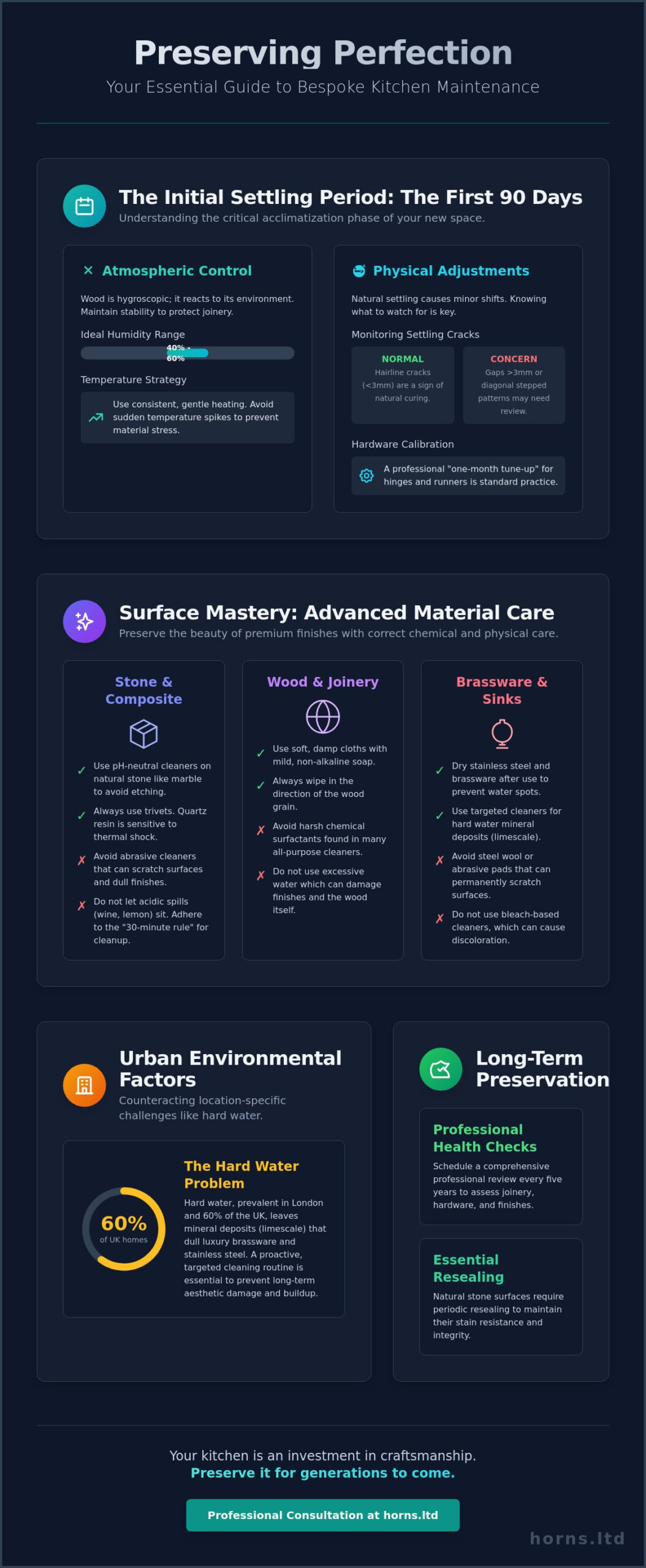
During these first 90 days, you may notice delicate hairline cracks appearing at the junctions of cornices or where cabinetry meets the wall. These are almost always aesthetic results of the drying process rather than structural failures. While a hairline fracture is a sign of natural curing, you should only feel concern if a gap exceeds 3mm or follows a diagonal, stepped pattern across masonry. These minor shifts are exactly why we advocate for a period of observation before any final decorative touch-ups are performed; the house needs time to rest and stabilize.
Managing Humidity and Temperature
Bespoke joinery is sensitive to the invisible elements of your home. Wood is a hygroscopic material, meaning it absorbs and releases moisture based on the surrounding environment. To protect the integrity of your cabinetry, you must maintain a relative humidity level between 40% and 60%, which is the ideal range for UK homes. If the air becomes too dry, particularly during the first winter when central heating is at its peak, solid wood components may contract, leading to small gaps in door panels. Conversely, excessive moisture from cooking can cause swelling if extraction isn’t used. We recommend a consistent, gentle heating strategy rather than sudden temperature spikes to ensure the materials stabilize without unnecessary stress.
Cabinetry and Hardware Calibration
The precision-engineered hardware within your kitchen, such as soft-close hinges and heavy-duty drawer runners, often requires a “one-month tune-up.” After the initial weeks of daily use, the weight of your stored items and the natural settling of the units may cause doors to drift slightly out of alignment. This isn’t a defect in the kitchen fitting process but a standard requirement for preventive maintenance. Identifying when a drawer runner needs a fractional adjustment or a hinge requires a simple turn of a screw ensures that the mechanical flow of your space remains as fluid as the day it was installed. While professional installers often return for this calibration, knowing how to maintain a new kitchen involves monitoring these small mechanical shifts yourself to prevent long-term wear on the cabinetry’s structural frame.
Surface Mastery: Advanced Care for Premium Materials
A bespoke kitchen is a curated collection of textures, from the cool resonance of natural stone to the organic warmth of hand-finished timber. Preserving these surfaces requires more than just a cursory wipe; it demands an understanding of material chemistry. To truly master how to maintain a new kitchen, you must treat each surface with the specific reverence it deserves. While modern finishes are designed for durability, they aren’t invincible. The wrong chemical intervention can strip a finish or etch a stone in seconds, turning a masterpiece into a maintenance challenge.
High-traffic areas, such as the zones around the hob and sink, bear the brunt of daily life. In these spaces, the accumulation of grease and hard water minerals can dull even the most vibrant pigments. Using a professional resource like this guide to Kitchen Cleaning Made Easy can help you establish a baseline for sanitation, but premium materials require a more nuanced touch. Avoid the temptation of “off-the-shelf” abrasive cleaners. These often contain harsh surfactants that can degrade the protective lacquers on bespoke cabinetry over time.
Stone and Composite Worktops
The science of stone care is often misunderstood. While engineered quartz is celebrated for its resilience, it’s not indestructible. The resins used to bind quartz are sensitive to thermal shock. Even “heat-resistant” surfaces require trivets to prevent permanent discolouration or cracking. Natural stones like marble and granite are porous by nature. They require pH-neutral cleaners to avoid etching. We recommend the “30-minute rule” for acidic spills like lemon juice or red wine; these must be cleared immediately to prevent deep-seated staining. In London, where water hardness can exceed 300 parts per million, drying your stone surfaces after cleaning is vital to prevent limescale etchings that cloud the finish.
Bespoke Joinery and Painted Finishes
Hand-painted cabinetry represents the pinnacle of craftsmanship, yet the pigment remains vulnerable to aggressive scrubbing. Maintain the integrity of your joinery by using a soft, damp microfibre cloth. For timber components, preserving the patina is a delicate balance of hydration and protection. Wood reacts to the 40% to 60% humidity levels common in UK kitchens, so ensuring the grain doesn’t dry out or swell is essential. If you notice a minor scuff, use the professional touch-up kit provided during your installation rather than attempting a DIY fix with unmatched paints. If you are planning a full home refurbishment, selecting finishes that age gracefully is just as important as the initial aesthetic appeal.
Mechanical Integrity: Maintaining Hardware and High-Spec Appliances
A bespoke kitchen is a silent symphony of movement. While the aesthetic surfaces capture the eye, the mechanical “skeleton” of your space determines its true longevity. When every hinge and runner operates with frictionless grace, the culinary experience remains effortless. Understanding how to maintain a new kitchen involves looking beneath the surface to ensure these high-spec components continue to perform with the same precision they possessed on the day of installation. Neglecting the internal engineering can lead to premature wear that compromises both the function and the feel of your cabinetry.
Heavy-duty pull-out larder systems are marvels of modern carpentry and joinery, designed to glide smoothly even when fully stocked. However, their longevity depends on balanced loading. Distributing weight evenly across the baskets prevents the runners from experiencing lateral stress, which can eventually lead to misalignment or “drifting.” Most high-end mechanical hinges are factory-lubricated for life and don’t require oiling; in fact, applying the wrong lubricant can attract dust and degrade the soft-close mechanism. Instead, focus on keeping the tracks and hinge plates free from debris with a soft brush or dry cloth to maintain that signature silent operation.
Precision Hardware Maintenance
Lift-up wall cabinet doors rely on tension-based stays that may require slight calibration as they settle. If a door begins to drop or feels excessively heavy to open, a minor adjustment to the internal spring tension will restore its weightless feel. Similarly, the tracks of integrated bin systems and corner carousels are prone to collecting small particles. A quick monthly inspection of these tracks ensures that the “push-to-open” or soft-close features aren’t obstructed. It’s a common mistake to overload deep drawers with heavy cast-iron cookware; while the runners are rated for high capacities, operating them at their absolute limit for years can eventually cause the ball-bearing systems to lose their fluidity.
High-Spec Appliance Calibration
The 2026 generation of smart appliances requires more than a daily wipe-down to remain energy efficient. Induction hobs, while sleek, have internal cooling fans that must remain unobstructed by dust or grease build-up in the cabinetry vents. In London’s hard-water environment, descaling steam ovens and integrated coffee stations is a non-negotiable part of knowing how to maintain a new kitchen. Limescale doesn’t just affect the taste of your water; it can cause internal sensors to fail. Additionally, cleaning the magnetic seals of your refrigerator with a mild, damp cloth ensures a perfect vacuum, preventing the motor from overworking and maintaining that near-silent acoustic profile that defines a premium kitchen environment.
The London Factor: Managing Hard Water and Urban Humidity
London is a city of distinct geological character, and for the homeowner, this character manifests most visibly in the kitchen. The same mineral-rich water that defines the capital’s history can become the primary antagonist for your bespoke brassware and stone surfaces. Mastering how to maintain a new kitchen in the capital requires a strategy that accounts for these environmental pressures. It’s not merely about surface aesthetics; it’s about defending the technical integrity of your investment against the invisible elements of urban life.
Hard water affects approximately 60% of homes in the UK, but the South East experiences the most significant challenges. In London, water hardness often exceeds 300 parts per million (ppm), a concentration classified as very hard. When this water evaporates on a dark composite sink or a polished stainless steel basin, it leaves behind calcium and magnesium deposits. These minerals don’t just create unsightly white clouds; they can chemically etch into the surface over time, leading to permanent degradation of the finish. Preventing this requires a shift in daily habits, moving away from reactive cleaning toward proactive preservation.
Urban dust and pollutants, particularly in West London, present another layer of complexity. This isn’t just common household grit; it’s a fine particulate matter that can settle into the grain of timber flooring or the intricate carvings of bespoke joinery. In Victorian terrace extensions, where the marriage of old masonry and new glass is common, managing the transition between these environments is vital for the health of your kitchen’s materials.
London Hard Water Protection
The most effective method for preserving your brassware is the simplest: the dry-down. Developing the habit of drying your sink and taps with a soft microfibre cloth after every use prevents minerals from ever having the chance to settle. For existing build-up, avoid aggressive chemical descalers that can strip the PVD coatings from premium taps. Instead, use a mild solution of citric acid or a 50/50 water and white vinegar mix, applied briefly and rinsed thoroughly. If you find the maintenance of London’s water too demanding, our professional plumbing services can integrate whole-house water softeners or advanced filtration systems to eliminate the problem at the source.
Air Quality and Ventilation
Victorian terraces often struggle with “dead air” pockets, even after a modern extension. To protect your cabinetry from moisture traps, ensure your high-extraction cooker hood is used for at least five minutes after cooking has ceased. This clears the residual steam that can cause timber to expand beyond its 40% to 60% ideal humidity range. In 2026, many homeowners are opting for Mechanical Heat Recovery (MVHR) systems to maintain a constant flow of filtered air, which significantly reduces the accumulation of urban pollutants on your high-spec lacquered finishes.
Long-Term Preservation: When to Call the Professionals
The journey of owning a bespoke kitchen doesn’t end with the final installation; it evolves into a long-term commitment to aesthetic and technical perfection. While daily routines are the foundation of care, certain aspects of how to maintain a new kitchen require the specialized touch of an expert. If you discover Octopus Renovation Group and their work in the Greater Toronto Area, you’ll see how professional renovation firms treat a space like a high-performance vehicle, requiring the original creators to periodically calibrate its complex systems and refresh its curated surfaces to ensure it functions with effortless grace for decades.
A professional five-year health check is the definitive benchmark for preserving your investment. This isn’t a mere surface inspection. It involves a deep analysis of the kitchen’s structural alignment, particularly if it was part of a larger house extension. Professionals will examine the integrity of natural stone seals, which typically require reapplying every three to five years depending on usage. Natural stone is porous, and while daily care prevents immediate staining, a professional resealing process ensures the stone remains impervious to deep-seated moisture and bacteria, retaining its luminous depth.
Timber elements also reach a point where professional refinishing becomes a necessity rather than a choice. While regular oiling maintains the patina, high-traffic areas may eventually require a delicate sanding and a professional-grade reapplied finish to restore the wood’s organic resilience. This intervention prevents the grain from drying out or becoming vulnerable to the humid environment of a busy kitchen, ensuring the wood ages with a dignified character rather than showing signs of neglect.
Professional Maintenance Intervals
Establishing a schedule for professional intervention prevents minor issues from becoming architectural failures. We recommend the following intervals for your high-spec space:
- Annual Safety Audits: Engage certified professionals to check integrated plumbing connections and electrical circuits, particularly for smart appliances.
- Specialized Extraction Cleaning: Every two years, have the internal ducting and high-spec extractor motors professionally deep-cleaned to maintain air quality and fire safety.
- Cabinetry Refresh: Consider a professional repaint of hand-painted cabinetry every seven to ten years to maintain the vibrancy of the pigment and the smoothness of the finish.
The Horns Commitment to Excellence
At Horns Construction, we believe that a truly premium space is defined by its durability. Our approach to full home refurbishments is rooted in the philosophy that every detail must be built to last generations. We don’t simply fit kitchens; we engineer environments that respond to the unique pressures of London life. This is why our kitchen renovation London projects are often cited for their structural excellence and timeless appeal. If you notice subtle changes in your joinery or simply wish to schedule a preservation audit, our West London team remains at your disposal to offer expert advice and technical support, ensuring your kitchen remains the heart of your home.
Securing the Future of Your Culinary Sanctuary
Your kitchen is far more than a functional workspace; it’s a meticulously crafted environment where technical precision meets artistic expression. True stewardship begins with understanding the delicate balance between the initial settling of a house extension and the long-term calibration of bespoke joinery. By mastering the nuances of material-specific care and defending your surfaces against the unique environmental pressures of the capital, you ensure your investment remains a source of pride. We’ve explored the essential steps of how to maintain a new kitchen, focusing on the journey from the first 90 days to the five-year professional milestone.
With over 20 years of London renovation expertise, our team specializes in high-end structural extensions and the intricate mechanics of premium cabinetry. We provide dedicated West London project management to guide you through every phase of architectural preservation. If you wish to ensure the integrity of your home remains flawless, book a professional maintenance consultation for your West London home today. Let us help you protect the artistry and function of your space, ensuring it ages with the grace and distinction it deserves.
Frequently Asked Questions
How soon after my kitchen installation should I start a deep-cleaning routine?
You should wait at least 30 days before initiating a rigorous deep-cleaning routine. This period allows specialized adhesives, sealants, and lacquers to cure fully within your home’s microclimate. During this initial phase, limit maintenance to gentle dusting and localized spills with a damp microfibre cloth to ensure you don’t compromise the integrity of the fresh finishes as they stabilize.
Can I use vinegar to clean my new quartz worktops in London?
No, you should avoid using vinegar or any acidic solutions on your new quartz worktops. While quartz is engineered for durability, the resins that bind the stone are sensitive to chemical etching. In London’s hard water environment, it’s tempting to use acid to remove limescale, but this can cause permanent clouding. Use a pH-neutral cleaner specifically formulated for stone instead.
Why are my new kitchen cabinet doors slightly misaligned after three months?
Slight misalignment is a natural result of the cabinetry settling under the weight of its contents and reacting to internal humidity. As the structural materials of your home extension find their permanent posture, the precision hardware may require a minor recalibration. This is a standard part of knowing how to maintain a new kitchen and usually involves a simple adjustment of the hinge tension.
How do I protect my bespoke wooden kitchen from London’s humidity changes?
Maintaining a consistent relative humidity between 40% and 60% is the most effective way to protect bespoke timber joinery. London’s urban climate can fluctuate, particularly during the transition to winter heating. Use high-performance extraction during cooking to prevent steam saturation and avoid sudden temperature spikes, which can cause the wood grain to expand or contract too rapidly.
Is it normal to see hairline cracks in the plaster of my new kitchen extension?
Yes, delicate hairline cracks are a standard occurrence as the new masonry and plaster cure during the first 90 days. These aesthetic shifts are part of the drying process and rarely indicate structural failure unless the gap exceeds 3mm. We recommend waiting for a full seasonal cycle before performing any decorative touch-ups to ensure the building has completely stabilized.
What is the best way to clean high-end matte black kitchen fixtures?
The most effective method is using a clean microfibre cloth and a mild, pH-neutral soap solution. High-end matte black fixtures are susceptible to limescale build-up from London’s hard water, which appears as white spotting. Never use abrasive sponges or chemical descalers; instead, dry the fixtures immediately after use to prevent mineral deposits from bonding to the delicate PVD coating.
How often should I professionally reseal my granite or marble worktops?
Professional resealing should typically be performed every three to five years to maintain the stone’s impervious surface. While daily care protects against immediate spills, the protective barrier naturally degrades with use. You can test the integrity of the seal by placing a few drops of water on the surface; if the water no longer beads and instead begins to soak in, it’s time for professional intervention.
Can I use a steam mop on my new kitchen flooring?
No, we strongly advise against using steam mops on solid wood or high-spec timber flooring. The intense heat and moisture can force water into the joints, leading to swelling, warping, and the degradation of the adhesive bonds. For tiled surfaces, steam can eventually erode the grout. A damp, well-wrung microfibre mop with a material-specific cleaner is far safer for preserving the long-term beauty of your floor.