

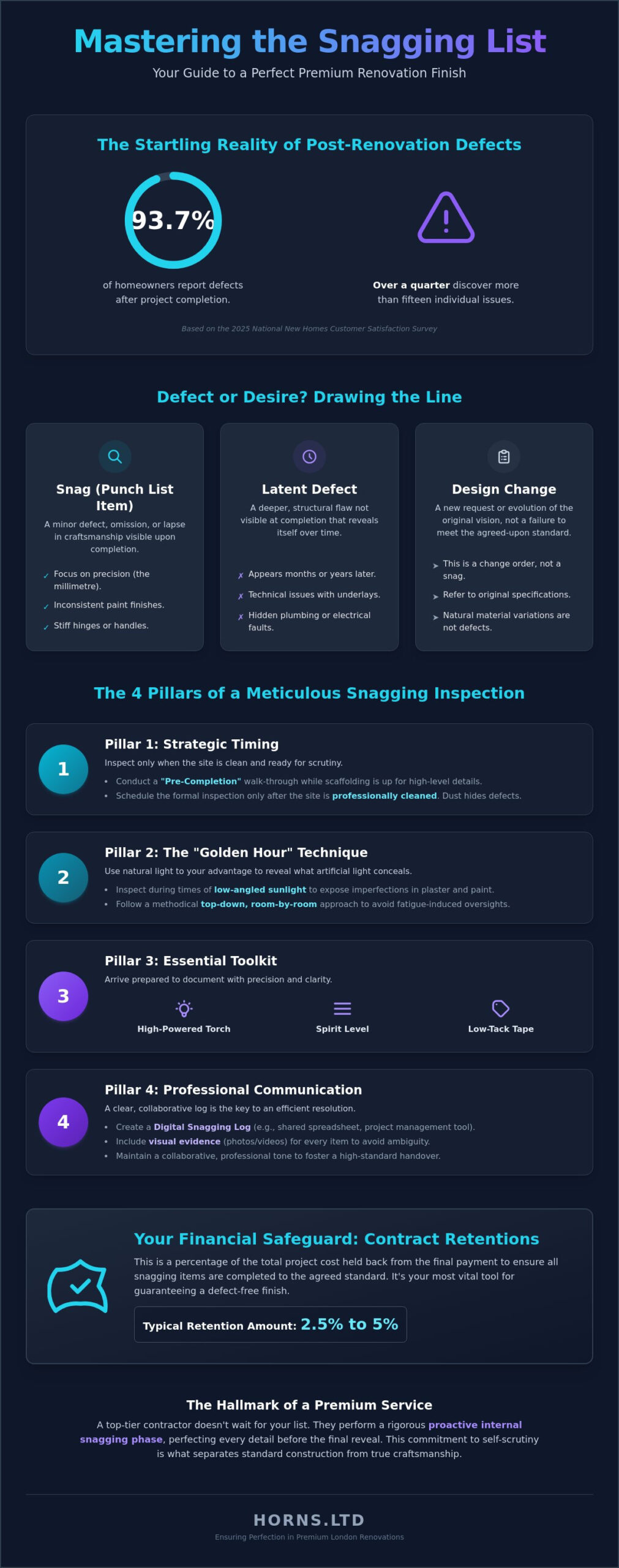
According to the 2025 National New Homes Customer Satisfaction Survey, 93.7% of homeowners reported defects after completion, with over a quarter discovering more than fifteen individual issues that required attention. It’s a startling figure that underscores why knowing how to manage a snagging list with builder is the essential final act of any premium London renovation. You’ve invested months into a vision of architectural elegance and technical precision, and the transition from a construction site to a sanctuary should be a moment of quiet triumph rather than a source of lingering anxiety. We understand that the fear of a contractor disappearing before the final polish is applied can often overshadow the beauty of your new space.
This guide serves as your masterclass in mastering the 2026 standards of craftsmanship, ensuring your home meets the highest levels of structural and aesthetic integrity. We’ll clarify the critical distinction between a minor snag and a complex change order, while providing a framework for maintaining professional rapport through the final inspection process. You’ll learn how to utilize contract retentions effectively, securing a defect-free finish that honors the artisanal quality of your investment. By the end, you’ll have a clear, agreed-upon timeline for every fix, allowing you to settle into your perfected home with total peace of mind.
Key Takeaways
- Distinguish between minor aesthetic snags and latent structural defects to ensure your renovation maintains its value and integrity over time.
- Learn how to manage a snagging list with builder using the “Golden Hour” technique, leveraging specific natural lighting to reveal hidden imperfections in craftsmanship.
- Master the art of professional communication by creating a digital snagging log that utilizes visual evidence to foster a collaborative, high-standard handover.
- Understand the strategic importance of contract retentions, typically 2.5% to 5%, as a vital tool to guarantee the final polish of your home.
- Discover why a proactive internal snagging phase is the hallmark of a premium service, ensuring every detail is perfected before the final reveal.
Understanding the Snagging Process in Premium Renovations
The final phase of a London home renovation is where the raw energy of construction evolves into the quiet poise of a finished masterpiece. A “snag” isn’t a failure; it represents the necessary bridge between a working site and a living home. By definition, a snagging list, often referred to in broader construction terms as a What is a Snagging List?, captures minor defects, omissions, or slight lapses in craftsmanship that emerge as the dust settles. It’s a fundamental truth in high-end building that the final 5% of a project often demands 20% of the total attention to detail. This is where the technical precision of the earlier structural work meets the delicate artistry of the finish. Understanding how to manage a snagging list with builder requires a psychological shift. You’re no longer looking at the big picture of walls and roofs, but at the alignment of a tile or the smoothness of a joint. This refinement phase is characterized by:
- Precision over Power: Focusing on the millimetre rather than the metre.
- Visual Fidelity: Ensuring paint finishes are consistent across all lighting conditions.
- Functional Fluidity: Testing that every hinge and handle operates with effortless grace.
It’s also vital to distinguish this list from the “latent defects” period. While snags are visible at completion, latent defects are structural flaws that may only reveal themselves months later, such as technical issues with zonal classification of underlays as defined in the NHBC Standards 2026. With the New Homes Quality Code (Version 2) now in effect as of March 2, 2026, the industry has never been more focused on these final standards of customer service and technical delivery.
When Should Snagging Actually Begin?
True refinement begins before the final handover. We recommend a “Pre-Completion” walk-through while scaffolding is still in place. This allows for a perspective on high-level detailing, such as wall and roof abutments, that’s impossible to reach once the site is cleared. However, navigating how to manage a snagging list with builder effectively means timing your inspection when the work is genuinely ready for scrutiny. Don’t rush into a formal inspection while the site is active and messy. Dust and debris mask true quality. A formal date for the “Practical Completion” inspection should only be set once the site is professionally cleaned and the air has cleared, allowing the quality of the finish to truly shine.
Snags vs. Design Changes: Drawing the Line
Distinguishing between a defect and a new request is vital for maintaining project momentum. A snag is a failure to meet the agreed standard, whereas a design change is an evolution of the original vision. When Mastering Home Refurbishment in London, you must refer back to the original specifications to resolve disputes fairly. Remember that natural materials like hand-cut timber or marble possess inherent “tolerances.” A slight variation in grain or a minor texture shift isn’t a defect. It’s a testament to the material’s authentic origin and the manual manufacturing process that defines a bespoke home.
Conducting a Meticulous Snagging Inspection
Approaching the final inspection requires the same level of discipline and artistry that defined the construction phase itself. To understand how to manage a snagging list with builder effectively, you must adopt a rigorous room-by-room methodology. We advise starting at the highest point of your home and working downwards. This top-down approach ensures that you don’t overlook ceiling finishes or loft access points in the later stages of the day when fatigue might set in. By moving methodically through each space, you treat every room as an individual gallery, ensuring the technical hűség of the project remains consistent from the attic to the basement.
Timing is everything. We recommend scheduling your inspection during the “Golden Hour,” that specific window of time when natural light is most revealing. Low-angled sunlight often exposes imperfections in plasterwork and paint finishes that artificial lighting might hide. To aid your vision, carry a high-powered torch to illuminate dark corners, a spirit level to verify the precision of joinery, and a roll of low-tack masking tape. Use the tape to mark defects directly on surfaces; it’s a visual shorthand that allows your builder to identify the exact location of a concern without confusion. If you find yourself unsure of the standards expected, referencing your consumer rights can provide a helpful baseline for what constitutes reasonable care and skill.
Every identified issue should be sorted into one of three categories to maintain a professional dialogue. Cosmetic snags, such as minor paint scuffs, are surface-level. Functional snags involve elements that don’t operate as intended, like a stiff window latch. Finally, structural or safety snags must be prioritized immediately. This organized classification is the hallmark of a sophisticated homeowner who knows how to manage a snagging list with builder without descending into unproductive frustration.
The Interior Refinement Checklist
Inside the home, the focus shifts to the tactile experience of the space. In bespoke kitchen fitting, check that every cabinet door aligns perfectly and soft-close mechanisms operate with silent precision. Test every electrical socket and dimmer switch, ensuring smart home integrations respond with the expected technical fluidity. In the sanctuary of a new bathroom, inspect the grout consistency between tiles and verify that water pressure meets the engineering specifications of your new plumbing system. If you desire this level of uncompromising detail for your own project, consider how a Full Home Refurbishment could transform your living standards.
Exterior and Structural Snagging
The exterior of your property demands a different kind of scrutiny, particularly when inspecting House Extensions in London. Examine the brickwork pointing for uniform color and depth, and ensure that external rendering shows no signs of cracking or unevenness. Guttering and drainage must be clear of construction debris to prevent future water ingress. Finally, test the integrity of new glazing. Large bifold doors should glide effortlessly along their tracks, providing a seamless transition between your interior elegance and the world outside.
Professional Communication: Managing the List with Your Builder
The final stages of a high-end renovation require a delicate balance of technical authority and collaborative poise. Managing the relationship with your contractor during this phase is as vital as the quality of the brickwork itself. Understanding how to manage a snagging list with builder effectively requires more than just a keen eye; it demands the diplomacy of a curator. We advocate for a “No Blame” approach, where the list isn’t presented as a catalogue of failures, but as a shared roadmap toward a perfect handover. This shift in perspective fosters a culture of mutual respect, ensuring that the craftsmen who built your vision remain committed to its final refinement—a standard of care that can be further enhanced by project managers who utilize Homes For Workers to ensure their teams are well-supported with high-quality accommodation.
Clarity is the cornerstone of professional communication. Rather than sending a flurry of individual emails or text messages, which can lead to administrative friction and overlooked details, you should create a single, comprehensive digital snagging log. This document should include high-resolution photographs, precise descriptions, and location tags for every item. By consolidating your observations into one refined file, you provide your builder with a clear, actionable brief. It’s standard practice to agree on a “Snagging Window” at this stage. A realistic 14-day period is usually sufficient for a dedicated team to resolve minor fixes without compromising the technical fidelity of the finish.
The Art of the Walk-Through
The formal walk-through is the moment where consensus is reached. You should walk the site alongside the site manager or lead builder, discussing each point on your list in person. As you move through the rooms, use the low-tack masking tape mentioned in the previous section to physically mark issues. These markers should correspond exactly to your digital log. For every item identified, document an “Agreed Action.” Whether it’s a simple paint touch-up or a more complex adjustment to bespoke cabinetry, having a recorded agreement on the specific solution prevents future disputes and ensures the work meets your uncompromising standards.
Handling Disagreements on Quality
In rare instances, you may find that your definition of a “perfect finish” differs from your builder’s perspective. When these outliers occur, refer to established industry standards, such as those provided by the NHBC or RICS, to provide a neutral baseline for acceptable tolerances. If a high-value dispute arises that cannot be resolved through dialogue, bringing in a third-party surveyor can offer the technical clarity needed to move forward. Maintain project momentum by focusing on the 95% of snags that are agreed upon. Don’t let a minor negotiation over a single detail stall the completion of your sanctuary.
Contractual Safeguards: Retention and Legal Protection
The elegance of a London home is not merely found in its visible surfaces, but in the invisible layers of legal and technical protection that surround it. While the previous sections focused on the visual and diplomatic aspects of refinement, the contractual framework provides the architectural spine that supports your investment. A JCT (Joint Contracts Tribunal) agreement is the gold standard for premium residential projects, offering a structured environment where both parties understand their obligations. Within this framework, knowing how to manage a snagging list with builder effectively involves understanding the financial levers at your disposal, primarily the concept of retention.
Retention is a standard mechanism in high-end construction, where a portion of the contract value, typically between 2.5% and 5%, is held back from the final payment. This isn’t an act of distrust; it’s a professional guarantee that ensures the builder remains engaged until the very last detail is perfected. This fund serves as a bridge between “Practical Completion,” where the home is fit for occupation, and the final handover of a defect-free property. Under the New Homes Quality Code (Version 2), which came into effect on March 2, 2026, these standards of completion and customer service are now more rigorously enforced than ever before, providing homeowners with a clear path to the New Homes Ombudsman Service should disputes remain unresolved.
Managing the Retention Fund
The release of the retention fund is usually split into two distinct stages. The first half is released upon the issuance of the Certificate of Practical Completion, marking the point where you take possession of your home. The remaining 50% is retained throughout the “Defects Liability Period,” which typically spans 6 to 12 months. This period allows the building to settle through a full cycle of seasons, revealing any issues that may arise from thermal movement or structural settlement. It’s vital to remember that withholding these funds without a formal, documented snagging list can have legal implications, potentially putting you in breach of contract. A clear, photographic record is your best defense.
Warranties and Building Control
True peace of mind comes from the completion of the “paper trail.” Before the final retention is released, you must ensure that all technical certifications are in hand. This includes Gas Safe and NIC EIC electrical certificates, as well as the Building Control Final Certificate. This final document is essential for the future value of your property, as it proves the work meets all relevant safety and performance regulations, including the latest NHBC Standards 2026 updates regarding thermal bridging and insulation. Professional indemnity insurance should also be verified, as it provides a safety net for major defects that may only emerge years after the craftsmen have left the site. If you are planning a project that requires this level of contractual and technical rigor, we invite you to discuss your vision with us at Horns Construction.
The Horns Construction Standard: Beyond the Checklist
At Horns Construction, we believe the final days of a project should be a period of celebration, not a stressful search for flaws. While understanding how to manage a snagging list with builder is an empowering tool for any homeowner, our philosophy is to render the process almost redundant through our proactive “Internal Snagging” phase. Before you’re even invited to the final walk-through, our site managers conduct their own exhaustive inspections; identifying and rectifying minor imperfections with a level of scrutiny that exceeds even the most discerning eye. This commitment to perfection is why we treat every Kitchen Renovation London project as a functional work of art, where the technical fidelity of the installation is as vital as its visual allure.
Our dedication to West London residential excellence is built on the foundation of long-term relationships. We don’t just finish a job and disappear; we remain your partners in maintaining the integrity of your investment. Moving into a newly refurbished space is a significant life event, and our post-completion support is designed to ease that transition. From maintenance advice tailored to your specific finishes to our responsive aftercare team, we ensure the artisanal quality of your home remains untouched by the passage of time. We take pride in the fact that our clients often return to us for future projects, trusting in our uncompromising standards.
A Legacy of Quality in London Homes
With over 20 years of experience refining the streets of Fulham, Chiswick, and beyond, we’ve honed a methodology that reduces the initial snagging count by 80% compared to industry averages. This isn’t just about careful labor; it’s about the uncompromising selection of high-quality materials. By choosing premium timber, stone, and high-performance adhesives, we significantly minimize “settlement snags” that often plague lesser builds as they adjust to the home’s environment. Our aftercare team remains on hand for all premium refurbishments, ensuring that the calm, dignified rhythm of your new life is never interrupted by technical concerns.
Final Handover: The Horns Experience
The final handover is a moment of total clarity. We provide every client with a comprehensive “Home User Guide,” a curated collection containing all technical manuals, warranties, and bespoke maintenance schedules in one accessible place. This ensures you have the knowledge to care for your home’s unique systems and materials for generations. As a final touch, our completion process includes professional cleaning and styling, allowing you to experience the full aesthetic power of your renovation from the very first second. Ready to start your journey toward a perfect finish? Contact Horns Construction for a premium London renovation quote and discover the difference that maximalist craftsmanship makes.
The Final Act of Architectural Refinement
Your journey from a conceptual vision to a physical sanctuary concludes with the deliberate, artistic polish of the final handover. We’ve explored how the strategic use of contract retentions and the technical precision of a “Golden Hour” inspection ensure that every millimetre of your home reflects your uncompromising standards. Mastering how to manage a snagging list with builder transforms what could be a source of friction into a collaborative celebration of quality. It’s about securing the technical fidelity of your investment while maintaining the professional rapport that makes a house feel like a home from the very first moment you take possession.
At Horns Construction, we bring over 20 years of West London building expertise to every project, offering dedicated project management that guides you from the initial design through to the final, meticulous snagging. Whether you’re seeking fixed-price quotes for bespoke house extensions or loft conversions, our team is committed to delivering a defect-free finish that stands the test of time. We invite you to explore our premium London construction services and begin the process of creating a space where every detail is a testament to perfection. Your dream deserves a finish that is as enduring as it is beautiful.
Frequently Asked Questions
How long should a builder take to fix snags?
A standard “snagging window” typically spans 14 days for minor aesthetic refinements and functional adjustments. For more complex technical issues, the timeline should be clearly defined within your JCT contract to ensure the architectural integrity of the finish isn’t compromised by undue haste. Clear communication during this period is essential to maintain the momentum of the final handover.
Can I move into my house before the snagging list is finished?
You can move into your property once the Certificate of Practical Completion has been issued, confirming the space is safe and habitable. However, we often advise clients that addressing snags is more efficient while the home remains empty. This prevents the risk of accidental damage to your furniture and allows craftsmen the freedom to achieve a perfect, undisturbed finish.
What happens if my builder refuses to fix a snag?
If a dispute arises, you should first refer to the “agreed standards” documented in your original specification or industry benchmarks like the NHBC Standards 2026. For new homes reserved after March 2, 2026, the New Homes Ombudsman Service provides a formal, impartial route for redress. Your retention fund, typically 2.5% to 5% of the contract value, serves as your primary financial safeguard in these instances.
How much does a professional snagging survey cost in London?
As of June 2026, the average cost for a professional snagging survey in London is approximately £394, with a typical range between £366 and £480. These costs vary based on property size; a 1-2 bedroom apartment usually averages £357, while a more expansive 4-bedroom residence can reach £407. Investing in an impartial technical audit often pays for itself by identifying hidden structural or energy efficiency defects.
Is it normal to have snags in a high-end renovation?
Yes, the 2025 National New Homes Customer Satisfaction Survey revealed that 93.7% of buyers reported problems after moving in. In a premium London renovation, the sheer complexity of bespoke joinery and smart home integrations makes a small number of snags a natural part of the final act of refinement. It is not a sign of failure, but rather the final bridge to achieving absolute technical fidelity.
Should I pay the final invoice before the snags are fixed?
You should never settle the final invoice in full until every item on the agreed snagging list has been resolved to a satisfactory standard. Understanding how to manage a snagging list with builder involves using the retention mechanism correctly. Holding back the final percentage of the contract value ensures the builder remains committed to the project until the very last paint stroke is perfected.
What is the difference between a snag and a defect?
A snag is generally a minor aesthetic or functional imperfection, such as a paint scuff or a stiff hinge, identified at project completion. In contrast, a defect, particularly a “latent defect,” refers to significant structural or technical failures that may emerge months later. These can include issues with rendering in cold weather or structural requirements for garage floors as defined in the latest NHBC updates.
How many snags are “too many” for an extension project?
While there is no legal maximum, the 2025 industry survey noted that over 25% of homeowners reported more than 15 individual snags. For a bespoke London extension, a high volume of minor issues may suggest a lack of proactive internal quality control. Learning how to manage a snagging list with builder effectively allows you to categorize these issues by priority, ensuring that safety and structural integrity are addressed before cosmetic refinements.